This article comes from the WeChat public account: 脑极体 (Naojiti), author: 珊瑚 (Shanhu)
Yu Pi never expected that after receiving an offer with a monthly salary of 50,000 yuan, his first day on the job would be spent at a factory sticking on QR codes.
The position he was hired for is called FDE, Forward Deployed Engineer. The job description listed production-grade Python coding, large model systems experience, and RAG building; the interview covered Agent architecture and Prompt engineering. But at the client site—a manufacturing factory—the actual work involved crawling into the workshop, recording each machine's "nickname" amid the roar of machinery, and personally sticking QR codes onto the equipment for positioning.
No office building, no floor-to-ceiling windows, no ready-made data pipelines—everything about the FDE role seems far from AI's spotlight.
Yet on social media, golden narratives about FDEs keep emerging. Phrases like "the job least likely to be laid off in the AI era," "100,000 yuan a month," and "hybrid talent" have never left this position. Reportedly, during two years when the entire industry was laying people off, FDE hiring demand grew more than fortyfold. OpenAI's offered annual salary starts at over 1 million RMB equivalent, and ByteDance offers up to 70,000 yuan per month for its "Doubao AI Large Model FDE" role.
A position almost unknown in the past has, in just two years, become the AI industry's hottest "golden rice bowl." What exactly is it? Why has it risen against the tide of layoffs? And behind the glamorous hiring figures, how much is inflated?

In 2026, the tech industry is experiencing an unprecedented tearing apart.
On one side, the layoff wave continues to spread. According to the monthly reports of US employment consulting firm Challenger, in the first half of 2026 alone, cumulative layoffs in the US tech industry approached 140,000 people. Amazon cut about 30,000 positions within a year, Meta laid off 8,000, and Oracle's total headcount dropped from 162,000 to 141,000 over the past twelve months—a 13% decline. Oracle stated in its annual report: "The application and deployment of AI technology in our operations has led, and may continue to lead, to a reduction in headcount."
On the other side, a position called FDE is surging at a staggering rate against the trend. LinkedIn's 2026 Workforce Report shows that between 2023 and 2025, global FDE job postings grew 42-fold, while AI engineer positions grew only 13-fold in the same period. ByteDance offers FDE experts a monthly salary of 30,000 to 50,000 yuan with 15 months' pay per year; Ant Digital Technologies offers 40,000 to 60,000 yuan per month; and Zhipu Huazhang's FDE lead position pays 60,000 to 80,000 yuan per month. In the US, OpenAI offers FDE annual salaries between $162,000 and $280,000, while Anthropic offers $200,000 to $300,000.
When Yu Pi saw these numbers, he was scrolling on his phone at his desk at his previous company. It was a mid-sized enterprise services firm where he had done six years of backend development—written Python, debugged APIs, and built some small-scale RAG projects. The company had a round of layoffs at the start of the year, and he stayed, but the colleague at the next desk left, and the workloads of those who remained grew heavier. Yu Pi started browsing job apps, and the term FDE kept appearing.
After some research, Yu Pi decided to submit his resume. When he went to Beijing for an interview, the interviewer asked how he understood "production-grade large model systems." He talked about the retrieval-augmented generation pipelines he had built and the clients he had worked with, and passed the interview, becoming an FDE at a top tech company.
Among the colleagues who had left his company, some were doing algorithms at big tech firms, others were working on Agents at startups. When they heard he was going into FDE, reactions split into two camps: one said, "Isn't this just high-end outsourcing?" and the other said, "I hear this role is insanely hot—you're so lucky."
To understand FDE, you have to go back to its birthplace. The term was first coined by Palantir in the mid-2000s. At the time, its government and defense clients had extremely sensitive data environments and highly customized architectures, making remote delivery impossible. An architect who flew away after delivering a solution left the client with a pile of pending tickets, not a working system. So Palantir simply embedded its own engineers long-term at client sites—people who both wrote code and understood the business—and thus the FDE was born.

Unlike traditional AI engineers or ML engineers, FDEs don't write core model code; instead, they embed model capabilities into clients' business systems, bridging the "last mile" from model to value. Simply put, AI engineers are accountable for model metrics, while FDEs are accountable for business outcomes.
Technology, business, and trust—all three are indispensable, and it is precisely for this reason that compensation has been pushed ever higher. LinkedIn data shows the median FDE annual salary is about $199,000, while mid-level FDE total packages at frontier labs like OpenAI and Anthropic generally fall in the $350,000 to $550,000 range, and senior and even Principal levels breaking $1 million is not uncommon. Translated to the Chinese context, FDEs at top firms like ByteDance and Alibaba commanding million-RMB annual salaries are everywhere. And Yu Pi was one of those swept up in this wave of high-salary recruiting.
So why did FDE suddenly explode in popularity? What undeniable forces are behind its breakout?
The fundamental reason for FDE's explosive rise lies in a simple judgment: model capabilities are being rapidly equalized, but three things cannot be equalized in the short term—connecting models to legacy systems, passing security and compliance reviews, and getting frontline employees to actually use them.
In May 2026, three of the world's top AI companies made almost the same move at the same time. Anthropic, together with Blackstone, Goldman Sachs, and other institutions, launched a joint venture with $1.5 billion in committed capital, whose core business is helping enterprises deploy Claude. OpenAI established an independent deployment subsidiary, DeployCo, with an initial investment of over $4 billion. Less than two weeks apart, Google Cloud's CEO publicly posted a call to recruit FDEs at scale, with over 1,500 AI deployment-related positions opened internally. All three companies reached the same judgment: selling APIs alone is no longer enough. After receiving the models, clients often get stuck at "don't know how to use it," "can't connect the data," "results are unstable," or "don't dare to use it after launch"—they need a role that goes down to the field and actually builds the thing.
According to Liepin's report, FDE positions are highly concentrated in four cities—Shanghai, Beijing, Shenzhen, and Hangzhou—together accounting for 68.33%. By industry, AI/internet remains the largest source of demand at 72.36%.
New to the FDE workplace, Yu Pi naively assumed that client engagement would only take up a small portion of his time, and that most of the time he would still be in an office building, endlessly meeting, coding, and aligning on plans.
But Yu Pi quickly discovered that among client engagements, traditional industries like retail and manufacturing had gradually become the tail and the bulk—FDE was expanding from an internal buzzword in the AI circle to all industries and all of society.
And this process would not be easy. His first client was a manufacturing factory. The client wanted AI predictive maintenance, but the factory had never even collected basic data like temperature, vibration, or runtime. Yu Pi had to settle for second best: first straightening out the repair reporting process, letting AI help workers organize repair reports, while structurally saving each fault description and repair result to accumulate data for the future.
It's not just about AI capability—what FDEs face is a question of organizational capability, process maturity, and data infrastructure. What an FDE can do is expose these problems one by one, then take the first step with a minimal viable solution.
Only after three months on-site did Yu Pi gradually figure out what FDEs are actually selling.
Selling outsourcing-style custom projects is the most common and most exhausting model. Clients pay, you go on-site, customize, and deliver, earning project fees. They dump the task of "figuring out the problem" on you. Many clients haven't even figured out what they want themselves, and halfway through the conversation the requirements vanish. Being overly customized also makes it hard to distill into a product, and the ceiling is plainly visible. Yu Pi's first project was exactly this kind: the client initially said they wanted "AI predictive maintenance," but it wasn't until the third week that they discovered the real problem was that quality inspection standards themselves had never been unified.
The second is selling product implementation—having a mature Agent product in hand and sending people to help clients connect data and systems. It's called FDE, but it's essentially implementation. Yu Pi later moved onto this track, and only then did he actually get to use the things written in the job description.
The third is selling knowledge—doing consulting and training, avoiding heavy delivery, helping bosses and employees understand AI and transform their ways of working. A peer Yu Pi knows runs a one-person company doing AI infrastructure consulting for traditional industries; his schedule is fully booked three months out, and he's already preparing to expand hiring.
There are also people who don't do delivery but matchmaking—running communities and organizing hackathons, connecting people who want to transition with enterprises that urgently need AI transformation.
Yu Pi realized that from this perspective, an FDE is more like a translator, translating AI's capabilities into solutions enterprises can understand; also a sensor, transmitting enterprises' real pain points back to product teams; and still a catalyst, proving through the results of AI-driven efficiency gains in certain stages that this work is worth continuing.

But any job that blows up inevitably gets inflated, and FDE is no exception.
The million-dollar salary narrative circulates online, but the real experience of frontline FDE workers is far less glamorous than the recruiting copy suggests.
Some overseas employees have even complained: "FDE is simply the worst role I've ever had as an engineer."
Based on Yupi's personal experience, being stationed on-site is the norm and drifting from place to place is the price. In the early stages, sales, delivery, and after-sales support are all on you alone. At his busiest, he worked nearly 50 hours a week, with three days a week on-site or traveling. Mornings were spent at the client's site in hours-long meetings confirming requirements, with the remaining time spent writing code. When deadlines were tight, he would code for seven or eight hours straight, and sometimes leave an AI agent an extra-long task to run overnight before going to bed. A former Palantir FDE described working on-site 3 to 4 days a week, staying with one client for about a year, on a team of 4 to 5 people.
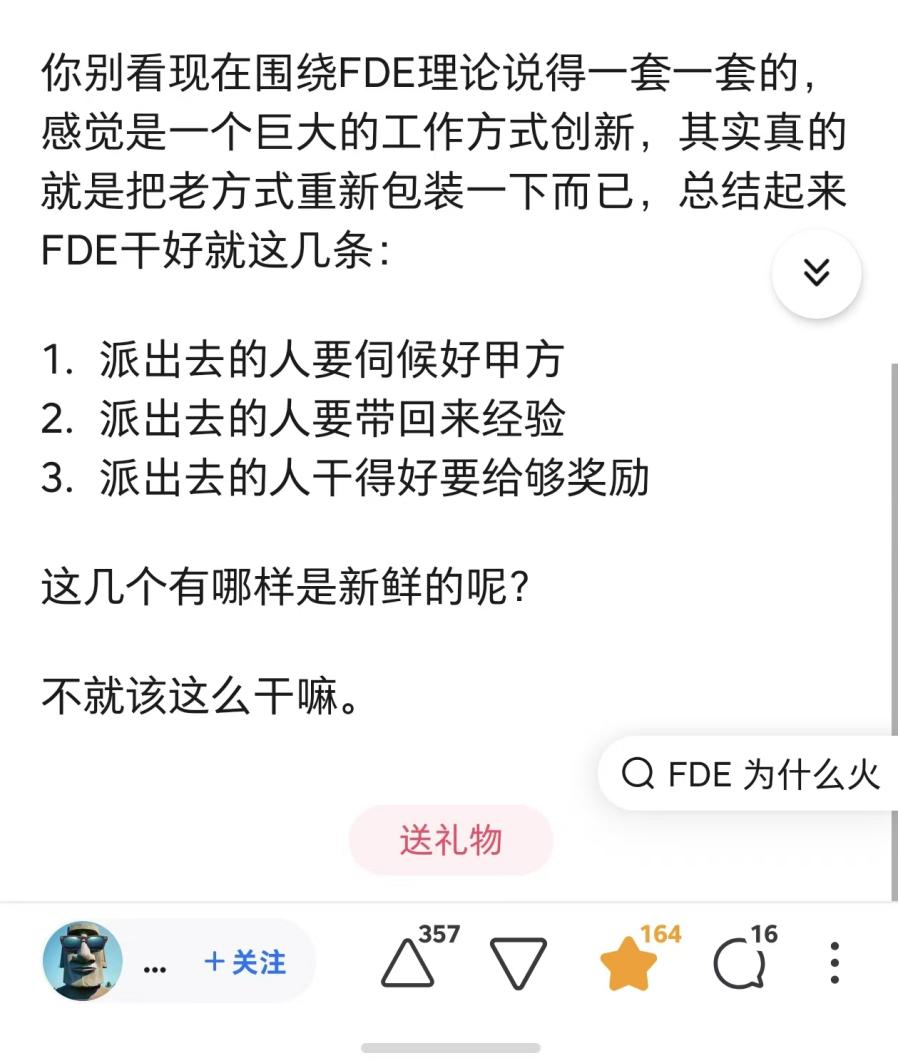
But exhaustion isn't even the hardest part. The hardest part is that you never know what role you'll have to play tomorrow.
An FDE at a Chinese AI company admitted that there's almost no fixed office location, weekend emergency support is routine, and long-term travel between cities has thrown many people's sleep schedules into disarray. You have to write high-quality code and debug like an R&D engineer, handle requirements and present solutions like a Sales Engineer, and deal with on-site failures and coordinate multiple teams to push projects forward like an ops engineer—playing multiple roles at once, yet with a very low margin for error. Client satisfaction is directly tied to performance reviews, and on-site problems must be solved immediately.
In Yupi's third week at a factory, the client's boss pulled him aside and asked: "Can this AI of yours help me predict which machine will break down tomorrow?" Yupi said they'd need data first. The boss replied: "Isn't data being recorded all the time?" Yupi followed the workers to take a look—the so-called "records" were handwritten in an oil-stained ledger, in scrawled handwriting, with some dates even written wrong. He spent considerable time typing the ledger into Excel, then another week persuading the workshop supervisor to have workers fill in two extra columns every day.
The irony is that this preliminary work, which has nothing to do with AI, directly determines whether the AI can even get started.
Moreover, not every company executive looking to use AI to improve quality and efficiency understands the most basic principles of AI. So frontline FDEs, who already wear multiple hats, also need to practice explaining concepts like agents and skills in plain language to traditional business owners. After all, the final deal-closing rate also depends on the FDE.
This explains why burnout has become a buzzword in FDE circles. Frequent travel, compound pressure, and blurred professional boundaries are pain points shared by almost all frontline practitioners.
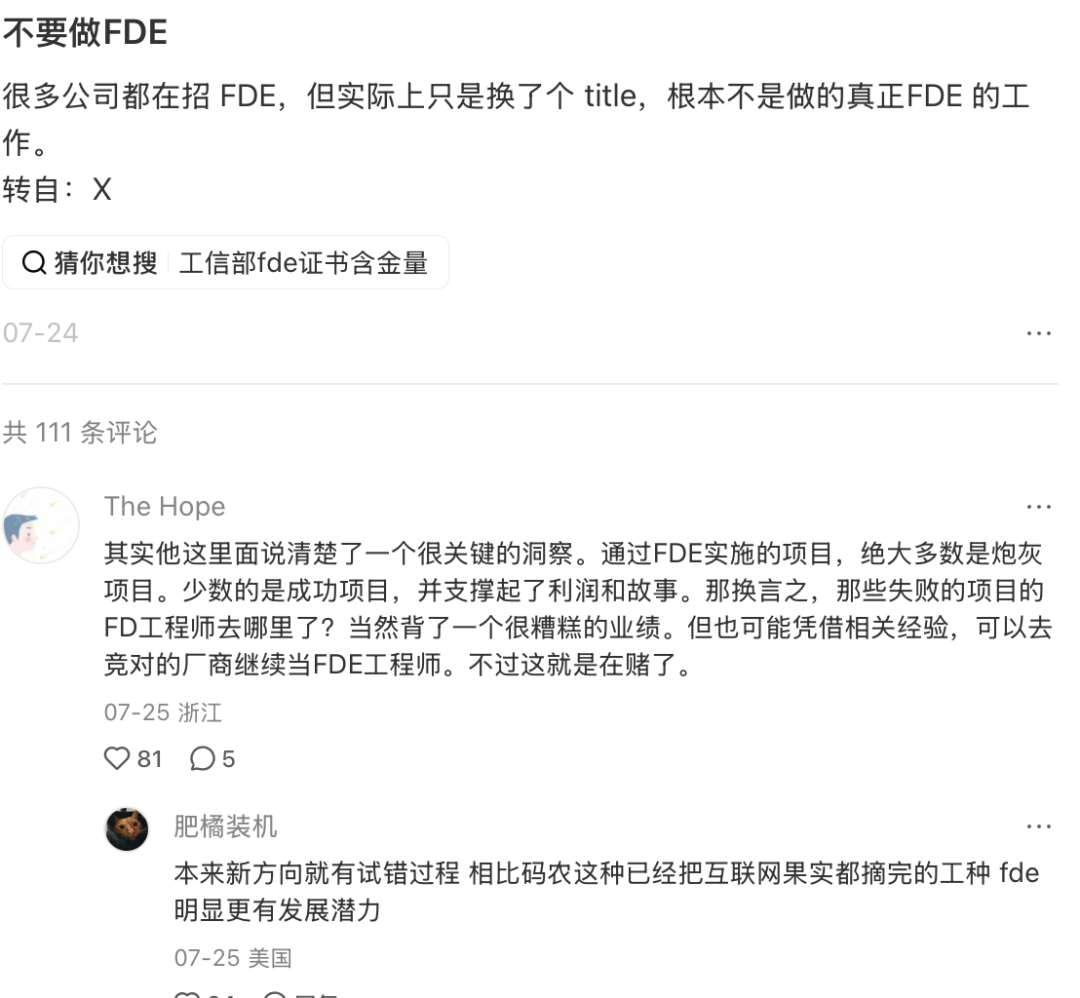
That said, even for those juggling multiple roles and rushing around day and night, the stories on social media about "solo freelancers earning 100k a month" or "zero-experience career switchers making a million a year" don't apply to everyone. The FDEs who actually earn million-yuan salaries are concentrated at top AI companies and elite consulting firms, and typically require 5+ years of engineering experience plus client-facing work experience like Yupi's—and even then, it's not stable. Hence FDE's other nickname: "on-site outsourcing."
Anyone who has done ToB business in China knows the pain: clients want customization, private deployment, and on-site presence. In the end, SaaS becomes project work, and a product company becomes an outsourcing company. Over the past decade, many ToB startups have crashed and burned on this path.
The FDE narrative is valuable in Silicon Valley because two premises hold: first, there's a reusable platform behind it; second, frontline discoveries can feed back into the product, making the next client's deployment faster and cheaper.
Customized delivery means labor costs grow linearly with the number of clients, which runs counter to the software industry's pursuit of decreasing marginal costs. Palantir can sustain this model because its deal sizes are large enough and its clients are concentrated in government and large enterprises. But when the FDE model trickles down to small and mid-sized clients that need AI, whether per-client profit can cover on-site costs is an unproven question.
Many FDE workers complain that some clients simply have a freeloader mentality—spending a little money to acquire AI knowledge, then canceling the contract and building their own workflows. But in an era when AI hasn't yet fully penetrated the market, pricing too high from the start would mean losing 90% of potential clients.
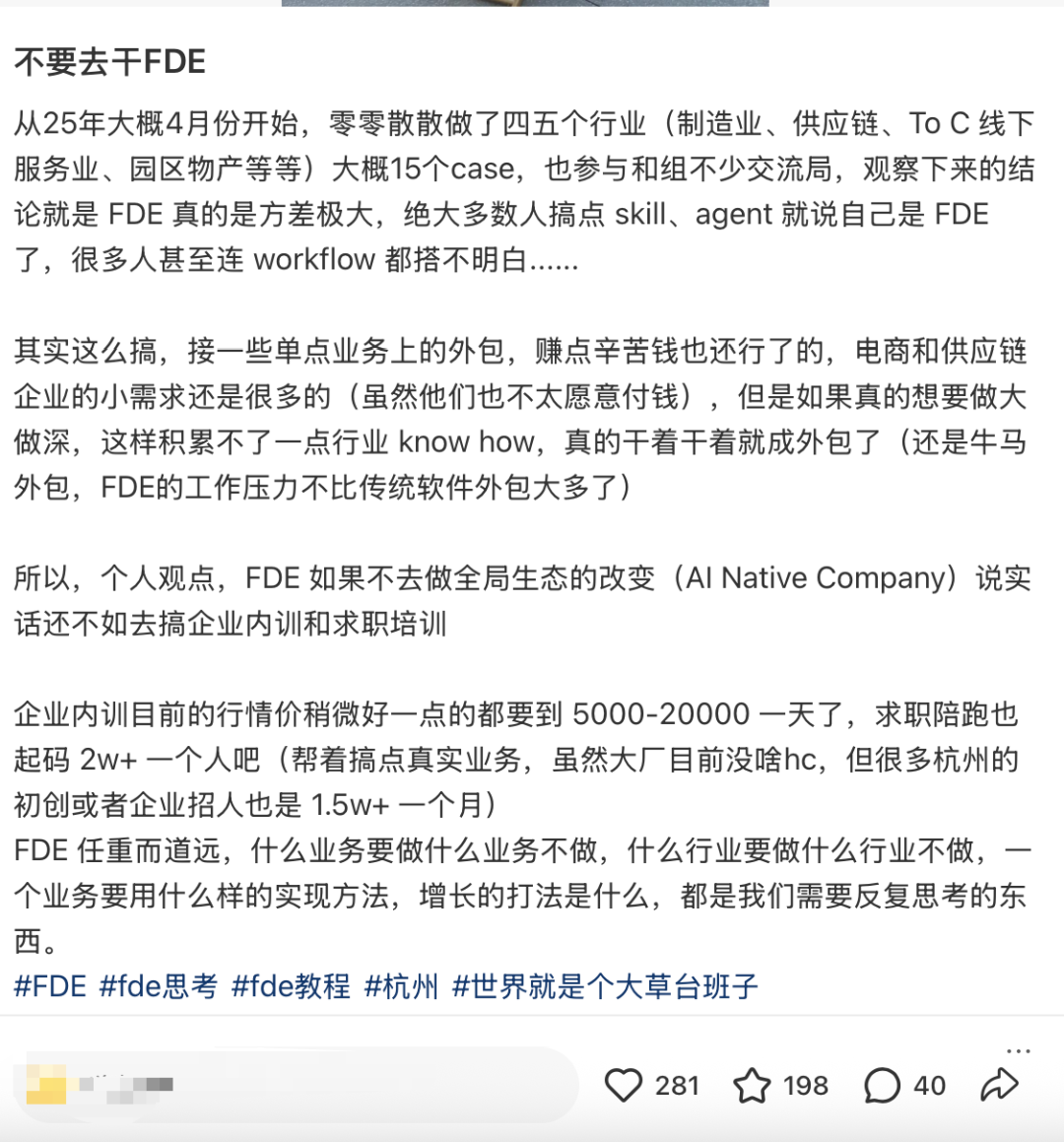
Still, dismissing FDE entirely as a rebrand would be oversimplifying. Whenever a technology moves from the lab into production environments, a role dedicated to "making it run" inevitably emerges. The cloud computing era gave rise to SRE and DevOps; the large model era is giving rise to FDE. SRE was once also seen as a variant of ops, and later became an independent technical discipline. FDE may be following the same path.
The FDE boom has a solid foundation of real demand, but it's not a golden rice bowl suited to everyone.
On the positive side, the growth speed this role offers is rare. An engineer who has spent three months embedded at a client's site may understand AI implementation better than a back-office team after three years of iteration. On the other hand, the boundaries of this role are being diluted. Some analysts point out that as demand has surged, more and more positions with the FDE title are actually sliding toward pre-sales, Solutions Architect, or even customer success work.
AI moving from the lab into business workflows does require a group of people who understand both engineering and business, and are willing to get their hands dirty in the field. That demand won't disappear when the bubble recedes. But within that 42x growth figure, there is indeed a mix of title inflation, role consolidation, and unproven value expectations.
Yupi, who has charged into this world, doesn't know whether he's caught a rising wind or walked through a narrow door that's been carefully packaged. He only knows that tomorrow at 8 a.m., he has to be at the workshop again, on time.