tldr: A forward deployed engineer (FDE) is a software engineer who embeds with a company's biggest customers and ships production code until the product actually works for them. As of October 2026, the median FDE in the US earns $220,000 in total compensation according to Levels.fyi, Palantir packages reach $590K, and Anthropic posts a salary of up to $320K for a staff FDE. Listings spiked 800% in 2025, and in 2026 AWS put $1 billion into a new FDE unit while Microsoft, Google, OpenAI and Anthropic all expanded the role. This guide covers the role, the pay, who's hiring, and how to get the job.
As AI and data platforms grow more complex, one role keeps showing up in every hiring pipeline: the Forward Deployed Engineer.
Companies like OpenAI and Palantir are scaling these teams fast. Job postings are exploding, with some reports citing an 800% spike in FDE job listings in 2025. Top-tier VC firms and tech media have dubbed it the "hottest job in startups".
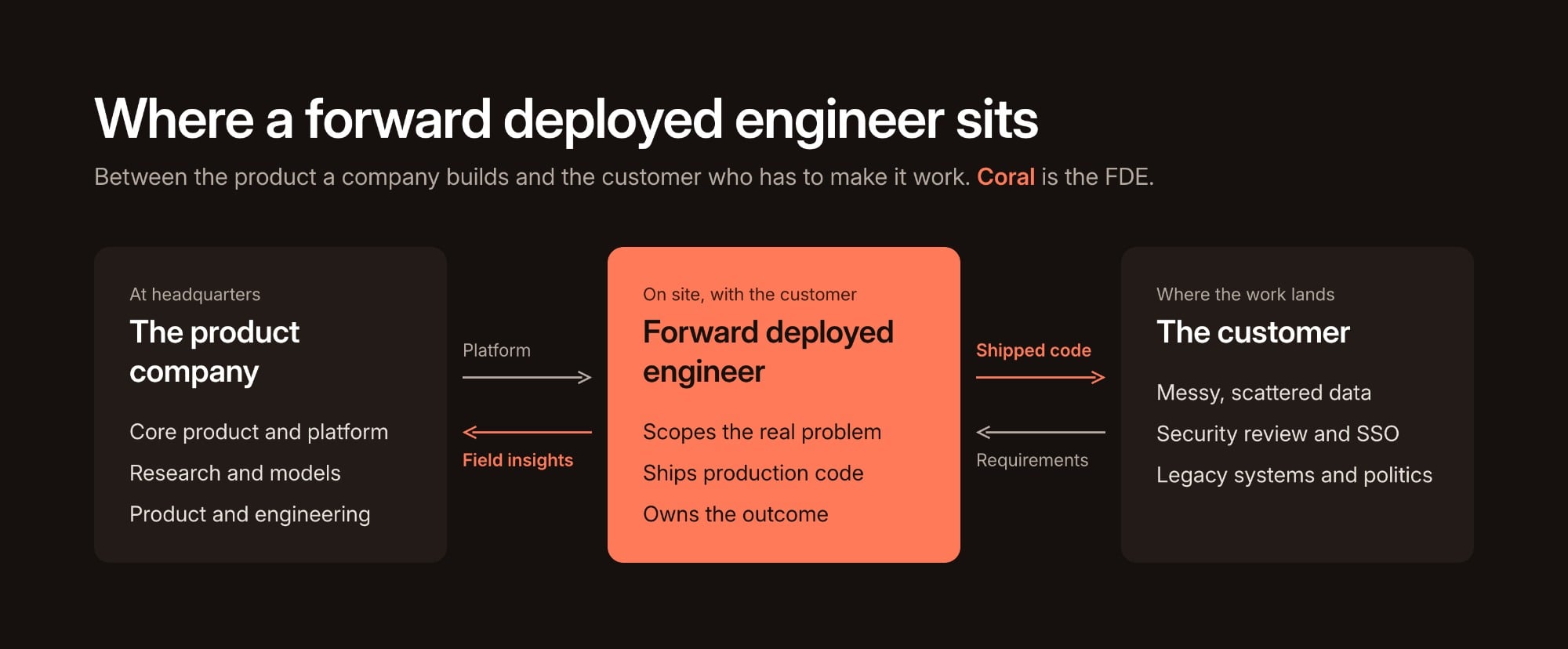
The FDE sits between the company that builds the product and the customer who has to make it work.
What is a forward deployed engineer?
A Forward Deployed Engineer (FDE), or Forward Deployed Software Engineer (FDSE), is an elite, hybrid technical role. These are your best engineers, the ones you embed directly with your biggest customers to solve their hardest, highest-stakes problems.
They operate with the autonomy of a founder but the technical rigor of a staff engineer. "Deployed" from HQ to the customer's "forward" position: their offices, their data centers, their messy reality. Empowered to build, design, and ship production code to make that customer win.
Below is a breakdown of current salary data, core responsibilities, and the "decomposition" interview format that firms like Palantir and OpenAI use.
What is a forward deployed engineer? The definition and meaning
The forward deployed engineer definition is simple. It's built on two concepts:
- "Forward Deployed": This is a military term for being on the front lines. For an FDE, it means working inside the customer's world, with their messy data and security rules.
- "Engineer": An FDE is not a sales rep, a consultant, or a support agent. They write, debug, and ship production-grade code, build data pipelines, and deploy systems.
The meaning of the role in practice is to be the human bridge between a powerful, generic platform (like Palantir's Foundry or OpenAI's GPT models) and a customer's unique, specific problem. They make the technology work for that client.
What does a forward deployed engineer do? (Role and responsibilities)
The forward deployed engineer role has one central mission: own the customer's technical success. Whatever it takes.
A look at a forward deployed engineer job description
Look at any OpenAI forward deployed engineer job description, such as OpenAI's San Francisco FDE posting. You'll see these role responsibilities:
- Embed deeply with customers. Lead complex, high-stakes deployments.
- Map customer problems, structure the solution, and ship it. Fast.
- Design, build, and deploy full-stack systems and custom data pipelines that create real value.
- Act as the primary technical owner. Build trust. Guide the customer's own teams.
- Find reusable patterns. Bring field insights back to your core product team.
- Troubleshoot the most complex production outages. Be the last line of defense.
The day-to-day: An FDE's four-stage loop
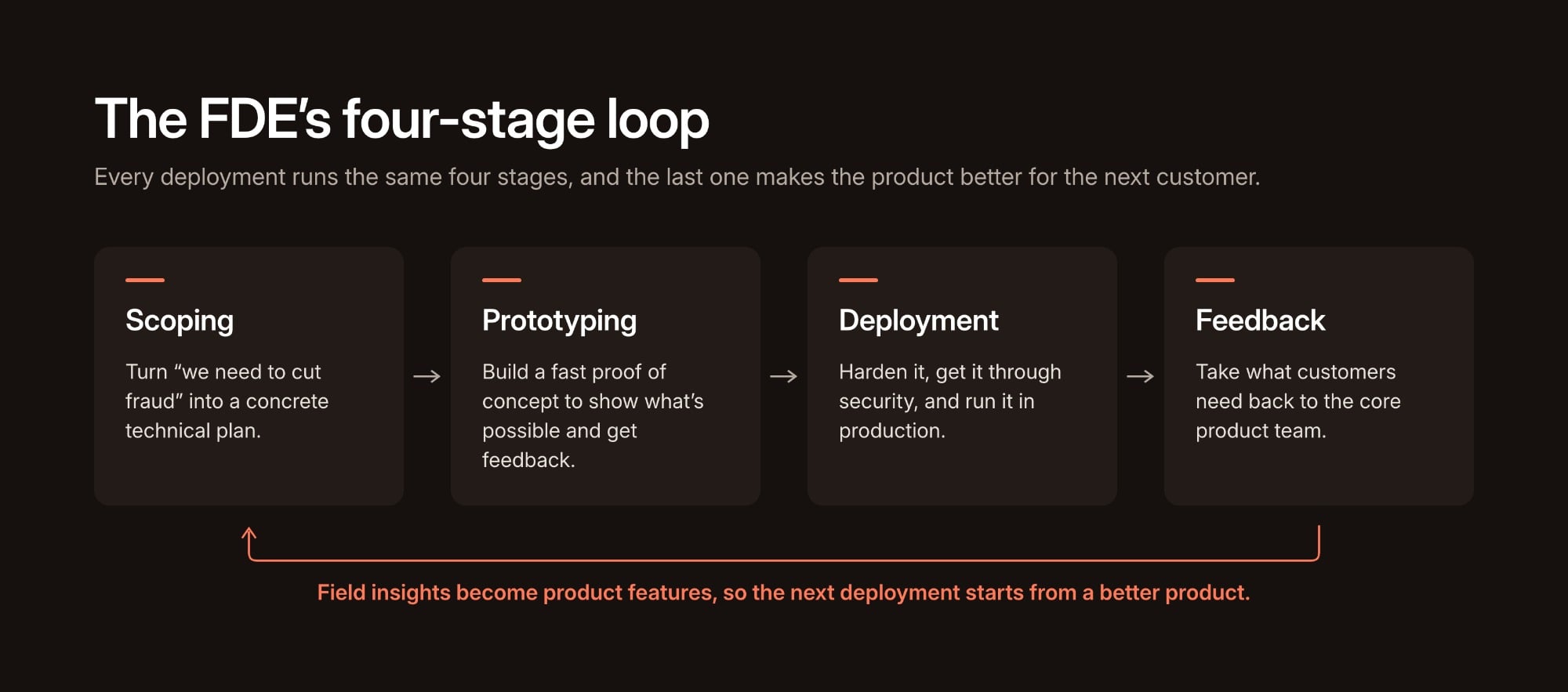
Each deployment runs the same four stages, and feedback improves the product for the next customer.
An FDE's work is a four-stage loop:
- Scoping: You get a vague problem, like "We need to cut fraud," find the real problem, and define a concrete technical plan.
- Prototyping: You build a fast proof of concept (PoC) to show the customer what's possible and get feedback.
- Deployment: You harden the PoC to be production-grade and secure, navigate the client's infrastructure, and get it live.
- Feedback: You take what customers need back to the core product and research teams, so the product gets better.
Forward deployed engineer vs. software engineer vs. solutions architect
Don't confuse the FDE with other roles. The difference is about shipping and ownership.
| Role | Primary goal | Key activity | Customer interaction |
| Forward Deployed Engineer | Customer success via custom, production-grade solutions. | Building and deploying | Deeply embedded, long-term partner. |
| Software Engineer (core) | Build and maintain the core, scalable product for all users. | Coding features | Minimal; filtered through product managers. |
| Solutions Architect / Sales Engineer | Get the technical "win" during the sales process. | Designing and demoing | Pre-sales; high-level and strategic. |
| AI Engineer | Build AI features and agents into the company's own product. | Prompting, evals, and model integration | Usually internal; works with product teams. |
The Sales Engineer sells the dream. The core Software Engineer builds the toolbox. The Forward Deployed Engineer uses that toolbox to build the custom, finished solution for the client. An AI engineer and an AI FDE share most of their skills, but the AI engineer ships into their own company's product, while the FDE ships into a customer's systems, under the customer's security rules.
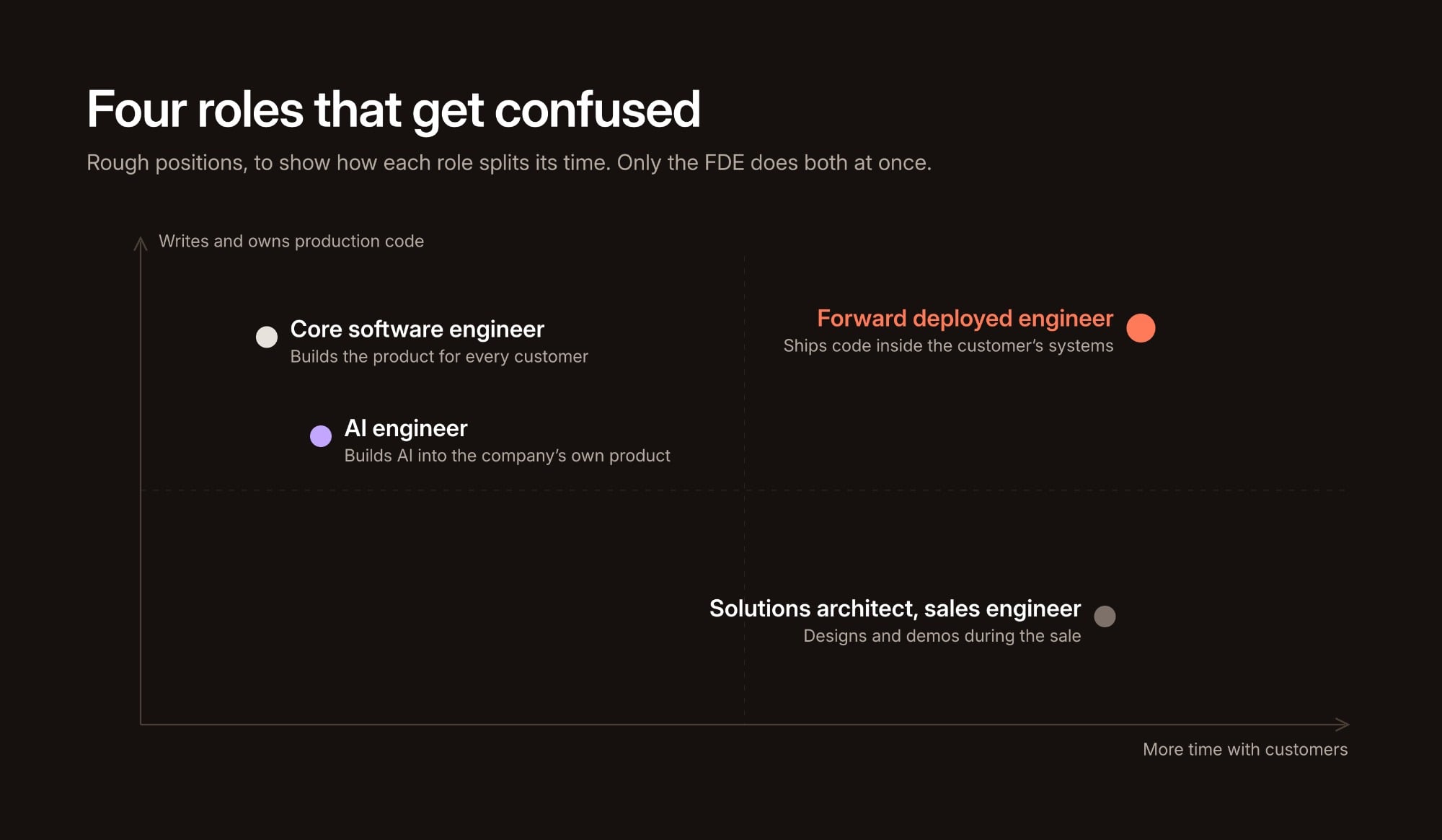
Rough positions, to show how each role splits its time. Only the FDE owns production code and spends most of its time with customers.
Which companies hire forward deployed engineers?
This role is hottest at companies selling complex, high-value platforms, where it works as a go-to-market strategy for products that need deep technical integration to win.
The pioneer: Palantir
The Palantir Forward Deployed Software Engineer (or FDSE) is the original. Palantir built its business on this model, embedding engineers with government and commercial clients to solve large data problems. The Palantir forward deployed engineer role is known for its autonomy and high stakes.
The new wave: The AI and data giants
The AI boom created a new wave of demand, because a raw model API doesn't make a bank or a hospital productive on its own. Three of the biggest private AI companies all hire FDEs for that reason:
- OpenAI: An OpenAI Forward Deployed Engineer leads end-to-end deployments of frontier models with strategic customers, and what they learn from evals feeds back into the roadmap.
- Anthropic: Its FDEs work with customers to decide what gets built, then ship production AI applications on Claude.
- Databricks: Its AI FDEs deliver professional services engagements and own production rollouts of customers' generative AI apps.
The new breed: Modern startups and scale-ups
These are the startups and scale-ups with the strongest FDE hiring as of October 2026. Titles vary, so read each posting for what the job actually involves.
| Company | What it does | Why it hires FDEs |
| Scale AI | AI data and enterprise agents | Scale says the hard part of enterprise AI isn't the model, so its FDEs deploy and run these systems for enterprise and government clients. |
| ElevenLabs | AI voice models | Large customers get an embedded engineer who owns the project from architecture through full integration. |
| Cognition | Maker of the Devin AI coding agent | Devin has to work inside each customer's own environment, so FDEs run the pilots and integrations that get it there. |
| Harvey | AI for legal and professional services | Engineers turn real investment workflows into Harvey solutions for asset managers, in a finance-focused version of the role. |
| Shield AI | Defense autonomy software and aircraft | Its Hivemind software has to be integrated in the field, so FDEs spend about half their time on customer sites. |
| Vercel | Web app platform behind Next.js | Enterprise teams need help moving to Next.js, so FDEs lead the migration and leave code those teams can extend. |
| Together AI | AI cloud for inference and training | Big accounts run complex proofs of concept, and FDEs tune inference setups to speed up results. |
| Glean | Enterprise AI search and agents | Its team builds for strategic customers' biggest unsolved problems, and the best work ships to every customer. |
| Cohere | Security-first enterprise AI | Its North platform runs in private clouds and on-premises, so FDEs work directly with enterprise IT. |
| Sierra | Customer-facing AI agents for large brands | "Software Engineer, Agent" is its version of the role: engineers build live agents with clients, from pilot through deployment. |
| Legora | AI operating system for lawyers | Law firms run a stack of legal tech, and FDEs connect Legora to it and turn prototypes into working tools. |
| Mistral | French AI lab | Its forward deployed ML engineers carry research to enterprise clients, from pre-sales through implementation. |
| Ramp | Corporate spend software | Ramp's engineering blog says the role grew out of the need to scale in enterprise. |
| Decagon | AI customer support agents | Its "Agent Deployment Engineers" work on making agent rollouts repeatable. |
| Replit | AI app-building platform | Large enterprises need Replit connected to their identity systems, data warehouses, and internal APIs, and FDEs build that along with the first apps. |
Smaller companies are also building the model into what they sell. Bug0 does this for QA: a forward-deployed QA engineer builds a team's tests on Bug0's AI engine, and a human verifies every failure before it reaches production.
Fortune 500 companies hiring forward deployed engineers
The title has spread well beyond tech. These Fortune 500 companies had FDE roles or teams as of October 2026. Half of them sell deployment to their customers, and the other half use FDEs to roll out AI inside their own business.
| Company | What it does | Why it hires FDEs |
| Amazon | Retail and AWS cloud | Its $1 billion AWS unit handles the last mile of AI, embedding engineers with customers, starting in regulated sectors. |
| UnitedHealth Group | Health insurance and Optum services | Optum partners with payers and providers to build and scale AI, sold as a client service. |
| Alphabet | Search and Google Cloud | Customers and partners want Google's own engineers, and Google Cloud is catching up on enterprise AI deployment. |
| Microsoft | Software and Azure | Its $2.5 billion Frontier Co. embeds experts, including FDEs, in customer businesses to build and run AI systems. |
| Ford | Automaker | Internal: custom software for its battery storage business, where buying a platform doesn't fit. |
| Citigroup | Global bank | Internal: squads sit inside business lines and move AI from experiments to live systems. |
| Salesforce | CRM software | Its FDEs deploy AI agents with customers and stay accountable until business outcomes are met. |
| NVIDIA | AI chips | Customers and partners need help turning open models into working AI products. |
| Morgan Stanley | Investment bank | Internal: speeds up AI work in its Research division. |
| Target | Retailer | Internal: gets teams from experimenting on its AI platforms to shipping on them. |
| American Express | Payments and cards | Internal: turns high-value opportunities into secure AI tools it can reuse across the company. |
| Broadcom | Chips and infrastructure software | Enterprise clients replatforming or building AI clusters get an embedded engineer to make adoption easier. |
| Cisco | Networking and Splunk | A customer-embedded team at Splunk speeds up time to value and drives retention. |
| Quanta Services | Energy infrastructure contractor | Internal: delivers software for its operating companies. |
| Ameriprise Financial | Wealth and asset management | Internal: LLM tools built alongside portfolio managers and researchers. |
| Intuit | TurboTax and QuickBooks | Internal: helps employees redesign their work around AI. |
| Kyndryl | IT infrastructure services | Engineers join customer delivery teams to build and deploy AI. |
| Booz Allen Hamilton | Government consulting | Government clients need tested AI solutions turned into working deployments. |
| Conagra Brands | Packaged foods | Internal: builds on Palantir Foundry for its supply chain and finance teams. |
| JPMorgan Chase | Largest US bank | Internal: copilots and agents for compliance, risk, and operations. |
Why is everyone hiring forward deployed engineers in 2026?
The short answer is that enterprise AI got stuck between the demo and production, and the companies selling models decided to send engineers to close that gap themselves. In 2026 that moved from a startup tactic to a strategy at the biggest companies in tech:
| Company | What it announced |
| AWS | A new $1 billion unit that embeds engineers with customers (June 2026) |
| Microsoft | $2.5 billion for Microsoft Frontier Co., which embeds about 6,000 employees with clients, including FDEs, consultants, support staff and salespeople (July 2026) |
| Plans to hire hundreds of engineers to help customers adopt its AI (May 2026) | |
| OpenAI and Anthropic | Both are expanding their forward deployed teams, with open FDE roles in the US and Europe |
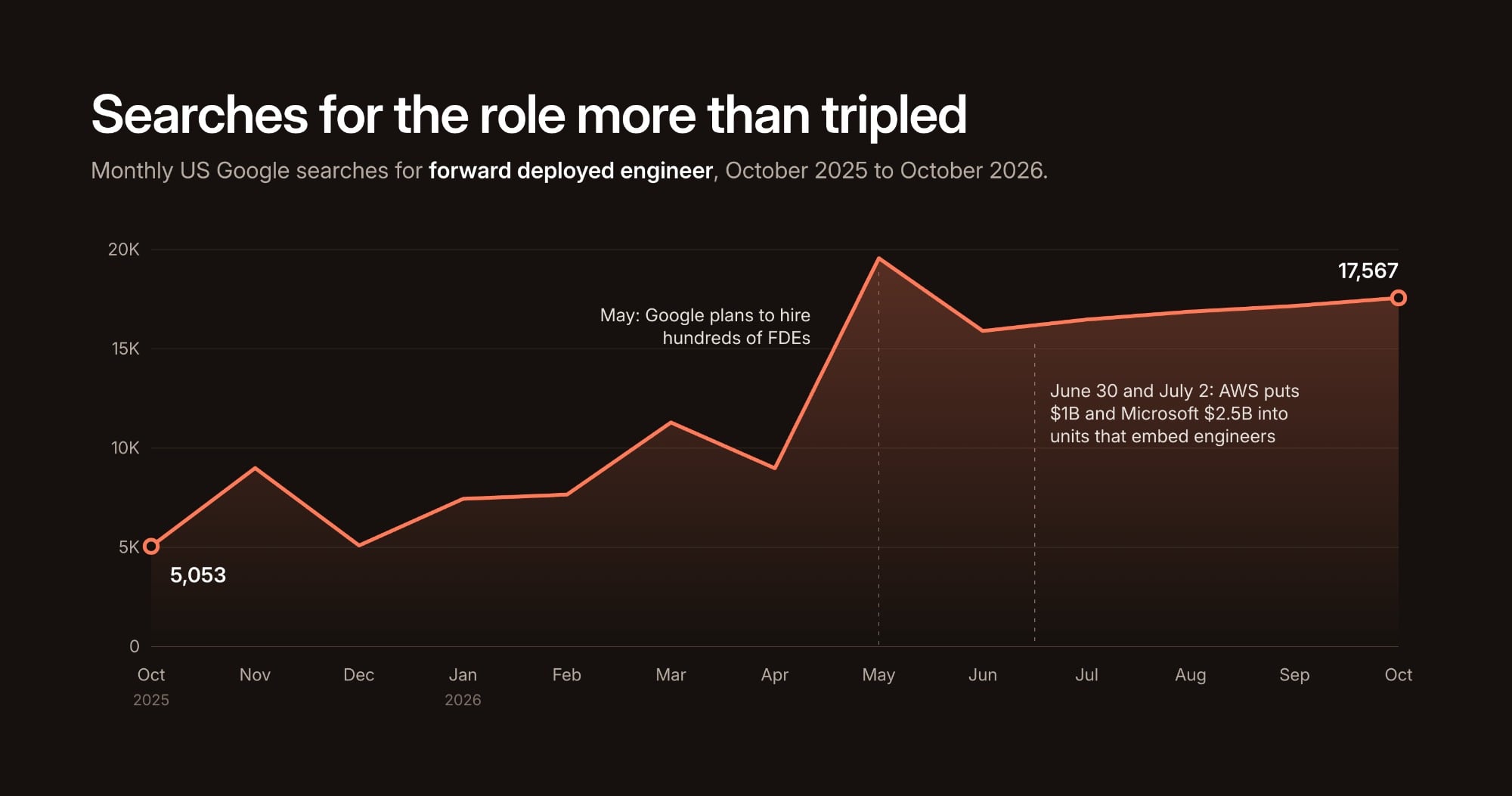
Data: Ahrefs Keywords Explorer, monthly US search volume for "forward deployed engineer", pulled October 30, 2026. Announcements reported by The Information and CNBC.
Box CEO Aaron Levie wrote that FDEs are about to become one of the most in-demand jobs in tech, and Google Cloud CEO Thomas Kurian said Google is investing in hiring more of them. When a cloud provider that already employs solutions architects puts $1 billion into a separate FDE unit, the signal is clear: it wants people who write and own production code at the customer, not people who stop at the architecture diagram.
What is an AI forward deployed engineer?
An AI forward deployed engineer is an FDE whose job is getting AI models and agents into production at a customer. Andrew Ng described the role as an engineer embedded with a client to customize solutions, such as building and tuning agentic workflows for that client's needs.
In practice, the work is less about the model and more about everything around it. An AI FDE connects the model to the customer's data, builds the evals that prove an agent behaves, wires in authentication and logging, and decides where the model runs. Regulated customers often can't send data to a hosted API, so self-hosting open-weight models inside their own network is a common part of the job. Most AI FDEs also lean heavily on coding agents to move fast at customer sites; our Claude Code vs Codex comparison covers the two most common ones.
Much of an FDE's day also goes to customer meetings, so a background agent can keep work moving while you're in them. With Buildful, you hand off a scoped change, like a connector or a failing test, from Slack or Linear. It works in a cloud sandbox, runs the repo's checks, and opens a pull request on GitHub for you to review afterward. Check the customer's security rules first, because many won't allow a cloud agent near their code.
Forward deployed engineer salary: Why it's one of tech's highest-paid roles
The forward deployed engineer salary is massive for one reason: skill scarcity. You need to be a strong engineer and a high-empathy communicator who can manage a multi-million dollar relationship.
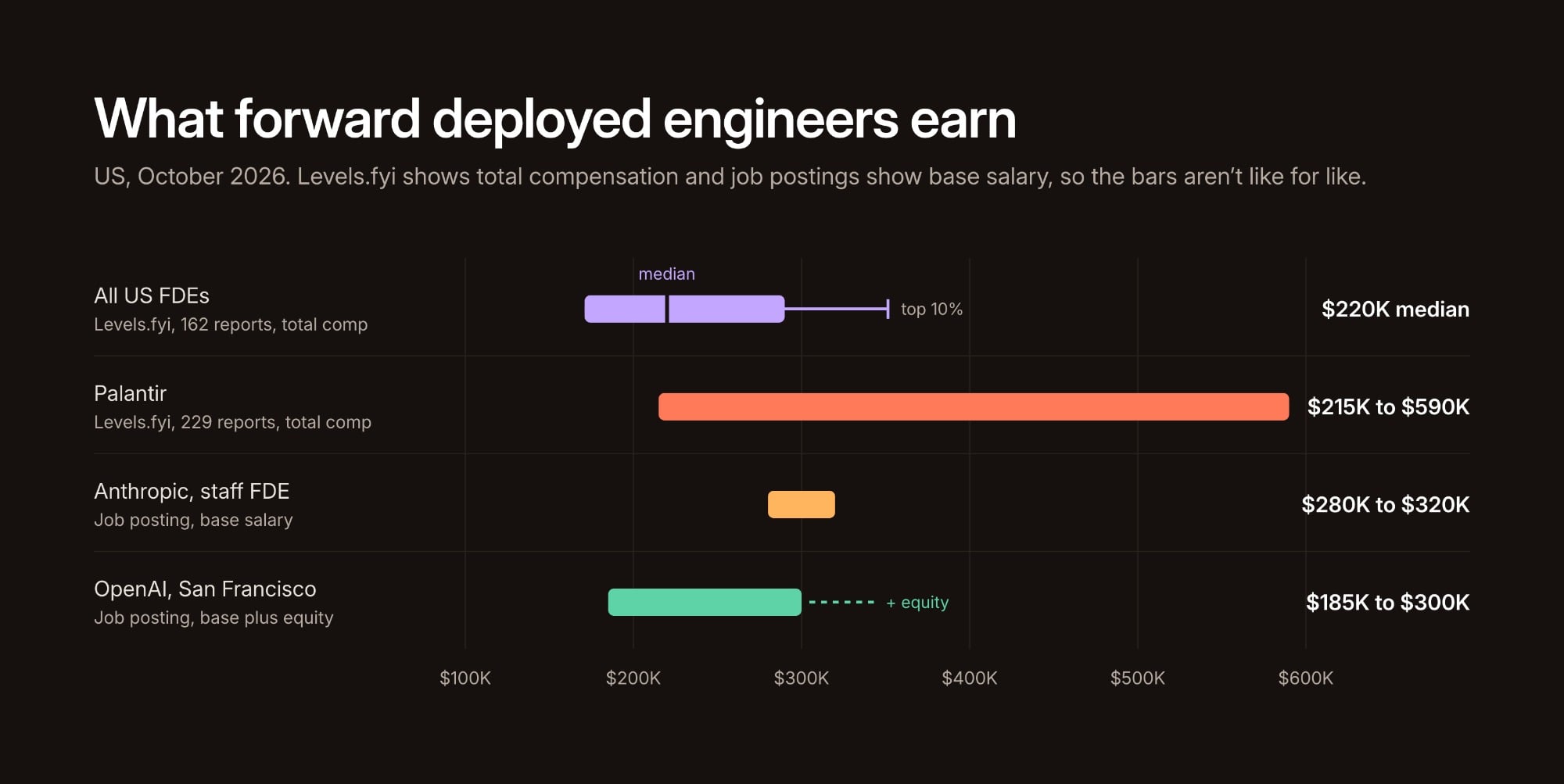
The purple box is the middle half of Levels.fyi reports, the tick is the median, and the line runs to where the top 10% starts. Data from Levels.fyi (October 30 and October 23, 2026) and the OpenAI and Anthropic job postings.
Note: TC = Total Compensation (base + stock + bonus). Figures below are US numbers as of October 2026.
| Data | What it shows |
| Levels.fyi, all FDEs | Median TC $220,000. The middle half earns $171,000 to $290,000, and the top 10% earn more than $351,400 (162 reports, updated October 30, 2026). |
| Levels.fyi, Palantir | TC from $215,000 to $590,000 (229 reports, updated October 23, 2026). |
| OpenAI's own FDE posting | Base salary of $185,000 to $300,000, plus equity. |
| Anthropic's Staff FDE posting | Annual salary of $280,000 to $320,000 (New York, San Francisco, Seattle). |
The benchmark: Palantir forward deployed engineer salary
Palantir has the deepest salary data because it has hired FDEs for more than fifteen years. Levels.fyi tracks 229 Palantir FDE packages, ranging from $215,000 to $590,000 in total compensation, and some of those packages clear $400,000.
The new standard: OpenAI forward deployed engineer salary
OpenAI publishes a base salary range of $185,000 to $300,000 for its San Francisco FDE role, plus equity. The posting adds equity on top of that base and doesn't publish a total package. Anthropic is more specific at the senior end: its Staff Forward Deployed Engineer posting lists an annual salary of $280,000 to $320,000 for New York, San Francisco and Seattle.
General salary expectations
Across all companies, the forward deployed engineer salary median in the US is $220,000 in total compensation, based on 162 reports to Levels.fyi. The middle half earn $171,000 to $290,000, and the top 10% earn more than $351,400.
Where the jobs are
The demand is concentrated at AI labs, cloud providers, and companies selling into fintech, healthcare, and government, where FDEs navigate complex compliance requirements alongside technical integration. Expect travel, because the job is named for the time you spend at customer sites.
The high pay reflects how much pressure, impact, and travel the job involves.
How to become a forward deployed engineer
Getting a forward deployed engineer job is hard, because the interviews test technical skill, problem-solving, and grit at the same time.
What background do you need?
Companies look for people who have already acted like an FDE, even without the title. The best backgrounds are:
- Early-stage startup engineer: If you were one of the first 10 engineers at a startup, you've talked to customers, worn all the hats, and shipped code to save the company.
- Hands-on solutions architect: You build the PoC yourself and write custom scripts.
- Data engineer / ML engineer: You've built and deployed data pipelines or productionized models.
- Full-stack engineer with product sense: You talk to the product manager and question why something is being built.
The must-have skills: A "T-shaped" profile
FDE hiring looks for "T-shaped" people. Deep expertise in one area, broad skills in many others.
Deep technical bar (the vertical "I")
- Coding: You need to be fluent in Python, and familiarity with Java, Go, or TypeScript helps for full-stack work.
- Data: You need to understand data processing (Spark), data pipelines (Airflow), and database trade-offs (SQL vs. NoSQL, OLAP vs. OLTP).
- Systems (DevOps/MLOps): You're deploying production code, so you need AWS, GCP, or Azure, plus Docker and Kubernetes. Experience with Terraform or other IaC tools is a plus.
- AI / ML (for AI FDEs): AI FDEs now build agentic workflows, where AI systems execute multi-step tasks like filing claims or running QA suites.
- Core concepts: RAG (Retrieval-Augmented Generation), fine-tuning, vector databases, and agentic orchestration (LangGraph, CrewAI).
- Evaluation frameworks (evals): You need to build and run evals that prove an agent won't go rogue in production.
- AI observability and guardrails: Tools like LangSmith, Braintrust, or HoneyHive let you trace, monitor, and constrain agents, which is how you win over the customer's security team.
- Frameworks: Hands-on experience with PyTorch or TensorFlow and HuggingFace.
Broad execution skills (the horizontal bar)
This is the harder half of the job.
- Customer fluency and empathy: You can explain a complex system to a non-technical executive and translate their business problem into technical specs.
- Grit and radical ownership: When a deployment fails at 2 AM, you don't file a ticket or blame another team. You own the problem from end to end.
- Problem decomposition: You can take a massive, vague problem like "Our supply chain is broken" and break it into a clear, shippable plan.
- Product sense: When you build the same custom script for three customers, you spot the pattern and tell the product team to build it into the platform.
The interview process: How to win
The process is multi-stage, and each round tests a different part of your "T".
- Behavioral / fit interview: This tests the horizontal bar, with questions like "Tell me about a time you handled a demanding stakeholder" or "Describe a complex project you owned from 0 to 1."
- How to win: Use the STAR method (Situation, Task, Action, Result), and tell stories about you shipping code and solving a problem.
- Technical deep dive(s): This tests the vertical bar.
- Coding: Expect a practical task, such as "Here's a messy 1GB JSON file, parse it, clean it, and expose an API to query it."
- System design: This will be data-heavy. For example, "Architect a RAG system for a company's internal wikis."
- The case study / decomposition interview: This is the hardest round, and it's the famous Palantir forward deployed engineer interview, a format other FDE employers have picked up. You get a massive, ambiguous, real-world problem on a whiteboard.
- Classic example: "A major city wants to use our platform to reduce 911 emergency response times. They have 911 call data, traffic data, and ambulance GPS data. You have 60 minutes. Go."
- 2026 agentic example: "A global logistics firm wants an AI agent to handle automated rerouting for delayed shipments. They have SAP data, real-time weather APIs, and 500 different warehouse managers. How do you build the eval suite to ensure the agent doesn't overspend on shipping while maintaining a 99% delivery rate?"
How to prep and pass the "decomposition" interview
The interviewer cares less about the "right answer" than about how you think.
- Do not jump to a solution. Your first instinct will be "Build an AI to predict traffic!" Don't.
- Ask questions (clarify and scope): What's the actual goal? Who is the user: the 911 operator, the ambulance driver, or the public? What does the data look like, and what are the budget and timeline?
- Decompose the problem: Break it into small, solvable chunks. Here, that might be ingestion (getting the messy data in one place), visibility (a real-time map for operators), and optimization (a model that suggests the best ambulance).
- Propose an MVP (version 1): Suggest the simplest thing that delivers value. "Forget the AI model for now. V1 is a data pipeline and a real-time dashboard. Just seeing all the ambulances on a map would be a huge win."
- Iterate and discuss trade-offs: The interviewer will push you on messy data and scale. Talk through your choices, like "I'd use Kafka for real-time ingestion, but a simple polling API might be better for the MVP."
A common mistake is showing off a specific tool before you understand the user's latency requirements. Be the engineer who cares more about the 911 operator's workflow than the database schema, and think out loud as you go.
Is forward deployed engineering a good job? The honest downsides
It's a great job for a specific kind of engineer, and a draining one for everyone else. The pay and the visibility are real, but so are the trade-offs, and it's worth knowing them before you apply.
- Travel and context switching. You live in the customer's world, which can mean weeks on site and several customers at once. As a March 2026 Wall Street Journal headline put it, the hottest job in tech "isn't very glamorous."
- Pressure on short timelines. You are measured on whether the customer gets results, often within a few months, and you don't control their data, their systems, or their politics.
- Some listings use the title loosely. In a Reddit thread titled "Forward Deployed Engineer" roles seem like a scam, engineers argue that some of these jobs are closer to technical sales than engineering. Read the job description: if it doesn't mention shipping production code, it isn't the job this guide describes.
- Less depth on one codebase. Core engineers spend years making one system excellent. FDEs trade that for breadth, which suits some careers and stalls others.
If you like customers, enjoy ambiguity, and want to see your code change a business within weeks, it's one of the best-paid ways to do that. If you want deep, quiet focus on one product, a core engineering role will make you happier.
The future of the FDE role
The integration wall
Most AI projects stall not because the model is bad, but because it can't reach the customer's legacy databases, pass their SSO and security review, or meet their data residency rules. Getting past that wall takes someone on site, with production access, who can ship, and that is where FDEs earn their pay.
Why FDEs are the new revenue multiplier
A platform that sits on a shelf earns nothing, and as models and platforms start to look alike, the ability to deploy them is what customers pay for. That makes the AI Forward Deployed Engineer one of the main ways AI companies turn a pilot into revenue.
FAQs
What does "forward deployed engineer" mean?
A Forward Deployed Engineer (FDE) is a hybrid technical role where engineers embed directly with customers to solve their hardest problems. They write production code, build custom solutions, and own the customer's technical success end to end. They're embedded at the customer's site, working on the customer's problems, with the customer's data.
How much does a forward deployed engineer make in 2026?
As of October 2026, the median forward deployed engineer in the US earns $220,000 in total compensation, according to 162 reports on Levels.fyi. The middle half earns between $171,000 and $290,000, and the top 10% earn more than $351,400. Palantir FDE packages range from $215,000 to $590,000, OpenAI posts a base salary of $185,000 to $300,000 plus equity, and Anthropic posts $280,000 to $320,000 for a staff FDE.
What's the difference between a forward deployed engineer and a software engineer?
A core software engineer builds the product for all users. A Forward Deployed Engineer takes that product and builds custom, production-grade solutions for specific customers. The FDE is deeply embedded with the client, owns the relationship, and ships code to solve that customer's unique problems. Core engineers rarely interact with customers directly.
Who hires forward deployed engineers in 2026?
Palantir pioneered the role. Today, AI companies (OpenAI, Anthropic, Cohere, Databricks, Scale AI), cloud providers (AWS, Microsoft, Google), fintech companies (Ramp), AI-native QA platforms (Bug0), and large enterprises like Citigroup, UnitedHealth Group, and Ford all hire FDEs. Job listings for the role spiked 800% in 2025, and in 2026 AWS put $1 billion into a new FDE unit, while Microsoft committed $2.5 billion to an implementation unit that includes FDEs.
How do I prepare for a forward deployed engineer interview?
FDE interviews typically include three stages: behavioral/fit interviews testing communication and ownership, technical deep dives testing coding and system design, and the famous "decomposition" case study. For the case study, don't jump to solutions. Ask clarifying questions, break the problem into solvable chunks, propose a simple MVP, then iterate. Think out loud and show structured, first-principles reasoning.
What skills do forward deployed engineers need in 2026?
FDEs need a "T-shaped" profile. Deep technical skills in coding (Python, TypeScript), data (SQL, Spark), and systems (AWS/GCP, Docker, Kubernetes). Plus broad execution skills: customer empathy, radical ownership, problem decomposition, and product sense. For AI FDEs in 2026, the bar has shifted to agentic orchestration (LangGraph, CrewAI), evaluation frameworks, and AI observability/guardrails, on top of RAG and fine-tuning fundamentals.
Is the forward deployed engineer role the same as a solutions architect?
No. A solutions architect designs solutions and demos them during the sales process. A Forward Deployed Engineer builds and deploys production-grade solutions after the deal is signed. The SA sells the dream. The FDE makes it real. FDEs write code, deploy systems, and own the customer's technical success long-term.
Is a forward deployed engineer a good job?
For engineers who like customers and ambiguity, yes: it's one of the best-paid roles in tech, and you see the impact of your code within weeks. The trade-offs are travel, pressure on short timelines, and less depth on a single codebase. Some listings also use the title for what is really a sales role, so check that the job involves shipping production code.
How much do forward deployed engineers make at OpenAI and Palantir?
OpenAI publishes a base salary range of $185,000 to $300,000 for its San Francisco FDE role, plus equity, and doesn't publish total packages. At Palantir, Levels.fyi tracks 229 FDE packages ranging from $215,000 to $590,000 in total compensation, as of October 2026. Anthropic's Staff FDE posting lists an annual salary of $280,000 to $320,000.
How does Bug0 use forward deployed engineers?
Bug0 applies the FDE model to quality assurance through Bug0 Managed, a done-for-you QA service. Each team gets a dedicated forward-deployed engineer who builds its tests on Bug0's AI platform, covers critical flows in about a week, and verifies every failure before it reaches production. It shows how the FDE model is expanding beyond data platforms into narrower areas like testing.
About the author

Co-founder, Hashnode and currently building Buildful and Bug0.