Text | Xiaguang Society
Large model parameters keep setting new records, but an MIT survey shows that 95% of enterprises' AI projects fail to generate quantifiable profits. Demos look stunning, but they break down once they enter real business processes. This delivery gap between model capability and business value is giving rise to a brand-new core role — the FDE (Forward Deployed Engineer).
The Xiaguang Think Tank has released the "FDE Industry Research Report," breaking down the full picture of FDE from its origins, explosion, and industry landscape to localization and overseas opportunities.
01. What is an FDE?
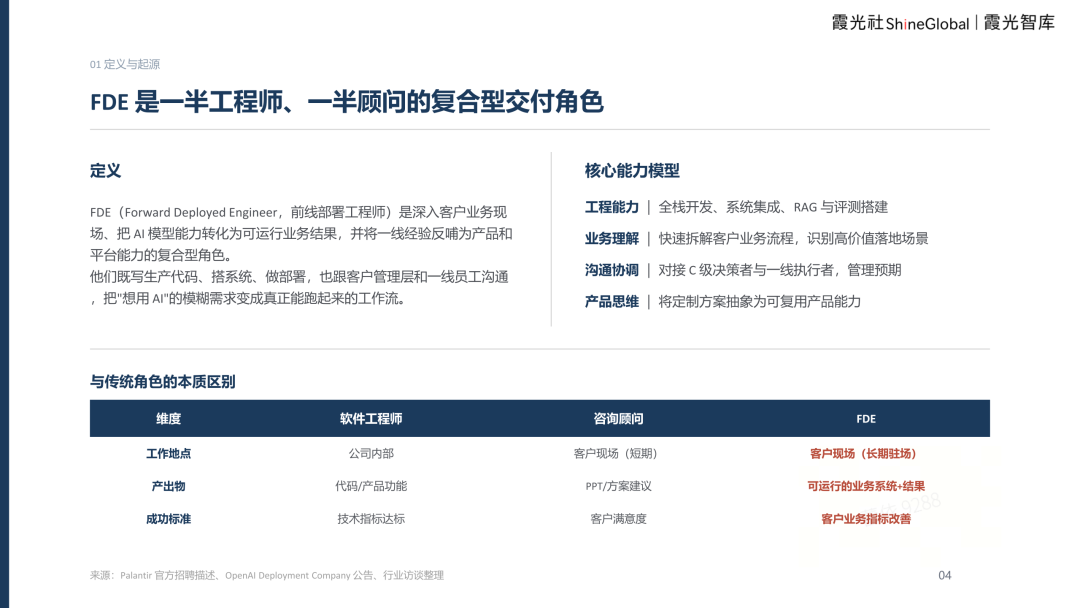
FDE (Forward Deployed Engineer) can be simply defined as someone who works long-term on-site in customers' businesses, converting AI model capabilities into runnable business results, and feeding frontline practical experience back into the product platform.
Core competencies include: engineering skills (full-stack development, RAG building, system integration), business decomposition ability, cross-level communication and coordination, and product abstraction thinking. An FDE can both write production code for deployment and understand management strategy, as well as grasp the real pain points of frontline employees — turning a customer's vague vision of "wanting to use AI" into a workflow that runs stably.

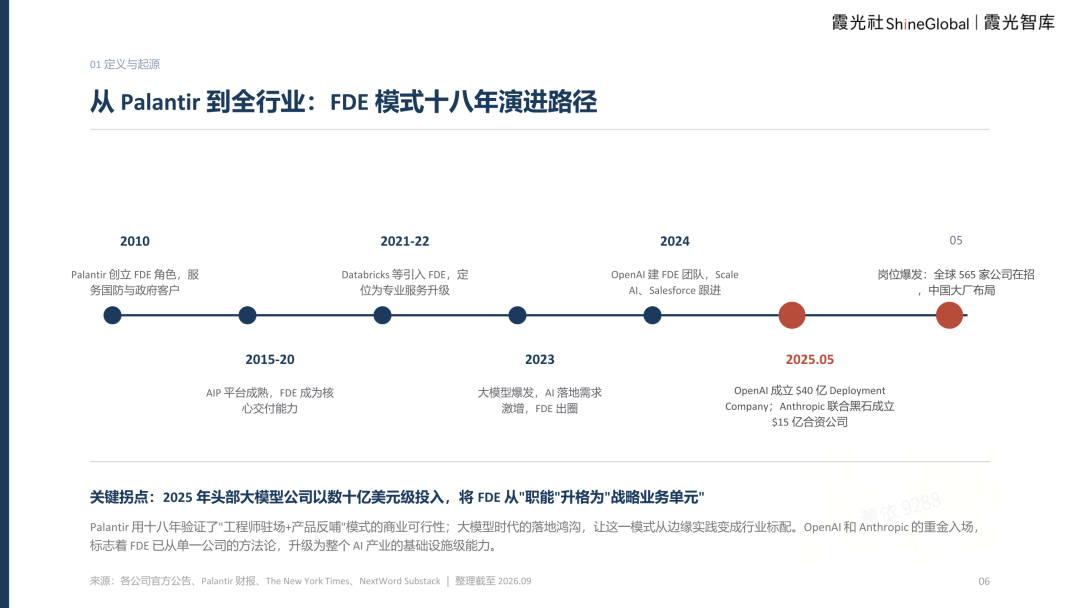
Tracing the development of the FDE: in 2010, Palantir first created the role to serve government and defense clients; in 2023, the explosion of large models and surging demand for AI deployment brought FDEs into the spotlight; 2025 became a key inflection point, with OpenAI investing $4 billion to establish a Deployment Company and Anthropic partnering with Blackstone on a $1.5 billion joint venture, upgrading FDE from a functional role to a strategic business unit.
From Palantir's internal weapon, to a strategic unit heavily backed by OpenAI and Anthropic, to ByteDance, Alibaba, and Tencent in China all racing to build it out, the FDE has evolved from a niche role into an infrastructure-level capability of the AI industry.
02. Job Postings Surge 729%, Global Seller's Market for Talent
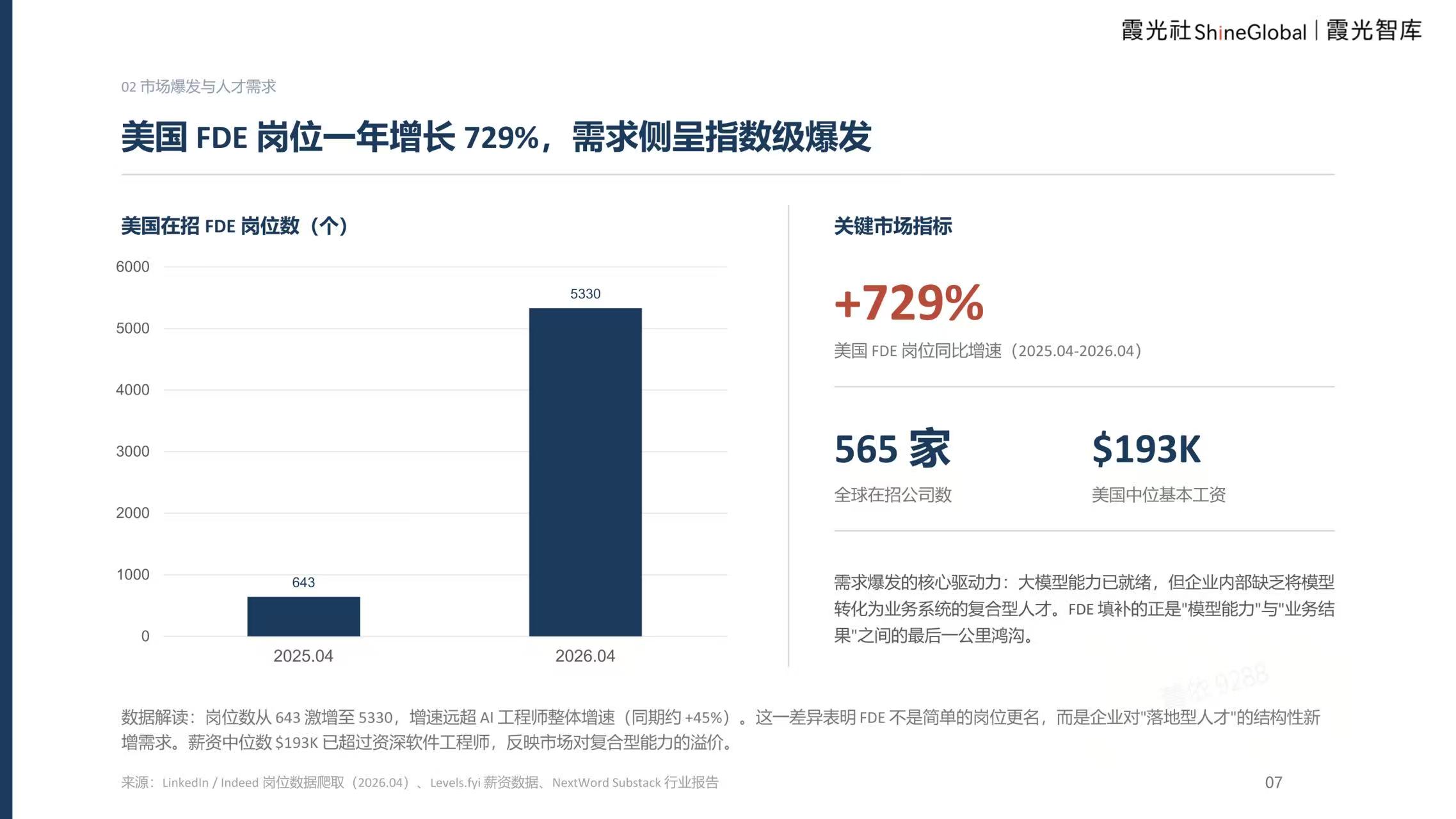
The rigid demand for AI deployment has directly ignited the FDE talent market. Data shows that FDE job postings in the US surged from 643 in April 2025 to 5,330 in April 2026, a year-over-year increase of 729%, far outpacing the 45% overall growth rate of AI engineers over the same period.
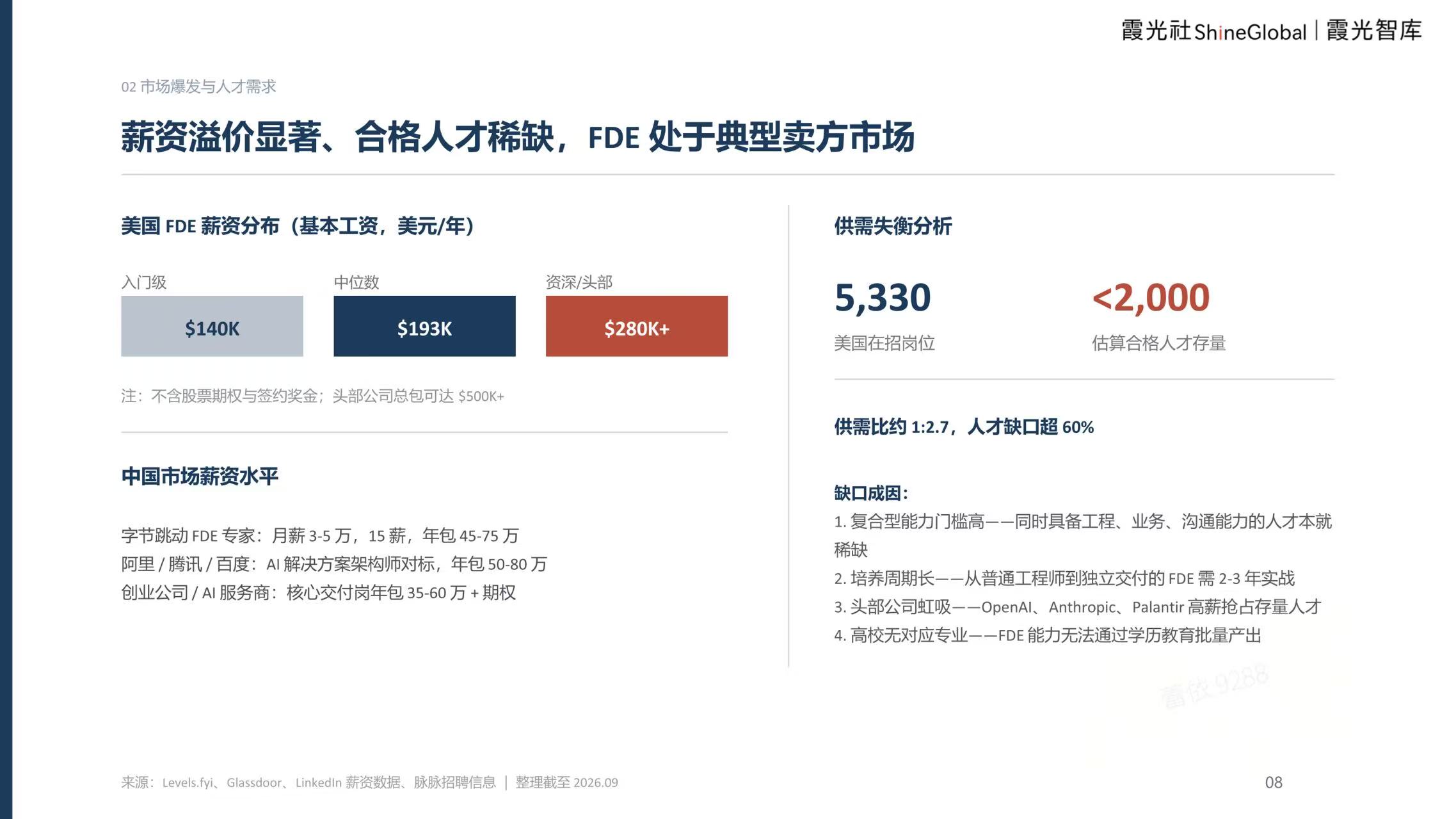
Globally, 565 companies have opened FDE-related hiring, yet talent supply is severely insufficient: the US market has 5,330 open positions but fewer than 2,000 qualified candidates, a supply-demand ratio of about 1:2.7, with a talent gap of over 60%.
Salary levels directly reflect the market premium:
US market: entry-level base salary of $140,000, median of $193,000, senior roles at $280,000+ per year, and total packages at top companies can reach $500,000+ (excluding options and bonuses);
Domestic market: ByteDance FDE experts earn a monthly salary of 350k RMB with 15 months' pay, an annual package of 450–750k RMB; comparable roles at Alibaba and Tencent offer annual packages of 500–800k RMB; core delivery roles at AI startups offer 350–600k RMB plus options.
03. Three Business Models — Who Has Achieved a Closed Business Loop?
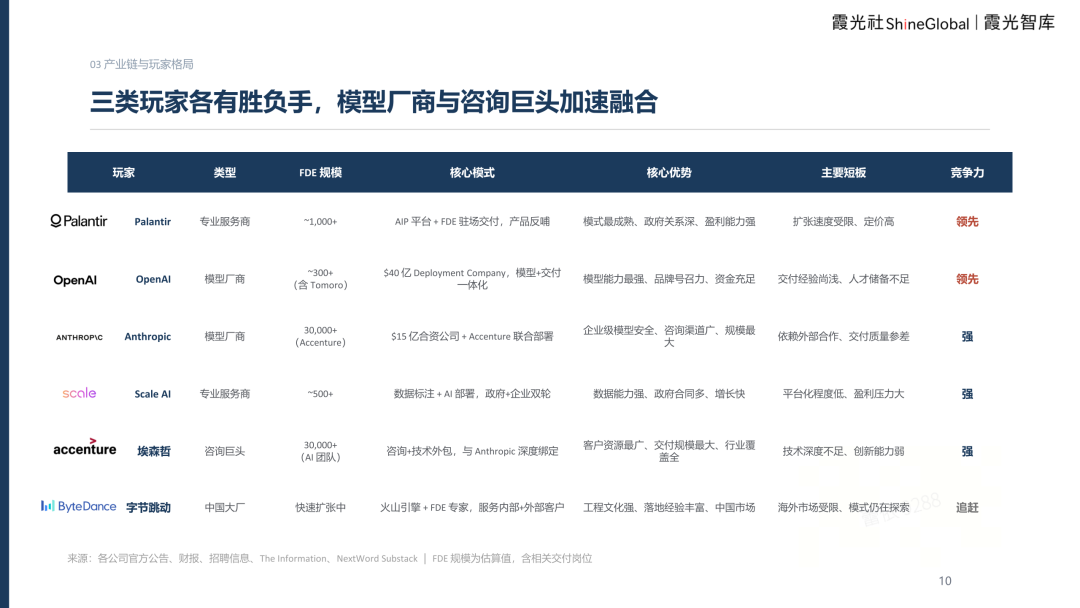
The global FDE track currently consists of three major player camps: professional service providers, large model vendors, and traditional consulting giants, each with distinct strengths and weaknesses in their approaches.
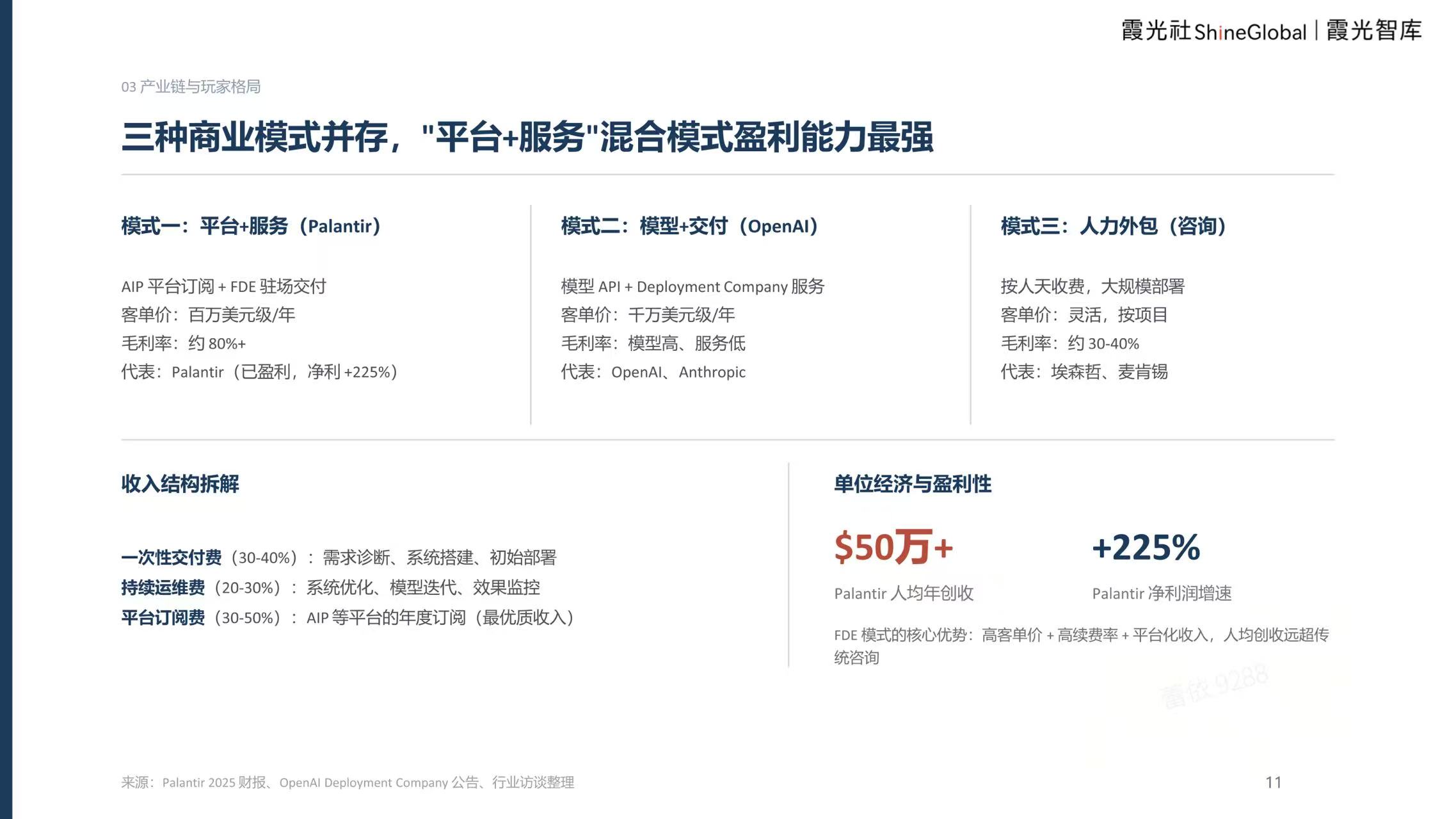
The profitability of the three business models differs greatly:
Platform + services model (Palantir): platform subscription plus on-site FDE delivery, with annual customer contracts in the millions of dollars, gross margin above 80%, and net profit growth of 225% — the profitable closed loop has been fully validated. Revenue consists of three parts: one-time delivery fees, operations and maintenance fees, and platform subscription fees, with subscriptions being the highest-quality recurring revenue.
Model + delivery model (OpenAI/Anthropic): model APIs combined with on-site deployment services, with contracts reaching the tens of millions of dollars. The models themselves have high gross margins, but the labor-intensive delivery component drags down overall returns.
Labor outsourcing model (traditional consulting): billed by person-day, with gross margins of only 30–40%. It easily falls into linear expansion of headcount and struggles to build a product reuse moat (P11).
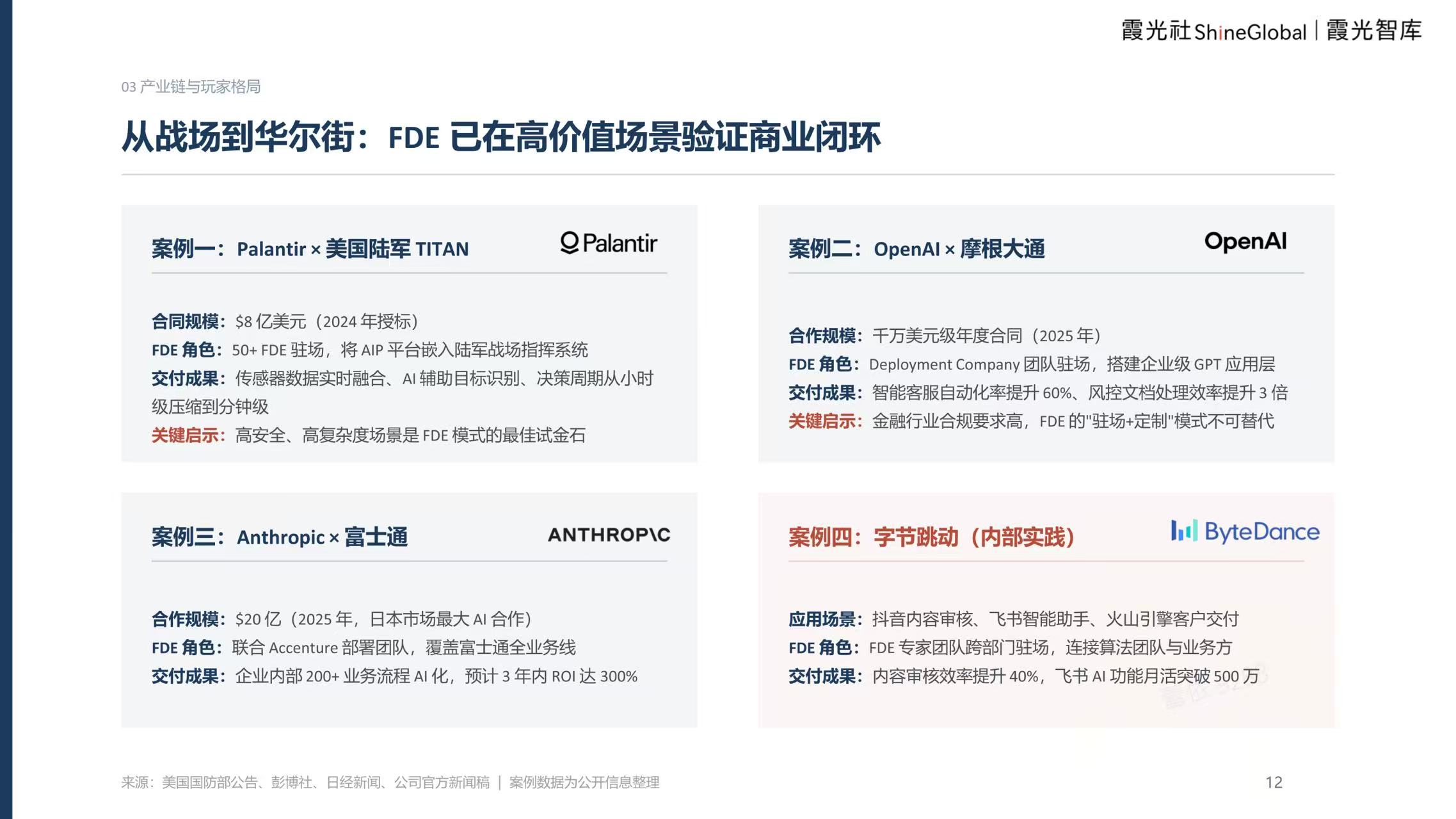
Real-world deployment cases prove that FDEs are irreplaceable in high-value scenarios: Palantir holds an $800 million contract with the US Army, with 50+ FDEs on site, compressing battlefield decision cycles from hours to minutes; OpenAI's FDE team served JPMorgan Chase, raising intelligent customer service automation by 60% and risk-control document processing efficiency by 3x; ByteDance internally relies on FDEs embedded across departments, improving content moderation efficiency by 40%.
04. Tech Giants Accelerate Their Moves, but the Industry Is Still in Its Early Stages
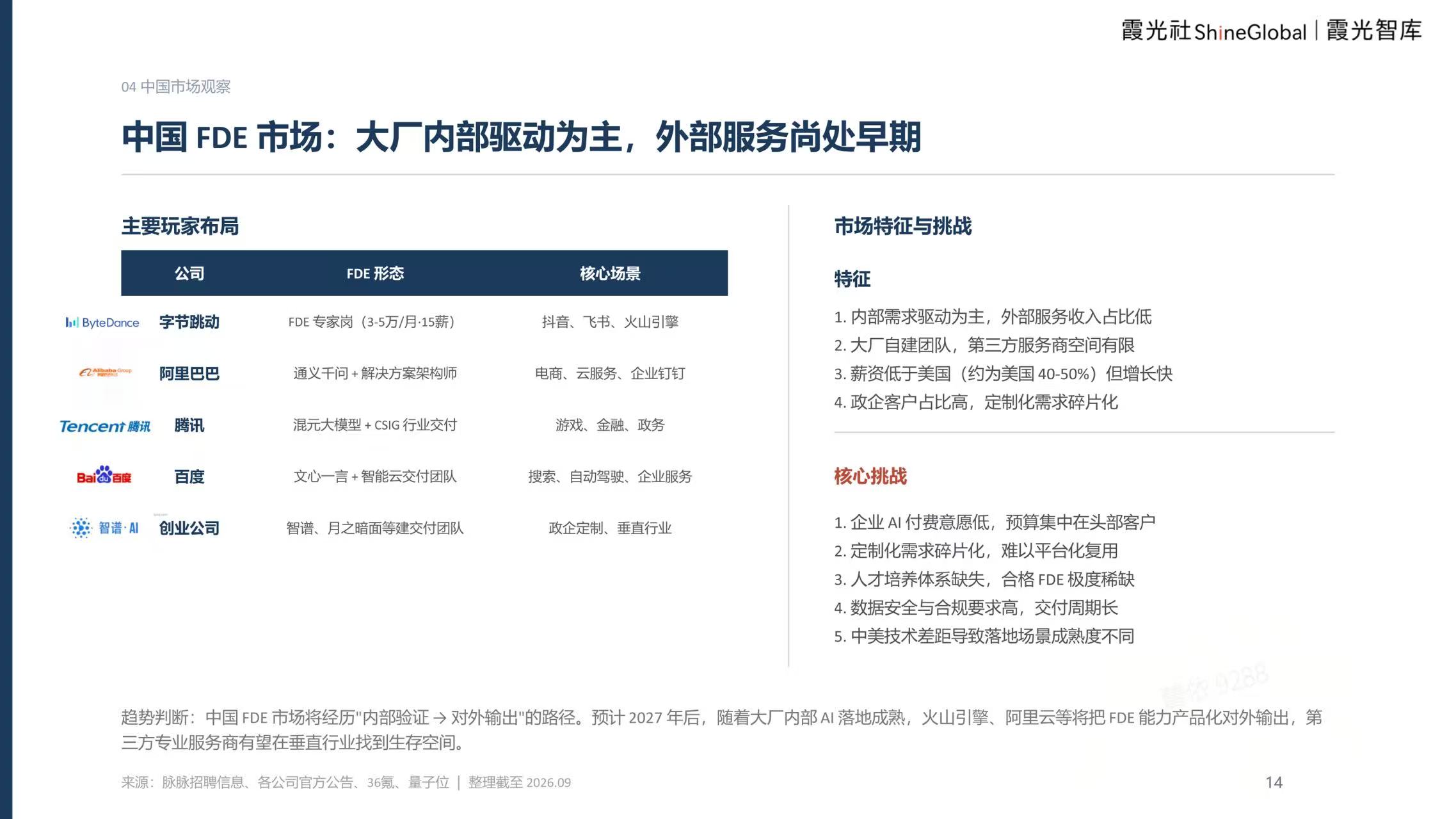
Domestic FDE is still in an exploratory phase, driven mainly by internal demand at large tech companies, with external commercial services not yet mature.
Leading companies such as ByteDance, Alibaba, Tencent, and Baidu have already built FDE-like delivery teams: ByteDance relies on Volcano Engine, supporting Douyin and Feishu internally while serving enterprise clients externally; Alibaba relies on Tongyi Qianwen and DingTalk; Tencent leverages the Hunyuan large model to deepen its presence in finance and government; AI startups like Zhipu and Moonshot AI have also formed delivery teams to take on customized government and enterprise projects.
But the domestic market faces multiple practical challenges: enterprise AI spending is concentrated among a few top clients, with limited willingness to pay among most enterprises; government and enterprise customization needs are highly fragmented, making platform-based reuse difficult; a complete talent development system is lacking; and strict data compliance requirements lengthen delivery cycles.
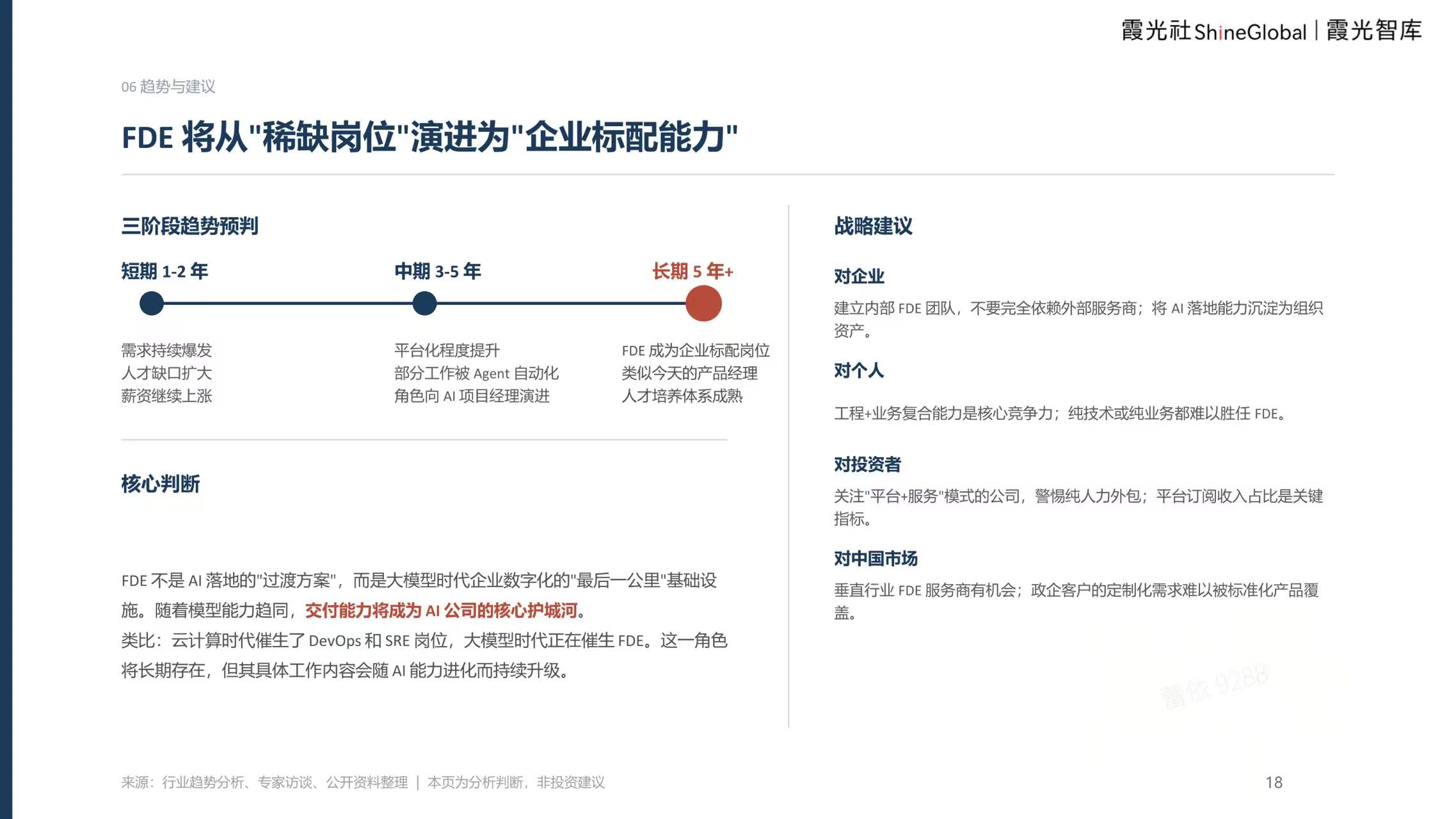
It is expected that after 2027, as large companies' internal AI deployment experience matures, cloud vendors will productize their FDE capabilities for external output, and third-party service providers in vertical industries will also find survival opportunities.
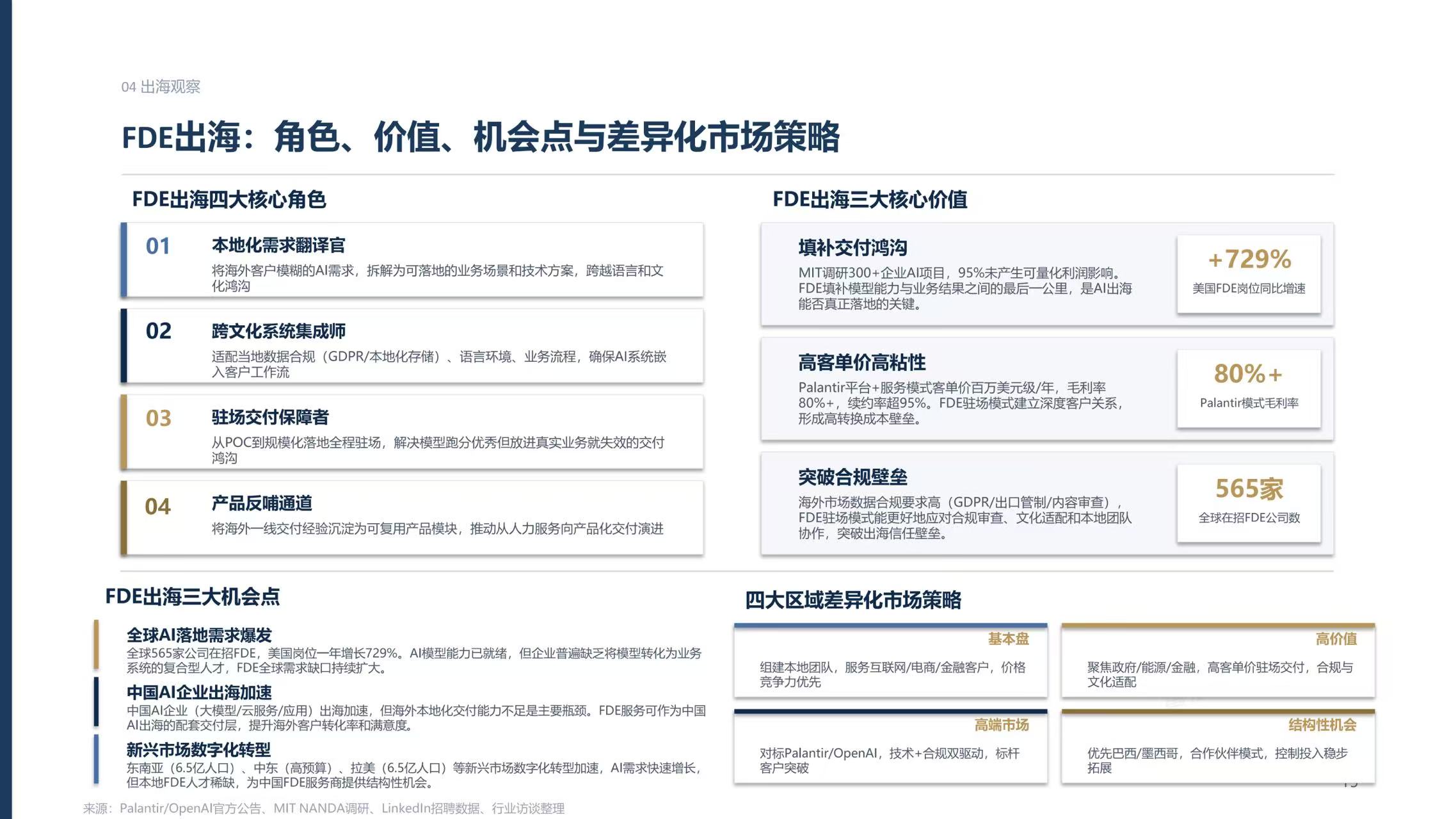
Also worth noting is the strategic value of FDEs for China's AI going global. As Chinese large models and AI applications expand overseas, the biggest bottleneck is often not model performance but localized delivery. FDEs play four roles in going global: translator of localized requirements, cross-cultural system integrator, on-site delivery guarantor, and product feedback channel — solving pain points such as language and culture, GDPR compliance, and business process adaptation.
Different regions call for differentiated strategies: in Southeast Asia, prioritize price competitiveness; in the Middle East, focus on high-contract-value government and enterprise energy projects; in Europe and the US, break through with flagship clients, driven by both technology and compliance; in Latin America, adopt a partner model for steady expansion.
05. Is the FDE a Transitional Solution or a Long-Term Standard?
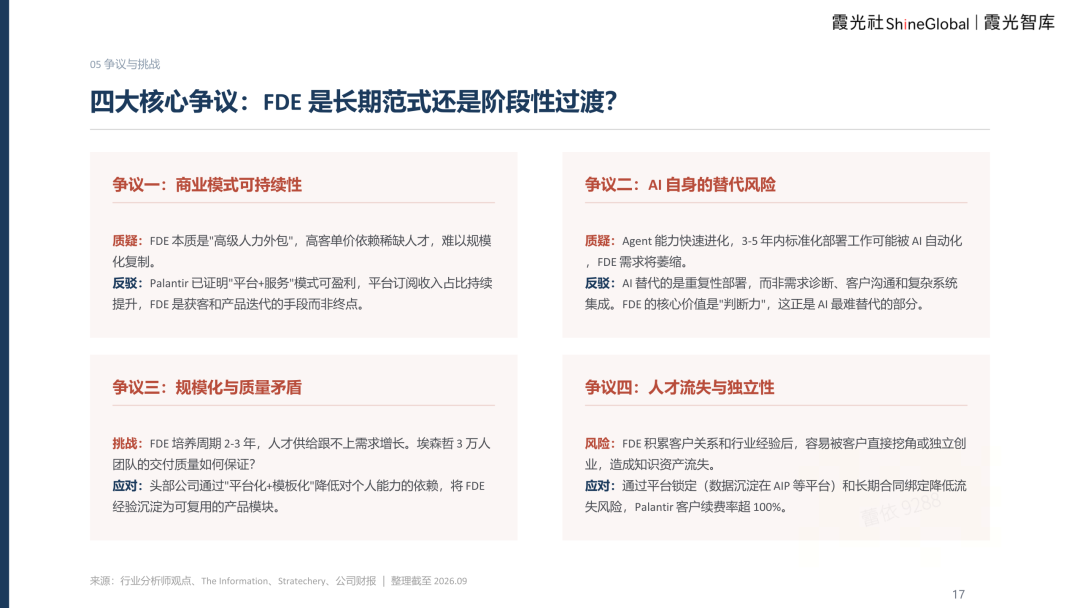
Four core controversies have long existed in the industry: Is the FDE just high-end labor outsourcing? Will it be replaced by AI agents in the future? How can delivery quality be guaranteed during large-scale expansion? How can the risk of talent loss taking client resources with them be addressed?
The report offers its core judgments:
1. FDE does not equal labor outsourcing. Palantir has proven the "platform + services" model is viable — the ultimate purpose of on-site delivery is to accumulate platform capabilities, not to endlessly expand headcount;
2. AI agents can only replace standardized, repetitive deployment work, but diagnosing customer needs, complex system integration, and business judgment are core values that AI can hardly replace;
3. Reducing dependence on individual talent through templated, platform-based accumulation is the key solution for scaling;
4. Mitigate the risk of client loss from talent turnover through platform assets and long-term contracts.
Just as the cloud computing era gave rise to the SRE and DevOps roles, the large model era is giving rise to the FDE. It is not a temporary transitional solution for AI deployment, but the last-mile infrastructure of digitalization. As the performance of large models gradually converges, delivery and deployment capability will become the most core moat for AI companies.