This article comes from the WeChat public account: TOP Innovation District Research Institute, author: Innovation District Research Team, header image: AI-generated
On August 27, the General Office of the Ministry of Industry and Information Technology issued a notice, document number MIIT Office Science Letter [2026] No. 414, which was made public on August 31.
It has a rather long name: "Notice on Launching the Special Action for Cultivating AI Application Service Providers."

Documents like this are usually never read closely, yet they are actually quite important, so we read it for you—and found that at the end of the fourth task item, there is a very important sentence hidden: "Encourage service providers to build Forward Deployed Engineer (FDE) teams, rooted at users' sites, to ensure scenario implementation."
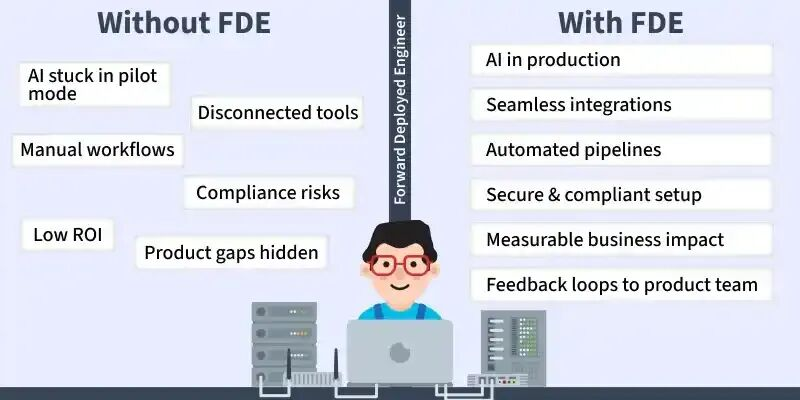
FDE, Forward Deployed Engineer.
These three letters are not a Chinese-made term; they come from an internal job title at Palantir. Think about it: the badge title of an American defense contractor (one that is not exactly friendly to China) appearing in a red-header document from a Chinese ministry does indeed say something.
AI is very hot right now, but there are also many problems. The MIIT's diagnosis of the current situation: unclear resource baselines, uneven delivery quality, broken commercial loops, and an underdeveloped service ecosystem.
For example, "broken commercial loop" means the work is getting done, but the people doing it aren't making money.
In fact, at this stage, the bottleneck for AI implementation has shifted from models to people.
I. The 5% Success Rate
MIT's Project NANDA conducted a study analyzing over 300 publicly documented enterprise AI deployment cases, 52 executive interviews, and 153 surveys.
The conclusion: 95% of generative AI pilots produced no measurable P&L impact.
Only 5% of integrated systems created significant value.
And the corresponding investment was $30–40 billion.
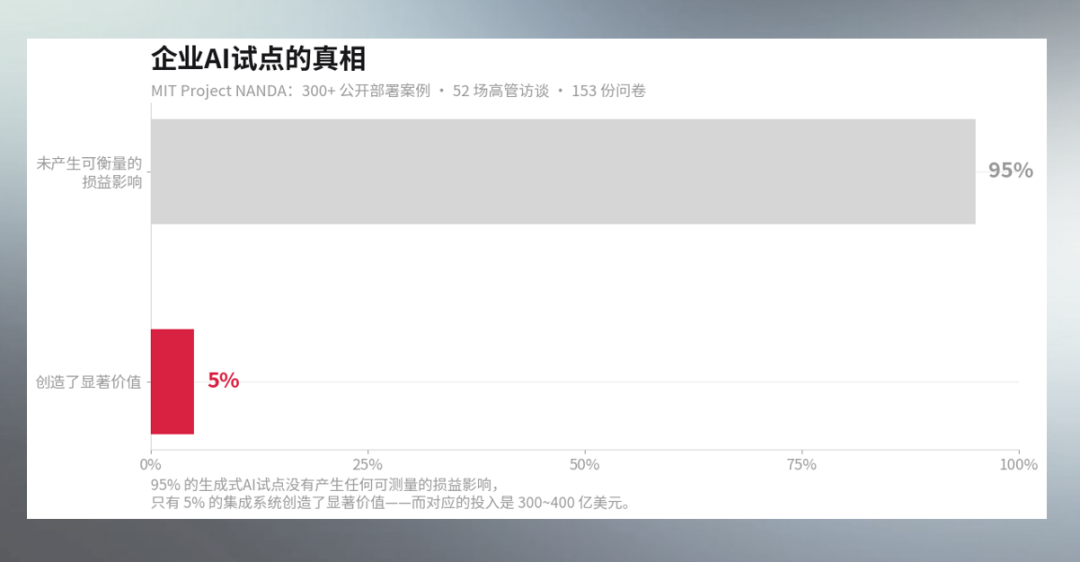
But the point is not that only 5% succeed—the point is why they fail.
The failure is not that the models are inadequate; the models are excellent. The problem lies in the "learning gap"—general-purpose tools are especially useful for individuals because they are flexible; but once they enter an enterprise, they get stuck, because they don't learn your workflows and don't adapt to your processes.
Here's an analogy.
Over the past two years, enterprises around the world collectively bought a gym membership. The card is real, the gym is real, all the equipment is brand new, and the trainers can speak eight languages.
The only problem is that it's very inconvenient for you to get there each time, and every time you go in, you have to speak the trainer's foreign language.
This is the "last mile" problem.
In the State Council's August 2025 "Opinions on Deeply Implementing the 'AI+' Initiative," the official interpretation states in black and white: application implementation faces "last mile" obstacles.
It was also that "Opinions" document that first proposed "cultivating AI application service providers" and "building an AI application service chain."
The MIIT's special action this time is the first construction blueprint for putting those words into practice.
II. China's Average of 5.11 Million
Let's do some math on China's own numbers.
Third-party statistics show that in 2025, 7,539 large-model-related bid-winning projects were recorded domestically, of which 5,779 disclosed their amounts, totaling 29.52 billion yuan.
The number of projects grew 396% compared to 2024.
By a rough calculation based on disclosed figures, the average large-model project was worth about 5.11 million yuan.
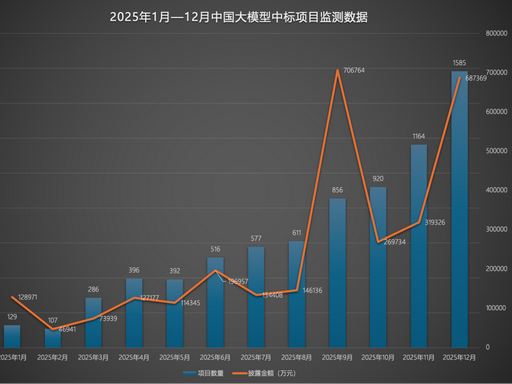
What can 5.11 million buy?
In a first-tier city, it's roughly the cost of a 15-person team working for six months—not counting travel, rework, or the client changing requirements three times. And after finishing that project, what do you have left that you could sell to the next client?
Most likely, nothing. That's the "broken commercial loop."
Here's another data point: in the first half of 2026, 2,770 application-type large-model bid-winning projects spanned more than 20 industries, with about 73% concentrated in five sectors: government affairs, telecommunications, education/science, energy, and finance. About a quarter of the project names included the word "agent."
Among the top ten vendors, three are state-owned enterprises with telecom operator backgrounds—they win projects in the role of "general integrator."
Now let's cross-reference: as of March 2026, domestic daily token usage exceeded 140 trillion, a more than thousandfold increase since early 2024.
But China's AI professional services market for all of 2025 only just surpassed $4 billion, growing only fourfold.
The model layer is riding a rocket.
The services layer is still laboriously riding a bicycle.

III. Understanding Palantir's FDE
Since the document mentions FDE, let's take a proper look at Palantir's FDE.
In the early 2000s, Palantir ran into a problem no other software company had ever faced: its customers were intelligence agencies.
These customers couldn't articulate what they wanted, couldn't show you their data, and their workflows changed daily.
The traditional software approach of "gather requirements—design a solution—deliver a product" simply failed here.
They realized that when facing sufficiently complex new problems, customers often need to see something running first before they know what they actually want.
So product discovery cannot be done at headquarters; it must be done on-site.
At the time, only two types of people were available:
One was consultants, who could understand the business but couldn't write production code;
The other was sales engineers, who could write code but couldn't change the product.
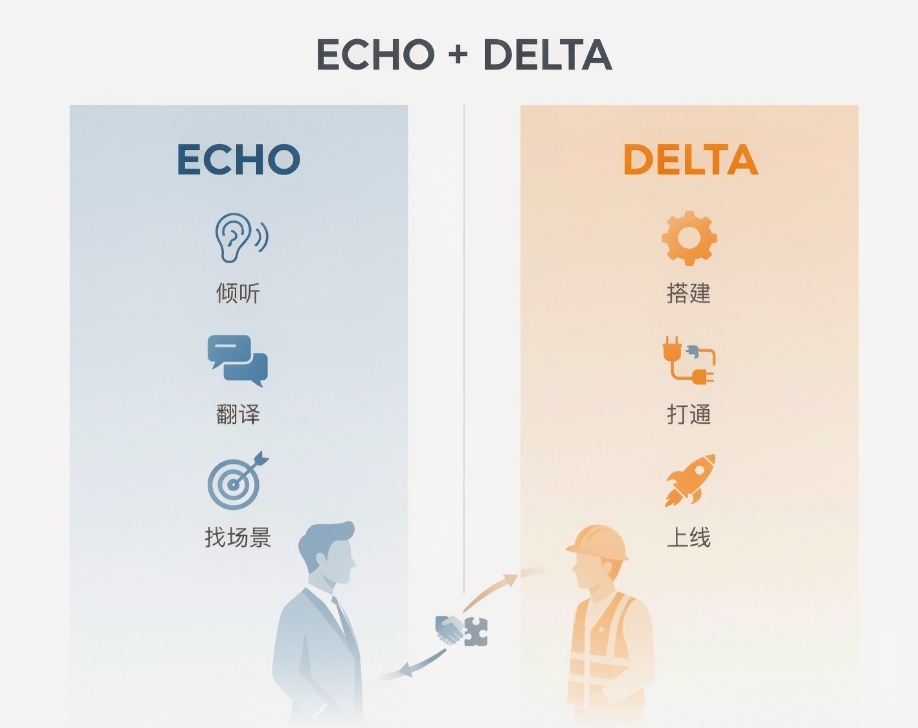
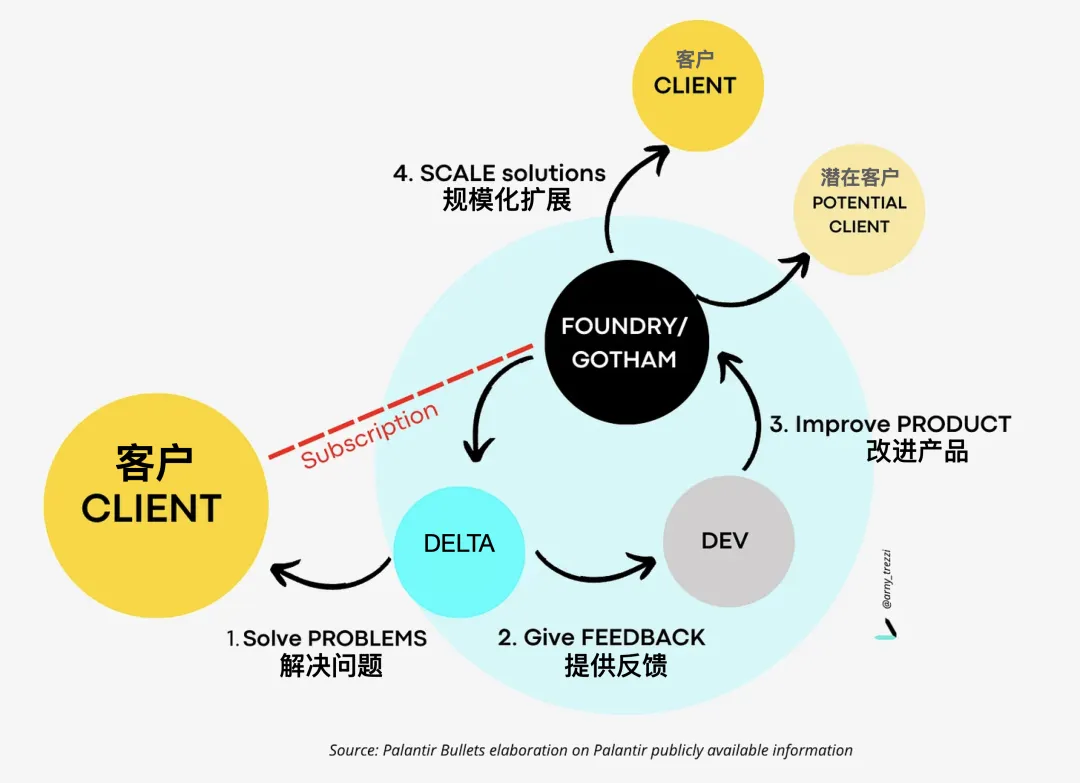
Palantir's solution was to embed engineers directly inside client organizations—internally called Delta.
For a full decade, Palantir had more Delta personnel than product engineers.
There's an organizational design detail here: a Delta is always paired with an Echo—a Deployment Strategist, a role specifically responsible for adoption, politics, and executive alignment.
Because the technical "last mile" is getting the model to run, while the organizational "last mile" is getting the client's leadership to sign off—two completely different problems requiring two different talents, so they need to be staffed separately.
It's a bit like our regiment commander and political commissar working as a team.
Even more worth learning from: the FDE's job is not to do custom work for clients indefinitely. Their real responsibility is to identify recurring patterns from one site after another, then abstract them into platform capabilities.
Palantir's ontology, object model, permission system, and data lineage were all dug out of the mud like this and then encoded into the product.
The essence of the Palantir model is that capability accumulation flows back into the product, making the next deal cheaper.
Someone online has already summarized it:
- Finish a project and leave the client with just one system—that's outsourcing;
- Bring back some experience but with no reusability—that's project-based delivery;
- Distill industry-general experience into templates and product capabilities—that's what makes an FDE;
- After that distillation, the delivery cost for the next similar client drops significantly—that's a scalable FDE.
Consulting firms sell the same billable hours twice; FDEs turn billable hours into product.
IV. America's Bet
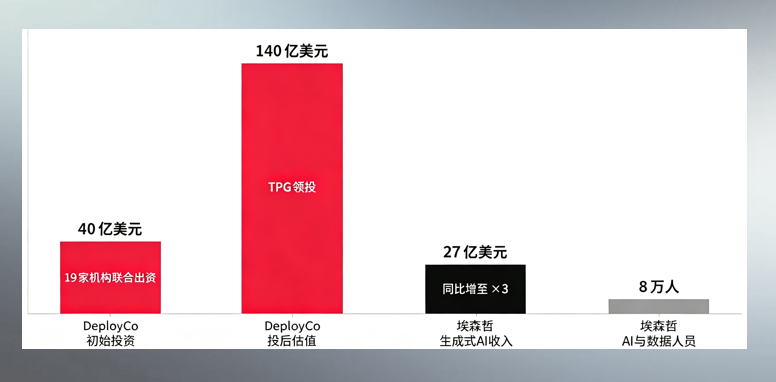
On May 11, 2026, OpenAI founded an independent company called DeployCo.

It launched with over $4 billion in investment, a post-money valuation of $14 billion, funded jointly by 19 global institutions, led by TPG, with Advent, Bain Capital, and Brookfield as co-leads.
The investor list also includes—McKinsey, Bain & Company, and Capgemini.
These three are the global first tier of consulting and systems integration, and DeployCo's business model is essentially using engineers plus language models to do what they are currently doing—but cheaper.
It's as if the carriage-makers' guild collectively bought shares in Ford Motor Company.
One analysis put it bluntly: just look at the capital structure and you'll understand—this company doesn't look like an OpenAI subsidiary at all; it looks like Accenture.
And what about the real Accenture?
Accenture's generative AI-related revenue tripled to $2.7 billion in fiscal 2025, with bookings nearly doubling to $5.9 billion. In Q1 of fiscal 2026, advanced AI bookings reached $2.2 billion, doubling again year over year, and AI & Data professionals reached 80,000.
Then the company announced: it would no longer disclose this figure separately.
The reason: AI has already permeated almost everything we do.
V. China's Bet
America's answer is a company.
China's answer is a list.
In 2023, the Ministry of Finance and the MIIT launched small and medium-sized enterprise digital transformation city pilots. The approach was: market-based open selection of digital service providers, having providers develop and integrate "small, fast, lightweight, precise" products for enterprises to voluntarily choose from, then creating models and replicating and scaling them.
Those four characters—"small, fast, lightweight, precise"—were carried over verbatim into this AI service provider document. It's a set of proven administrative tools, just applied to a new track.
The new document also includes a design called "AI Application Service Teams": each team is led by one service provider with no fewer than two upstream and downstream partner organizations participating, and each region is in principle required to submit no fewer than 10.
This is essentially using administrative power to forcibly assemble Palantir's Delta + Echo.
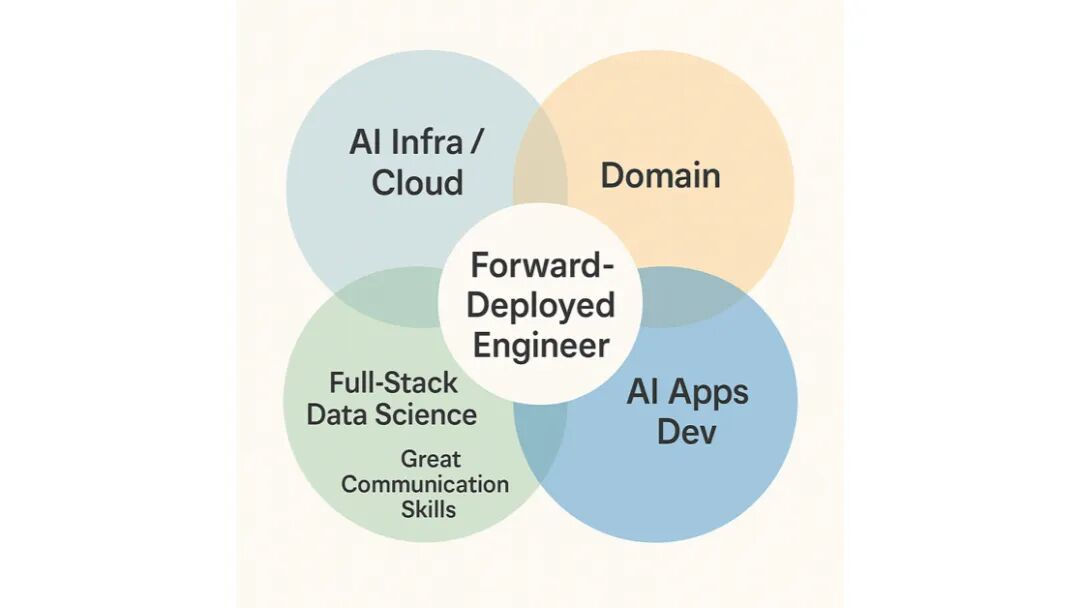
Because in China, very few companies possess all three things at once: model capability, industry know-how, and delivery capability.
Since no single company can pull it all together, three companies form a team.
Shanghai is leading the way.
On November 29, 2025, Shanghai held the first FDE (Forward Deployed Engineer) specialized training program. It then launched the "Hundred-Thousand-Ten-Thousand" initiative: connecting a hundred enterprises, building a thousand AI agents, and driving ten thousand developers through career transition, while establishing an FDE talent reserve of over a thousand engineers.
The incentive system has also been set up: FDE training is tied to intermediate professional title certification from the human resources and social security authorities.
And the evaluation system is already growing rapidly.
The CAICT's AI agent application development service capability standard has already divided vendors into five tiers: Foundational, Enhanced, Excellent, Leading, and Exemplary. The enterprise AI service capability maturity model assessment, led by an institution directly under the Ministry of Industry and Information Technology, has also been rolled out nationwide.
Of course, under these incentives, the first thing to grow may well be an industry dedicated to evaluating delivery capability.
The organizational problem also has to be considered.
Palantir's model works because of an entire organizational system behind it—a flat structure that eliminates internal competition, autonomous task-based teams organized around problems rather than functions, and that feedback loop that turns on-the-ground pain points into platform capabilities.
Without that system, rushing to hire a team of FDEs gets you nothing more than embedded consultants.
But viewed from another angle, this may not be a bad thing.
Because embedded consultants are precisely the scarcest role right now.
Where Chinese companies are stuck today is mostly not "lacking reusable platform capabilities"—it's that no one has sat down in the workshop and run a single thing end to end.
First people go down into the field; then you talk about consolidation. The order is not reversed.
More importantly, anything transplanted from the outside, once it grows in Chinese soil, will eventually grow into its own form.
Township and village enterprises are not a corporate form found in any textbook, and the industrial organization of solar PV and electric vehicles was not copied from Germany or Japan.
FDE will most likely be the same. When it arrives, it's called Forward Deployed Engineer; a few years later, whatever grows out of it may no longer look much like Palantir—but it will likely be far better suited to the clients here, the payment terms here, and the people here.
VI. The Map of Localities
Finally, one last practical point for cities and industrial parks.
FDE is a profession that must be on-site.
He doesn't sit at headquarters writing code; he needs to sit in the meeting rooms of factories, banks, and hospitals.
So the geographic distribution of this kind of capability will be forced to hug the industries, not the model companies.
At the 2025 World AI Conference, Shanghai disclosed that its AI talent pool had reached nearly 300,000 people, roughly one-third of the national total. But factories, power grids, hospitals, and ports—the vast majority are not in Shanghai.
The geographic mismatch between supply and demand starts right here.
There's another line in the document: organize the opening up of a batch of real-world scenarios.
Before this, "scenarios" was an adjective in investment-attraction pitch decks; under this mechanism, scenarios become, for the first time, an asset that can be traded—because what service providers truly lack is not compute, not models, but a place where they can run their solution once and be allowed to fail while running it.
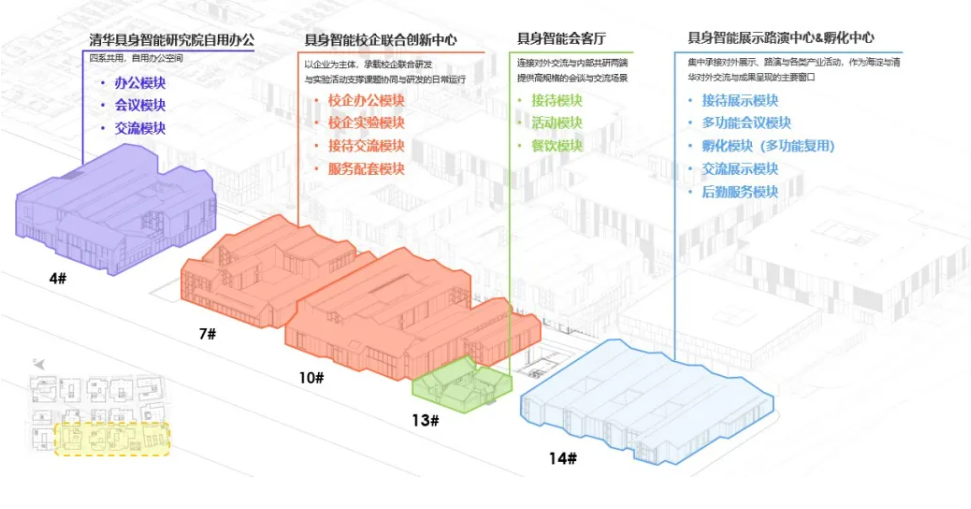
Accompanying this, pilot-testing bases and incubators have been explicitly written into the document as the foundational conditions for service providers' R&D, testing and validation, and pilot maturation.
The role of industrial parks is shifting from "providing space" to "providing validation conditions."
VII. The Wager in the AI Crevice
Historically, every time a new profession was invented, the signal was the same.
After the steam engine came mechanical engineers; after electricity came electrical engineers; after ERP came implementation consultants; after cloud computing came SREs.
Each time, it wasn't because the technology was inadequate—it was precisely because the technology had become good enough—good enough that the bottleneck shifted from the machine to the human.
This time is the same: models are no longer the problem.
Open-source models have become so strong that many tendering parties only need to buy compute; everything else is the dirty, exhausting work of integration, data, processes, and compliance.
But this time is also a little different.
The very reason the FDE profession exists is that models are still not good enough at landing themselves.
It is a gap-filling profession—and gaps change.
If models keep getting stronger—strong enough to read codebases on their own, connect systems on their own, run validation on their own, write delivery documentation on their own—then how long is the window for this profession that was just named by two great powers at the same time?
No one knows the answer.
But both sides have already placed their bets.
America is betting on compounding: one company, a group of engineers, turning every field experience into product, betting that it will roll and grow.
China is betting on scale: three thousand service providers, one set of standards, one professional title track, betting that a sea of people can flatten that last mile.
And the shared premise of both bets is: this gap will persist for at least another five to ten years.