The AI implementation deadlock gives rise to a new role, the FDE: opportunity or transition?
The Forward Deployed Engineer (FDE), a role that lay dormant for 20 years, is experiencing explosive growth in the AI era. From Palantir's secret weapon to a standard fixture at OpenAI and Anthropic, why has the FDE become a scarce resource that global AI giants are scrambling for? This article takes a deep dive into how this mysterious profession, with salaries reaching 3.5 million RMB a year, solves the "last mile" problem of AI implementation, and what the industry's predicament and window of opportunity behind it reveal.
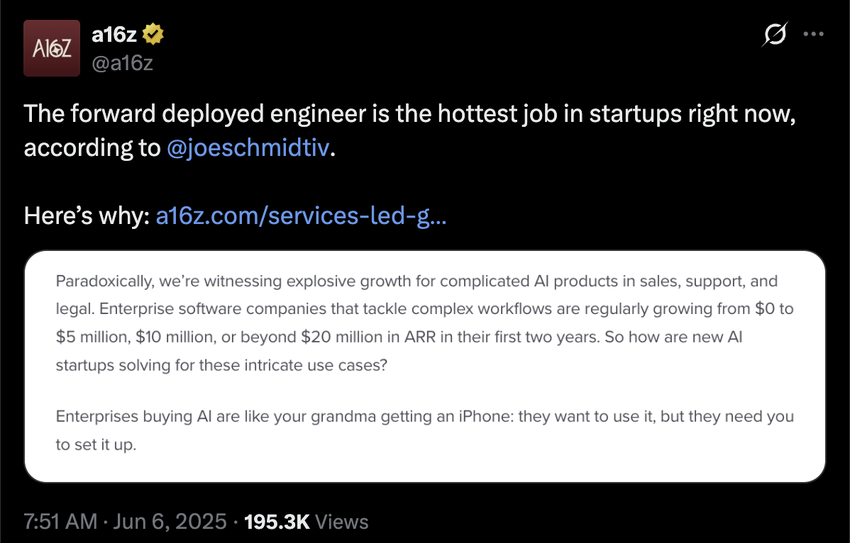
Last June, a16z posted a tweet with a striking line:
The forward deployed engineer is the hottest job in startups right now.
At the time, I glanced at it—FDE, three letters, just one letter off from FE (Front-end Engineer). I instinctively assumed it was some new variant of front-end work, didn't look closely, and scrolled past.
Later, those three letters started to seem off.
The Financial Times reported that the role had grown 800% in nine months. Pragmatic Engineer ran a full dedicated issue dissecting it. OpenAI announced the creation of a company valued at 14 billion dollars, specifically to house this group of people. Anthropic also teamed up with Blackstone and Goldman Sachs in a 1.5 billion dollar round.
This was no longer just a new title.
Then one day, while searching for AI-related jobs on Boss Zhipin, I scrolled through a long list of them, with salaries reaching as high as 100,000 RMB a month.
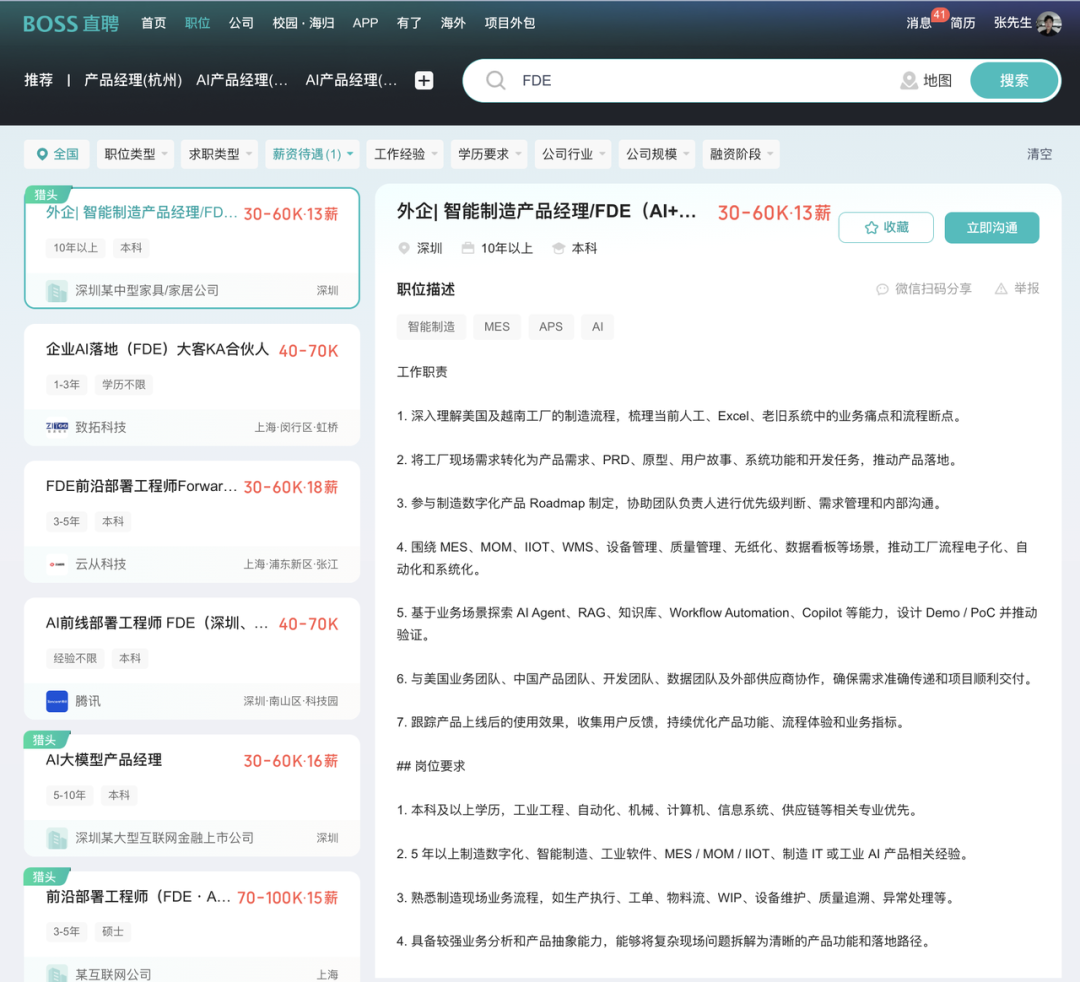
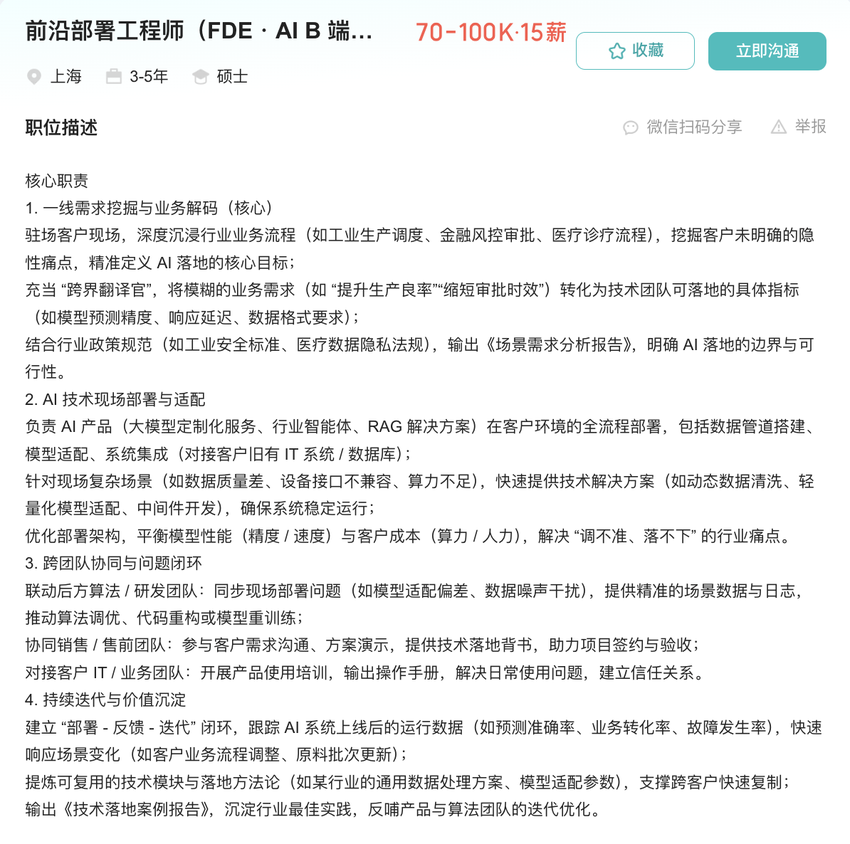
This wave has already reached China.
But the real reason I sat down to study it wasn't because it was hot—it was because after digging into it, I discovered: this role that looks like a brand-new invention of the AI era has actually existed for a full 20 years.
Why has a 20-year-old role suddenly become the job that global AI giants are lining up to fight over? What problem does it actually solve? And what does the very existence of that problem say about what stage the AI industry is in?
What exactly is an FDE
First, let's get the name straight.
The F is not for Frontend—it's for Forward. FDE stands for Forward Deployed Engineer. The term is borrowed from military jargon, originally referring to troops deployed at the front line.
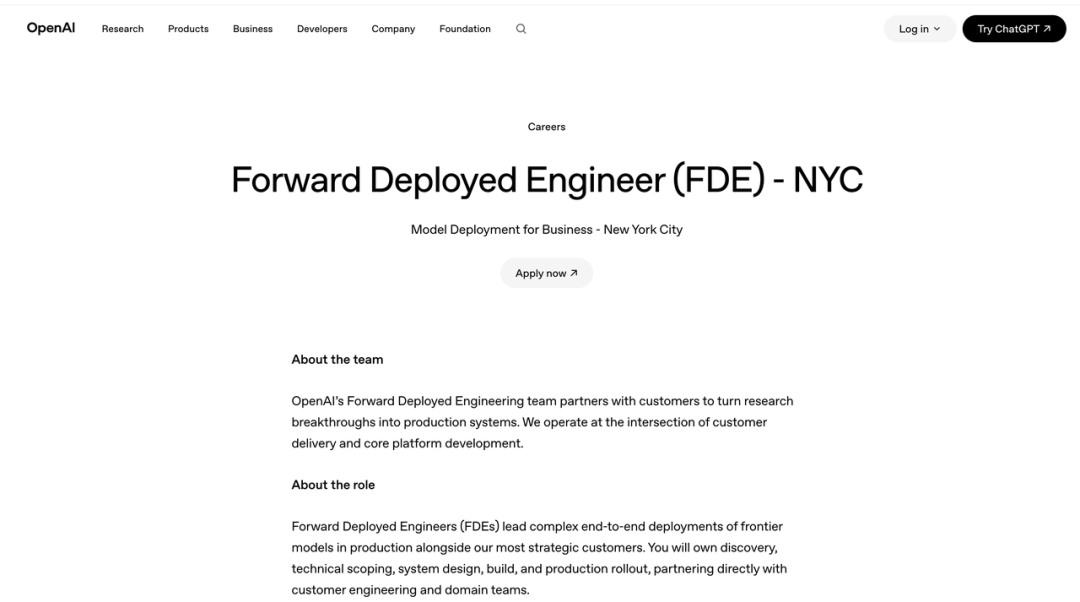
To sum up this role in one sentence: an engineer who moves into the customer's company with an AI model.
Note that "moves into" is not an exaggeration. FDEs literally set up shop in the client's office, join the client's Slack channels, get access to the client's internal network, plug into the client's actual production systems, and stay for anywhere from a few weeks to six months. This isn't the kind of involvement where you hop on a remote call to go over requirements—it's physical embedding.
Their work forms a complete four-step closed loop:
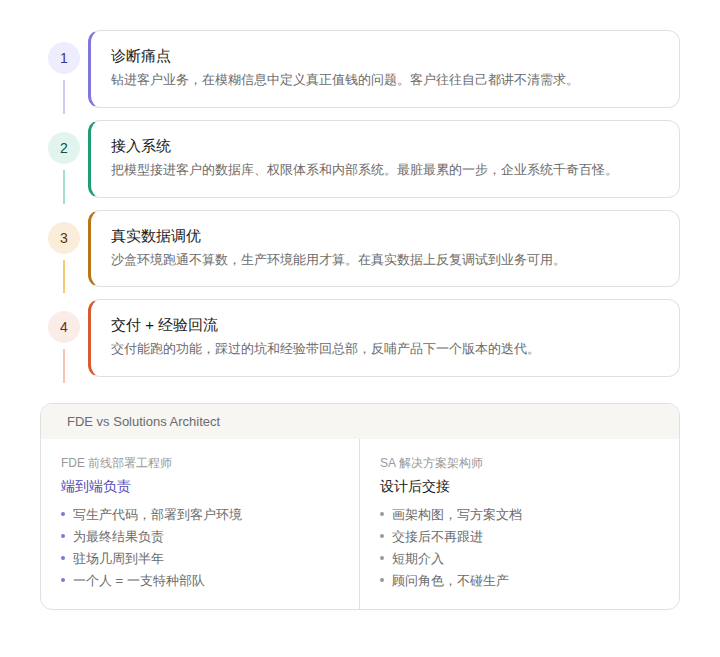
Here's my take:
First, the most valuable of the four steps are the first and the last. Diagnosing pain points tests not technical skill, but the ability to define the problem when information is extremely ambiguous. Anyone who has worked in to-B knows this is the hardest step in the entire chain. When a client says "I want to use AI to optimize some process," you have to figure out for yourself which process they mean, what "optimize" means, and what counts as "good." Experience flowing back is the essential difference between an FDE and outsourcing: outsourcers deliver and leave, while the pitfalls an FDE stumbles into become the product's next feature.
Second, in the lower half of the diagram comparing FDE and SA, the core difference comes down to one sentence: the SA draws the architecture diagram and hands it over, while the FDE writes the production code themselves, deploys it themselves, and takes responsibility when things break. From defining the problem on day one to responding when the system throws a bug six months later, one person carries it end to end.
There's a saying in the industry that captures it perfectly: one person is an entire special forces unit.
This also explains why salaries can reach this level. Overseas, the median FDE base salary is 210,000 dollars, with total compensation (TC) reaching 500,000 dollars—roughly 3.5 million RMB. In China, the current monthly salary is 30–50k, with a few individuals earning a million a year, but the job titles haven't even been standardized yet—some call it FDE, some call it AI implementation engineer, others on-site delivery engineer. The same work commands a 3-to-5x price gap between China and abroad.
In one sentence: the domestic market is still extremely early.
Why did a 20-year-old role suddenly catch fire today, of all times
You might assume the FDE is a new invention of the AI era.
It's not. The role was born around 2005, invented by a company called Palantir.
Palantir is Silicon Valley's most mysterious data company; its early clients were the CIA, the NSA, and other US intelligence agencies. Intelligence agencies' data is highly classified and their needs extremely vague—traditional software delivery simply couldn't work. You can't ask clients to send their data over, and you can't debug remotely. Even a simple demo requires weeks of security review and NDAs.
Palantir's solution was blunt: send engineers directly into the client's office, for a minimum of six months at a time.
This playbook was codenamed Delta inside Palantir. By 2016, Palantir's FDE headcount actually exceeded that of its traditional software engineers. Alumni who left Palantir went on to found over a hundred companies, including the voice synthesis company ElevenLabs—its co-founder Mati Staniszewski came out of Palantir's deployment strategist ranks.
The model was validated. But for the decade-plus that followed, the FDE remained a niche role, circulating only within the circles of Palantir and a handful of government contractors.
Until AI came along.
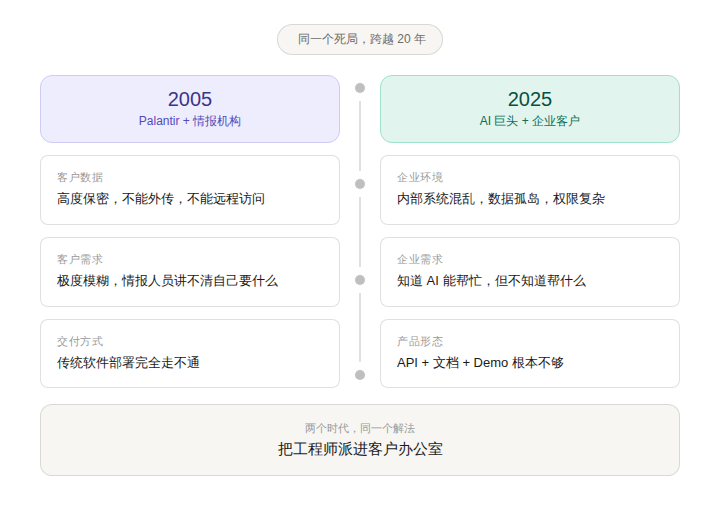
Put the predicaments of the two eras side by side and you'll find the structural similarities are absurdly high: can't touch the data, can't articulate the requirements, traditional delivery doesn't work. Twenty years later, a different industry, the exact same dead end.
An MIT study analyzed 300 enterprise AI deployment cases and reached a painful conclusion: 95% of AI pilots produced no measurable P&L impact.
A caveat on methodology: this figure comes from the MIT NANDA team's 2025 report, and its methodology is contested within the industry—some argue there are problems with the sample selection criteria and evaluation standards. But the core contradiction it points to is real: the problem isn't the models, it's implementation.
The GPT-4 series, the Claude series, the Gemini series—the models are already strong enough. But between a chat-capable API and a business function that actually runs inside an enterprise lies a huge chasm. Integrations don't get done, workflows can't be changed, data pipelines can't be connected, and no one inside the enterprise knows how to turn a model into an actually usable system.
The sentence clients say most often is: I know AI can help me do something, but I don't know what exactly.
a16z partner Joe Schmidt offered a precise analogy: enterprises buying AI is like your grandma getting a new iPhone—she wants to use it, but she needs you to set it up for her.
Product-led growth (PLG), which Silicon Valley believed in for over a decade, fails completely in enterprise AI. ChatGPT took PLG to its extreme—sign up and use it, pay with a credit card. But enterprise customers are not individual users. What enterprises want isn't a chat box, but a system that can plug into approval workflows, read internal databases, and run stably within compliance frameworks.
This kind of need can't be solved with documentation, APIs, or demos. Only with people.
And so the industry, after taking a long detour, circles back to the answer Palantir gave 20 years ago: send the engineers in.
In early 2025, OpenAI's Colin Jarvis proposed forming an FDE team internally, initially with just two people. In July of the same year, Oliver Jay, OpenAI's head of international business, officially announced it at the Fortune Brainstorm AI conference. Data from the Financial Times and Indeed shows that between January and September 2025, FDE job postings surged by more than 800%. Salesforce alone has committed to building a 1,000-person FDE team.
A role that had been dormant for over a decade has been reactivated by the difficulties of putting AI into practice.
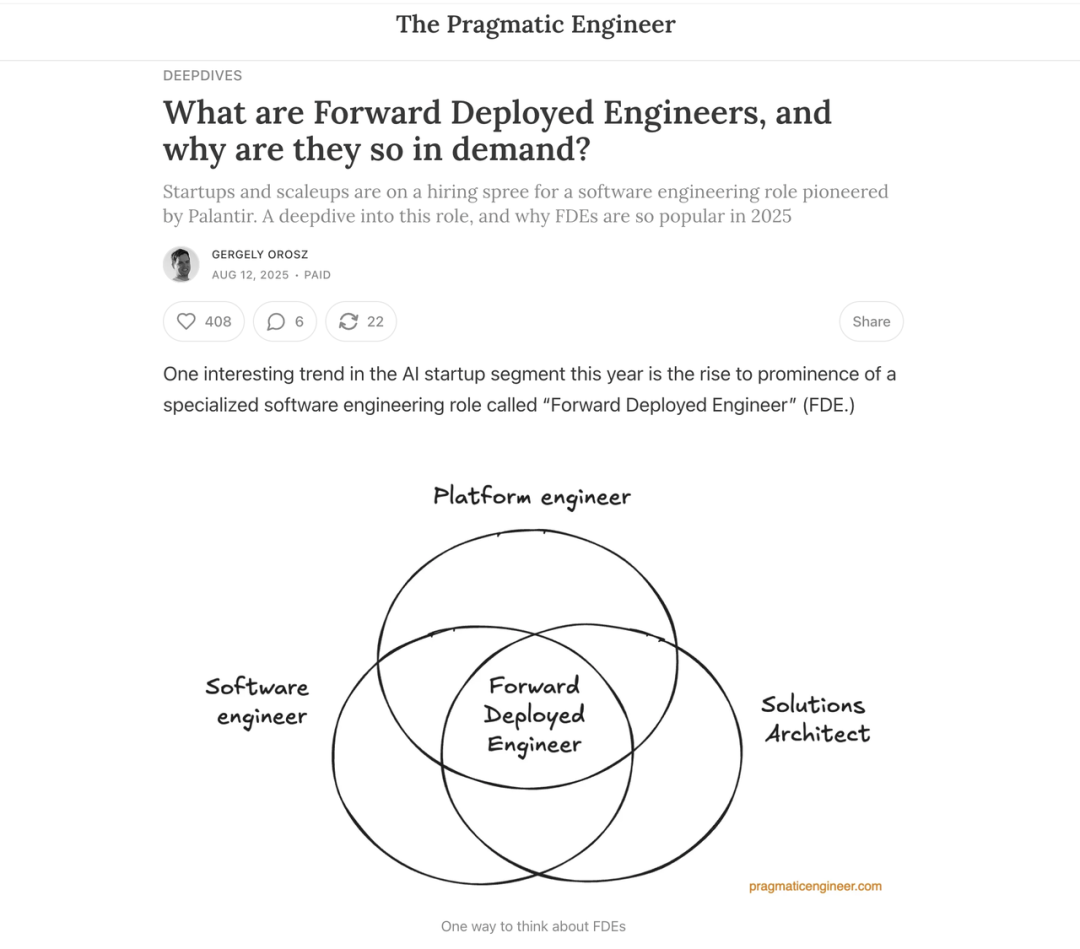
One Role, Three Faces
FDE is hot, but different stakeholders see completely different things in it.
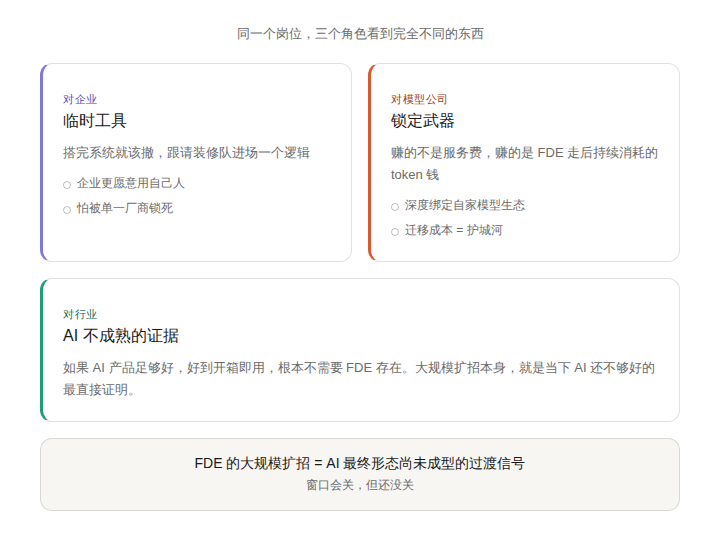
For enterprises: a temporary tool
The logic is straightforward. An FDE comes in to diagnose pain points, integrate systems, get the model working, deliver, and leave. It's the same logic as hiring a renovation crew: once the house is done, the crew should pack up and go.
In May this year, Andrew Ng wrote a long piece about FDEs and offered two clear-eyed judgments. First, enterprises would rather have their own employees do this work—developing internal AI Engineers is more sustainable than relying on external FDEs. Second, FDEs are inherently tied to a single vendor; having someone from OpenAI deeply embedded in your business processes means you've voluntarily given up the flexibility to switch suppliers.
Both of these concerns are valid. In his view, the broader pool of AI Engineer roles will, in the long run, far outnumber FDEs.
For model companies: a lock-in weapon
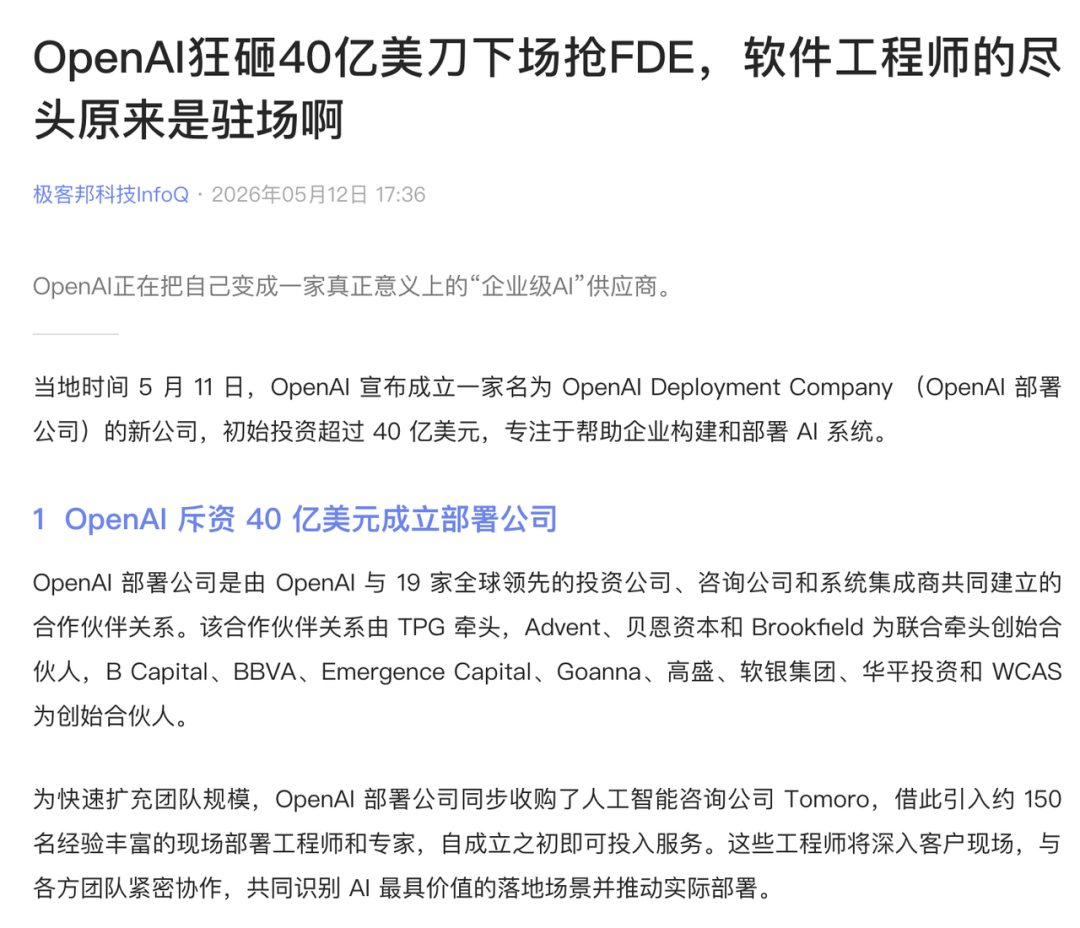
Why would OpenAI set up an independent company valued at $14 billion to house FDEs? Initial investment exceeds $4 billion, with 19 institutions co-investing, plus the acquisition of a deployment company called Tomoro, absorbing 150 FDEs in one go.
Why not just let customers connect to the API themselves?
Because the FDE's real function isn't helping customers build systems—it's using the act of building systems to weld their own models into the customer's business processes.
It doesn't matter if the FDE leaves. What they leave behind is an entire set of workflows, eval systems, and prompt orchestration logic deeply bound to OpenAI's models. Want to migrate to Claude or Gemini? You'd have to tear down the entire tech stack and rebuild—migration costs are enormous.
Anthropic, together with Blackstone and Goldman Sachs, backed a $1.5 billion joint venture. Same calculation.
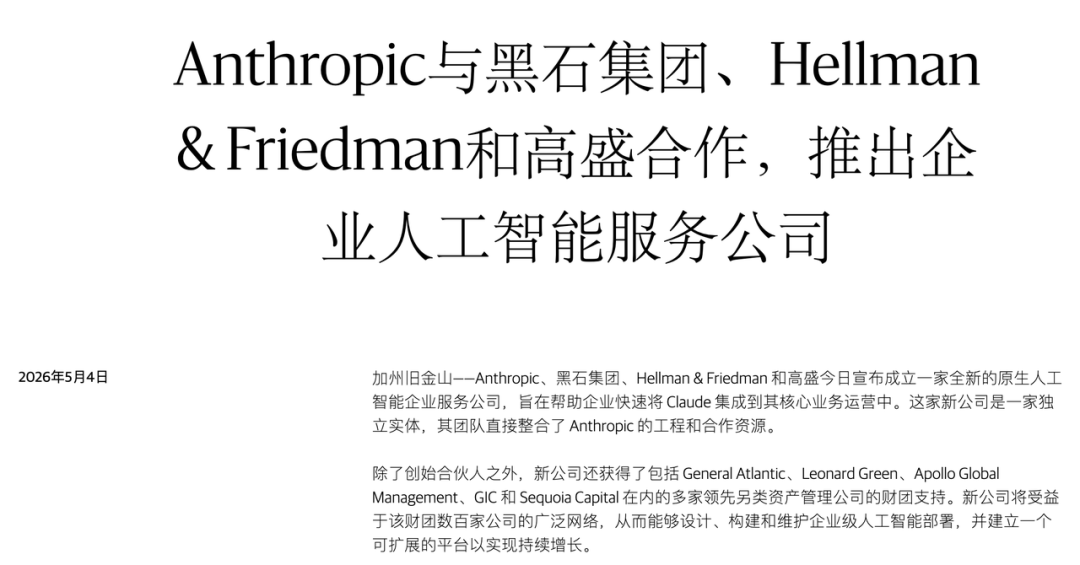
What they're earning isn't FDE service fees—it's the token money customers keep burning after the FDE leaves. It's the same logic as telecom carriers sending someone to install broadband for free: the installer leaves, but your monthly internet bill never stops.
This isn't consulting. This is lock-in.
For the industry: evidence that AI isn't mature
If AI products were good enough—good enough that enterprises could buy them and use them out of the box—there would be no need for the FDE role to exist at all. Just as you don't need someone to come to your home to install the OS and tweak the BIOS when you buy a MacBook today, and you don't need an engineer on-site to set up a database when you use Notion.
But the reality is that today's AI products are still far from out-of-the-box ready. Enterprises pay the money, buy API credits, and just can't get them to work. That's why humans are needed to fill the last-mile gap.
The mass expansion of FDE hiring is itself the most direct proof that AI isn't good enough yet.
I felt this deeply while building Lollipop. Even for a consumer-facing AI interview product, there's a huge amount of dirty work between model capability and a usable product experience: prompts have to be tuned one by one, edge cases covered one at a time, business logic repeatedly aligned with the model. B2B scenarios are only ten times more complex.
Who Can Do This Job
Having covered what this role is, why it's hot, and what its essence is, a natural question follows: who is suited for it?
The answer is deeply counterintuitive. When Palantir hires FDEs, it doesn't screen for computer science degrees. They've admitted people who studied mechanical engineering, economics, even philosophy.
What really matters is two things: the ability to act with incomplete information, and the guts to talk directly to the customer's boss.
To elaborate, several traits are especially critical.
First, no aversion to sales and communication. FDEs spend half their time dealing with people—coordinating with the customer's technical team, reporting to the customer's business leads, giving feedback to their own headquarters' product team. If you just want to quietly write code, this role will make you miserable.
Second, comfort with ambiguity. Having no requirements document is the norm. The input a customer gives you might just be "help us use AI to improve efficiency," and you have to break that sentence down into an executable plan yourself.
Third, the ability to build end-to-end. You don't need to be a coding genius, but you have to be able to handle frontend, backend, databases, and deployment yourself—at least well enough to be usable.
Fourth, a feel for the boundaries of model capabilities. Knowing which tasks are suited for AI and which must be left to humans. There's no shortcut to this feel—it only comes from extensive practice.
Conversely, two types of people are clearly unsuited: pure tech purists who want to hide in their code, and people who get annoyed whenever money or contracts come up. An FDE is essentially a hybrid of a business role and a technical role—you need to touch both sides.
Here's a self-test question for you: with no one writing a requirements document for you, could you produce a prototype presentable to a client within a week? If your first reaction is "how am I supposed to do this without a requirements doc," this role probably isn't for you. If your reaction is "let me go talk to the customer first," then you already have the makings of an FDE.
The Window Will Close
Back to the fundamental question: Is this wave of mass hiring permanent, or a window of opportunity?
My judgment is the latter.
That's not to say the FDE role will disappear. Palantir's FDEs have been doing this for 20 years and are still at it. But the Palantir model is an elite small team serving highly confidential, highly customized government clients, with contracts worth millions of dollars per deal—a high density of FDEs makes sense there.
What OpenAI and Anthropic are doing now is an industrialized assembly line. A $14 billion valuation, 150 people absorbed in bulk, teams expanding to 1,000—this scale-up is a product of the times sweeping everyone along.
When AI products mature to the point where every customer doesn't need their own FDE, this tide will recede.
It's like how, in the early days, every enterprise implementing ERP needed an implementation consultant on-site for six months; in the SaaS era, most companies can just sign up for an account and use it. Implementation consultants haven't disappeared, but their numbers and importance have returned to a normal level.
FDE is just the first to get a name. Looking ahead, there will be Forward Deployed Product Managers, Forward Deployed Designers. a16z is already using the term "Agent Product Manager" and has even launched an 8-week FDE Fellowship to incubate this group. Decagon, a company making customer service agents, has an entire team of Agent PMs helping customers deploy.
All these newly emerging roles are, at their core, different facets of the same thing:
The final form of AI hasn't taken shape yet.
Models are evolving, products are iterating, and enterprise adoption is climbing. When these three lines converge—the day AI products are truly out-of-the-box ready—these transitional roles will naturally shrink.
But that day hasn't come yet.
A Few Final Words
However temporary a bridge may be, someone still has to build it.
But the bridge builder should be clear about one thing: you're building a bridge, not a house. A bridge's value lies in connecting two shores; once the two shores are connected, the bridge's mission is complete.
If you happen to be standing right at the entrance of this window period, an FDE or similar AI implementation role is indeed a decent ticket in. But don't treat the window-period dividend as a lifelong meal ticket.
In the process of building the bridge, what's truly worth accumulating isn't how many agents you've helped customers deploy, but three things: a feel for the boundaries of AI capabilities, a deep understanding of enterprise business processes, and the ability to push things forward in environments with incomplete information.
These things are yours, whether the bridge exists or not.
Models handle intelligence; humans handle implementation.
AI can't walk the last mile of implementation on its own. And every step it doesn't complete is your window of opportunity.
This article was originally published on Everyone Is a Product Manager by @小普. Reproduction without the author's permission is prohibited.
Cover image provided by the author
The views expressed in this article are solely those of the author. The Everyone Is a Product Manager platform only provides information storage services.