A forward deployed engineer writes production code inside the customer’s environment and answers for whether the customer’s workflow actually changed. Not a consultant, who advises and leaves. Not a solutions architect, who designs and hands off. About half the week is code. The rest is scoping, evals, and earning enough trust that anyone uses what you built.
You are inside the 🤖 Agents course.
Every lesson free, in order.
TL;DR
- The job exists because the models were not the problem. Colin Jarvis, who runs forward deployed engineering at OpenAI, says early customers found it “kind of hard to get value from the models”, so the company sent engineers into the customer’s building instead of releasing better models.
- Palantir ran this for a decade before the labs copied it. Two tracks: one engineer builds many capabilities for a single customer, and another turns whatever worked there into a platform feature every customer gets.
- The engagement runs in three phases, and the middle one surprises people. Scope, validate, deliver. Validation sits between agreeing the work and building it, so you are judged on eval design before you are judged on shipping.
- Only half the week is code. The rest is process mapping, stakeholder meetings and infrastructure work that looks nothing like model engineering.
- ⭐ There is a free roadmap that teaches the whole job. Awesome FDE Roadmap runs every layer in the order an engagement throws it at you.
Four Pilots, None in Production
Your company signed a frontier-model contract eighteen months ago. Since then: a support-triage pilot, a document-search pilot, a contract-review pilot, and one nobody talks about any more. All four demo well. None is in production.
The model is not the reason. It has worked the whole eighteen months, in a browser tab, while the pilots died.
What is missing sits between that browser tab and the systems your company actually runs on. Someone has to find out which of your forty support workflows is worth automating, discover that the ticket data carries three schemas, write evals for what a good answer looks like when your own team disagrees, and then keep showing up until support agents route their tickets through the new system without being told to.
Colin Jarvis, OpenAI’s head of forward deployed engineering, put it plainly. People were excited, he said, “but it was also, like, kind of hard to get value from the models.1”
So the labs stopped trying to close that gap with better models and started sending engineers instead. The seat shows up in the postings as FDE, the standard abbreviation for forward deployed engineer.
Palantir Did This First
The role is not new. Palantir has run it for over a decade2.
They split the job into two tracks. One engineer builds one capability that many customers use. Another builds many capabilities for one customer. Palantir calls them Dev and Delta, and its job board still tags every requisition with one of the two. The split is the point: what the Delta engineer learns in the field becomes what the Dev engineer productizes.
Their engineers were onsite four or five days a week, which is why the customer’s own staff stopped treating them as vendors and started routing problems to them directly.
What changed in 2025 and 2026 is who copied it. The labs hit the same wall Palantir hit in 2010.
What the Week Actually Looks Like
About half the week is code.
The other half is process mapping in a room with the people whose work you are about to automate, stakeholder meetings about whose team owns the data, and infrastructure work that looks nothing like model engineering. Palantir’s own description includes AWS infrastructure, network administration and racking servers alongside the application code.
Its requisition goes further and lists the work as “shaping team strategy and driving projects from ideation to deployment, increasing your pain threshold to deliver real value.” Increasing your pain threshold is in the job description3.
Who Hires, and What They Pay
The same job pays $135,000 at one of these companies and $320,000 at another.
Palantir pays least and asks least: $135,000 to $200,000, and one year of experience.
OpenAI spun the function into its own business in May 2026, the OpenAI Deployment Company, a $4 billion consultancy that opened with 150 forward deployed engineers and deployment specialists acquired along with the London firm Tomoro4. OpenAI itself now lists 7 forward deployed roles against 790 open jobs.
Anthropic has six of these roles open, two of them engineering-manager posts and one a pre-sales lead inside the same org. Its forward deployed engineer posting wants “experience shipping production applications”, estimates travel at 25 percent, and lists $280,000 to $320,000.
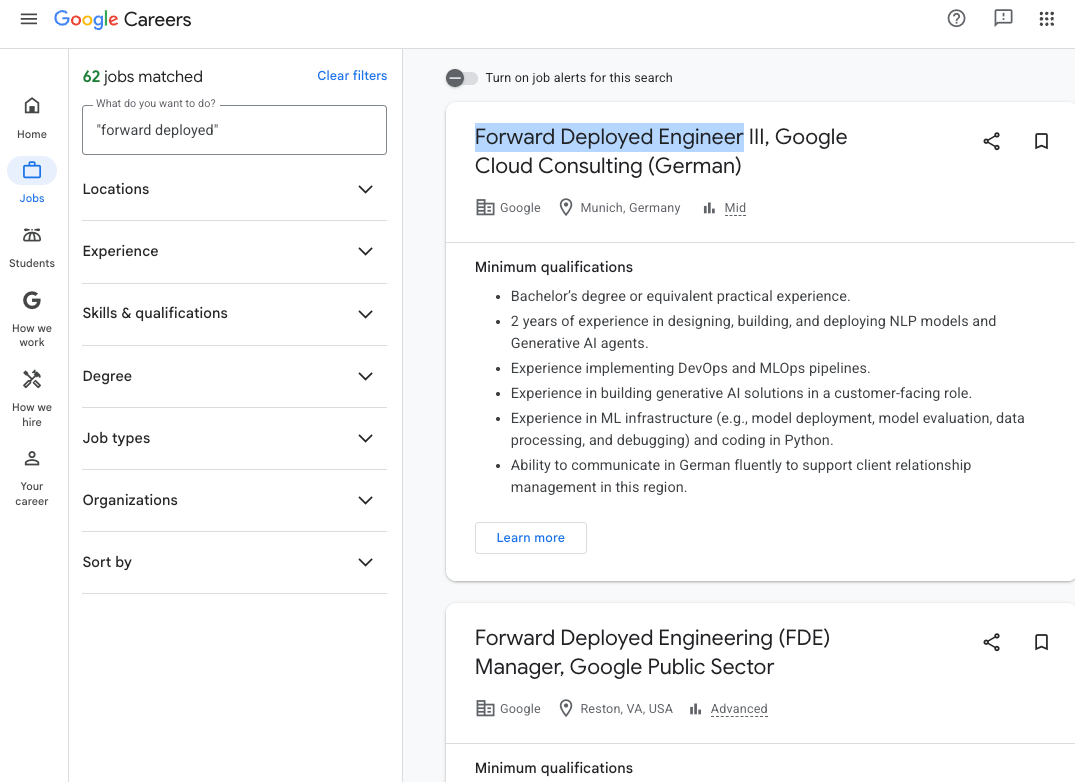
Google runs the model at a volume nobody advertises. Its careers site returns 62 open roles matching forward deployed, spread across Munich, Singapore, Reston and Latin America, with titles running from engineer to engineering manager to a dedicated public-sector line5.
One number circulates against those bands. Perspective AI’s 2026 compensation report puts the mid-level median at $385,000, staff at $610,000, and principal roles at frontier labs clearing $1.2 million, drawn from 1,200 data points across Levels.fyi, public postings and pay-transparency bands. It is counting total compensation, where equity runs 55 to 70 percent of the package, while every band above is base salary. Both are true, and only one of them lands in your bank account each month6.
So before you decide an offer is low, check whether the number you are comparing it to includes equity.
Two Things to Read in the Posting
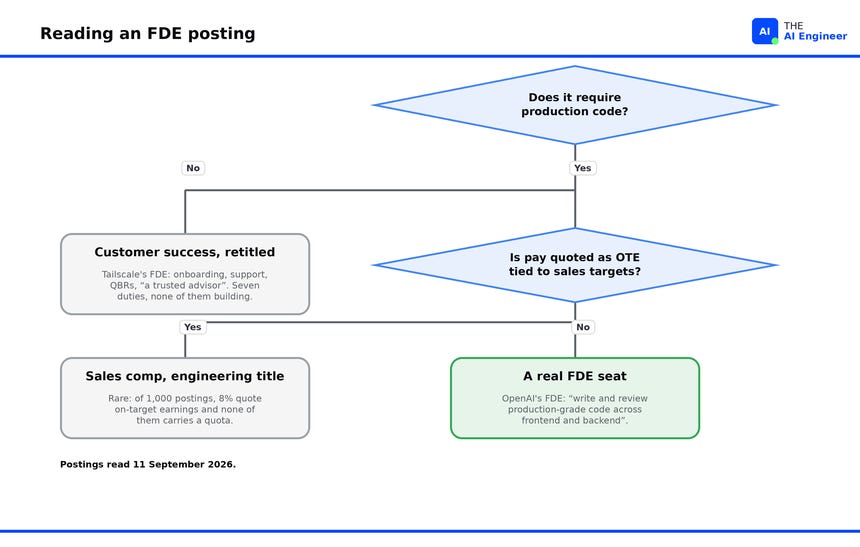
Some postings carry this title for work that is not this job. Skip the title and read two lines in the responsibilities.
Does it ask you to write code? OpenAI’s posting requires you to “write and review production-grade code across frontend and backend using Python, JavaScript, or comparable stacks.” Tailscale’s posting, same title, lists the job as leading onboarding, offering technical support, conducting quarterly business reviews and “acting as a trusted advisor.” Seven responsibilities, none of them building anything7.
Does it pay like sales? Of a thousand forward deployed postings Bloomberry analyzed, 8 percent quote on-target earnings and none carry a quota, so a posting that does is the rare one worth catching. Tailscale’s quotes “target OTE (on target earnings), inclusive of base salary and variable compensation tied to the attainment of quarterly sales targets.”
The experience bar is not where you would guess. OpenAI asks for five or more years of engineering that includes customer-facing work, against Palantir's one. The doors are not all set at the same height8.
How You Actually Become One
The job is a stack of three things, and almost nobody has all three when they start.
- Data engineering, because the first two weeks of every engagement are somebody else’s schemas. SQL at a level where a join across three acquisitions does not scare you, data modeling, and enough distributed compute to move terabytes.
- Cloud architecture, because you deploy inside their environment and not yours. Kubernetes, networking, infrastructure as code, and the air-gapped variants of each when the customer is a bank or a defense contractor.
- The consulting mindset, which decides whether the other two ever ship. Scoping a problem down until it is buildable, reading which stakeholder actually has to say yes, and translating a business complaint into a requirement.
There is no degree for this. The three do not live in the same course, the same team, or usually the same career. So where do you learn three things that no single job has ever taught you at once?
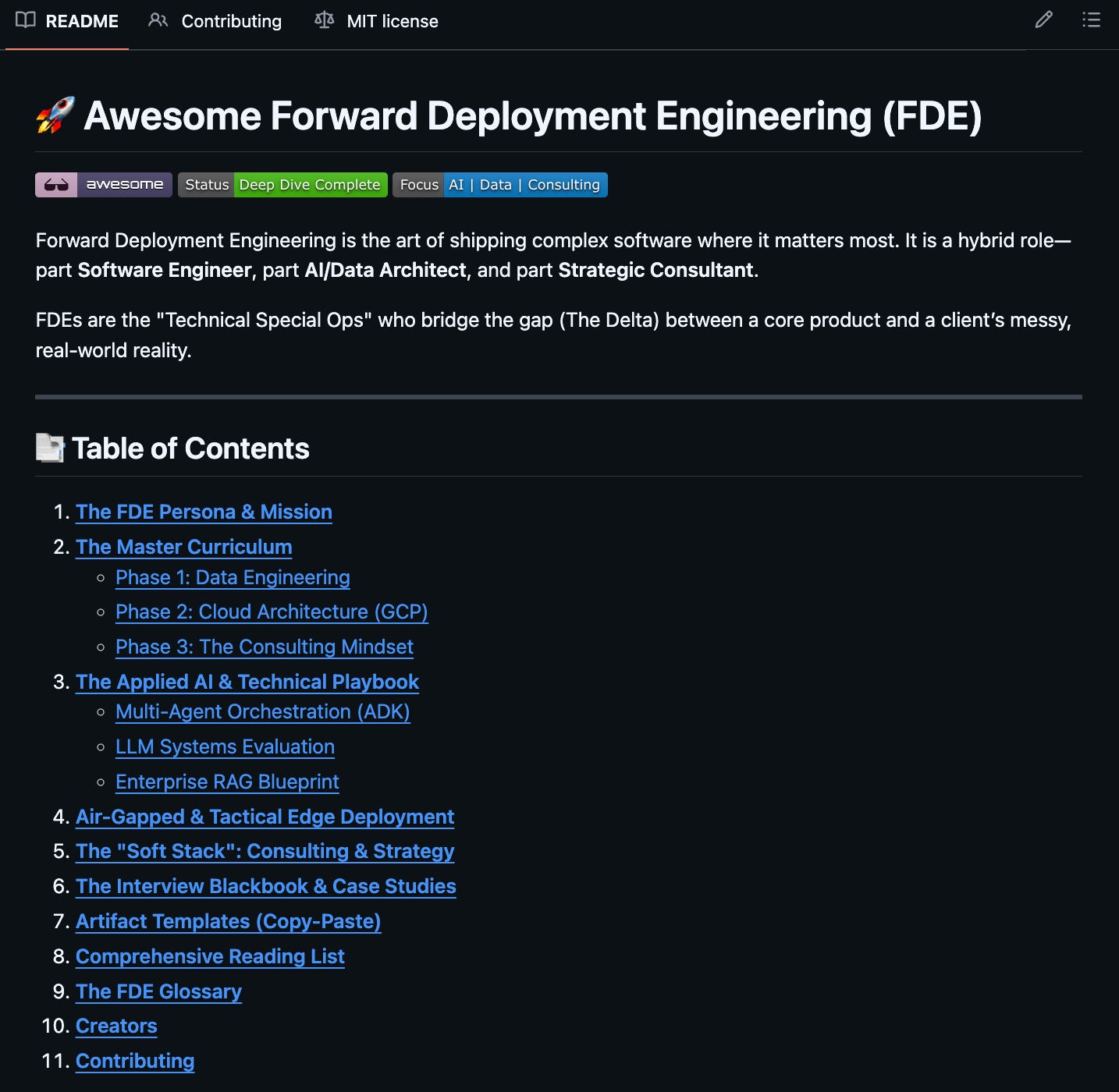
⭐ The free curriculum for this role is Awesome FDE Roadmap, which I build and maintain with Pier Paolo Ippolito.
Pier Paolo is one of the sharpest people I know, and he is the person who first told me this role existed. He is a Forward Deployed Product Manager at Google Cloud, the product manager for the Agents CLI, and a contributor to the Agent Development Kit, Google’s open-source framework for building agents.
The roadmap runs in the same order as the work does: data engineering, then cloud, then the consulting layer, before applied agents, evaluation frameworks, enterprise retrieval and air-gapped deployment, with case studies and interview prep attached. It is free and open source. Take what you need. ⭐
Who Should Not Do This
Half your week is not code. If you took this job to write software all day, you will spend most of it in rooms deciding what the software should do.
There is a perception tax, and it is real. If your next role depends on reading as a core engineer, the label is something you have to actively manage, and nobody has published evidence of movement between forward deployed and core engineering in either direction. Managing it means keeping evidence of shipped production code and system design, not only delivered outcomes.
And the first engagement is mostly throwaway. You will build something that works, the contract will end, and the next customer starts you at zero again: new schemas, new stakeholders, new definition of a good answer. Nothing you build follows you. What carries forward is how fast you read a new customer, which is what makes the fifth engagement easier than the first.
The One Thing to Remember
The forward deployed engineer exists because capability stopped being the bottleneck. The model in the playground already does the thing. What nobody had was a person who would sit inside one company’s mess, learn which of its forty workflows is worth automating, and stay long enough for the people there to trust the result.
🔜 Friday: REINFORCE vs PPO vs DPO vs GRPO, and which one fits the cards you actually have.
FAQ
Is a forward deployed engineer just a consultant?
No, and the difference is verifiable. A consultant advises and leaves a document. A forward deployed engineer writes production-grade code inside the customer’s environment and answers for whether the workflow changed. Palantir publishes a section answering this exact question, which tells you how persistent the confusion is.
Is it the same as a solutions architect?
No. OpenAI staffs both on the same account, which is the clearest proof they are different jobs. The bright line is the production-code requirement: a solutions architect designs and builds proofs of concept, a forward deployed engineer ships code that runs.
How much travel should I expect?
Between 25 and 50 percent in the postings that name a number. OpenAI’s San Francisco role says up to 50 percent, Palantir’s New York role says up to 25, and some requisitions give no percentage at all. Get the specific team’s number written into the offer, because a company-wide average hides which requisition you actually signed.
What do forward deployed engineers actually build?
Terabyte-scale data pipelines, access-control configurations, retrieval and eval systems, and applications for people who are not technical, plus the infrastructure underneath, which at Palantir has included network administration and racking servers.
Does the role transfer back to core engineering?
Nobody has published evidence either way, and that is the honest answer. Practitioners describe a persistent perception tax if your next role wants a core engineer, so keep evidence of the production code and system design you shipped rather than only the outcomes you delivered.
An OpenAI exec explains how his growing team helps companies move from AI hype to adoption, Lee Chong Ming, Business Insider (November 2025)
Palantir Technologies Form S-1, U.S. Securities and Exchange Commission (August 2020)
Forward Deployed Software Engineer, New York, Palantir Careers (September 2026)
OpenAI launches the Deployment Company, OpenAI (May 2026)
Forward Deployed Engineer, Anthropic Careers (September 2026)
Jobs search for “forward deployed”, Google Careers (September 2026)
The 2026 Forward Deployed Engineering Compensation Report, Perspective AI (May 2026)
Forward Deployed Engineer, Tailscale (September 2026)