Provost and Fawcett teach data-analytic thinking: before you write code on-site at a customer, first turn vague concerns into measurable questions.
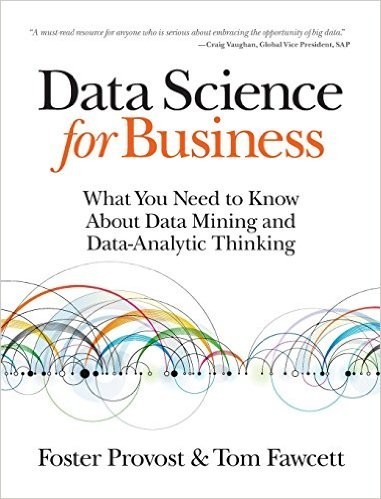
Data Science for Business: What You Need to Know about Data Mining and Data-Analytic Thinking · Foster Provost ·
Key Takeaways
- Data Science for Business (O'Reilly, 2013) is about the principles of extracting knowledge from data, not algorithms.
- Three ideas worth remembering: principles matter more than algorithms; data mining is a craft with a process; data is an asset that requires investment.
- Read it first, then read ML technical books—especially if you're moving from software engineering to FDE work.
The book's official page says it plainly from the start: this is not a book about algorithms. For an O'Reilly book with "data mining" on its cover, that's an unusual stance. But for a Forward Deployed Engineer (FDE), that's exactly why it's worth reading.
The book is titled Data Science for Business, with a subtitle promising data mining and data-analytic thinking. It was written by Foster Provost and Tom Fawcett and published by O'Reilly Media in 2013.
The book grew out of a popular course Provost taught at NYU. According to NYU Stern, more than a dozen universities across eight countries have adopted it as a textbook, and Fortune included it on its list of must-read MBA books.
What can a 13-year-old book offer an FDE in 2026? On-site at a customer, the hardest part is often not choosing a model, but turning a customer's vague statement into a measurable question.
The authors' goal is to explain the fundamental principles of extracting useful knowledge from data. The book is also written for people who won't do the analysis themselves but want to improve their data-analytic thinking.
Customers bring concerns, not problems
Suppose a subscription-based company tells you: "We want to reduce churn." That sentence is not yet a data problem. It doesn't say who will act, over what timeframe, or what success looks like.
A few more questions reveal that the customer support team only has the bandwidth to call 500 of 10,000 subscribers each month. The problem then becomes clear: rank those 10,000 users by their likelihood of churning within the next 30 days, then pick the 500 most worth contacting.
Now the problem has a concrete decision (who to call) and a measurable goal (how many of those contacted stay). It also points to the data needed: subscription history, who churned, and when.
This is what the book calls "data-analytic thinking." According to the publisher, every principle in the book is illustrated with real business problems. As a result, people who work with customers will find it closer to their daily work than a math textbook.
First idea: principles outlast algorithms
Algorithms change year by year. But the question "Given this answer, which decision would change?" never changes—whether you're using a 2013 decision tree or a 2026 LLM-powered agent. This book teaches exactly the part that doesn't change.
MIT Sloan professor Sinan Aral has said that in the field of applied data science for business, no other book is as authoritative yet accessible.
For an FDE, accessibility pays off immediately. It gives you a way to explain to a director of operations why "predicting churn" and "choosing who to call" are two different problems.
When a customer makes a request, the first thing to do is write down the decision this analysis is meant to support. If you can't write that sentence, you're not ready to open a notebook yet.
Second idea: data mining has a process
Provost describes data mining as a craft that relies on skill, not the push of a button. According to O'Reilly's release announcement, it follows a well-established process that improves the odds of success. This matters for FDEs because it breaks the myth that "data plus a model automatically produces results."
The process also carries from one customer to the next. In the subscription example, the path is: clarify the decision, define "churn," find the data, then measure the outcome on exactly those 500 calls. Swap in a bank or a logistics company, and the steps are identical—only the nouns change.
Write your own process as a short checklist and use it in every requirements discovery. After three customers, you'll see where failing projects usually get stuck.
Third idea: data is an asset, and assets cost money
The publisher summarizes one of the book's lessons: treat data as a business asset, and only with deliberate investment can it deliver real value. On-site at a customer, this often leads to an awkward conversation: telling the customer that their existing data isn't enough.
Back to the example. Suppose the company never recorded when customers canceled their subscriptions—only their current status. In that case, you can't build a model yet.
The first task is to advise the customer to invest resources in recording that kind of data, and to explain how much effort it will take. An FDE who can say this in the first week can avoid three months of empty promises.
Which interview question reveals a candidate's thinking?
The publisher's introduction mentions a lesser-known use: applying data science principles when interviewing candidates for data roles. FDEs often need to assess a customer's data team or help hire for their own team, so this skill genuinely comes in handy.
Give a candidate the subscription scenario above: "The company wants to reduce churn—where do you start?" A weak answer jumps straight to models: try a few algorithms, compare accuracy, pick the highest one. It sounds technical, but the candidate hasn't asked a single question about the customer.
A strong answer starts with counter-questions: who will act on the results, how many people can be contacted each month, how "churn" is defined, and whether cancellation dates are stored in the system.
Only after learning that the support team can contact 500 people does the candidate start talking about ranking, and about measuring effectiveness on exactly that group. One question like this says more than any algorithm puzzle.
Who should read it, and when
If you're a software engineer transitioning to FDE work, read this book first, then the ML technical books. If you're already an FDE, reread the chapters that correspond to the questions your customers ask most often.
This capability should also show up on your resume. Instead of writing "built a churn prediction model," state the original business problem, the question you reframed it into, and the numbers that measured the outcome. A line like that shows the reader your thinking, not just which tools you used.
Models will change many more times. "Which decision would change as a result?" is still the first question to ask once you're on-site with the customer.
Was this article helpful?
Thanks for your feedback!