When a customer API hangs for 30 seconds at a time, a thread pool can be exhausted in just 5 seconds; Nygard's patterns can cut off this kind of cascading failure at the design stage.
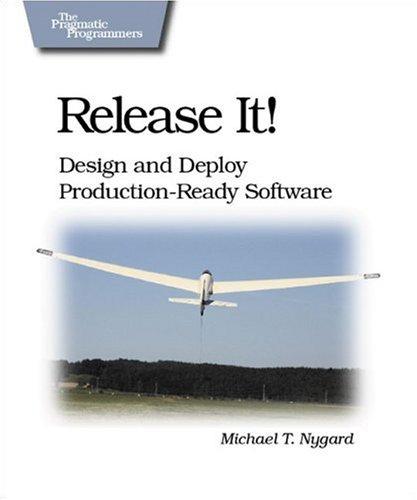
Release It! Design and Deploy Production-Ready Software · Michael T. Nygard ·
Key Takeaways
- According to the publisher, 80% of a software project's lifecycle cost occurs in production, which is exactly where FDEs work every day
- Read the catalog of anti-patterns first, then the patterns: recognize the symptoms before prescribing the cure
- Three ideas FDEs should remember: every integration point is a risk, slow is more dangerous than down, and failures must be isolated
According to the publisher, 80% of a software project's lifecycle cost occurs in production, yet very few books seriously address this phase. Michael Nygard's *Release It!* was written to fill exactly that gap.
For a Forward Deployed Engineer (FDE), this statement is practically a job description. You don't deploy to a clean cluster your own team controls; you deploy into the customer's environment: legacy APIs, databases no one dares touch, and intranets that work only sometimes. Few books explain how to keep a system standing when everything around it is failing as thoroughly as this one.
Written for those afraid of being woken by alerts at night
The first edition was published in 2007. The current edition is *Release It! Second Edition: Design and Deploy Production-Ready Software*, published by Pragmatic Bookshelf in January 2018, 376 pages (ISBN 9781680502398). According to the publisher, Nygard has worked as a professional programmer and architect for over 15 years.
The publisher's pitch is blunt: if you're a developer who doesn't want to be woken by alerts every night, this book is for you. It teaches through case studies and immediately actionable advice. The second edition expands the catalog of stability anti-patterns to systemic problems at scale.
The anti-pattern catalog includes Integration Points, Cascading Failures, Blocked Threads, Slow Responses, and Unbounded Result Sets. The patterns section covers Timeouts, Circuit Breaker, Bulkheads, Fail Fast, and Shed Load. Martin Fowler credits Nygard himself with popularizing the Circuit Breaker, a pattern used to stop failures from cascading between services.
From this catalog, three ideas are worth carrying into every customer project.
Idea one: every integration point can fail
For FDEs, Integration Points is the anti-pattern most worth reading closely. Every connection to a customer system, from the CRM and data warehouse to the authentication API, has the other side outside your control.
Imagine you deployed an agent that reads customer order data. In staging, the orders table has only 100 rows; in production, the same query returns years of historical data and the service's memory is exhausted outright. That's Unbounded Result Sets: the problem isn't in the code, and it only surfaces when it hits real data.
The simplest defense is to add row limits and pagination to every query against customer systems. More broadly, the first thing to do on site is map out all integration points, then ask three questions about each: What happens if the other side goes down? What happens if it gets slow? And what happens if it returns an absurdly large amount of data?
Idea two: slow is more dangerous than down
A service that goes down outright returns errors immediately, but a slow service drags you down with it. Do the math: your service has a thread pool of 50 threads and receives 10 requests per second, each of which calls a customer API with a normal response time of 200ms.
One morning that API slows down, and every call hangs for 30 seconds. With 10 new stuck threads per second, all 50 threads are waiting within just 5 seconds. Your own service's health check has no threads available, the load balancer marks it as down, and every system that depends on you starts slowing down too.
This chain runs through Slow Responses, then Blocked Threads, and finally Cascading Failures. The first and cheapest line of defense is Timeouts. Set a 2-second timeout and the thread returns to the pool instead of hanging for 30 seconds; combine that with Fail Fast to error out immediately rather than leaving users waiting indefinitely.
Idea three: isolate failures; don't let one broken piece take down everything
Timeouts only cut off a single call. Circuit Breaker goes further, and Fowler summarizes its principle this way: wrap the protected call in a circuit breaker object that monitors for failures. Once failures exceed a threshold, the breaker trips and subsequent requests are rejected outright instead of repeatedly knocking on the door of a nearly dead API.
The rest is handled by Bulkheads. Returning to the example above, if calls to the customer API can only use a dedicated 10-thread pool, then when that API hangs, the remaining 40 threads can keep supporting other features. Shed Load is the last step: under overload, proactively reject some requests rather than letting all of them slow down together.
Who should read it, and in what order?
This book suits developers with two or more years of experience who have had their sleep disrupted by an incident at least once. The second edition came out in 2018, so a sensible approach is to pair the book with the author's two interviews.
Step one: listen to the 2023 GOTO Book Club conversation between Nygard and Trisha Gee, which discusses patterns and anti-patterns that emerged after the 2007 edition. Listening to this episode first tells you which parts of the book still hold and which need to be understood in a new context.
Step two: read the anti-pattern catalog, and for each entry, find a corresponding example in a system you currently operate. You can only choose the right remedy after recognizing the symptoms in your own code.
Step three: read the patterns section, noting for each pattern which anti-pattern on your list it can block. Step four: listen to episode 141 of Cognicast from 2018, which discusses circuit breakers and the dogpile effect (a flood of requests hitting the same place at the same moment) in depth.
Developers looking to transition into an FDE role shouldn't just write "read Release It!" on their resume. Write a sentence with real numbers from your own work, such as "added a 2-second timeout and circuit breaker to partner API calls, reducing incident duration from X hours to Y minutes."
If the job description mentions "production-ready" or "reliability," prepare a story that follows exactly the chain above: slowdown, stuck threads, cascading failure.
Customers won't remember how smooth your demo was. What they'll remember is that their API slowed down that morning, and your system kept running.
Was this article helpful?
Thanks for your feedback!