FDE has suddenly become a topic people "don't want to talk about"
In just two months, FDE has gone from hot trend to target: tech companies are rushing to build teams, the Ministry of Industry and Information Technology issued a document calling for cultivating FDE talent, and job postings surged 21x in the first half of the year; on the other side, an Alibaba Cloud executive said bluntly at the Yunqi Conference that anything said now could be picked apart, and the old problems of implementation engineers changing titles and on-site delivery have not gone away.
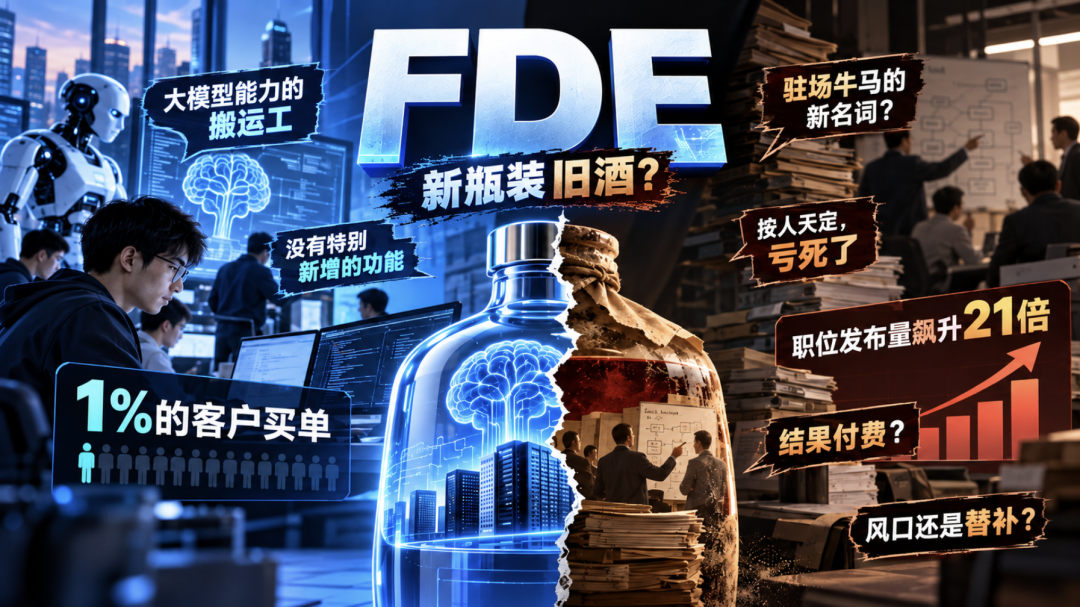
"I don't want to talk about FDE anymore." Huo Jia, Vice President of Alibaba Cloud Intelligence Group, told Shuzhi Qianxian at the Yunqi Conference, "Anything I say now could be picked apart." When FDE was at its hottest, Shuzhi Qianxian reached out to several veterans—some felt FDE was too idealistic, some felt it was too early to go deep, and others said FDE was already outdated.
In just two months, FDE went from hot trend to target. On one side are legions of supporters: tech companies are rushing to form FDE teams, and the Ministry of Industry and Information Technology issued a document calling for cultivating FDE talent; Maimai data shows FDE job postings surged 21x in the first half of the year. Supporters argue that what's missing for model deployment is someone to carry it into enterprises on the ground, and FDE is exactly the "porter of large model capabilities."
On the other side is skepticism. "FDE in China is just a new name for on-site workhorses." Some joke that implementation engineers change their title and want the daily rate to jump from 1,500 to 15,000. Critics argue that on-site customization has long been the norm in China; a cloud vendor executive told Shuzhi Qianxian that FDE has "no particularly new functions"—it's just a customer-facing service team with a trendier name.
Huo Jia said FDE can easily "go off flavor" in China and be dismissed as old wine in new bottles, or selling dog meat under a sheep's head, "but if you're not on the industry front line, it's hard to answer these questions clearly." Liu Song, Vice President of PingCAP, put it bluntly to Shuzhi Qianxian: the discussion of FDE is still in its early stages, and large-scale validation has not yet begun; "all predictions and judgments have some merit, but also carry a degree of subjectivity."
So what exactly is FDE? And why did it suddenly take off this year?
01 FDE: An "Old Model" Amplified by AI
FDE stands for Forward Deployed Engineer. It sends engineers to the customer's site to work on solution delivery together with the customer—what gets delivered is not a report, but a system that actually runs; at the same time, frontline feedback is sent back and consolidated into the company's own product capabilities.
"Some people ask, isn't FDE just our old custom development or outsourcing?" Wang Peng, a senior expert at Tencent Research Institute and author of the FDE report, told Shuzhi Qianxian that there is a fundamental difference between the two. In the past, after a project was done, the experience mostly stayed in experts' heads, requirement documents, and code, with extremely low transfer efficiency; today, AI can solidify personal experience through bidirectional distillation mechanisms and Skills, and can also consolidate business knowledge into an "ontology"—"AI makes this scalable."
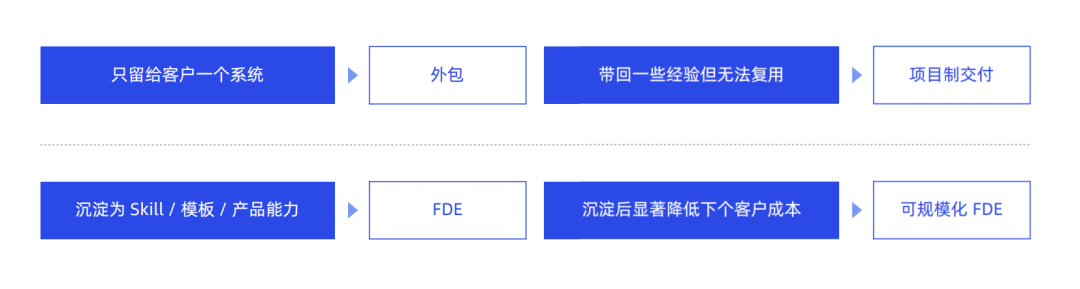
Chart source: Tencent Research Institute, "FDE Model: Industry Observation and Practice"
"FDE is a model created by the software company Palantir, not by internet giants." At the AI Roundtable, Zuo Chun, Chairman of Sinosoft, stated clearly that FDE was born for "constraint-type software."
Software falls roughly into two categories: record-type software records what happens in a company's business—ERP, CRM, financial systems, and bank core systems all belong to this category, with relatively stable requirements and strong standardization; constraint-type software includes military command, aerospace mission planning, factory production scheduling (APS), financial risk control, and so on. It targets a goal and must find an optimal action plan under a set of resource, rule, and risk constraints, and therefore carries flexibility.
Palantir was serving military institutions at the time. It created a model where traditional consulting delivered a report, while Palantir delivered a solution prototype—what Zuo Chun calls "unity of knowledge and action." This won high recognition from customers, and FDE was born out of it.
For this reason, "FDE is clearly a team." Palantir divides it into two roles: Echo is responsible for understanding the business and defining problems; Delta is responsible for turning solutions into something that runs. In Zuo Chun's view, the recently hot Agents are methodologically identical to this—only the Delta side has been massively accelerated. Back then Palantir was still using tools like IBM low-code; today, thanks to AI technology, the interaction and experimentation cycle is incomparable to before.
Wan Ruyi, Vice President of Chinasoft International and Dean of its AIGC Research Institute, believes some of FDE's good qualities "have been amplified by the AI era." The biggest one is moving results forward: AI coding has greatly compressed the path from idea to result. Previously, government and enterprise projects were first problem-driven, then test-driven. In this round, because large models produce probabilistic outputs, benchmarks and test sets must also be moved forward. This part is something traditional FDE never had—it was forced out by AI.
"FDE has different dimensions." analyzed Li Gang, Vice President and CTO of Digital China Group. It is a job role, and also a new type of organization. Digital China is still internally debating whether it should be a physical or virtual organization. It is also a new process, with the boundaries of pre-sales and product managers shifting accordingly. And most critically, it's the business model. "Without transformation, companies like Digital China and Sinosoft, strictly speaking, would have no interest." He believes that the first lever of FDE is building super teams.
02 Why Is FDE Hot Right Now?
When Wang Peng started writing his FDE report last October, he found that no domestic companies were hiring for such roles, while in the US many such companies had already been founded and were recruiting FDE talent. "They saw this thing half a year before we did," Wang Peng said.
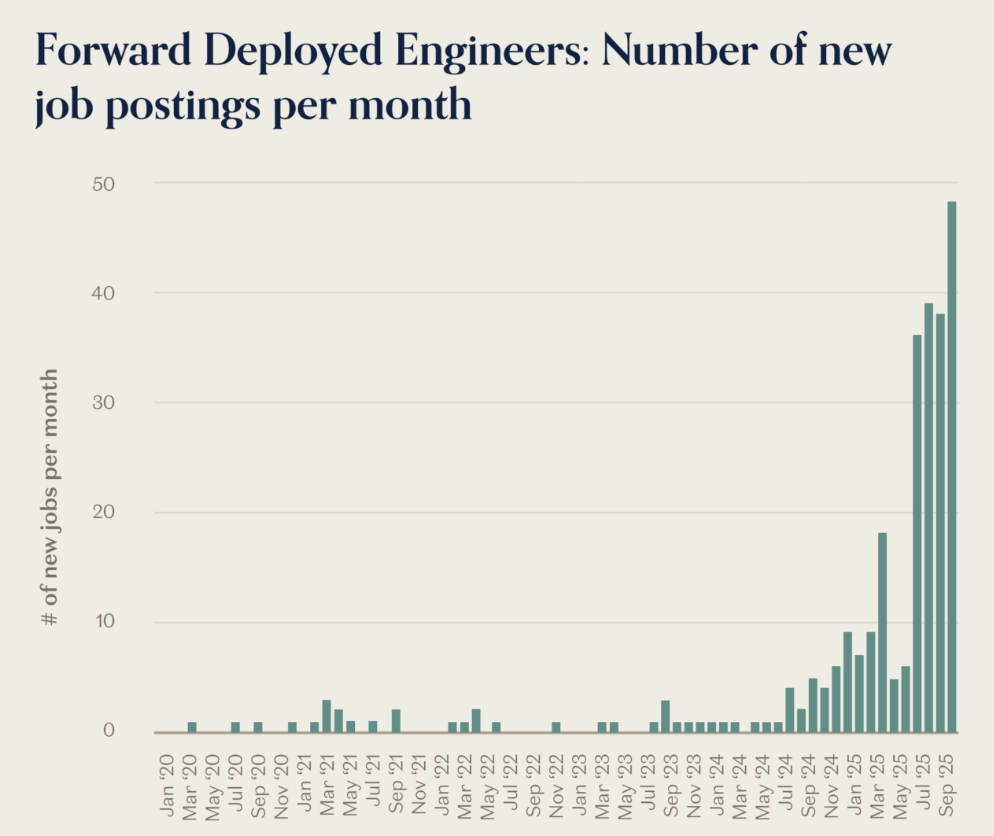
Chart source: a16z's 2026 "FDE Role Study"
Why did FDE suddenly explode this year? "Because this year is truly the first year of AI application deployment," Huo Jia said. AI is no longer a chat and entertainment tool; it has begun entering the early stage of being a productivity tool. Huo Jia observed that since September of last year, enterprises have begun thinking very seriously about how to add AI to core processes. But this step is very hard: AI talent is extremely scarce, and there are few real deployment practices; Harness engineering, Loop Engineering, and the like keep emerging, making it hard to manage things the traditional IT project way of "plan first, execute later"—a highly agile development approach is needed.
Alibaba Cloud's FDE was also figured out on the ground at customer sites. During last year's Yunqi Conference, Huo Jia met with Kunlun Digital Intelligence, which wanted to apply AI to its core production processes. After visiting many customer sites, Alibaba Cloud's solutions team found that some of the scenarios initially envisioned could not be deployed; and even if they could, if results weren't visible quickly, projects were hard to sustain.
The traditional approach no longer worked. This time, the team first validated with the customer which scenarios were worth doing—it was a process of talking while doing, unlike the traditional pre-sales stage where the scope of requirements is defined upfront. What was shown to the customer was not a PPT, but a demo that actually ran, which was quickly built into a production-grade system and launched.
This approach worked. During a project retrospective at the end of last year, Huo Jia suddenly realized: "This feels exactly like FDE." Kunlun Digital Intelligence thought so too. In fact, many customers were stuck at the same three points: they couldn't find scenarios, didn't know how to validate technical feasibility and return on investment, and didn't know how to turn a pilot into a production-grade system for launch. Because customer demand was so strong, Alibaba specifically discussed FDE at its January strategy meeting and decided to "give it a try."
Looking at the bigger picture, Liu Song of PingCAP believes that after March this year, the industry formed a consensus: enterprise-level productivity is the main thread of AI. Large manufacturing companies, financial institutions, and pharmaceutical plants are all seriously pushing core business into the era of enterprise-level agents.
But going from individual productivity gains to enterprise productivity gains involves crossing a threshold. Wang Peng observed that some companies do "token maxing," distributing large amounts of tokens to employees—individual productivity did indeed improve, but over time they found the enterprise itself did not benefit. Liu Song's team also fell into this trap: last November, all 300+ people on their R&D team were consuming tokens heavily, yet it brought no enterprise-level productivity gains. A customer survey they conducted this June showed that Chinese financial institutions had been using vibe coding for over a year, yet overall productivity gains basically did not exceed 15%.
Wang Peng attributes the cause to two walls: one is organizational barriers, the other is business process barriers. In his view, the FDE's job is to break through both walls, and "it is by no means just custom development". The true Echo is someone who can explain clearly to a client's top executives "how to rebuild an enterprise with an AI-native approach"—this demands a great deal from a person, and right now 99.9% of people who call themselves FDEs don't have this capability.
Liu Song explains that AI development moves so fast that it triggers overlapping features and mutual conflicts. "We had to shift from large-scale use of vibe coding to collaboration." First, get everyone on the same project and the same channel; second, make agents more autonomous, with most work driven forward autonomously by agents. After the shift, under a multi-agent collaboration model driving the full software engineering process, new applications improved in efficiency by about 10x, while old applications—because they had to coordinate with existing systems—improved by about 4x. He has asked internet companies, including ByteDance, and this is basically the consensus level.
Liu Song believes that in the long run, serious, large-scale, complex tasks and organizations will all move toward multi-agent systems. And the most important thing for an FDE is not to finish the system for the client, but to "teach a man to fish": first pick a minimal scenario to get the whole system working, then have the client take over themselves and develop the next, larger-scope application.

Gartner on the key to teaching a man to fish: retain the system, accumulate the product
03 FDE pricing, the industry's biggest mystery
"It's not a question of good or bad, it's a question of survival." That's how Wan Ruyi describes the importance of the FDE business model.
Liu Song read an article by an industry figure: "FDE absolutely must not be paid by the old person-day model; it should be paid by results." But some industry figures are not entirely optimistic about this. "Enterprise software in China ended up in the person-day model because of its roots in the project system: ownership of the solution sits with the client's IT department, requirements are translated by them, architecture is decided by them, and the vendor is just 'supplying people to do the work'—so the pricing unit naturally becomes person-days," one person said. "Only when the counterparty becomes the business department, with the vendor defining the problem and being accountable for results, is value-based pricing possible."
Huo Jia's attitude toward paying for results has gone through a shift. In his view, function-based SaaS pricing easily leads to homogenization and a vicious cycle of price wars; the advantage of paying for results is that as long as you can truly deliver results, you have room to negotiate. But he admits he didn't believe in this model before—"back then we did many projects and felt it wasn't reliable." In the previous AI wave, some pay-for-results companies also struggled. It was only after May this year that he gradually figured it out: the problem wasn't the business model, but that there hadn't been enough practice—"you don't know where you dare to deliver results." But the AI era is genuinely different: because of technological progress, confidence in delivery capability is starting to rise.
Wan Ruyi analyzes that "pay for results" has several levels: the most basic level is accuracy and adoption rates, while the highest, most ideal level is changing a company's financial metrics. For this reason, the ideal state for an FDE is only one thing—solving hard problems. If the hard problem can't be solved, the client won't pay a premium, and the vendor won't invest top-tier talent—both sides downgrade at once. "This thing has a strong downward pull." The moment you loosen your grip, the FDE gets dragged back into traditional custom development or even outsourcing.
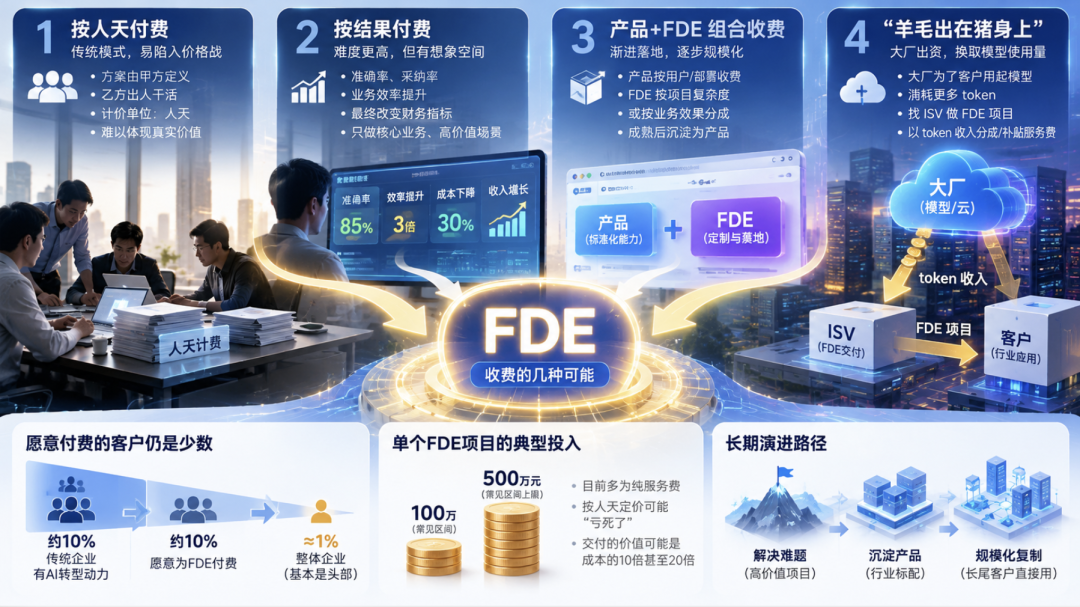
This is why OpenAI's head of FDEs emphasizes "only doing core business, high-value scenarios." But what price corresponds to high value? There is still no answer. For a company that has built an FDE team, the biggest worry is pricing: pricing by person-day means "losing money badly," because the value delivered may be 10x or even 20x the cost of these people.
Wang Peng's report tallies that a current FDE project involves investment at the million-RMB level, with a common range of 1 million to 5 million RMB, and it's pure service fees. And few clients are willing to pay that. Wang Peng estimates that about 10% of companies in traditional industries are motivated to do AI transformation, and of those only about 10% are willing to pay for FDEs—together about 1% of the whole, essentially all leading enterprises.
"FDE costs are necessarily higher early on, because you have to do extra work like the ontology; but once you succeed at a representative company in an industry, you can quickly replicate it to peers and costs drop sharply," he said. Gradually, these capabilities will be absorbed into the product and become an industry standard, and long-tail customers can just use the product directly.
PingCAP's current approach is a combination: one way is to bundle the product with FDE, with the product charged by user deployment and the FDE by project complexity; another way is revenue sharing based on business results; overall it's still being explored. Even so, Liu Song still says: "How exactly to price FDE is the industry's biggest mystery."
Another line of thinking is "the wool comes from the pig." The industry sees that if ISVs want to improve their business model, the new possibility comes from the big tech companies. Big companies do FDE to get customers using their models and consuming their tokens, so their motivation far exceeds ISVs'. They can hire ISVs to do projects, effectively sharing out part of their token revenue. Li Gang believes this logic resembles the mainframe sales of years past: users then demanded free mainframe software, and in the end the money vendors made on solutions came out of generous hardware profits. Today, this money may come from the model side.
Huo Jia believes the question ultimately comes down to the moat. "For a vendor, the moat must be the product." At Alibaba Cloud, driving product adoption is an important KPI for the FDE team. The other path is for clients to sign long-term service contracts. Previously, Chinese companies were used to signing contracts per project. However, Huo Jia has observed that some startup teams in Beijing and Shanghai, mostly made up of people born in the 1990s, began working with service contracts three years ago—after proving their value they secured long-term client contracts, some have grown to nearly a hundred people, and they are making a profit.
04 How FDEs work—is it heavier than ERP implementation?
The FDE's first step on entering is choosing the scenario. Li Gang believes the biggest gap today is knowledge processing. "Over the past few decades, only one product in the knowledge domain has been truly great: Office. But it only solved the recording and sharing of knowledge; processing knowledge is basically beyond it." Large models happen to open up this market—knowledge-intensive scenarios with high-paying roles will see explosive growth; coding is another big domain.
Beyond scenarios, a very important task for the FDE is building up the enterprise knowledge that past digitalization failed to capture—something like Palantir's ontology. The ontology sounds a bit "mystical," but it's really a "manual of the enterprise's business" prepared for AI: what things exist in the company, what each means, how they relate to each other, and what rules must be followed.
Does the ontology have to be heavy? Zuo Chun advocates lightweight ontologies. In the knowledge graph era, when big companies built graphs at enterprises, "just building the graph database took several hundred people—that path simply doesn't work." He believes the FDE should decide the ontology's complexity based on specific goals, building it up goal by goal. AI has also made ontologies cheaper. Wang Peng says that in the insurance industry projects they've encountered, experts "don't hand-craft the ontology, they just review and fine-tune it," reducing the workload by one to two orders of magnitude.
On pacing, Huo Jia says the biggest difference between today's FDE and the traditional approach is starting work without waiting for the SOW (statement of work), and finding ways to keep the collaboration as flexible as possible. "In the past, to sell person-days, people liked to stretch out project timelines; the FDE must compress the timeline." On a project at a state-owned enterprise, the initial plan was to go live for the first time only after three months. "That approach fails 100% of the time." Huo Jia went directly to meet the company's chairman and ultimately changed delivery to monthly releases, then later to weekly ones.
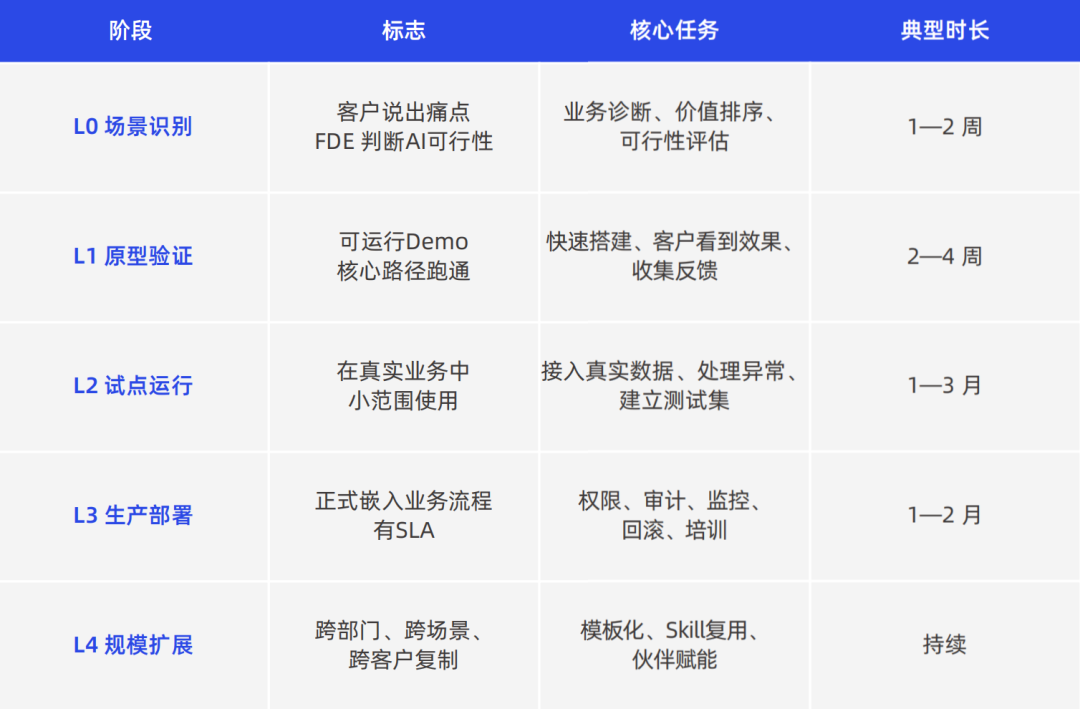
Chart source: Tencent Research Institute, "FDE Model: Industry Observation and Practice"
Liu Song's team's project at a financial institution, using the PingCAP Loop multi-agent collaboration platform, shows the FDE's concrete moves on the ground. The client wanted to develop a large securities business software system and first handed one component to its own development team and the PingCAP team to test the waters together. This client had already used vibe coding for a year, yet encountered a string of problems: distorted requirements, out-of-control code quality, and a lack of standards.
The team first explains the working mechanism and capability boundaries to the customer. After the FDE team comes on site, they first set standards for development governance and "usability," using AI agents for automated quality checks. During the requirements phase, FDEs and AI conduct "Socratic" questioning of the business side, probing boundary conditions and exception scenarios; during development, each AI output is capped at three days' worth of work, leaving room for human review, with test-driven development. After a month, the components run through a closed loop, and the entire system—including the knowledge base middle platform MeshX—is deployed at the customer. The experience is distilled into a playbook, and the customer team takes over development of the next module.
The final hurdle is organizational. Liu Song's team once tried to promote the human-agent collaborative model to finance and healthcare customers, but they asked to "respect existing management rules, business processes, and division of responsibilities." So they turned the multi-agent capabilities into a PaaS, broken down into atomic capabilities, embedded through interfaces into the customer's existing systems. In the end, the interface stays unchanged while the underlying layer is replaced with a platform centered on large models and agents.
Wang Peng analyzes that AI essentially eliminates the friction of layer-by-layer communication within enterprises; middle management is likely to resist this change, so FDEs must first win over the top leader. Huo Jia's experience is that both parties must become one team—"if you still work in the client-vendor way, the project will most likely fail." The industry has seen that, fortunately, in this round of AI adoption, many division chiefs born in the 1970s, 1980s, and around 1990 are taking the helm—"they really want to get things done."
Liu Song recently attended a conference where many CIOs who had done ERP implementations believed that AI adoption, like ERP back in the day, is a very heavy implementation. In his view, this is even heavier than ERP, because FDEs ultimately have to embed a digital employee system into the customer's organization. Back then, ERP reshaped processes and data; this time, agents will ultimately reshape how enterprises work, their decision-making mechanisms, and their organizational structures.
05 The FDE Arena: Which Factions?
The FDE arena has participants from several different backgrounds.
One type is large model companies and major cloud vendors doing FDE, aiming to drive model calls, tokens, and cloud resource consumption, while also valuing frontline demand flowing back into AI products. OpenAI and Anthropic have each partnered with investment institutions and consulting firms to form FDE companies, diving into high-value scenarios like finance for validation and product development. When Alibaba Cloud does FDE, frontline demand flows back in real time to product teams like Qwen Office and Qoder.
Another type is product platform companies like PingCAP, which started with the open-source database TiDB and has extended into AI in recent years, launching the multi-agent collaboration platform Loop and the knowledge base middle platform MeshX. It uses FDEs in key industries such as finance, healthcare, and manufacturing to validate and deploy its own multi-agent product system. "In theory, early on we help customers build benchmark scenarios and make good use of PingCAP Loop. In the future, customers will no longer buy our FDEs, only the product system; their own FDEs can use this Loop multi-agent platform to build their digital employee systems faster."
There are also ISVs focused on applications and large outsourcing vendors, all building agent platforms. For them, FDE is itself a business, and the key is whether it can improve gross margin.
Where does FDE talent come from? Palantir-style FDEs come in two roles: Echo and Delta. Wang Peng says Palantir has a saying: a person who can do Echo "is like a small CEO," needing a cross-industry, cross-domain knowledge structure, understanding both business and AI.
Zuo Chun also values Echo more. In his view, this role is highly practical, the person may be slightly older, and what matters most is initiative and the ability to learn, understand, and communicate. If the knowledge boundary is too narrow, "no matter how much you say, the customer simply won't accept you." Delta can be younger, since new technologies can be picked up through training. Liu Song observes that those currently qualified are basically mid-level or above people with strong AI sense; junior staff can hardly take on the role.

Each company builds teams differently. Alibaba Cloud doesn't split Echo and Delta, instead pushing solutions architects with technical backgrounds and long customer-facing experience "one step forward." Huo Jia found that what determines whether someone can become a good FDE is not just technical knowledge but also communication—"can they understand and express things clearly"—and at the most basic level, telling the customer whether something should be done and what it costs.
Almost everyone emphasizes initiative: an FDE who can truly solve problems is not necessarily the most experienced, but may be the one with the strongest initiative.
FDEs won't necessarily all come from outside. Wang Peng observes that AI-native companies like large model firms and autonomous driving companies have a situation where "everyone is an FDE," with no need for third parties; traditional industries will gradually grow such roles internally. He cites the example of "Director Xie," who recently went viral: during this year's flood season, this deputy director of the Miyun Branch of the Beijing Municipal Planning and Natural Resources Commission bought 1 billion tokens himself and spent nearly a month using AI to write a flood-prevention mini program. Alert releases and resident evacuation statistics were all completed in real time within the mini program. "He is essentially playing the role of an FDE—this is the more ideal state." In Wang Peng's view, what vendors should really do is lower the barriers to AI and programming enough that more and more industry experts can personally act as FDEs.
This also raises new questions for education. FDEs are hard to fit into existing disciplines: building financial software requires understanding both economics and technology, and curricula can only change slowly, so for now everyone relies mainly on on-the-job training. Wang Peng judges that people like Echo, who need to span the humanities and sciences, cross industries, and have innovative thinking, "can hardly be cultivated" by the current education system. He has noticed that overseas, more and more FDE talent is being cultivated from high school students: they have solid foundational knowledge and haven't yet been constrained by industry processes and habits. "China will see this trend too."
Text | Zhou Xiang_, Wanzi, Xiao Ke; Edited | Zhao Yanqiu
This article was originally written/authorized by the author [Shuzhi Qianxian] of "Everyone Is a Product Manager" (人人都是产品经理), WeChat official account: [Shuzhi Qianxian], and published on Everyone Is a Product Manager. Reproduction without permission is prohibited.
Cover image from Unsplash, licensed under CC0.





- No comments yet—be the first to share your thoughts!