The Ground-Force Implementer of the AI Era: A Comprehensive Analysis of the FDE (Forward Deployed Engineer)
Companies worldwide have invested over $30 billion in generative AI, yet 95% of projects fail to generate positive profit—technology is no longer the bottleneck; the last mile between technology and real business has completely broken down. The FDE (Forward Deployed Engineer), the only hybrid role in the AI era that connects standardized technology with non-standardized scenarios, is becoming the core focus of the tech hiring market with million-yuan salaries. From a product manager's perspective, this article breaks down the underlying logic and complete closed loop of the FDE.

Many AI newcomers share a common confusion: with large models and AI algorithms emerging endlessly, open-source models readily available, and enterprise AI teams constantly expanding with growing budgets, why do the vast majority of enterprise AI projects end up as "demo products" that never truly land and generate business value?
The NANDA team at MIT gave a painful answer in its 2025 report "The GenAI Divide: State of AI in Business 2025": global enterprises have cumulatively invested over $30–40 billion in generative AI, but 95% of AI projects produce no measurable positive impact on corporate profit statements.
The industry's core bottleneck is no longer "AI technology isn't strong enough," but rather the complete breakdown of the last mile between technology and real business—models that run perfectly in the lab immediately fail and struggle to adapt when deployed in enterprises' complex, non-standardized, and legacy real-world business scenarios.
In traditional internet and software industries, the product delivery loop is relatively smooth: standardized products + remote iteration + online updates complete value delivery. But the AI industry is entirely different. The core of AI value is "scenario-based enablement"—there is no universal, all-purpose AI product, only AI solutions tailored to specific businesses, specific processes, and specific data.
Under this industry transformation, the division-of-labor barriers among traditional R&D, product, and delivery roles have completely collapsed, giving rise to a brand-new core role—the FDE (Forward Deployed Engineer).
Especially in recent years' tech hiring market, top global AI companies have been aggressively expanding FDE hiring, with salaries far exceeding those of ordinary engineers. ByteDance offers monthly salaries of 35,000–70,000 yuan with 15 months' pay per year, reaching up to 1.05 million yuan annually; Alibaba Cloud Intelligence offers 20,000–50,000 yuan monthly with 16 months' pay per year; in Silicon Valley, the median total annual compensation for senior FDEs at frontier labs reaches $485,000.
Meanwhile, OpenAI has partnered with 19 PE firms to invest over $4 billion in establishing a deployment company; Anthropic has partnered with Blackstone, Goldman Sachs, and others to establish an enterprise services company valued at $1.5 billion; Amazon Web Services announced a $1 billion investment to build an FDE team of thousands. FDE-related positions surged from 643 in April 2025 to 5,330 in April 2026—a year-over-year increase of nearly 729%.
The FDE has become one of the scarcest and most critical roles in the AI industry. Yet the vast majority of AI newcomers, working professionals, and even business managers cannot clearly define the FDE, cannot distinguish it from ordinary development, implementation, or pre-sales roles, and fail to understand the underlying logic behind companies hiring FDEs at high salaries.
Is this a brand-new golden profession born of the AI era, or just "old wine in new bottles" concept hype?
As a product manager, I want to use a complete product-thinking framework to help AI newcomers truly understand the FDE—what it is, what it does, why it's hot, and whether it's worth it.
Chapter 1: What Is an FDE?—Redefining It from a Product Manager's Perspective
1.1 Explaining the FDE in One Sentence
If I had to explain the FDE to an AI newcomer in one sentence, I would say:
An FDE is "an engineer who goes to the front lines with a toolbox"—stationed at the customer's site, understanding the business while writing code, breaking down a vague AI idea into a production system that is runnable, evaluable, and sustainably maintainable.
Breaking it down, this definition contains four key phrases:
- "Going to the front lines"—not writing generic code at headquarters, but going to where the customer is
- "Carrying a toolbox"—possessing complete engineering and technical capabilities
- "Understanding the business while writing code"—spanning business understanding and technical implementation
- "Breaking it down into a production system"—not just building demos, but delivering something that actually works
Taken literally, "Forward Deployed" is a military term whose core meaning is leaving the rear headquarters, going deep into the front-line battlefield, and making decisions, executing, and iterating on the spot. This is the most fundamental difference between FDEs and all traditional technical roles: traditional engineers work "in the rear office, delivering remotely," while FDEs are "stationed at the front line, tackling problems on-site, closing the loop on delivery."
Combining the product manager's value closed-loop theory, I offer a precise definition of the FDE that newcomers can fully understand:
The FDE is a hybrid value-delivery role exclusive to the AI era, the sole core bridge connecting an enterprise's standardized AI technical capabilities with customers' non-standardized real business scenarios. It breaks the fragmented division of "product defines requirements, R&D builds features, delivery handles deployment," with one person handling the entire chain of "requirement discovery, on-site implementation, problem-solving, product feedback, and value validation." The core goal is not "delivering a product" but "landing value."
Simply put: traditional engineers are responsible for "building the product," while FDEs are responsible for "getting the product used, making it effective, and iterating it to work better."
1.2 The Origin of the FDE: From Palantir's "Necessity" to the AI Era's "Inevitability"
The FDE was not invented out of thin air in the AI era. To understand it, you must return to its source—Palantir.
Palantir was founded in 2003, initially serving US intelligence and defense agencies. These clients faced a fundamental problem: their work was highly classified, making it impossible to describe their requirements in detail to external engineers. After Palantir's founders showed demos to potential clients, the feedback was: "This product is terrible—it has nothing to do with what we do."
The traditional software development model completely failed here—it was impossible to first write requirement documents, then develop, then deliver. Palantir's solution was to have engineers directly embed at the client's site. Engineers were not just technical support staff, but people who truly embedded themselves in the client organization, understood business pain points, and directly wrote programs to solve problems.
This model gradually became Palantir's core competitive advantage and gave rise to the title "Forward Deployed Engineer." Within Palantir, FDEs are called "Delta," complementing the "Dev" (Software Engineer) role responsible for product development. By around 2016, Palantir's FDE headcount even exceeded that of traditional software engineers.
Palantir officially describes this model as "the human equivalent of backpropagation"—engineers stay as close to the problem itself as possible, collaborating with the core engineering team to continuously synthesize and transform on-site feedback into new features.
After the AI wave emerged, companies like OpenAI and Anthropic began widely adopting this model. Why? Because the deployment of generative AI faces the same dilemma—demos look beautiful, but once they enter real enterprise environments, they hit all kinds of practical problems. The FDE, this "old approach," has found a brand-new stage in the AI era.
1.3 The Core Underlying Logic of the FDE (Product Duality Theory)
The vast majority of FDE explainers on the market merely list job responsibilities, ignoring its most essential duality—which is precisely why 90% of AI newcomers can't understand the FDE.
From the perspective of product manager role evolution and value accumulation, the FDE is inherently endowed with a bidirectional closed-loop capability of delivery implementation + product iteration—two forces that check and empower each other, both indispensable:
Left hand · Delivery side (immediate value): Facing customers' real business scenarios directly, solving non-standardized implementation problems, adapting to customers' legacy systems, complex processes, and special rules, rapidly completing AI feature deployment, debugging, and trial runs, taking full responsibility for landing business value for individual customers, and solving the problems of "usable and easy to use."
Right hand · Product side (long-term value): During on-site implementation, continuously uncover common pain points, shared needs, and implementation pitfalls, and abstract and distill non-standard solutions from individual customers into reusable product capabilities, general templates, and standardized processes, feeding them back to the product and R&D teams in the rear. This role is responsible for the overall iteration and upgrade of the product, solving the problem of "replicability and scalability."
This dual logic is the core moat that distinguishes FDEs from pre-sales, implementation, outsourcing, and ordinary R&D roles, and it is the underlying reason for their high salaries and scarcity. Ordinary technical positions only handle work in a single dimension, while FDEs take on the dual closed loop of "short-term delivery value + long-term product value," making them the core hub for enterprises' AI commercialization at scale.
1.4 Understanding the FDE's Positioning in One Diagram
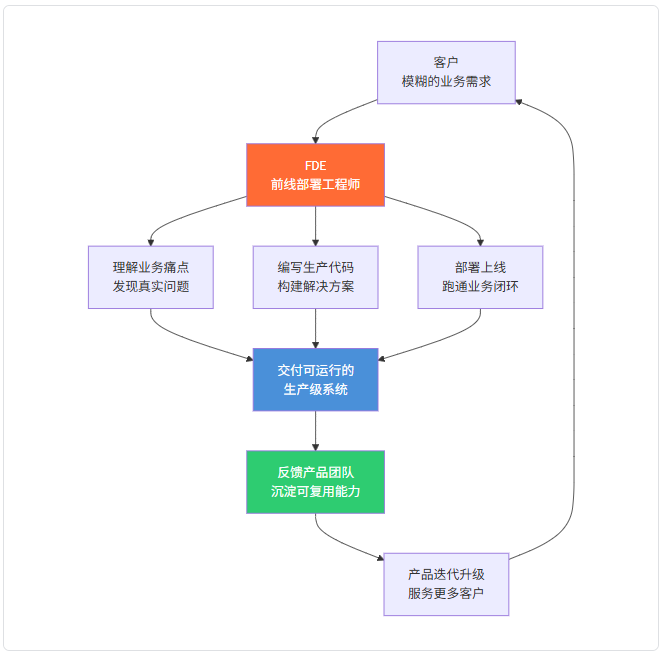
The core logic of this diagram: the FDE is the bridge connecting "customers' vague needs" and "a runnable production system," while also feeding frontline insights back to the product team, forming a positive cycle.
Palantir has officially given a precise and classic positioning: the FDE's working model is highly consistent with that of a startup CTO. In a small frontline team, the FDE takes end-to-end full responsibility for high-risk, high-difficulty AI implementation projects—no cumbersome division of labor or handoffs, no layers of approval, and the ability to make decisions, implement, and iterate quickly on-site.
Unlike traditional roles where "everyone does their own job and delivers in stages," the FDE is the owner of the entire chain: if requirements aren't understood, they break them down themselves; if the system doesn't run, they debug it themselves; if processes don't fit, they adapt them themselves; if the product has flaws, they give feedback themselves; if results fall short, they optimize themselves. This "one-stop closed-loop capability" is precisely the core capability most needed in complex AI implementation scenarios.
Chapter 2: The FDE's Scope of Responsibilities — A Complete Closed Loop from Entry to Exit
2.1 The Full Picture of Responsibilities
The complete work cycle of an FDE can be broken down into five phases:
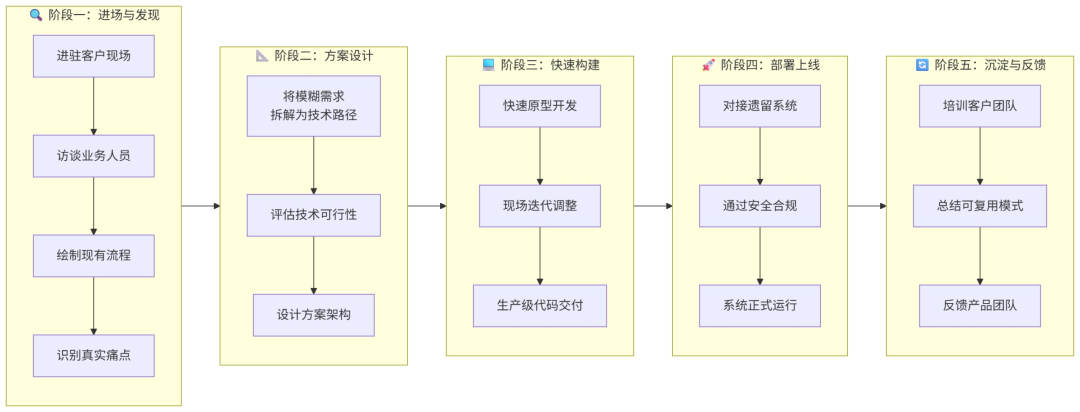
2.2 Detailed Breakdown of Each Phase
Phase One: Entry and Discovery
The first thing an FDE does after arriving at the customer's site is not to write code, but to understand. They need to map out the customer's existing systems—which data sources, which legacy systems, what permission structures, what compliance requirements. More importantly, they must understand how business people actually work—the operations that happen in practice, outside of what's written in process documents.
The biggest pitfall in AI implementation is "implementing pseudo-needs." Customers often cannot clearly articulate their pain points and only put forward vague feature requests; traditional pre-sales and product teams are easily misled by surface-level needs, ultimately resulting in "features that no one uses, while users' real pain points go unsolved."
The FDE's primary responsibility is to go deep into the business frontline and complete separating real needs from false ones and deep decomposition:
1. Immersive on-site research: fully embed in the customer's business scenario, follow business staff through the entire workflow, and understand the real business logic, process bottlenecks, and efficiency pain points, rather than judging needs based on the customer's verbal descriptions or written documents;
2. Translating vague needs: translate vague requests like "we want intelligent efficiency gains" or "we want intelligent analytics" into AI technical requirements that are implementable, quantifiable, and verifiable;
3. Prioritizing needs: based on business value, implementation difficulty, and cost, filter out high-value essential needs and eliminate invalid pseudo-needs to avoid wasting resources;
4. Stakeholder alignment: engage with multiple roles across the customer's business, IT, and management to unify implementation expectations and clarify the core metrics and acceptance criteria for AI implementation.
A typical scenario: the customer says "I want an AI customer service system." After arriving on-site, the FDE discovers that the real pain point is that customer data across multiple business systems is completely disconnected, and low customer service efficiency is only a surface symptom. If you build an AI customer service system directly, the core problem remains unsolved. The FDE must first penetrate the surface and find the problem truly worth solving.
Phase Two: Solution Design
After finding the real problem, the FDE must translate vague business requests into concrete technical solutions. This requires breaking down empty ideas like "I want to use AI to cut costs and boost efficiency" into implementable technical paths.
Standardized AI products can only fit generic scenarios, while 90% of enterprises' real business scenarios are non-standard: incompatible legacy systems, messy data formats, unusual business processes, strict security permissions, and numerous customization rules. This is also the core reason ordinary AI products fail in implementation.
The FDE's core engineering responsibility is to solve the last-mile implementation challenge of non-standard scenarios:
1. On-site system adaptation: connect with the customer's on-premise systems, legacy ERP, CRM, and industrial control systems, solving problems like disconnected interfaces, data isolation, and format incompatibility;
2. Rapid prototyping and iteration: based on the company's core AI models and standardized platforms, quickly develop customized adaptation modules and build implementation prototypes suited to the customer's scenario, without waiting for remote scheduling from the rear R&D team;
3. Production environment deployment and debugging: independently complete on-site deployment, stress testing, bug debugging, and security adaptation of the AI system, ensuring stable integration into the customer's production environment and true business usability;
4. Immediate problem-solving: resolve unexpected implementation issues on-site, such as data anomalies, model accuracy deviations, process adaptation conflicts, and permission errors, preventing project stalls and failures.
Phase Three: Rapid Building
The FDE's core deliverable is not a PPT or solution document, but runnable production-grade code. They typically need to go from a vague customer problem to a working prototype (Proof of Concept) within days, and to production-grade deployment within weeks.
Unlike sales, whose core goal is "closing deals," the FDE's core goal is "deepening value." Through immersive on-site implementation, the FDE understands the customer's business pain points and potential needs best, making them the core role in mining existing customer value and increasing customer stickiness:
1. Answer customers' technical questions, resolve long-term usage issues, and build deep trust;
2. Uncover customers' potential business scenarios, promote cross-scenario reuse of AI capabilities, and achieve project expansion, renewals, and additional purchases;
3. Collect customers' long-term strategic needs, providing frontline input for the company's long-term product planning and industry positioning.
The FDE is the core hub between the enterprise's frontline and rear, needing to connect sales, product, R&D, algorithms, and after-sales teams: facing forward to engage with the customer's business, facing backward to sync implementation progress, issues, and needs, and coordinating rear resources to solve core technical challenges the frontline cannot overcome, achieving an efficient closed loop of "frontline implementation + rear iteration."
Phase Four: Deployment and Launch
This is the most easily underestimated phase. An AI model may run perfectly in a demo environment, but once it enters a real enterprise environment it hits: legacy systems without standard interfaces, uneven data quality, incompatible permission systems, and failed compliance audits. The FDE must solve these problems one by one to get the system truly running.
A core product manager principle: implementation without value validation is ineffective delivery. Many AI projects end once deployment is complete, but never verify whether they truly improve business efficiency or reduce costs—this is the key reason AI projects "seemingly land but are actually ineffective."
One of the FDE's core responsibilities that distinguishes them from ordinary engineers is taking full responsibility for business outcomes:
1. Business user training: guide customer employees in using the AI system, establish standardized usage processes, and resolve user operation bottlenecks;
2. Implementation effect monitoring: track the AI system's operational data and business usage data in real time, measuring core metrics such as efficiency gains, cost reductions, and error rate declines;
3. Value closed-loop validation: verify the real business value of AI implementation against the acceptance criteria agreed upon earlier, producing a quantifiable implementation report;
4. Experience optimization and adjustment: based on user feedback and business operational data, fine-tune system features and process logic on-site to improve product fit.
Phase Five: Consolidation and Feedback
The FDE's responsibilities don't end with delivery. They must also train the customer's team so they can operate and maintain the system independently after the FDE leaves; at the same time, they feed lessons learned on-site back to the product team to drive product iteration.
This is the FDE's most core, most scarce, and most easily overlooked responsibility, and it is the key criterion for distinguishing a "real FDE" from a "fake rebranded FDE." Ordinary delivery roles serve only a single customer and end once the work is done, whereas the FDE bears the responsibility of being the core data source for the enterprise's product iteration at scale.
The FDE needs to convert non-standard deployment experience from individual customers into reusable, general-purpose product capabilities for the enterprise:
1. Distilling common pain points: aggregating deployment pitfalls, high-frequency requests, and adaptation difficulties across multiple customers, and filtering out industry-wide common problems;
2. Abstracting non-standard solutions: abstracting a single customer's customized adaptation schemes, interface modifications, and process optimization logic into general templates, configurable components, and standardized adaptation tools;
3. Feeding product requirements back: delivering precise iteration requirements to the product and R&D teams behind the scenes, driving the core product to improve model accuracy, add adaptation features, and refine industry solutions;
4. Accumulating industry methodology: summarizing AI deployment processes, adaptation standards, and pitfall-avoidance guides across different industries, and building an enterprise industry deployment knowledge base to reduce deployment costs for future customers.
2.3 How FDEs Spend Their Time
Based on industry practice, an FDE's working time can roughly be allocated as follows:
- 25%: pure coding
- 50%: integration and debugging (connecting to customer systems, handling data, resolving compatibility issues)
- 25%: communication and project management (aligning requirements with customers, coordinating resources, driving decisions)
Chapter 3: How the FDE Differs from Other Engineers — One Table to Understand It All
The question AI beginners and working professionals most easily get confused about: what exactly is the difference between an FDE and a backend developer, algorithm engineer, implementation engineer, pre-sales architect, or Solutions Engineer?
To attract candidates, many companies package traditional implementation or pre-sales roles as FDEs, leading to a flood of "fake FDEs" in the market. This section makes a precise distinction across five dimensions — product division of labor, value orientation, work scenarios, competency model, and salary logic — and also provides criteria for identifying real vs. fake FDEs, completely eliminating cognitive confusion.
3.1 Comparison Table of Key Role Differences

3.2 In-Depth Interpretation of Key Role Differences
3.2.1 FDE vs Algorithm Engineer: The Division Between a Model That "Works" and One That "Works Well"
The two roles AI beginners most easily confuse: the algorithm engineer is responsible for building good models, while the FDE is responsible for using models well.
The algorithm engineer's core work is optimizing model parameters, improving general accuracy, and training datasets in the lab, pursuing "maximizing the model's theoretical performance," completely detached from specific business scenarios. As a result, many models score perfectly in the lab but, when deployed in real scenarios, become completely unusable due to messy data, mismatched processes, and scenario-specific quirks.
The FDE, by contrast, does not train models or tune core algorithms; the core work is adapting the general-purpose models built by algorithm engineers to specific business scenarios, solving the adaptation, process, data, and experience problems of model deployment.
In short: the algorithm engineer solves the "technical ceiling," while the FDE solves the "deployment floor." Without an FDE, even the best AI model is a castle in the air.
3.2.2 FDE vs Ordinary Development Engineer: Building Products in the Back Office vs Creating Value on the Front Line
Palantir has an incisive internal summary:
- Dev (traditional software engineer) focuses on "one capability, many customers"
- Delta (FDE) focuses on "one customer, many capabilities"
Ordinary backend/frontend developers are typical "back-office executors": all their work is based on requirement documents produced by product managers; they are only responsible for feature development and need not care whether requirements are genuine, whether they fit the business, or how deployment turns out. Once development is complete and the code is tested and launched, the work is done — they never touch customers or understand the business.
The FDE is a "front-line decision-maker + executor": there is no fixed requirement document; the FDE must discover requirements, judge them, design custom solutions, implement them, and iterate. The ordinary developer "builds one standardized feature for a massive number of customers," while the FDE "builds end-to-end business capabilities for one customer" — and then reuses those capabilities for a massive number of customers.
3.2.3 FDE vs Implementation Engineer: Closed-Loop Delivery vs Executing Deliveries
This is the role most easily confused, and the one with the most "fake FDEs" on the market. Many companies simply rename implementation engineers as FDEs — essentially job repackaging.
The implementation engineer's core is standardized execution: after the product is finalized, they follow a fixed process to complete deployment, installation, and training. They can only solve standardized problems — no custom development, no product iteration, no handling of complex non-standard scenarios. When they encounter system incompatibility, process conflicts, or requirement changes, they can only report back to the team behind the scenes and cannot resolve issues on-site.
The FDE's core, by contrast, is non-standard problem-solving + value closure: they have the ability to develop independently, modify on-site, and iterate immediately, can solve all non-standard deployment challenges, and their core goal is not "completing the delivery" but "generating business value," while also bearing the core responsibility of feeding product iteration.
3.2.4 FDE vs Pre-Sales Architect: Accountable for Deployment Outcomes vs Accountable for Closing Deals
The pre-sales architect's entire work has one core goal: helping sales close deals. Their work is concentrated in the early project stage; once the deal is signed, they immediately exit the project, taking no part in deployment and bearing no responsibility for outcomes. Their compensation includes sales commissions and performance bonuses, strongly tied to deal size.
The FDE's work is concentrated after the deal is signed; they are accountable for deployment outcomes, business value, and long-term iteration. They do not participate in deal-making and receive no sales commission; their compensation structure is "base salary + performance bonus + stock," strongly tied to deployment value and product iteration results.
3.3 A Broader Perspective: The FDE as a "Tri-Hybrid Talent"
Palantir has officially given a precise and classic positioning: the FDE's working model is highly consistent with that of a startup CTO. In a small frontline team, the FDE takes end-to-end full responsibility for high-risk, high-difficulty AI implementation projects—no cumbersome division of labor or handoffs, no layers of approval, and the ability to make decisions, implement, and iterate quickly on-site.
Unlike traditional roles where "everyone does their own job and delivers in stages," the FDE is the owner of the entire chain: if requirements aren't understood, they break them down themselves; if the system doesn't run, they debug it themselves; if processes don't fit, they adapt them themselves; if the product has flaws, they give feedback themselves; if results fall short, they optimize themselves. This "one-stop closed-loop capability" is precisely the core capability most needed in complex AI implementation scenarios.
Overall, the FDE is a highly hybrid role:
- 20% sales: understanding customer needs, building trust, driving collaboration
- 30% product: requirements analysis, solution design, product thinking
- 50% engineering: writing code, doing integration, deploying to production
It sits at the intersection of product management, software engineering, and strategic consulting.
Based on the JDs and deployment models of leading industry companies, here are 5 stress-test criteria that beginners can use directly to tell real FDE roles from fake ones:
1. Salary structure (the hardest criterion): a real FDE has no sales commission; compensation is base salary + performance bonus + equity. Any role with performance commissions or deal bonuses is a rebranded pre-sales/implementation position.
2. Work content: a real FDE spends over 70% of their time writing production code and doing on-site development and debugging; those who only write proposals, make PPTs, and demo prototypes are architects/pre-sales.
3. Product feedback channel: a real FDE has a well-established mechanism for distilling field experience into general product capabilities; roles with no product feedback loop that leave once the work is done are outsourcing/implementation.
4. Timing of engagement: a real FDE comes in after the deal is signed and is accountable for deployment outcomes; those who come in before signing to help close deals are pre-sales.
5. Requirement decision-making authority: a real FDE can independently judge whether requirements are genuine, optimize solutions, and reject invalid requirements; those who can only passively execute customer requests are basic delivery roles.
Chapter 4: Why Enterprises Need FDEs — Pain Points, Necessity, and Value
4.1 Product Strategy Perspective: Solving the Core Pain Points of the AI Industry
From the product manager's pain point–solution–value matching theory, the birth of the FDE is not a case of companies following trends, but an inevitable strategic choice as the AI industry has reached its current stage. The traditional division-of-labor model can no longer solve the three core pain points of AI commercialization, and the FDE is the only solution that fits.
4.1.1 Pain Point One: The Inherent Contradiction Between Standardized AI Technology and Non-Standardized Business Scenarios
Traditional internet products (social media, e-commerce, office software) have highly standardized user needs and usage scenarios. A single product can serve tens of millions of users, and value delivery can be completed through "back-end R&D iteration + online updates."
But AI products are completely different, especially enterprise AI and industry AI: there are no standardized scenarios, only non-standardized needs. The business processes, data standards, system architectures, and core pain points of different industries, companies, and departments are all completely different. General-purpose AI models must go through scenario adaptation, custom modification, and process integration before they can generate value.
Under the traditional division of labor, back-end R&D doesn't understand frontline business, and frontline delivery doesn't understand technical iteration, resulting in "features built by R&D go unused, while features customers need are never built"—a dead loop for implementation. As the frontline technical hub, the FDE perfectly resolves this contradiction, achieving precise adaptation between standardized technology and non-standardized scenarios.
4.1.2 Pain Point Two: Overly Long Traditional Division-of-Labor Chains Lead to Extremely Low AI Implementation Efficiency and Extremely High Costs
The traditional AI project implementation chain: customer raises requirements → sales records them → product breaks them down → R&D schedules them → development and testing → delivery and deployment → after-sales operations. The entire chain involves 5–6 roles, with layer-by-layer handoffs and losses; requirement deviations, communication delays, and slow iteration are the norm.
The core requirement of AI implementation is fast trial-and-error, fast iteration, fast validation. Vague requirements and dynamic scenarios are the norm, and an overly long division-of-labor chain directly leads to project delays, failures, and wasted investment.
The FDE's full-chain closed-loop model completely cuts out redundant intermediate steps—one person handles requirements, development, implementation, iteration, and feedback—greatly improving implementation efficiency and reducing communication costs, labor costs, and trial-and-error costs.
4.1.3 Pain Point Three: Implementation Experience Cannot Be Accumulated, So Companies Cannot Build Scalable Moats
The fatal problem of most AI companies: every customer implementation "starts from zero." Once one customer project is done, all the experience is lost; the next customer means stepping on the same pitfalls again, redeveloping, and readapting. Scalable replication is never achieved, and companies can only pile up labor to do projects, unable to build a product moat.
The core strategic value of the FDE is to transform one-off project delivery into continuous product assets. By accumulating general capabilities, industry templates, and adaptation solutions through frontline implementation, the company's products grow stronger, implementation costs keep falling, replication speeds keep increasing, and a core industry moat is built.
4.1.4 Pain Point Four: AI Projects Emphasize Delivery Over Value, Leading to Extremely Low Customer Retention
The traditional delivery model only cares about "whether deployment is complete," not "whether business value is generated." Many AI projects, after delivery, are shelved or abandoned by customers due to poor fit, complexity of use, or failure to solve core pain points—ultimately leading to non-renewals and no additional purchases, so company revenue cannot grow sustainably.
The FDE takes "business value implementation" as its core goal, following up throughout on usage outcomes, optimizing the experience, and digging deeper into scenarios, ensuring AI capabilities truly empower the business—greatly improving customer satisfaction, retention, and repurchase rates, and achieving a sustainable closed loop of commercial value.
4.2 When Must a Company Deploy an FDE
The FDE is not a universal role; not all software and internet projects need one. Based on the product scenario adaptation theory, I have summarized 6 core scenarios where an FDE must be deployed—also the core tracks of current FDE expansion at AI companies—precisely distinguishing business scenarios that "need an FDE" from those that "don't."
4.2.1 Scenario One: Enterprise AI and Industry AI Non-Standardized Implementation Projects (Core Rigid-Demand Scenario)
AI transformation projects in traditional industries such as industrial manufacturing, finance, government, healthcare, energy, and transportation feature high industry barriers, complex business processes, legacy systems, non-standardized data, and stringent security and compliance requirements. Standardized AI products simply cannot fit; an FDE must be stationed on-site to tackle the work, completing scenario adaptation, custom iteration, and value delivery. This is currently the most core and mainstream application scenario for FDEs.
4.2.2 Scenario Two: Frontier AI Model Commercialization Projects
Frontier AI technologies such as large models, multimodal AI, AI agents, and intelligent decision-making currently have no mature implementation standards, no fixed usage scenarios, and highly uncertain requirements. Such projects cannot rely on back-end standardized R&D for implementation; they need FDEs to go deep into the field, explore implementation scenarios, validate business models, and accumulate implementation standards, paving the way for product scale-up. OpenAI and Anthropic's large-scale FDE hiring is precisely to serve the commercialization of these frontier models.
4.2.3 Scenario Three: High-Risk, Highly Confidential, High-Security Government and Enterprise Projects
4.2.4 Scenario Four: 0-to-1 Exploration and Implementation Projects for New Products and New Tracks
4.2.4 Scenario Four: 0-to-1 Exploration and Implementation Projects for New Products and New Tracks
When a company enters a brand-new AI track or incubates a brand-new AI product, there are no mature requirements, no implementation cases, and no standardized solutions. An FDE is needed to go deep into the field, completing 0-to-1 scenario exploration, requirement validation, model refinement, and case accumulation, helping the company validate its business model and product implementation path.
4.2.5 Scenario Five: Strategic Projects Requiring Deep Customer Co-Creation
AI customization projects for a company's key accounts and strategic partners require deep binding with the customer's business, co-creation of solutions, and long-term iterative optimization. An FDE must be stationed long-term, engaging throughout, continuously optimizing, and digging deep into value, building benchmark customers and benchmark cases to drive industry-wide scale expansion.
4.2.6 Scenario Six: Existing AI Projects with High Failure Rates and Stalled Iteration
When a company's existing AI projects frequently fail, deliver poor results, generate many customer complaints, and cannot be scaled, the root cause is a lack of frontline implementation and iteration capability. Bringing in an FDE can close the implementation loop, resolve bottlenecks, accumulate standardized capabilities, and revitalize existing projects.
4.2.7 Scenarios That Do Not Need an FDE (Reverse Benchmark)
Standardized C-end internet products, general-purpose SaaS software, and lightweight tool products have unified scenarios, standard requirements, remote iterability, and no implementation barriers; there is no need to station an FDE—the traditional R&D + delivery model suffices.
4.3 The Core Value of the FDE
Combining the product value layering theory, the FDE's value is divided into three dimensions—from surface-level implementation value to deep strategic value—fully explaining why this role is highly paid, scarce, and irreplaceable.
4.3.1 Surface Value: Solving the Last Mile of AI Implementation and Closing the Business Value Loop
This is the FDE's most intuitive value: thoroughly solving the industry pain points of AI projects being "hard to implement, poor in results, and prone to failure." Under the traditional model, AI technology can only stay at the demo or pilot stage, unable to integrate into real business processes. Through on-site presence, non-standardized adaptation, and immediate iteration, the FDE gets AI systems truly running in the customer's production environment—genuinely replacing manual work, improving efficiency, and reducing costs—completing the final transformation from "technical demo" to "business value."
Traditional software sales is "I give you the software, you use it yourself." The FDE model is "I help you solve the problem."
For customers, the value of the FDE lies in:
- Faster time to production: integration work handled by an FDE, if left to the customer's own engineering team, might sit in the internal backlog for months
- Higher adoption rates: deployments tailored to how customers actually work are the ones that get truly used; generic configurations often end up sitting on the shelf
- Lower deployment risk: FDEs identify and resolve environment-specific issues before deployment—authentication gaps, data governance gaps, compliance obstacles
4.3.2 Mid-Level Value: Reducing Enterprise Implementation Costs and Improving Commercialization Efficiency
1.Cost reduction: An FDE takes on the composite work of multiple roles, replacing the fragmented division of labor across traditional product, delivery, sales engineering, and operations functions, significantly reducing personnel, communication, and trial-and-error costs; on-site real-time iteration avoids cross-team communication overhead and reduces resource waste caused by project delays and rework.
2.Efficiency gains: By cutting redundant processes, FDEs enable a rapid closed loop from requirements to implementation, shortening AI project implementation cycles by more than 50%; meanwhile, through the accumulation of experience, subsequent similar projects no longer need to reinvent the wheel, continuously improving the efficiency of scaled implementation.
3.Revenue growth: By delivering real value, FDEs boost customer satisfaction, achieving high retention, high repurchase, and high expansion; they also uncover customers' potential use cases, opening up new business growth points and increasing per-customer ARPU.
For companies providing FDE services, the value of FDEs lies in:
Distilling frontline insights back into platform products, reducing the customization cost and time of future projects.
Palantir's model is a classic example: an FDE solved the supply chain data integration problem at Airbus, and that solution was later distilled into a capability of the Foundry platform, so when serving airlines and manufacturers, they no longer had to start from scratch.
This creates a positive cycle:

4.3.3 Deep-Level Value: Accumulating Core Product Assets and Building Long-Term Enterprise Moats
This is the FDE's most core and scarcest strategic value, a value that ordinary technical roles do not possess. FDEs are the enterprise's frontline touchpoint for product iteration, the core source of industry data, and the vehicle for accumulating implementation methodologies.
Every customer implementation is an opportunity for product iteration. FDEs abstract scattered non-standard requirements, implementation pitfalls, and adaptation solutions into generic features, industry templates, and standardized processes, upgrading the enterprise's AI products from "scattered custom projects" to "standardized products that can be replicated at scale," continuously accumulating product assets, industry experience, and customer reputation, and building a core moat that competitors cannot replicate.
FDEs are not just "delivering"—they are also "discovering." Their work is directly embedded in customer workflows, uncovering real operational constraints, organizational dynamics, and architectural bottlenecks.
An excellent FDE does five things:
- Map the customer's workflow, including the hidden logic behind each step
- Uncover hidden constraints—technical, organizational, and process-related
- Educate and align stakeholders, turning vague requirements into clear problem statements
- Build "gravel road" solutions that immediately produce measurable results
- Show the customer new possibilities the product can unlock
- Feed patterns back to headquarters, where product teams codify them into reusable features
Think of an FDE as a product discovery loop embodied as a person—an FDE is the personification of the "product discovery loop."
4.3.4 Industry Value: Restructuring the AI Commercialization Model and Solving the Industry Paradox
The popularization of the FDE model has completely restructured the implementation logic of the AI industry, shifting it from the distorted model of "heavy on technology R&D, light on implementation and application" to a healthy closed-loop model of "technology R&D + scenario implementation + value iteration," solving the industry paradox of "technology surplus, implementation barrenness," and enabling AI technology to truly empower all industries, driving industrial digital and intelligent transformation.
The FDE role also has unique value for individual careers.
A Palantir FDE described their work this way: "I chose to become an FDE because the feedback loop between creating a solution and seeing its effect is extremely short."
This complete closed loop of "discover problem → design solution → write code → deploy → see results" gives FDEs practical experience far beyond that of ordinary engineers. No wonder so many former FDEs later became founders: Tarek Mansour of Kalshi, Quinn Slack of Sourcegraph, Matt Grimm of Anduril, and others.
The essence of FDE work is running a "one-person company"—you independently face customers, define problems, deliver solutions, and take responsibility for outcomes.
Chapter 5: In-Depth Breakdown of Real-World Cases
5.1 Case One: AI-Driven Intelligent Risk Control Implementation in Banking
5.1.1 Project Background: The Extreme Pain Points of AI Implementation in Finance
Banking is the core scenario with the highest requirements for AI commercialization, the strongest barriers, and the greatest ability to demonstrate the FDE's core value. Compared with industrial scenarios, AI implementation in banking has five core characteristics: strict regulatory compliance, highly sensitive data, extremely complex business logic, legacy system architecture, and near-zero fault tolerance. It is also the disaster zone where 90% of general-purpose AI products fail to implement.
This case is based on the retail credit intelligent risk control AI upgrade project of a domestic joint-stock commercial bank, fully reproducing the industry's real implementation situation. The bank's original traditional credit risk control system relied on manual review plus a static rules engine, with serious business pain points: high volume of small loan applications, extremely low manual review efficiency, poor user experience due to no manual staffing at night, and traditional rules unable to identify new types of fraud, resulting in annual bad debt losses exceeding ten million yuan.
The bank procured a general-purpose intelligent risk control large model system from a leading domestic AI company. The model achieved an accuracy rate of 98.7% on test datasets and standardized financial samples, and in theory could fully replace traditional manual risk control review, intercept fraudulent orders, and reduce the bad debt rate.
However, after the project team entered the site, the traditional R&D and delivery teams were completely unable to make progress, and the project stalled, on the verge of being scrapped. The core implementation pain points were all non-standard scenario adaptation issues, which are also the common challenges of all financial AI projects:
1.Non-standard data and compliance barriers: The bank's core credit data is entirely isolated in an intranet classified environment and cannot be transmitted externally or connected to cloud models; the cloud invocation architecture of general-purpose AI models is completely unable to adapt to the bank's localized, private, and intranet/extranet-isolated deployment requirements. Meanwhile, financial data is regulated by the banking regulator, with strict compliance standards for data desensitization, field access, and log retention, which general-purpose products cannot accommodate.
2.Legacy system compatibility barriers: The bank's core credit system, user credit reporting system, and transaction flow system are all legacy architectures over ten years old, with no standardized API interfaces, chaotic data formats, and inconsistent fields, making it impossible for the general-purpose AI risk control system to complete data integration and business linkage.
3.Highly non-standard business rules: The bank has exclusive differentiated risk control rules for small loans, young customer groups, and lower-tier customer groups, which differ from industry-wide standards. The risk control decision logic of general-purpose AI models is too standardized to adapt to the bank's differentiated credit granting and interception rules; direct implementation would cause a large number of misjudgments, wrongful rejections, and wrongful approvals, triggering financial risks.
4.Overly long iteration cycles, unable to adapt to real-time financial risk control: In the traditional back-end R&D iteration model, a single rule optimization or model fine-tuning takes 1-2 months, while financial fraud tactics iterate in real time and new scam schemes emerge constantly—slow iteration is completely unable to meet the needs of real-time risk control interception.
5.Business value cannot be realized: Simply deploying a general-purpose model can only achieve simple data display; it cannot truly integrate into the credit approval process, cannot automatically complete risk control decisions, and cannot reduce the bad debt rate. It can only serve as a demonstration tool with no actual business value.
5.1.2 The FDE's Full-Process Battle After Entering the Site
To revive the project, avoid financial risks, and deliver real business value, the AI vendor urgently dispatched a senior financial FDE specialist team to be stationed long-term in the bank headquarters' technology department and retail credit department, conducting a fully immersive six-month campaign that fully implemented the FDE's end-to-end capabilities of "requirements validation—non-standard adaptation—engineering implementation—value verification—product accumulation," perfectly illustrating the core logic of FDE duality. The specific work is broken down as follows:
Step one: Immersive on-site research to dissect genuine versus false financial requirements (core product capability)
Unlike the traditional pre-sales model of remote engagement and judging requirements from documents, the FDE team is fully on-site, rotating through work alongside the bank's credit reviewers, risk control specialists, and compliance officers, thoroughly mastering the bank's complete credit business processes, regulatory rules, and risk control pain points, and filtering out false requirements to keep the real ones:
1. Eliminating surface-level false customer requirements: the bank initially requested "improving overall model accuracy"; after research, the FDE judged this requirement to have no business value — the core of financial risk control is not general accuracy, but reducing the false rejection rate of quality users and increasing the interception rate of malicious fraud; balancing these two metrics is the core;
2. Uncovering hidden essential requirements: beyond basic risk control review, the bank has five hidden essential needs — automatic retention of compliance logs, automatic generation of risk control reports, tracing of abnormal orders, rapid iteration of new fraud rules, and automatic output of regulatory filing data;
3. Aligning expectations across multiple parties: synchronizing the demands of the bank's business, technology, and compliance departments, and defining core implementation metrics: bad debt rate reduced by more than 15%, manual review efficiency improved by 60%, zero compliance violations, and no batch misjudgment incidents.
Step 2: Customized adaptation for non-standard financial scenarios, breaking through implementation barriers (core engineering capability)
Addressing four major non-standard pain points — the bank's private deployment, legacy systems, compliance controls, and differentiated risk control — the FDE team developed and iterated rapidly on-site, without needing back-office R&D scheduling, resolving all implementation blockers on the spot:
1. Private deployment compliance transformation: completely restructured the model invocation architecture, abandoned the cloud deployment model, completed fully localized intranet deployment of the AI risk control model, and built a bank-specific data masking module, a full operation log retention module, and a tiered permission control module, 100% meeting the CBIRC's financial data compliance requirements;
2. Legacy system integration and adaptation: independently wrote adaptation code, developed dedicated compatibility interfaces for the bank's legacy credit system, completed multi-source heterogeneous data cleaning, field unification, and format adaptation, achieving seamless linkage between the AI risk control system and the bank's core business systems, with real-time synchronization of credit application data and real-time return of risk control results;
3. Customized differentiated risk control rules: based on the bank's specific customer segment rules, fine-tuned model weights on-site and added a custom risk control strategy engine, supporting the bank's flexible configuration of differentiated credit granting, interception, and review rules, solving the "one-size-fits-all" misjudgment problem of generic models and adapting to the bank's personalized business logic;
4. Real-time iteration and hard-hitting problem solving: for new financial fraud schemes in the market, the FDE rapidly updated risk control features and iterated judgment rules on-site, achieving strategy launch within 24 hours, completely solving the industry pain points of lagging traditional R&D iteration and ineffective risk control.
Step 3: Business enablement and quantifiable value verification (operational implementation capability)
The FDE does not just complete system deployment, but takes full responsibility for the bank's final business results, continuously providing business enablement and effect optimization after implementation:
1. Tiered enablement training: training for risk control specialists on AI system operation, abnormal order handling, and rule configuration; training for the compliance department on compliance verification and log auditing; establishing standardized usage processes;
2. Full-dimension data monitoring: real-time monitoring of core business metrics such as credit review efficiency, order pass rate, fraud interception rate, bad debt rate, and misjudgment rate, with daily output of AI risk control operation reports;
3. Refined effect optimization: for the small number of misjudged orders in the early stage, on-site review and optimization of model strategies and rules, continuously polishing adaptation effects to ensure stable system operation.
Final quantified implementation results: the bank's retail micro-credit manual review efficiency improved by 68%, fully automated review was achieved in unattended overnight scenarios, and user credit approval time was reduced from an average of 5 minutes to 10 seconds; the interception rate of malicious fraud orders increased by 22%, annual credit bad debt losses decreased by 18.3%, directly saving the bank tens of millions in costs, with zero compliance violations throughout.
Step 4: Consolidating financial industry capabilities and feeding back into products (FDE's core strategic value)
After the project was stably implemented and its value verified, the FDE team did not leave; instead, it completed the transformation of single-project experience into general-purpose enterprise product assets — this is also the core barrier that distinguishes FDEs from ordinary delivery engineers:
1. Consolidating general financial compliance modules: abstracting the bank's non-standard solutions for private deployment, data masking, log retention, permission control, and regulatory adaptation into standardized AI compliance components for the banking industry, reusable with one click across all bank and financial institution projects;
2. Consolidating legacy financial system adaptation templates: organizing integration solutions and data cleaning rules for the legacy core systems of state-owned banks, joint-stock banks, and city commercial banks into a standardized adaptation toolkit;
3. Consolidating a financial risk control strategy engine: polishing the bank's differentiated customer segment risk control rules and dynamic iteration logic into a configurable, customizable general risk control strategy engine, incorporated into the enterprise's core AI risk control platform;
4. Outputting financial AI implementation methodology: producing the "Banking AI Risk Control Implementation Compliance Handbook" and the "Financial Non-Standard System Adaptation Pitfall Avoidance Guide," and building a financial industry implementation knowledge base.
Through the FDE's consolidation and enablement, the AI vendor subsequently served AI risk control projects at dozens of banks nationwide, reducing implementation cycles from the original 4-6 months to 1 month and implementation costs by 75%, while achieving industry-leading product compliance and adaptability, rapidly building a core competitive barrier in financial AI implementation.
5.1.3 In-Depth Financial Case Review: Fully Understanding the Irreplaceability of the FDE
Through this bank AI risk control implementation case, the core differences between FDEs and traditional R&D, delivery, and implementation roles can be precisely distinguished, thoroughly confirming the FDE's essential value in high-end commercial AI scenarios:
1. Traditional delivery teams can only "do the grunt work of implementation": they can only complete standardized deployment, unable to handle financial compliance non-standard requirements, legacy system compatibility, or differentiated business rules, ultimately delivering only an unusable demo system that produces no business value;
2. Back-office algorithm/R&D teams can only "build standardized products": they do not understand financial regulatory rules or the bank's non-standard business logic, so the generic models they polish cannot adapt to real financial scenarios, and remote iteration completely fails to keep up with the real-time needs of financial risk control;
3. The FDE achieves a fourfold closed loop of "implementation + value + iteration + consolidation": it not only resolves all of the bank's implementation blockers on-site and delivers real cost reduction and efficiency gains, but also transforms single-project customized implementation experience into reusable product capabilities for the enterprise, helping the enterprise upgrade from "single project delivery" to "industry-scale replication."
At the same time, this case perfectly confirms the product theory stated earlier: the core barrier in the AI industry has never been the technical model, but scenario adaptation and implementation capability. With the same model accuracy, the presence or absence of an FDE team directly determines whether an AI project is a "decorative demo" or a "profit-making tool" — this is also the core reason why leading financial AI companies are aggressively hiring FDEs at high salaries.
Final value summary of this project:
1. Customer (bank) level: while satisfying strict regulatory compliance, achieved an intelligent upgrade of credit risk control, greatly improving review efficiency, reducing bad debt losses, and optimizing user experience, delivering real financial business value;
2. Enterprise (AI vendor) level: created a benchmark financial industry case, consolidated proprietary financial AI standardized product capabilities and implementation methodology, greatly reduced subsequent industry implementation costs, and built an industry barrier;
3. Product level: improved the financial industry AI product matrix, filling gaps in compliance adaptation, legacy system compatibility, and differentiated risk control iteration capabilities, upgrading the product from "general-purpose" to "industry-specialized."
5.2 Case 2: AI Quality Inspection Implementation Case in Industrial Manufacturing
5.2.1 Project Background
A large auto parts factory relied entirely on manual labor for traditional parts quality inspection, suffering from three major pain points: low efficiency, high missed detection rates, and high labor costs, which plagued production for years. An AI company provided it with an AI visual intelligent quality inspection system, whose core capability is automatically detecting defects such as scratches, deformation, and blemishes in parts through image recognition.
At the start of the project, the model polished by the company's back-office algorithm team achieved a laboratory detection accuracy of 99.2%, theoretically fully capable of replacing manual inspection. But once the project went on-site, large-scale implementation problems immediately emerged that the traditional delivery team could not solve, and the project was on the verge of failure:
1. The factory's production environment had complex lighting, equipment vibration, and unfixed shooting angles, causing the images collected on-site to differ greatly from the laboratory dataset; the model's on-site accuracy plummeted to 85%, failing to meet production standards;
2. The factory's legacy production systems have no standardized interfaces, so the AI system cannot connect to the production line, making automated data collection, automated quality inspection, and data synchronization impossible;
3. The factory's quality inspection process has special validation rules and grading standards that a standardized AI system cannot adapt to, conflicting with employees' workflows;
4. The traditional delivery team could only complete basic deployment, unable to modify code on-site, adapt to scenarios, or optimize model invocation logic; feedback to the R&D team for iteration took 1-2 months, severely stalling the project.
5.2.2 Full-Process Breakthrough After the FDE Team Arrived (Core Work Recounted)
The company urgently dispatched a 10-person FDE team to stay on-site for 9 months, rooted in the production workshop throughout, completing a full-chain implementation breakthrough. This fully demonstrates the dual working mode of the FDE:
Step 1: Immersive Requirements Discovery and Problem Identification (Product Capability)
The FDE team followed workshop workers through job rotations, thoroughly understanding the production process, quality inspection standards, and environmental pain points, and precisely identified the core reason for the failed implementation: not insufficient model accuracy, but missing scenario adaptation, mismatched data environments, and incompatible workflows. They also uncovered the customer's unspoken implicit requirements: AI quality inspection data needed to sync to the production management system, support defect classification statistics, generate quality inspection reports, and adapt to multi-model parts inspection.
Step 2: On-Site Non-Standard Adaptation and Rapid Iteration (Engineering Capability)
1. On-site optimization of image capture logic: adjusted shooting parameters and image preprocessing algorithms based on workshop lighting and equipment environment to adapt to complex on-site conditions;
2. Development of dedicated integration interfaces: wrote code independently to break through the data barriers between the AI system and the factory's legacy production equipment and management systems, enabling automated collection, quality inspection, and synchronization;
3. Customized workflow transformation: optimized the AI defect determination logic and added custom validation modules based on the factory's quality inspection grading rules to fit the workshop's real workflow;
4. On-site data iteration: collected real production data from the workshop, filtered valid samples, and coordinated with the backend algorithm team to fine-tune the model, raising on-site detection accuracy from 85% to 99.1%, meeting production standards.
Step 3: Business Enablement and Value Validation (Operations Capability)
The FDE team conducted tiered training for workshop employees, establishing standardized usage procedures and exception handling processes; they monitored system operation data in real time and tracked core value metrics: quality inspection efficiency improved by 70%, missed detection rate dropped from 3.2% to 0.3%, and annual labor cost savings for the factory exceeded 2 million, completing the closed-loop validation of business value.
Step 4: Experience Consolidation and Product Feedback (Strategic Capability)
This is the core action that distinguishes the FDE from traditional delivery. After the project stabilized, the FDE team did not simply leave; instead, they consolidated core experience:
1. Distilled a general-purpose image capture solution for complex lighting and vibration environments in industrial workshops;
2. Developed a general-purpose adaptation interface template for legacy industrial systems;
3. Consolidated a custom configuration module for parts quality inspection grading;
4. Produced an industrial AI quality inspection implementation pitfall-avoidance guide and standardized process manual.
All consolidated capabilities were fully synced to the backend product and R&D teams and iterated into the company's core AI quality inspection platform, becoming standardized, general-purpose capabilities. When the company later served similar factory customers, no re-development or re-adaptation was needed; implementation time shrank from 3 months to 2 weeks, implementation costs dropped by 80%, achieving scalable replication.
5.2.3 Final Project Value Summary
1. Customer level: successfully deployed the AI intelligent quality inspection system, achieving cost reduction and efficiency gains, and completing the intelligent upgrade;
2. Company level: delivered a successful benchmark case, increased customer stickiness, consolidated general-purpose product capabilities, and opened up a path for industry-wide scaled implementation;
3. Product level: completed the industrial AI quality inspection product matrix, enhanced scenario adaptation capabilities, and built an industry competitive moat.
5.3 Case Three: Palantir's Classified Defense AI Implementation Case
5.3.1 Project Background
Palantir's early core business was providing AI data analysis and intelligent decision systems for US defense and intelligence agencies, serving classified mission scenarios such as counterterrorism, counter-proliferation, and logistics support. These scenarios share three core characteristics: highly non-standard requirements, highly classified data, dynamically changing tasks, and no universal implementation standard.
The traditional remote development and delivery model was completely unsuitable: classified data could not be transmitted externally, business requirements could not be documented in writing, task scenarios changed dynamically, and system adaptation requirements were extremely high. For this reason, Palantir pioneered the Echo-Delta dual-team FDE model, which became the global benchmark for the FDE model.
5.3.2 The Echo-Delta Core Collaboration Model
1. Echo team (business insight team): composed of industry domain experts, deeply versed in defense business scenarios, familiar with existing workflows, core pain points, and task shortcomings; responsible for uncovering real business needs, aligning with leadership expectations, and screening high-value implementation scenarios—solving the "what to do" problem;
2. Delta team (FDE frontline engineering team): the core FDE team, responsible for rapidly building implementation prototypes, on-site development and adaptation, iterative optimization, and system deployment, validating solutions in real classified scenarios and quickly producing a "usable, effective" implementation prototype (known in the industry as the "gravel road solution")—solving the "how to do it" problem;
3. Backend core product team: observes the frontline FDE's gravel road solutions, distills general logic and common capabilities, and polishes one-off customized solutions into standardized, reusable product capabilities (known in the industry as the "paved road capability"), achieving the upgrade from single-point implementation to scaled products.
5.3.3 Core Value of FDE Implementation
1. Solving the classified scenario implementation challenge: the FDE team is stationed in classified environments, completing system development, deployment, and iteration on-site, avoiding data exfiltration risks and meeting security and compliance requirements;
2. Adapting to dynamic non-standard requirements: for the differentiated needs of different missions such as counterterrorism and logistics, solutions are rapidly iterated on-site to fit dynamically changing business scenarios;
3. Building a product iteration closed loop: continuously consolidating non-standard implementation experience from defense scenarios into general-purpose capabilities of Palantir's core platform Foundry, enabling the product to fit more government and defense sub-scenarios and making it a benchmark product for global government and enterprise AI implementation.
5.4 Case Four: A Tech Company's Implementation at an Overseas Branch of a State-Owned Bank
5.4.1 Background: A Going-Global Bank's Triple Predicament
A state-owned bank opened an overseas branch in Southeast Asia. The business was doing well—cross-border SME account opening, asset custody, investment and wealth management, bond trading—but the IT systems were nearly at breaking point.
First predicament: Technical debt piled up like a mountain
The branch's legacy IT systems contained a large number of outdated modules developed in VB (Visual Basic), carrying extremely long SQL stored procedures. Business documentation had long been lost, and the code had no unified standards. The entire branch had more than 70 mutually isolated systems, like 70-plus islands that never spoke to each other.
Second predicament: Inefficiency across the entire business chain
Core business processes such as bond trading, cross-border account opening, and wealth management approvals relied heavily on email and phone-based offline workflows. Information did not flow between business and technology departments; requirements were passed along by word of mouth, and delivery cycles dragged on.
Third predicament: Dual compliance pressure
The branch had to satisfy two sets of regulatory requirements simultaneously—head office group controls and overseas local financial regulation. Both sets of standards imposed strict requirements on operation audit trails, permission controls, and change traceability. The traditional "billed by person-day" outsourcing model had ambiguous delivery accountability and simply could not satisfy both sets of standards at once.
What was the traditional IT vendor's solution? Send a few people over, charge by the day, write the code, and leave. But what this bank needed was not "someone to write code"—it needed a cross-functional team that could handle technology, business, and compliance all at once.
5.4.2 The FDE Arrives: Not "Sending People," but "Co-Building"
A tech company won this project, but not with a traditional outsourcing model. They adopted a combined approach:
- FDE deep on-site presence: assemble a dedicated FDE team stationed long-term at the customer's site
- Full-chain AI enablement: use AI tools to cover the entire workflow of requirements gathering, code development, and automated testing
- Dual-regulation underlying architecture: one data foundation outputs two sets of regulatory reports
The project started in March 2024 and lasted two years.
5.4.3 What does the FDE team do? — Not "writing code," but "doing business"
This tech company's FDE team is not the traditional "on-site programmer." They combine three capabilities:
Business consultant capability: understanding the bank's business logic — what the cross-border account opening process is, how long the approval chain for bond trading is, what compliance requirements wealth management products have. The FDE team must be able to speak the same language as business staff.
Full-stack development capability: able to write code, refactor architecture, integrate with over 70 legacy systems, and carry out cloud migration.
Product accumulation capability: not just delivering one solution per project, but distilling each problem solved into reusable, standardized components.
The key difference is here: traditional outsourcing is "the customer says what they want, and you build it." The FDE team "proactively uncovers business pain points and delivers customized solutions."
5.4.4 Results: what report card did they deliver in two years?
System level:
- From March to October 2024, the FDE team entered 7 major business domains and took on 12 key system development projects
- In December 2024, the office area was expanded, adding 120 dedicated workstations and an independent security operations center
- By the end of 2024, the team had grown to 74 people
- Throughout 2025, over 50 development projects were completed, with more than 15 million lines of code written, and 16 cloud migration and refactoring projects
Architecture level:
- Upgraded the traditional monolithic development model to a loosely coupled microservices architecture
- Built a bridge integrating overseas systems with the head office's new-generation components
- Used one data foundation to output two sets of regulatory reports — one for the head office and one for overseas local regulators
9 core systems (enterprise applications, electronic channels, investment and wealth management, etc.) went live smoothly. Core applications such as the MPF system, online banking, and the bond trading system not only improved business processing efficiency but also strengthened system security and scalability.
Chapter 6 Summary: The Essence and Future of FDE
6.1 Understanding FDE Through an Analogy
If we compare an AI company to a weapons manufacturer:
- AI researchers: research more advanced gunpowder formulas
- Software engineers: build standardized weapons in the factory
- Sales: show customers how powerful the weapons are
- FDE: goes to the front line with the troops, adjusting weapons based on actual battlefield conditions, teaching soldiers how to use them, and repairing malfunctions on the spot
No matter how powerful AI capabilities are, if no one brings them to the battlefield and makes them truly work, they are just a pile of technology sitting in the lab. FDE is the person who brings technology to the battlefield.
6.2 The Core Essence of FDE
Looking back at this article, the essence of FDE can be summed up in three points:
First, FDE is a "results-oriented" engineer. He is not accountable for his lines of code, nor for the number of features delivered — only for the customer's business outcomes.
Second, FDE is an engineer with "closed-loop thinking." He doesn't just build something and stop; he feeds frontline lessons learned back into the product to make it better.
Third, FDE is an "amphibious" engineer. He must have solid engineering skills (able to write production-grade code), business understanding (able to communicate with non-technical executives), and the ability to independently drive work forward in ambiguous environments.
Companies are willing to pay a high premium for FDEs precisely because this "amphibious" capability is extremely scarce.
6.3 The Future of FDE
FDE is evolving from a standalone role into a standard capability of ToB teams. A major tech company in Hangzhou has already implemented a policy of "new hires spend their first three months as FDEs," and even directly dispatches product managers on-site for requirements research and demo development.
Against the backdrop of rapid AI technology iteration, customer demand for on-site engineering support that "understands both technology and business" is growing sharply. The FDE role will not disappear — it will only become more important.
But a word of caution: FDE is not a model that can be casually copied. It requires high-value customers, a mature product platform, and talent that truly possesses "amphibious" capabilities. Blindly following the trend of hiring FDEs will only become an expensive mistake.
6.4 Advice for AI Beginners
If you are an AI beginner trying to understand FDE, remembering these three sentences is enough:
- FDE is "an engineer who goes to the front line with a toolbox" — not writing generic code at headquarters, but solving problems at the customer's site
- FDE is accountable for results, not lines of code — the goal is to get the customer truly using it and generating value
- FDE is "the personification of the product discovery loop" — discovering problems on the front line, solving them, and bringing the experience back into the product
If you are considering whether to pursue FDE as a career, ask yourself three questions:
- Can I accept working long-term at customer sites (rather than sitting in a comfortable office at headquarters)?
- Can I push work forward when information is incomplete and goals are vague?
- Do I have engineering skills and am I willing to deeply understand the business?
If all three answers are "yes," FDE may be one of the best-fit careers for you.
6.5 Closing Remarks
The essence of FDE is: in the most complex environments, with the shortest feedback loops, turning the vaguest problems into working systems, and then turning frontline experience into reusable product capabilities.
The AI industry has completely left behind the era of wild growth where the game was "competing on technology and model parameters," and has entered an era of refined competition centered on deployment, scenarios, value, and scale.
In the past, a company's core competitiveness was "whether it could build advanced AI technology"; in the future, it will be "whether it can deploy advanced AI technology, use it well, create value, and replicate it at scale." And FDE is the key role that holds this core competitiveness.
For AI beginners, understanding the essence of FDE means understanding the underlying business logic of the AI industry: technology is the foundation, deployment is the core, and value is the ultimate goal.
The rise of FDE is not an iteration of job roles, but a landmark transformation of the entire AI industry from "technical hype" to "industrial practicality." Only by grasping the core understanding of FDE can you truly see the future trends of AI commercialization, avoid industry misconceptions, and precisely seize career and business opportunities in the AI era.
In the AI era, the FDE role will only become more and more important. Keep going, everyone!
Appendix: Glossary
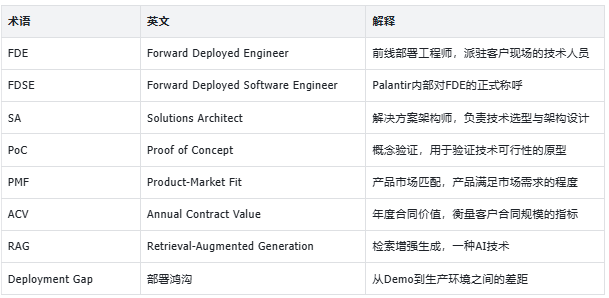
This article was originally written and authorized for publication on "Everyone is a Product Manager" by author [Wang Jialiang], WeChat official account: [Jiajia Original]. Reproduction without permission is prohibited.
Cover image from Unsplash, under the CC0 license.