Hey folks,
If you’re here, you probably commented “FDE” on my Instagram posts. So first off, thank you. And as promised, this is the whole thing: the complete roadmap, the learning guide, and where to find the actual job openings. All in one place. Bookmark it.
A few weeks ago a friend from my Harvard cohort texted me a screenshot. It was an OpenAI job posting. Total comp north of $500K. The title? “Forward Deployed Engineer.”
His message was three words. “What even is this?”
And honestly, I get the confusion. The name sounds like something out of a military briefing. But this is quietly becoming one of the most valuable jobs in tech right now. While everyone is busy learning AI tools, a small group of people is getting hired to actually deploy AI inside companies.
a16z literally called it “the hottest job in tech.” One report tracked 800% growth in these roles during 2025.
So I went down the rabbit hole. I read the Palantir engineering blog, the Pragmatic Engineer breakdown, comp reports covering 1,200 FDEs, and watched a bunch of day-in-the-life videos. Then I pulled it all into one place.
If you’re an engineer wondering whether to make this pivot, or a student trying to figure out where the puck is going, this is your one-stop guide. Let’s get into it.

(I was recently in NYC; here is a picture taken from one of Google NYC’s iconic offices)
First, what the heck is a Forward Deployed Engineer?
Strip away the buzz and it’s simple.
A Forward Deployed Engineer (FDE) is a software engineer who gets embedded directly inside a customer’s company. Not on a sales call. Not over email. Inside their Slack, inside their infrastructure, sometimes literally sitting in their office for weeks.
They work directly with a business, understand its real problems, and then build AI-powered solutions around its actual workflows. That means connecting AI with the company’s data, internal tools, security systems, automations, and day-to-day operations.
In one line: they’re the bridge between powerful AI models and real-world business problems.
Because here’s the thing nobody tells you. A foundation model on its own doesn’t solve a single business problem. Someone has to wire it into the mess. That someone is the FDE.
Palantir invented this role back in the early 2010s. They called them “Deltas.” Here’s the wild part. Until 2016, Palantir employed more FDEs than regular engineers. The whole company was built on this idea.
The way Palantir frames it stuck with me. A normal developer is “one capability, many customers.” An FDE is “one customer, many capabilities.” You go deep on a single client and solve everything in front of you.
Why this role exploded in 2025 and 2026
Two words. Foundation models.
LLMs are powerful but messy. A company buys access to GPT or Claude and then realizes they have no idea how to wire it into their actual workflows, their actual data, their actual mess. The demo looks magical. The production reality is brutal.
That gap is exactly where FDEs live.
OpenAI formalized the role in early 2025 with Colin Jarvis as Head of FDE. They scaled to 10+ FDEs across 8 cities on 3 continents fast. Anthropic is hiring them. Google, Databricks, Ramp, Gecko Robotics, Commure, Salesforce. The list keeps growing. One job tracker counted 224 open FDE roles across 39 AI companies.
The reason is brutal and simple. AI labs make money when customers actually deploy. And customers don’t deploy on their own. They need someone in the trenches who can write real code on their systems and prove the thing works.
The money (let’s just talk about it)
I’ll be straight with you. This is part of why the role is so hot.
From the 2026 comp data I dug through, here’s the rough landscape:
- Palantir median: around $215K total comp
- Mid-level FDE (market median): about $385K total comp
- OpenAI and Anthropic mid-to-senior: $350K to $550K
- Staff level: $610K and up
- Principal FDEs at frontier labs: clearing $1.2M
A few things to understand before you get stars in your eyes.
Equity is now 55 to 70% of comp at the top of the market. And at OpenAI and Anthropic that equity is tied to private valuations that get revised every six to nine months. So a “$550K” offer in February might be worth a lot more or a lot less by August. It’s a bet, not a salary.
There’s also an FDE premium baked in. These roles pay 15 to 25% more than equivalent ML engineering roles, because the labs benchmark FDEs against research engineers, not against normal solutions architects. You’re being paid like a builder, not a support rep.
What an FDE actually does all day
The romantic version is “you parachute in and save the day.”
The real version is messier and more interesting. Based on how OpenAI structures it, the work runs in three phases.
1. Scoping. A couple of days onsite with the customer. You map their processes, find the real bottleneck, and throw together a quick prototype using synthetic data. Scrappy. Fast. Ugly is fine.
2. Validation. You build evaluation metrics, label data, and stress-test the solution against real benchmarks. This is where you “prove out the brick walls” before anyone commits months to it. Most FDEs say this is the part that separates a real solution from a pretty demo.
3. Delivery. Now you write production code directly on the customer’s infrastructure. Often several days a week onsite. The mantra is “smallest unit possible” that works end to end. Ship something real, then expand.
One FDE described their week as a rough 50/50 split. Half meetings and customer conversations. Half actual building: coding, prompt work, debugging. Expect to travel 20 to 50% of the time depending on the company.
If you hate ambiguity and you only feel safe with a perfectly defined ticket, this role will eat you alive. If you love walking into chaos and turning it into something that works, you’ll love it.
The skills you actually need
I read through about a dozen roadmaps and they all converge on the same four buckets.
1. Strong engineering fundamentals. You need production proficiency in at least one serious language (Java, C++, TypeScript) plus strong Python. You’ll write clean code, build integrations, fix nasty edge cases, and wrangle APIs and data pipelines daily. Problem-solving is the number one skill, full stop.
2. AI and LLM fluency. For the AI roles, you need to actually understand RAG architecture, prompt design, evaluation frameworks, agent failure modes, and the cost-versus-latency tradeoffs. Not the buzzwords. The real mechanics of why an agent breaks and how to fix it.
3. Customer communication. This is the part most engineers underrate. You have to listen to a customer, understand how their business actually makes money, and explain a technical solution in language a non-technical executive gets. Shyam Sankar, Palantir’s President, says the best FDEs are “heretics” and “rebels” with the depth and energy to unlock 3x to 10x growth. Low ego. High empathy. Humble and collaborative.
4. End-to-end ownership. This is the big one. The role basically demands “startup CTO” instincts. You scope it, build it, ship it, and own the outcome.
Here’s a stat that should change how you think about your path. The number one predictor of being a great FDE? Being one of the first 10 engineers at a startup. If you’ve done that, you’ve already lived this job. The ambiguity, the wearing five hats, the shipping under pressure. It’s the same muscle.
How to actually break in
The good news. FDE hiring is portfolio-driven, not credential-driven. Nobody cares about your GPA. They care if you can ship in chaos.
Here’s the path I’d map out if I were doing this today.
Build end-to-end, not toy projects. The most important thing on an FDE resume is evidence that you scoped, built, shipped, and owned something real with measurable impact. One full product beats ten half-finished tutorials.
Get reps with LLMs in production. Build an actual RAG app. Build an agent. Make it break, then figure out why. Write down the failure modes. That hands-on debugging story is gold in interviews.
Practice explaining tech to non-engineers. Record yourself explaining a project to a “customer.” If you can make your mom understand why your solution matters, you’re ahead of most engineers applying.
Use the free training. Salesforce runs a ton of relevant material on Trailhead for free, and their “Ready in Six” onboarding program (technical training, field work, and a capstone) is a great blueprint for what skills to build even before you get hired.
Target the right companies. Early-stage AI startups are the easiest entry point and the best training ground. The frontier labs (OpenAI, Anthropic) are the top of the mountain. Start where you can get reps, then climb.
The exact prep stack (the links I promised in the reel)
The skill they actually pay for is one thing: taking a powerful AI model and making it work inside a real company. Everything below builds exactly that skill — and it’s almost entirely free. Do it in this order.
1. Anthropic Academy — “Building with the Claude API.” Free, with a real certificate. This is how you learn to build AI agents straight from the lab itself: API calls, tool use, RAG, and evaluations. Start here. → https://anthropic.skilljar.com/claude-with-the-anthropic-api (full catalog of 13 free courses at https://www.anthropic.com/learn)
2. Andrew Ng’s “Agentic AI” on DeepLearning.AI. Free to audit. It teaches the four agent patterns every FDE ships: reflection, tool use, planning, and multi-agent systems. This is the conceptual backbone. → https://learn.deeplearning.ai/courses/agentic-ai/information
3. Hugging Face AI Agents course. Free, certified, and completely hands-on. Stop watching tutorials and start building agents that actually run. → https://huggingface.co/learn/agents-course
4. One cloud certification — AWS Solutions Architect Associate. This one costs $150, and it’s the only paid step. It’s worth it: it’s the proof you can actually deploy on real infrastructure, which is half the job. → https://aws.amazon.com/certification/certified-solutions-architect-associate/
5. Palantir Learn. Free. Palantir invented this role — learn their playbook directly from the people who created it. →
https://learn.palantir.com/
And the one that actually gets you hired: build ONE real AI agent that solves a real business problem, end to end, and deploy it. One working project beats ten certificates — because that is the job. (More on exactly how, in the 90-day plan below.)
Your 90-day plan to break in
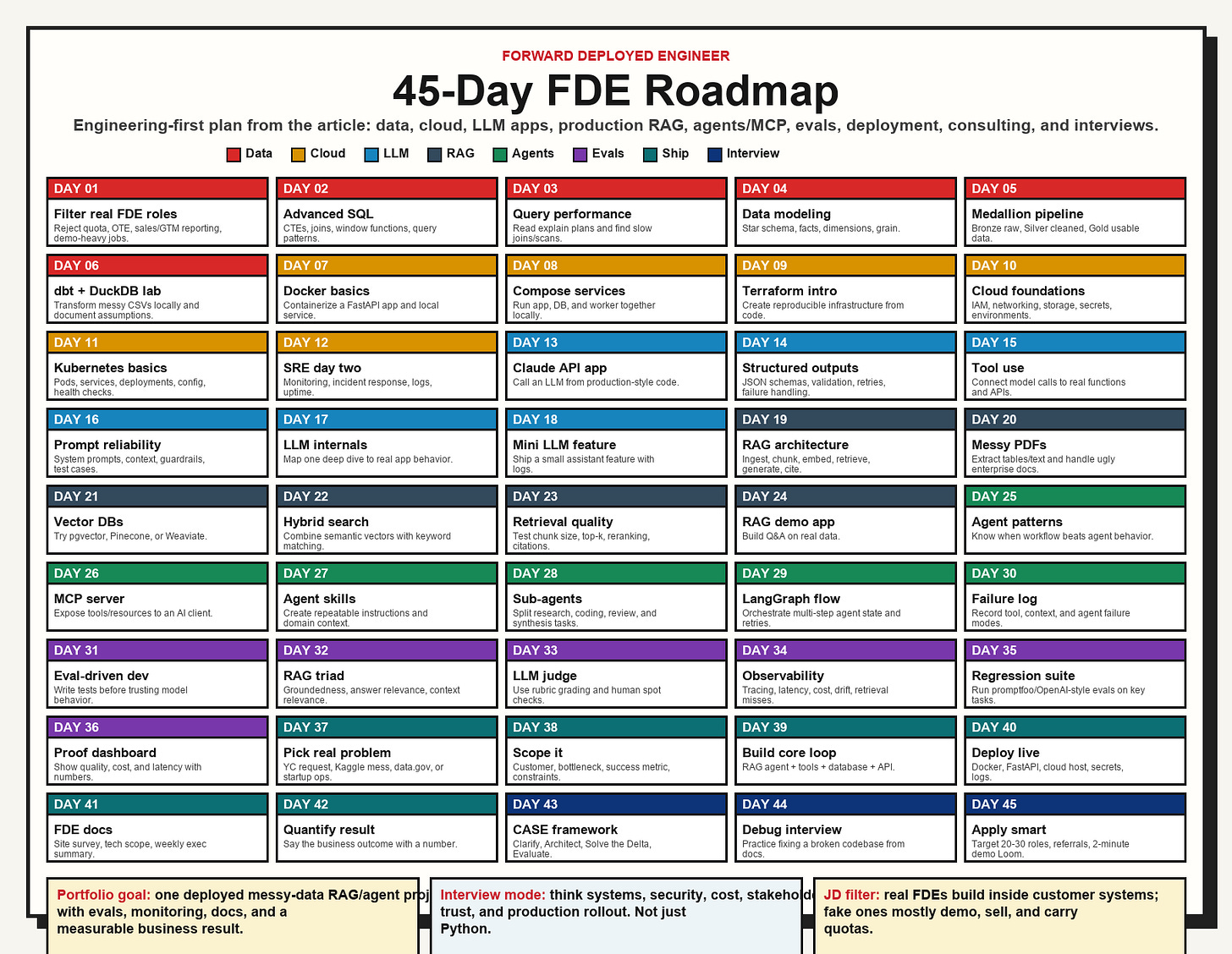
Here’s how I’d sequence the next three months if I were starting from an engineering background and wanted to land an FDE role. Resource-dense, week by week. Don’t just collect certificates — the whole plan is built so you walk out with one deployed project and a story to tell.
Days 1–30: Foundations (learn the meta-skill)
The goal this month is fluency, not perfection. You’re learning how to wire a model into a workflow.
- Week 1 — Claude API basics. Knock out Anthropic Academy’s “Building with the Claude API” (https://anthropic.skilljar.com/claude-with-the-anthropic-api). Get the certificate. By the end of the week you should be able to make tool-use calls and a basic RAG query from scratch.
- Week 2 — Agent patterns. Work through Andrew Ng’s “Agentic AI” course (https://learn.deeplearning.ai/courses/agentic-ai/information). Take notes on the four patterns: reflection, tool use, planning, multi-agent. These are the vocabulary you’ll use in every interview.
- Week 3 — Hands-on agents. Do the Hugging Face AI Agents course (https://huggingface.co/learn/agents-course). Build the sample agents, then deliberately break them and write down the failure modes. That debugging notebook becomes interview gold.
- Week 4 — Pick your problem. Choose ONE real business problem to solve for the next 60 days. Best sources: a small business or nonprofit you know, your current employer’s internal grunt work, or a public dataset with an obvious pain point. Write a one-paragraph scope: who the “customer” is, what bottleneck you’re killing, and what success looks like.
Days 31–60: Build (ship the one project that matters)
This is the month that actually gets you hired. Treat it like a real FDE engagement and run the same three phases the labs use.
- Week 5 — Scope & prototype. Map the workflow. Build an ugly, scrappy prototype on synthetic data. Don’t polish — just prove the core loop works.
- Week 6 — Validation. Build evaluation metrics. Label a small dataset. Stress-test against real benchmarks so you can say “here’s why I know it works,” not “here’s a pretty demo.” This is the phase that separates real FDEs from tutorial-followers.
- Week 7 — Deploy for real. Put it on real infrastructure. This is where your AWS Solutions Architect Associate prep pays off (https://aws.amazon.com/certification/certified-solutions-architect-associate/) — deploy the agent so it runs end to end, not just on your laptop. Smallest unit possible that works.
- Week 8 — Measure & write it up. Capture the measurable impact (hours saved, error rate dropped, cost reduced). Write a short case study: problem → approach → result. This document is your real resume.
Days 61–90: Position & apply (turn the project into offers)
Now you package the work and get in front of hiring managers.
- Week 9 — Learn the playbook. Run through Palantir Learn (
https://learn.palantir.com/
- ) and read the field’s canonical breakdowns (Pragmatic Engineer and the Palantir blog, both linked below). You want to speak the FDE language fluently before interviews.
- Week 10 — Practice the customer muscle. Record yourself explaining your project to a non-technical “customer” in under three minutes. Redo it until your mom would understand why it matters. This communication skill is what most engineers fail on.
- Week 11 — Build your target list & apply. Pull 20–30 openings (use the job links in the next section). Prioritize early-stage AI startups — they’re the easiest entry and the best reps. Set a “Forward Deployed Engineer” job alert on LinkedIn and Wellfound.
- Week 12 — Skip the line. For your top 10 targets, find the hiring manager on LinkedIn, send them your one-paragraph case study plus a link to the deployed project, and ask for 15 minutes. A working, deployed agent in their inbox beats a cold application every single time.
Run the gap-analysis prompt at the bottom of this post before Week 1 and again after Week 8 — it’ll tell you exactly where you still need reps.
Where the jobs actually are (the openings I promised)
Companies like OpenAI, Google, Anthropic, and Palantir are all actively hiring for this right now. And they’re not alone. Databricks, Ramp, Gecko Robotics, Commure, and Salesforce are all building out FDE teams. One tracker counted 224 open FDE roles across 39 AI companies.
Here’s exactly where to look:
- Palantir careers (the original, still the biggest): https://www.palantir.com/careers/open-positions/
- OpenAI careers (filter for “Forward Deployed”): https://openai.com/careers/
- Anthropic careers: https://www.anthropic.com/careers
- Levels.fyi to sanity-check comp before you negotiate:
https://www.levels.fyi/
- LinkedIn and Wellfound: search the exact phrase “Forward Deployed Engineer” and set a job alert. New roles drop weekly.
Pro tip. Don’t just apply cold. The early-stage AI startups posting these roles are the easiest to reach. Find the hiring manager on LinkedIn, show them one thing you built, and skip the line.
A copy-paste prompt to map your own gap
Want to know exactly what you’re missing? Drop this into any LLM.
You are a hiring manager for Forward Deployed Engineer roles at a top AI lab.

Here is my background:
[paste your resume or a paragraph about your experience]

Do three things:
1. Score me 1-10 on each of the four FDE skill buckets:
   engineering fundamentals, AI/LLM fluency, customer communication,
   and end-to-end ownership. Be brutally honest.
2. For my two weakest areas, give me a specific 30-day project
   that would close the gap and look great on an FDE resume.
3. Write three interview talking points from my real experience
   that signal "I can ship in ambiguity."
Use it, then go build the projects it spits out. That’s the whole game.
Resources to go deeper
I’m not going to make you find these yourself. Here’s the actual reading and watching list I’d hand to anyone serious about this.
Read these:
- A Day in the Life of a Palantir FDE (the original source): https://blog.palantir.com/a-day-in-the-life-of-a-palantir-forward-deployed-software-engineer-45ef2de257b1
- PostHog: WTF is a forward deployed engineer? (honest and practical): https://posthog.com/blog/forward-deployed-engineer
- Salesforce: 5 Skills for the FDE role: https://www.salesforce.com/blog/forward-deployed-engineer/
- The New Stack on the FDE hiring race: https://thenewstack.io/forward-deployed-engineer-fde-openai-google/
My honest take
The FDE role is what happens when “software engineer” and “the person who actually makes AI work for real companies” become the same job.
It’s not for everyone. If you want a quiet desk and a clean backlog, skip it. But if you like ambiguity, you like talking to humans, and you like the feeling of building something that ships and matters, this might be the best-positioned role in tech for the next five years.
The demand is real. The money is real. And the skills it asks for are the exact skills that survive whatever AI does to the rest of the industry. Because the one thing AI can’t automate is the messy human work of figuring out what a customer actually needs.
This is one of those roles that could define the next decade of tech careers. I genuinely believe that. Get in early.
If you are finding value in my AI action letters, please consider subscribing. It keeps me going.
If you know an engineer who’s been quietly hunting for their next move, please share this with them. It might be the nudge they needed.
That’s it from me today.
Till next time. Stay tuned as I will share best resources from both my Harvard and Google networks to bring the best to you. Let’s up skill together. Aspyre higher!