Reporter Lou Chun, Tide News
In the summer of 2026, the internet job market remains sharply divided between hot and cold. Traditional generalist tech roles—front-end, back-end, and testing—are oversupplied, leaving many programmers with three to five years of experience stuck in delayed promotions and harder job-hopping. Yet a role called the FDE (Forward Deployed Engineer) has quietly risen to the top of the hiring market.
On mainstream recruitment platforms, Alibaba, Tencent, ByteDance, leading cloud providers, and AI large-model companies are all posting FDE openings, with salaries generally higher than equivalent R&D roles—ByteDance's "FDE Expert" position offers a monthly salary of 30,000 to 50,000 yuan, with 15 months' pay per year. Unlike traditional R&D roles, which screen candidates layer by layer on credentials and project history, FDE hiring places greater weight on hands-on deployment ability. Many candidates, armed only with project experience closely matching the role, can skip multiple rounds of follow-up interviews and land an offer directly.
The AI industry is shifting from a race over models to real-world deployment, and the FDE is the key link in closing the "last mile" of AI commercialization.
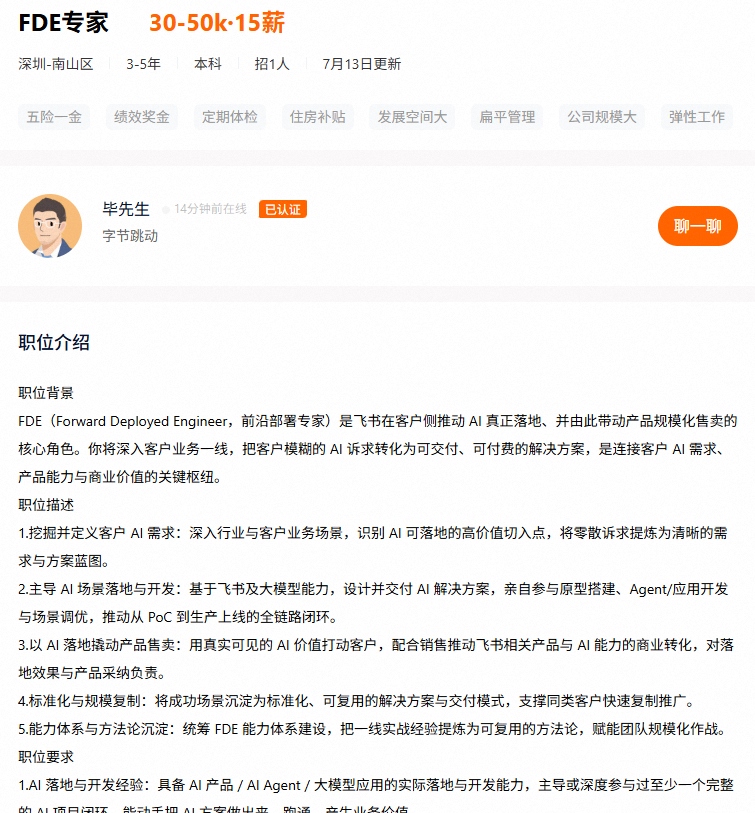
Image source: Liepin
A "New Species" on the Hiring Front Line
The trend becomes even more vivid when backed by data. According to Indeed, the number of FDE postings grew from 643 in April 2025 to 5,330 in April 2026—an increase of roughly 729%, making it one of the fastest-growing segments among tech roles. While the overall internet hiring market is still adjusting, demand for FDEs is expanding against the tide.
Even more notable is the spread of hiring organizations: FDE employers have expanded from the initial foreign companies and leading cloud providers to AI large-model firms, government-enterprise digitalization service providers, and smart manufacturing companies. As one practitioner put it: "Two years ago, everyone was competing over model parameters and computing power. Now the industry has entered the deployment phase, and the scarce resource is people who can turn technology into products customers can actually use."
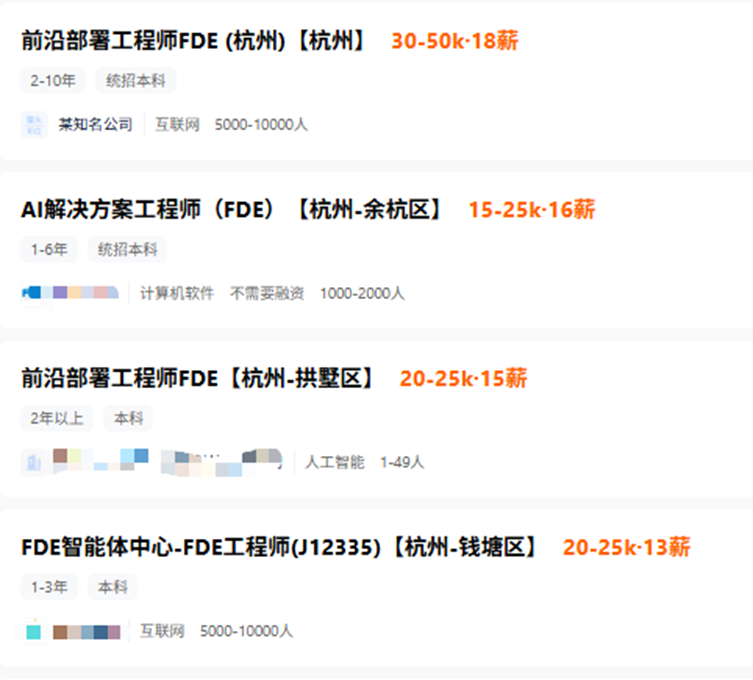
Sample FDE job postings in Hangzhou. Image source: Liepin
What Exactly Is an FDE: A Misunderstood "Hybrid Tech Role"
Outsiders mostly picture the FDE as a "highly paid on-site engineer" or "senior technical support"—some even think it's just "someone who installs software." In reality, the role has long outgrown the scope of traditional operations and implementation jobs: it is a hybrid technical position that combines coding and development, scenario adaptation, client engagement, and hands-on problem solving.
Most FDEs at major Chinese tech companies today are full-stack developers or AI application engineers with 2 to 5 years of experience—people with solid technical foundations as well as a frontline, business-deployment mindset. Lin Ze (a pseudonym) is one example. With three years of internet development experience, he previously worked in back-end development at a small-to-midsize tech company, and at the end of 2025 moved to a leading cloud provider as an FDE. Explaining the switch, he said: "Traditional R&D roles mostly iterate on products internally; the code you write doesn't necessarily translate directly into business value, and the promotion ladder is crowded. FDEs face customers' real scenarios directly, so technical value gets realized faster, and the pay-to-effort ratio is better."

Image source: VCG
Lin Ze's job search is fairly representative. When applying for regular R&D roles at major tech companies, he repeatedly got stuck at final interviews—interviewers focused on algorithm drills and low-level fundamentals, where his advantages were not obvious. But when he applied for FDE roles, his project experience in government-enterprise system integration and on-site debugging carried him through the written test and two rounds of interviews, and he received a formal offer within a week.
On compensation, Lin Ze's total annual package is now about 420,000 yuan, including base salary, travel allowances, quarterly performance bonuses, and year-end bonus, with fixed monthly take-home pay of about 23,000 yuan—higher than the average annual salary of around 300,000 yuan for traditional back-end developers with comparable experience. Six months after joining, his work on critical deployment projects for two key clients earned him eligibility for an annual raise, with his total package expected to rise above 500,000 yuan.
"We're not just going on-site to install and deploy," Lin Ze explained, breaking down his job. "About half my time goes into coding and on-site debugging, and the rest into solution design and client communication." In his day-to-day work, he is stationed at government-enterprise client sites, performing secondary development and adaptation debugging of AI large models and cloud service products for clients' production and office scenarios—resolving compatibility, adaptability, and usability issues in model deployment—while also distilling clients' real needs and feeding them back to the back-end product and R&D teams.
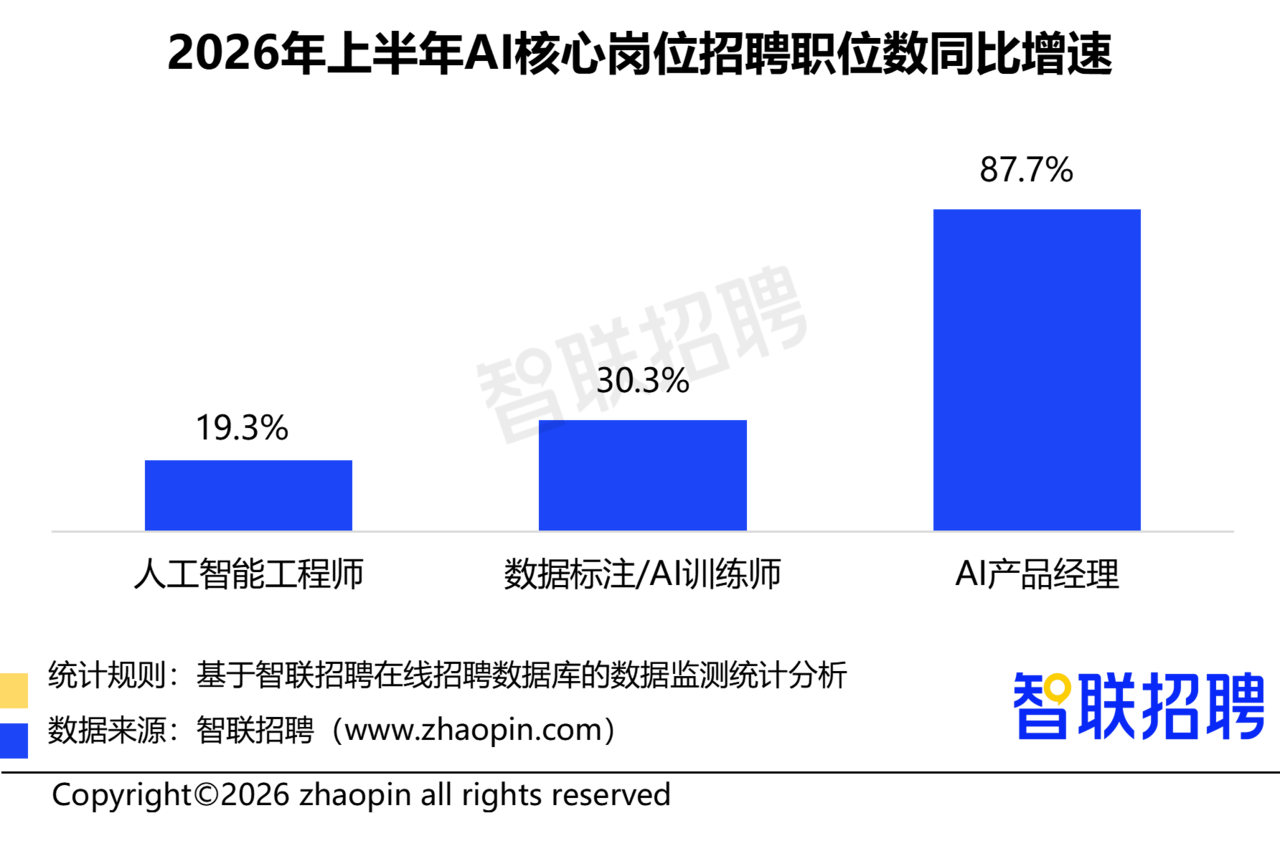
Image source: Zhaopin
Unlike traditional R&D, which "sits in the office iterating on features," the FDE's core mission is solving deployment problems. Lin Ze once encountered a manufacturing client whose AI quality-inspection model suffered poor equipment adaptation and recognition accuracy below target after introduction; back-end R&D could not pinpoint the problem remotely. He stayed on-site for two weeks, modifying code on the spot, tuning algorithm parameters, and interfacing with production equipment, ultimately completing the model deployment and helping the client raise inspection efficiency by about 40%. "That's where the FDE's value lies: bridging the gap between the lab demo and commercial deployment. That's also why big companies are willing to pay high salaries."
Su Yu (a pseudonym) is a veteran FDE with four years in the role, who has lived through the position's journey from obscure to hot.
When he entered the field in 2022, only a handful of foreign companies in China were hiring FDEs, with annual salaries around 280,000 yuan. Now, promoted to team lead coordinating multiple deployment projects, his total annual package has reached 780,000 yuan, including stock options and project-specific bonuses. "Two years ago, everyone was competing over model parameters and computing power. Now the industry has entered the deployment phase, and the scarce resource is people who can turn technology into products customers can actually use," Su Yu said.
The Other Side of High Pay: Travel, Hybrid Pressure, and Blurred Boundaries
High salaries, relatively lenient credential requirements, and the scarcity premium have made the FDE a top choice for many programmers looking to switch jobs. But once the halo fades, the role's difficulties and pain points gradually come to light: compared with the stable office work and focused technical iteration of traditional R&D, FDEs face three practical challenges—frequent travel, hybrid pressure, and blurred career boundaries.
Frequent travel and long on-site deployments are pain points shared by nearly all FDEs.
Lin Ze admits that since joining, his monthly on-site travel has consistently exceeded 20 days, with almost no fixed office location. "Constantly shuttling between different cities and providing last-minute weekend support is the norm—it's very hard to balance with a personal life." Some government-enterprise projects run long, with single deployments lasting one to two months, and the prolonged time away from home has left many practitioners with disrupted sleep schedules and physical and mental exhaustion. "The salary looks higher than ordinary R&D, but travel allowances mostly just offset the costs of being away, and the time and energy costs are significant," Lin Ze said.
The hybrid nature of the work is another major challenge. Traditional R&D roles have clear divisions of labor—front-end, back-end, and testing each handle their own piece—but the FDE is an "all-rounder" role that must simultaneously handle coding and development, architecture debugging, requirements communication, answering questions, and project management. Su Yu feels this keenly: "We have to write high-quality code and debug technical bugs like developers, engage with clients and present technical solutions like pre-sales engineers, handle on-site equipment and system failures like operations staff, and even coordinate multiple teams to push projects forward—one person wearing many hats."
What's trickier still, the problems FDEs face are mostly scenario-specific issues that cannot be reproduced in the back-end lab—there are no ready-made solutions, requiring improvisation on the spot. "Client site environments are complex and varied: device compatibility, network adaptation, business logic conflicts—the problems never stop. Many issues have no documentation or reference cases, so you can only troubleshoot bit by bit yourself, and the psychological pressure is intense," Su Yu said. Traditional R&D can iterate and optimize over time, but FDEs must solve on-site problems immediately, with client satisfaction directly tied to performance reviews—leaving very little margin for error.
Blurred career boundaries and growth anxiety are widespread concerns among veteran practitioners. Many worry that FDEs can easily fall into the trap of being "a jack of all trades and master of none"—large amounts of time are consumed by communication, debugging, and coordination, so deep technical specialization progresses far more slowly than in traditional R&D, and core skills like algorithms and low-level architecture can atrophy. Meanwhile, the role's boundaries of responsibility are unclear: clients bring every kind of technical and usage problem straight to the FDE, who often faces "requests beyond the scope of the job," making passive overtime the norm.
Industry bias also leaves many practitioners frustrated. Even with salaries far above ordinary R&D, many still equate the FDE with senior on-site operations or technical after-sales support, ignoring the core technical value of secondary development and solution customization. "Many clients and internal colleagues assume we don't need to go deep on technology—that we're just field executors—without realizing that the technical difficulty of on-site deployment is far higher than routine iterative development," an FDE with two years in the role commented on Maimai.
Yet amid all these difficulties, practitioners also hold a clear-eyed view of the career. As Su Yu put it: "The FDE role isn't for people seeking stability who want to focus solely on deepening a single technical specialty. But it suits developers who want to escape the rat race and understand both technology and business. It's hard work, but you get rapid exposure to deployment scenarios across different industries and accumulate real-world commercialization experience—that kind of all-around growth is something traditional R&D sitting in an office can rarely obtain."
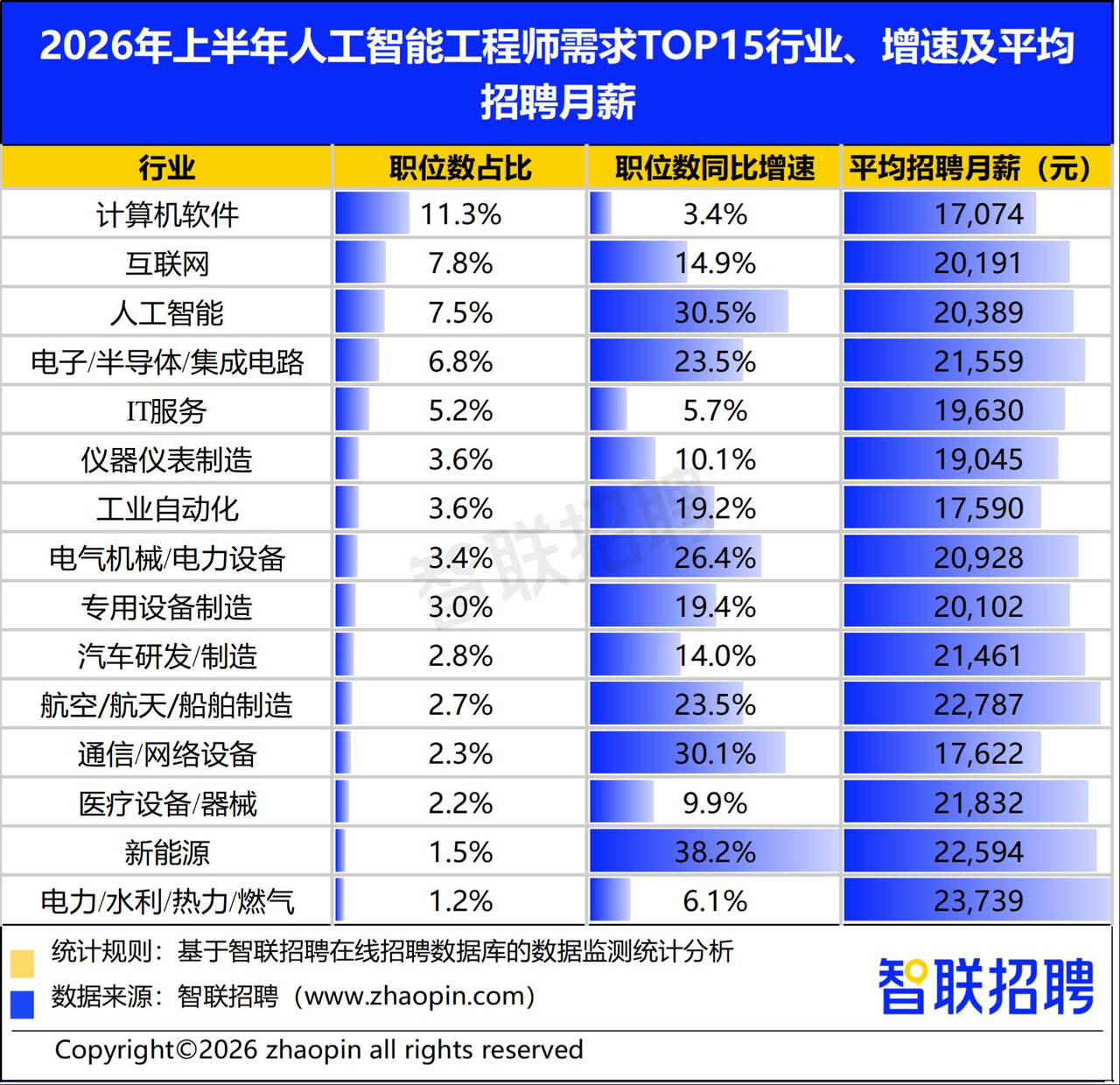
Image source: Zhaopin
In the First Year of AI Deployment, Why Has the FDE Become a "Must-Have"?
The rise of the FDE is no accident—it is the inevitable result of China's AI industry shifting from a technology race to commercial implementation.
According to Zhaopin's 2026 AI Industry Talent Development Report, in the first half of 2026, the number of companies hiring in the AI industry grew 24.8% year over year, and the number of job openings grew 10.6%, continuing an upward trend. Notably, the job structure of the AI industry is changing: in addition to technical roles such as mechanical design/manufacturing engineers, software R&D, and AI engineers dominating the market, non-technical roles such as HR, sales, and product managers have also entered the top 15 in hiring. This means the AI industry is moving from "R&D-driven" to "equal emphasis on R&D and commercialization"—while expanding their technical talent reserves, companies are also accelerating the buildout of sales, marketing, HR, and other support systems to provide the organizational foundation for scaling up technology deployment. As the key role bridging technology and commercial implementation, the FDE is a direct beneficiary of this structural shift.
Over the past two years, the AI industry was fixated on competing over model parameters and compute scale, leaving a large number of high-quality lab models unable to reach commercial deployment—over 70% of AI projects got stuck at the implementation stage, and fewer than 30% of PoCs (proofs of concept) were converted into actual production. Now the industry logic has changed: technology deployment and commercial monetization have become the core goals of major vendors, and as the key role connecting technology and business, the FDE's status as an in-demand position continues to strengthen.
At the same time, hiring requirements for the role are quietly changing. Early FDE hiring mostly prioritized experienced R&D engineers; today, major companies are gradually opening up hiring to fresh graduates and career changers, placing greater emphasis on hands-on capability, deployment-oriented thinking, and resilience under pressure—no longer judging candidates solely by credentials or algorithms—making it one of the viable paths for ordinary tech professionals to get ahead.
Perhaps, in a future where AI deployment becomes the norm, the FDE will not be a fleeting internet-famous job, but will become an indispensable role in the internet technology ecosystem, continuously capturing new dividends from industry growth. What it reflects is a deeper question: as the main battleground of the AI race shifts from "whose model is stronger" to "who can actually put technology to use," the value coordinates of the talent market are being quietly rewritten as well.
"Please indicate the source when reposting"
Editor: Pan Jie