The AI job market is shifting, with roles such as Forward Deployed Engineers and agentic AI specialists witnessing skyrocketing demand. Companies prioritize expertise in AI application and maintenance, leading to higher salaries and the popularity of specialized certifications.
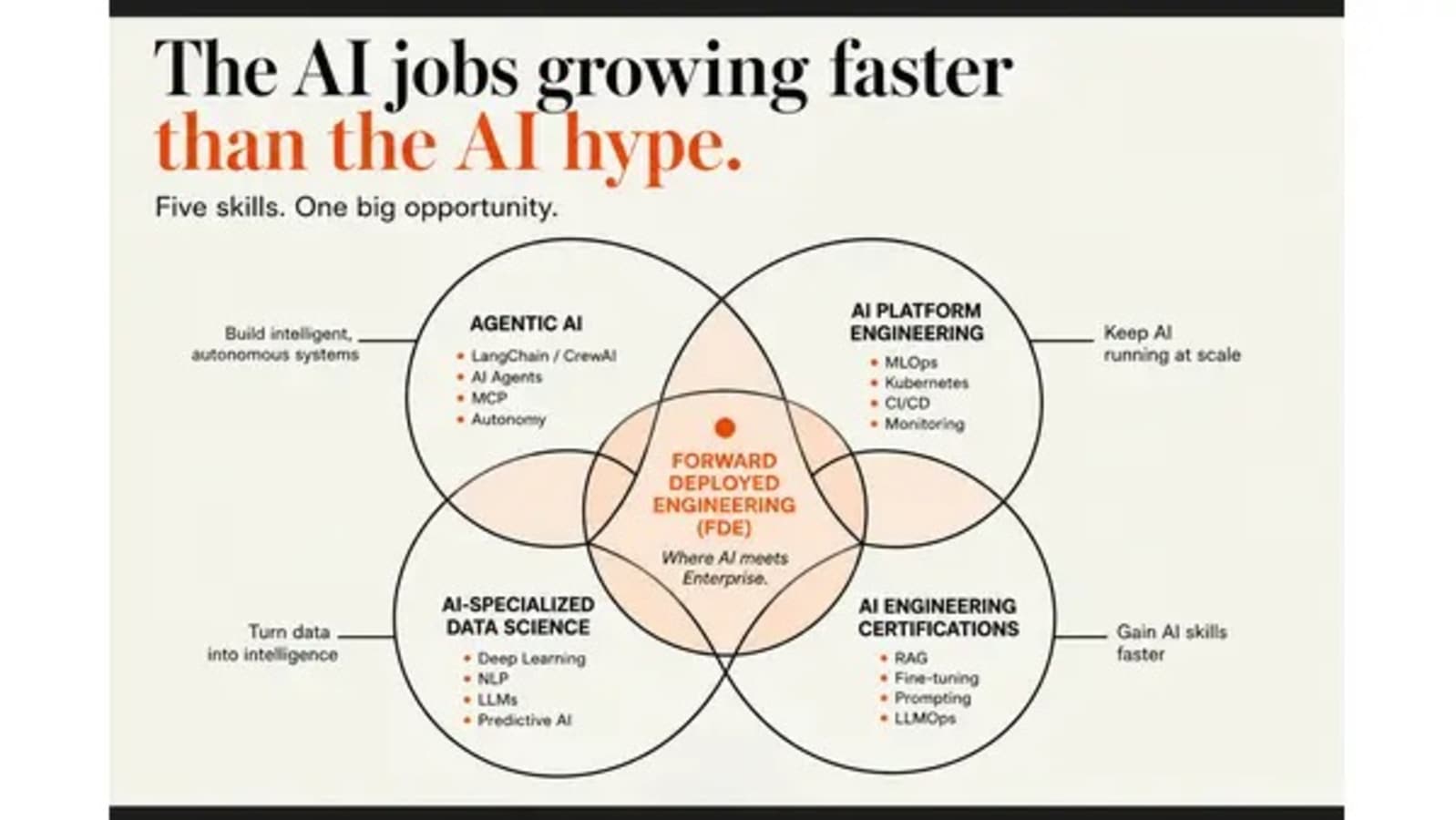
The way AI is changing tech hiring goes well past adding a few AI tasks to jobs that already existed. New titles are appearing outright, with Forward Deployed Engineer leading the list, and capabilities like agentic AI, AI infrastructure, and AI-powered data science have quietly moved from resume padding to the baseline recruiters screen for. For most professionals, the useful question is no longer whether AI belongs in their skill set. What matters now is figuring out which AI skills still carry weight three years out, and which ones are close to their peak.
Below are five roles worth keeping an eye on, along with what the hiring data shows and why those numbers are climbing faster than the general conversation suggests.
Forward Deployed Engineering (FDE): 2026's most talked-about title
An FDE works where engineering meets client delivery. The job is to take an AI system past the polished demo and get it running inside a company's actual operations, then stay close enough to patch whatever breaks along the way. Think less about building a model from scratch and more about embedding in the client's stack until the thing holds up in production.
The demand tells the clearest story. FDE postings have grown 700–800% year on year, and the companies chasing that talent (OpenAI, Anthropic, Palantir, Databricks, Sarvam AI, and even TCS) are all fishing in the same shallow pool. Going from almost no listings to a widely discussed title in under two years is a steep climb by any measure, including the inflated standards of AI hype. It suggests the role answers a real problem rather than a fad. Plenty of enterprises now own capable AI. What they lack is people who can make it stick.
Agentic AI: from prompting to autonomy
Most AI tools still wait on a person to prompt them at every turn. Agentic AI moves past that pattern. These systems accept a goal, split it into steps, reach for the tools they need, and finish the work with very little supervision.
In a little over a year, LinkedIn India has logged a jump of more than 300% in postings that mention agent frameworks such as LangChain and CrewAI. Pay has kept pace. Junior agentic AI developers are pulling in ₹12–20 lakh, while senior specialists clear ₹40 lakh. That is a notably compressed curve, and you tend to see it when demand outstrips supply so sharply that employers can no longer afford to wait for people to accumulate years of experience.
AI-specialized data science: the premium is now structural, not novel
General data science has matured into a reasonably predictable career track. Add deep learning, NLP, and cloud AI on top, and the compensation picture changes sharply. Specialists earn roughly ₹3–10 lakh more than their generalist peers, and senior AI-focused data scientists at product companies and GCCs push past ₹40–50 lakh. Google, Amazon, Flipkart, and Razorpay sit near the front of this hiring wave.
Scale is what separates this from an ordinary skills-premium trend. NASSCOM estimates India will need more than 3 lakh additional data science professionals by 2028. At that size, the field has outgrown any niche label. It represents a structural shortage the market will spend years closing, not a gap that resolves in a quarter or two.
AI Platform Engineering / MLOps: the unglamorous job that keeps AI running
Sooner or later, every company rushing AI into production hits the same wall. Once a model leaves the lab, somebody has to keep it alive. That responsibility belongs to MLOps, and it carries a genuine premium: 10–25% above standard DevOps pay at a comparable experience level, with mid-career engineers landing ₹20–40 lakh.
It is a helpful reminder that the market pays for more than model-building talent. Reliable operation at scale is its own skill, and far fewer people have it.
The compressed path: fast-track certifications
Not everyone can step away for a year to complete a full program. Shorter, targeted certifications, such as those organized around applied ML, generative AI, LLMs, and RAG systems, have become a credible fast lane. They work especially well for working professionals who already have an engineering foundation and simply need the AI-specific layer added on top.
The numbers back the shortcut. Fresher packages for LLM- and GenAI-focused engineers in India run ₹15–25 lakh, comfortably above the ₹6–15 lakh that a general AI engineering role tends to offer. Programs that include a campus-immersion or cohort element, IIT Roorkee's CEC among them, usually land better with hiring managers than fully online certificates, mostly because a harder entry filter signals something about the candidates who get in.
The pattern across all five
These are five distinct bets, yet they rhyme. In each case supply has not caught up with demand, and that shortfall explains why the pay looks the way it does today. The roles most likely to keep their premium are probably the ones anchored to structural shifts, like data science and platform engineering, rather than to a single fashionable framework such as agent tooling. Frameworks get commoditized quickly. The deeper skill of making AI systems actually work in production fades much more slowly.
Scaler shaped its latest slate of programs around this same reading of the market. It covers Forward Deployed Engineering, Agentic AI, AI-specialized data science, AI platform engineering, and an AI engineering certification affiliated with IIT Roorkee.
Disclaimer: This article is sponsored content curated by HT Syndication. The inputs and details accounted for in the article do not necessarily reflect those of HT, and HT does not endorse or assume any responsibility for the information provided.
Want to get your story featured as above? click here!
Catch all the Latest Tech News, Mobile News, Laptop News, Gaming news, Wearables News , How To News, also keep up with us on Whatsapp channel,Twitter, Facebook, Google News, and Instagram. For our latest videos, subscribe to our YouTube channel.
NEXT ARTICLE BEGINS
