Which chapters matter depends on the round: Google's 45-minute algorithm test is the book's home turf, OpenAI's 60-minute production build uses only a few.
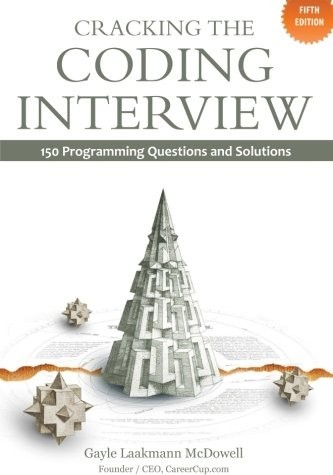
Cracking the Coding Interview· Gayle Laakmann McDowell ·
In brief
- The 6th edition (CareerCup, 2015, 708 pages) has 189 questions, even though its title on the official site still says 150
- The two opening chapters on Big O and problem-solving technique are worth more than grinding through all 189 questions
- An FDE coding round may be a 45-minute algorithm problem or a 60-minute build with added requirements, so ask the recruiter first
The sixth edition of Cracking the Coding Interview runs to 708 pages. With a month to go before an FDE interview, few candidates can read all of it, so the real question is which chapters to read.
That depends on the kind of coding round you face. At some companies it is the familiar algorithm problem the book teaches in depth. At others it is a production-style build, and then only a handful of chapters really help.
A book bigger than its title
The author is Gayle Laakmann McDowell. According to the bookseller’s listing, the 6th edition was published by CareerCup on July 1, 2015, runs to 708 pages and carries ISBN 978-0-9847828-5-7. The official site still titles it “150 Programming Interview Questions and Solutions”, yet inside are 189 questions, each with hints.
The author’s site says this edition adds 70% more content than the previous one. The book has been around for a while, but its core has not aged: how to think when an unfamiliar problem lands in front of you and an interviewer is watching.
The difficulty is that FDE coding rounds follow no common template. Educative’s course on Google FDE interviews describes the coding round as a standard data structures and algorithms interview. It lasts about 45 minutes, with one or two problems, which is exactly the book’s home turf.
For OpenAI, Exponent’s guide describes the onsite round as a 60-minute production-style build. The task can be split into several consecutive parts, and new requirements arrive once you have a first version working. Same book, but each round calls for a different way of reading it.
The value sits before question one
Before the 189 questions come several opening chapters: the interview process, behavioral preparation, Big O, and a chapter on technical questions with five approaches to algorithms. Many readers skip straight to the exercises, and that is a mistake. The opening chapters teach the method; the exercises are only where you practice it.
The Big O chapter covers time and space complexity, amortized time, when log N appears, and how to work out the runtime of recursive functions. The section “Multi-Part Algorithms: Add vs. Multiply” deserves a close read.
Take a loop over every order in list A, followed by a loop over every customer in list B. Two loops in sequence give O(A + B); nest the B loop inside the A loop and it becomes O(A × B).
With 10,000 orders and 1,000 customers, that is the difference between 11,000 steps and 10,000,000.
Practice saying this calculation out loud before you type any code. A single sentence such as “two loops in sequence, so O(A + B)” is enough to show the interviewer you understand what you are about to write.
Named techniques beat memorized answers
The technique chapter teaches named problem-solving methods such as BUD, Base Case and Build and Data Structure Brainstorm, along with guidance on what good code looks like. Named techniques are easy to remember. When you get stuck, you have a list to work through instead of sitting in silence.
In OpenAI’s build round, the “good code” part matters even more. When the second requirement appears at minute 30, code with clear names and sensible functions can be changed in a few minutes. Code rushed out just to run may have to be rewritten from scratch.
What order to read in for each type of round?
The 189 questions are grouped by topic: arrays and strings, linked lists, stacks and queues, trees and graphs, recursion and dynamic programming, sorting and searching, object-oriented design, databases, threads and locks, testing, and a few others. That means you can choose chapters rather than read cover to cover.
If the round is an algorithm problem of about 45 minutes, read the Big O and technique chapters first. Then work through Arrays and Strings, trees and graphs, sorting and searching, and finally recursion.
If the round is a production-style build, move after the two opening chapters to Object-Oriented Design, Scalability and Memory Limits, and Threads and Locks. These three are closest to the real-world work this kind of round simulates.
Say the task is to write a tool that reads logs and counts errors per service. Then two requirements are added: the log file is larger than memory, and several threads write at once. At that point the chapters on memory limits and locks are exactly what you need.
Turn practice into evidence on your CV
Educative advises asking the recruiter to confirm the interview format, and that should be the first thing you do. One email sent in advance can save you two weeks of grinding dynamic programming for a round that contains none.
After that, turn what you practiced into something others can see. A small repo whose commit history shows the code growing through two or three changes in requirements, with notes on complexity, says more about you than a line reading “solved 300 LeetCode problems” on a CV.
Cracking the Coding Interview remains a solid foundation for the coding round. For FDEs, the efficient way to read it is to study the two opening chapters closely, then choose the rest according to the format the recruiter confirms.
Was this article useful?
Thanks for the feedback!