The Heath brothers' 2007 book teaches Forward Deployed Engineers to turn dry metrics into stories that customer executives will repeat on your behalf.
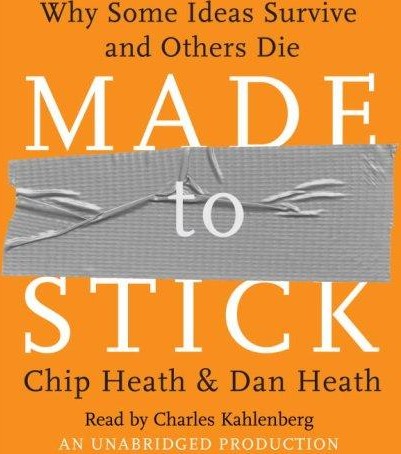
Made to Stick: Why Some Ideas Survive and Others Die · Chip Heath ·
Key Takeaways
- Made to Stick (Random House, 2007, 336 pages), co-authored by Chip Heath and Dan Heath, explores why some ideas survive and others die.
- The six traits of SUCCESs: Simple, Unexpected, Concrete, Credible, Emotional, and Stories.
- For an FDE, the book's greatest value is breaking the "Curse of Knowledge" when reporting results to customer executives.
"A lie can travel halfway around the world while the truth is putting on its shoes." Made to Stick's official page opens with this quote, attributed to Mark Twain. It also aptly describes an afternoon that Forward Deployed Engineers (FDEs) often encounter.
You've just deployed a system to production, and the metrics have clearly improved. Three weeks later, at the renewal meeting, the customer's VP asks what the project actually delivered. Nobody remembers the number. The results themselves were fine—they just never stuck in anyone's mind.
So a book published in 2007 is still worth keeping on the desk of engineers who work directly with customers. You already know how to do the technical work; getting customer executives to remember it and advocate for the project requires dedicated learning.
Who are the authors, and what is the book about?
Chip Heath is a professor at the Stanford Graduate School of Business, and Dan Heath is a Senior Fellow at Duke University's CASE Center. The book was published by Random House on January 2, 2007, runs 336 pages, and carries the subtitle "Why Some Ideas Survive and Others Die."
The core question is simple: why do some ideas survive while others die? The authors' website argues that any information people remember benefits from the same six traits. A book summary by Antoine Buteau lists them as Simple, Unexpected, Concrete, Credible, Emotional, and Stories, abbreviated as SUCCESs.
The authors promise the book will change the way you communicate ideas. Read through the lens of an FDE, the most valuable part is: how to design an idea so that others pass it along when you're not in the room. This is exactly the situation you face most often—renewal decisions are often made in meetings you weren't invited to.
Point 1: The enemy is your own expertise
Buteau's summary captures the core problem in one sentence: experts tend to forget that their audience doesn't know what they know. This is the "Curse of Knowledge."
Imagine an FDE who deployed a ticket-triage AI agent for a logistics company. The progress report reads: "After changing the retrieval strategy, F1 on the eval set improved from 0.71 to 0.86." To an engineer, this sentence is complete. To the head of operations, it contains three unfamiliar terms and two numbers unrelated to anything they care about.
At the customer site, before passing any document up the chain, reread it and ask yourself: what does the reader need to know first to understand this sentence? If the answer is longer than the original sentence, rewrite it.
Point 2: Open with a gap
The book explains how to create a "curiosity gap": pose a question first, so the audience wants the answer before you give it. Many technical reports do the opposite—they open with an architecture diagram and save the results for the last page.
In the logistics example, the opening could be: "Last month, how many of every ten urgent tickets spent the night in the wrong queue?" Now the customer executives have a reason to listen to the next number.
Point 3: Give your idea more hooks
The book also introduces a concept called the "Velcro Theory of Memory." The name alone suggests a useful image: Velcro holds fast through many tiny hooks, and a result with only one hook (a number) is likely to fall off. Add a night shift and a specific person, and it gains several more places to grip.
The table below applies the six traits, cell by cell, to the same example.
| Trait | Common report style | Stickier style |
|---|---|---|
| Simple | Five metrics on one slide | One sentence: urgent tickets no longer sit overnight in the wrong place |
| Unexpected | Results saved for last | Open with a question about tickets stuck in the wrong queue |
| Concrete | "Accuracy improved" | One specific ticket handled earlier |
| Credible | Numbers from an internal eval set | Numbers verified against the customer's own logs |
| Emotional | No people | Night-shift staff no longer need to repeatedly check queues |
| Stories | A list of changes | A before-and-after comparison told through one shift |
Put together, what does the report look like?
Each cell in the table is only useful as part of one coherent message. Below are two versions of the same hypothetical result.
Before rewriting: "This iteration we changed the triage agent's retrieval strategy. F1 on the eval set improved from 0.71 to 0.86. Next steps are tuning the prompts and expanding the eval set."
After rewriting: "Urgent tickets no longer sit in the wrong queue until the next morning. Previously, night-shift staff had to manually comb through queues to find misrouted tickets; with the new agent, this work has nearly disappeared.
On the numbers: the classification accuracy metric (F1) improved from 0.71 to 0.86, and the results have been verified against the company's own support logs, not just test data. Next month's goal is to extend the same approach to the day shift."
The numbers are still there—just placed after the story rather than leading with them. The order of edits matters more than it looks: first settle the core sentence, then cut jargon, then write the opening, and only then attach the evidence and real people.
Then have someone outside the team read it and retell it the next day: whatever they can retell is what customer executives will remember.
What are the common mistakes in applying SUCCESs?
First, treating the six traits as a checklist and cramming all of them into one sentence. The message becomes long and tangled, losing even the "Simple" trait itself. Each sentence should carry at most one or two jobs.
Second, getting so absorbed in storytelling that the numbers get lost. A story without evidence won't hold up when the finance team pushes back. Keep the numbers, but place them after the story and tie them to the customer's data. Third, opening a curiosity gap and never closing it, or delivering a result smaller than what was promised.
Who should read it, and what should it be paired with?
The book suits engineers who have written code for a few years and are starting to report to customer executives, as well as those preparing to move into an FDE role. The most effective way to read it is against a real document: after finishing a chapter on a given trait, open a report you recently sent to a customer and revise it specifically for that trait.
When job hunting, this skill should also come through. If an interview asks about a time you explained technical results to decision-makers, have a story ready: with a gap, a credible number, and a specific beneficiary. Resume entries should be written the same way, rather than listing dry metrics.
Good numbers earn you trust. Good stories get customer executives to carry those numbers into the renewal meeting for you.
Was this article helpful?
Thanks for your feedback!