Credibility, reliability, and intimacy sit in the numerator, but whether clients actually listen to you depends on the variable in the denominator.
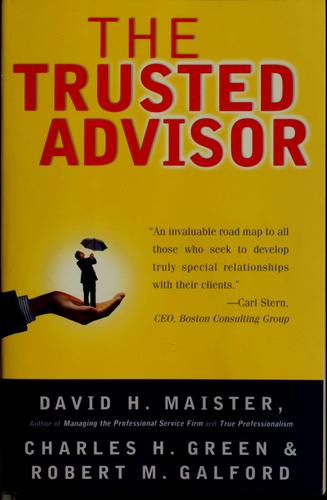
The Trusted Advisor· David H. Maister ·
Key Takeaways
- The Trusted Advisor (Maister, Green, Galford, 2000) argues that professional success depends on earning client trust, not just technical competence
- The trust equation puts credibility, reliability, and intimacy in the numerator and self-orientation in the denominator: the more you focus on yourself, the less you are trusted
- Harper's FDE job posting explicitly requires serving as a trusted technical advisor, making this book foundational reading for transitioning into the role
In its job posting for Forward Deployed Engineers (FDEs), Harper asks candidates to serve as trusted technical advisors throughout the entire client relationship. The posting is blunt about the role's goal: winning technical trust, because it is precisely what "lands and expands enterprise contracts."
Clearly, trust is not a decorative soft skill. For an FDE, it is an output metric. The problem is that few people teach trust as a skill, so it is easy to walk into a meeting assuming that if you just solve the problem, trust will follow naturally.
The book that comes closest to a textbook on this topic was published in 2000. The Trusted Advisor, co-authored by three consultants—David H. Maister, Charles H. Green, and Robert M. Galford—makes a simple but uncomfortable point: the key to professional success lies in earning clients' trust and confidence, not merely professional expertise. Green later founded Trusted Advisor Associates, a company named after the very concept.
Trust Has a Formula
The book's most memorable contribution is the trust equation. The model breaks trust into rational and emotional components. The numerator has three variables. Credibility is about your words: do clients trust your judgment about their systems? Reliability is about your actions: do you deliver on promises on time?
The third variable is intimacy, the one engineers should pay the most attention to. The authors define it as the interpersonal connection and understanding deep enough that the other party feels safe exposing their vulnerabilities to you.
Imagine a data lead on the client side admitting that their data pipeline is a patchwork no one dares to touch. If they are willing to tell you that, you have intimacy. If they only say it internally, your deployment will hit a wall you never knew existed.
These three variables explain why an FDE with well-written code can still fail. High credibility with low reliability—say, promising to fix something by the weekend and then going silent—drags down the whole score.
Meanwhile, an engineer who only talks about system architecture and never asks what the client is worried about will remain "the person hired to do the work" rather than "the person whose opinion people want to hear."
The Denominator Decides Success or Failure
The fourth variable sits alone in the denominator: self-orientation, or how much you focus on yourself. The larger the denominator, the lower the trust. Trusted Advisor Associates calls it the most influential variable in the equation.
This is a trap specific to FDEs, because the role sits close to sales. Harper states directly that technical trust is the key to expanding contracts, so the pressure to prove product value is always present. An engineer who walks into requirements discovery with a "let's show them what our Agent can do" mindset raises self-orientation without realizing it.
Clients notice. They nod politely, then stop returning calls.
One exercise worth trying to keep the denominator down: before every meeting, write one sentence describing the client's problem in their own words, without mentioning your product's name. If you can't write it, you're not ready to propose any solution.
Five Steps from First Meeting to Commitment
The book's 20th anniversary edition describes a five-step process, with one chapter per step: engage, listen, frame, envision, commit. The key is the order. Think back to your most recent client meeting: chances are you rushed through a bit of listening and jumped straight to proposing a solution, skipping the framing and envisioning steps.
These five steps map closely onto the deployment cycle. Engage and listen are client discovery. Framing means restating the problem so the client confirms: "Yes, that's exactly it."
Envisioning means describing the state of the system after go-live in terms of business outcomes rather than architecture diagrams. Only at the commitment step do you discuss scope and timeline.
| Step in the book | What an FDE does at this step |
|---|---|
| Engage | Center the conversation on what the client cares about; hold off on the product |
| Listen | Ask questions, then stay quiet; note the exact words they use to describe the problem |
| Frame | Restate the problem and let them confirm or correct it |
| Envision | Describe the post-deployment state in terms of the outcomes they care about |
| Commit | Agree on scope, milestones, and what you are accountable for |
Who Should Read It, and How
The book was written by three career consultants, so translating it into the context of deployments and Agents takes some work on your part. That is exactly why it's worth reading: its core argument is that professional success goes far beyond technical expertise, and few engineers ever hear that said to their face.
Developers aiming for an FDE role should read the trust equation first to get a measuring stick, then the five steps to get a process. Those who have been an FDE for a year or two can go the other way: read the five steps first, review your most recent deployment to see which step you skipped, then return to the equation to understand why.
The most intriguing phrase in Harper's job posting is "throughout the entire client relationship." Trust is not something you win in a single demo and then put away; it needs to be replenished in every call, every pull request, and every time you say "I don't know yet, let me look into it." This 26-year-old book won't teach you how to make Agents run better.
What it teaches is this: when the Agent breaks, the client will call you, not your competitor.
Was this article helpful?
Thanks for your feedback!