Cohen and Bradford's exchange model, written for flat organizations, is almost tailor-made for FDEs stuck waiting on data access.
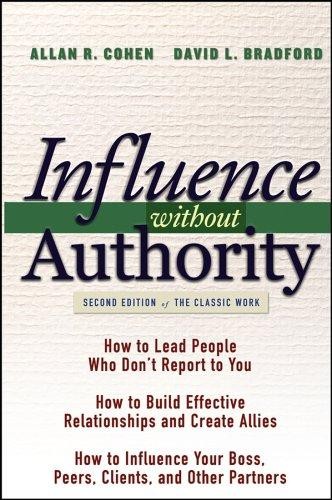
Influence Without Authority · Allan R. Cohen ·
Key Takeaways
- The exchange model: to get someone's cooperation, offer something they value in return.
- The same request may require different currencies for different people on the customer's side.
- Get the third edition, read the six steps in order, and as you read, test them on a stuck ticket.
Imagine deployment has entered its second week. The code is ready, but read access to the data is still sitting in a database administrator's (DBA) backlog. This person doesn't report to you, nor to your manager. You have no authority to give orders, and sending another reminder probably won't change anything.
Influence Without Authority wasn't written specifically for Forward Deployed Engineers (FDEs), but few books come this close to capturing their situation. The publisher Wiley calls it a classic guide to getting what you need from people you don't control.
For an FDE, this is daily work, not a soft skill to practice later. Your projects depend on people outside your organization, and this book gives you a concrete framework for thinking about them.
Two authors, writing for a flatter world
Allan R. Cohen is Distinguished Professor of Global Leadership at Babson College. David L. Bradford is a Senior Lecturer Emeritus in Organizational Behavior at the Stanford Graduate School of Business, where he ran the school's Executive Program in Leadership.
The third edition was published in 2017. Wiley frames the book this way: organizations are increasingly flat and increasingly dependent on external contractors, so getting results requires collaborating as peers, often across borders, time zones, and organizational boundaries.
That sentence practically describes an FDE stationed at a customer site. The announcement for this edition also explicitly states that the model applies to influencing peers, superiors, or customers.
First idea: don't start by asking "who can force them to comply?"
The process in the book has six steps, and the first is to assume that anyone can become an ally. This sounds like polite advice, but it completely changes what you do next.
If you treat the DBA as an obstacle, your instinct is to escalate to the project sponsor. You might get the access, but next week it's still this same DBA responding to you. If you treat the DBA as a potential ally, the question becomes: what does this person want to get done?
Escalation is sometimes still necessary, but it should be the last resort, and only after you truly understand what the other person needs.
Second idea: currencies belong to the receiver
The core of the book is the exchange model: offer something valuable to the other person in exchange for what you need. What they value is their "currency"—in Wiley's words, the direct tool for winning their cooperation.
Back to that stuck ticket. "Give me read access to production so the data pipeline can run"—this request only states your need. Suppose that over a cup of coffee, you learn that the DBA's biggest fear is being woken up in the middle of the night because some strange query slowed down the system.
Now the proposal looks completely different: use a read replica instead of the primary database, cap concurrent queries at 5, run outside peak hours, take ownership of any alerts triggered by these queries yourself, and have the access expire automatically after 30 days. You still get to read the data, and the DBA gets what they actually need: a good night's sleep.
Now try sending the same proposal to the security lead. Suppose this person values being able to account for things to auditors—then query limits don't matter much; what's needed is a dedicated account, access logs, and a list of approved tables for reading.
So at the customer site, the first step isn't drafting the request—it's asking what causes the person the most headaches in a given week, and writing your proposal only after hearing the answer.
Third idea: give-and-take runs through the entire project
The model is built on what social scientists call the Law of Reciprocity. In the six-step process, identifying currencies is only the fourth step; two tasks remain: maintaining your relationship with the other person, and then persuading them through reciprocal exchange.
This order is worth noting, because currencies aren't a one-off trick. An FDE who once fixed a backup script that kept failing for the DBA doesn't have to start from scratch when requesting access in week six.
There's a trap FDEs need to watch out for here: don't pay with currencies that aren't yours to spend. Trading a feature on the product roadmap for access advances today's work, but the debt lands on the product team. Only offer things you can deliver yourself.
Which edition to choose, and how to read it?
This book suits engineers currently working as FDEs, or about to transition from software engineer (SWE) roles, where influence has always come from writing correct code. People who have long led cross-functional projects may find the content familiar, though it's still useful as a shared vocabulary for coaching teammates.
Choose the third edition. The second edition is also from Wiley, but the new edition adds case studies and covers remote and geographically distributed teams. If you'll be working with customers in other time zones, that alone is reason enough.
For reading, remember just one thing: go through the six steps in the author's order, and as you read, test them on a stuck ticket. When you reach the first step, write down the name of the person holding that ticket, and treat them as a potential ally before reading on.
When you reach the fourth step, stop and write down that person's currency. The last two steps cover relationships and give-and-take, where you can put that answer to direct use. If you finish the book without changing a single email, you might as well not have read it.
For career development, this skill only has value if you can back it up with evidence. When reading job descriptions, look for items about collaborating with stakeholders or influencing without direct authority. On your resume, replace "strong communication skills" with something concrete: what proposal you made to which team, and which step of the deployment it unblocked.
Prepare this story for interview questions about customer conflicts. The next time a ticket goes quiet, before sending the fourth reminder, ask yourself: which currency is the person on the other end spending?
Was this article helpful?
Thanks for your feedback!