Edmond Lau calls it leverage: the value created per hour invested. When you're on-site, everyone claims their task is the most urgent; this helps you set the order.
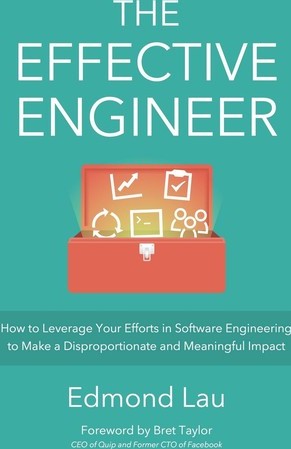
The Effective Engineer · Edmond Lau ·
Key Takeaways
- Edmond Lau's The Effective Engineer (2015) boils down how effective engineers work to a single concept: leverage.
- For an FDE, the leverage of the same task changes with the number of weeks left in the project.
- Read the part on prioritizing work first, then immediately apply it to this week's task list.
The book's blurb on Goodreads makes a bold promise: the best engineers produce 10x the impact of others without working 10x the hours. If you have 12 customer requests this week but time for only 4, the most worthwhile question is: where does that gap come from?
Edmond Lau's answer in The Effective Engineer, published in March 2015, is one word: leverage. The book's official site defines it as the value created per unit of time invested, and all roughly 250 pages revolve around this framework.
The book is written for all software engineers; applying it to the work of a Forward Deployed Engineer (FDE) requires some translation on your part. Try placing it in an on-site week: the people making requests are sitting right next to you, everyone says their task is urgent, and you decide what comes first.
Why should one division carry a whole book?
Lau has been consistent on this point. In a 2015 Glitch interview, he recommended prioritizing work with greater impact relative to time invested. Two years later on Intercom's podcast, his definition of leverage was unchanged: how much impact is created per unit of time invested.
Suppose you're in week 3 of a 12-week project, deploying a record-processing system for a customer. 300 records come in every day, and 30% of them—90 records—need manual correction. You have three tasks; the numbers below are hypothetical estimates, all in one unit: hours saved by the end of the project.
| Task | Hours invested | Hours saved | Leverage |
|---|---|---|---|
| A. Change the report format as the department head requested | 3 | 0 | 0 |
| B. Write a script to check the input file that breaks every week | 8 | 4 hours × 9 weeks = 36 | 4.5 |
| C. Fix the bug causing half of the manually corrected records | 16 | 3 hours × 45 days = 135 | about 8.4 |
Row C assumes 45 fewer records needing correction each day, at 4 minutes each. B and C both assume the fix takes effect the day work starts. The most time-consuming task has the highest leverage, while the one most likely to earn a thank-you ranks last.
These numbers don't need to be precise; they're only for ranking. But try deliberately getting them wrong: if C's hours saved were only half the estimate, its leverage would drop to about 4.2, below B's 4.5. No matter how you estimate A's invested hours, it ranks last because it saves no time at all.
So the order of B and C depends on the "45 records, 4 minutes" assumption. Before investing 16 hours, count how many of today's 90 manually corrected records were actually caused by this bug, and time a few of them.
On-site leverage has an expiration date
Applying Lau's division to a project with a deadline reveals more. Take task B again: if you start it in week 11, only 1 week remains to pay it back—8 hours invested, 4 saved, leverage drops to 0.5.
Task C also drops to about 0.9: 3 hours × 5 days = 15 hours saved against 16 hours invested. The real figure would be even lower, because those 8 to 16 hours of development time themselves eat into the final week. Late in the project, the worthwhile task may no longer be a fix but a handover document so the customer's team can handle the issue themselves.
Conversely, if script B can be reused at the next customer, the denominator stays the same while the numerator grows. So before writing it, ask: how long will it keep working after you leave?
Three ideas worth remembering
First, look for leverage points, not more work. Lau describes effective engineers as people who are good at finding points that amplify their investment. At a customer site, before accepting a request, ask: is there a way to achieve the same result with only a fraction of the hours?
Second, use a shared metric to say "not now." On Intercom's podcast, Lau recommended tying priorities to the team's mission and a shared metric, so that everyone, whatever their specialty, aims at the same number.
In the example above, that metric could be the share of records needing no manual correction: task C can raise it from 70% to 85%, while task A doesn't affect it at all.
Agree on this metric with the customer in the first week, so that saying no is no longer just your personal opinion. Even so, don't apply it mechanically: if that department head has a say on launch day, spending 3 hours on task A is still worth it. Treat it as the cost of maintaining the relationship, strictly capped at 3 hours, and don't mistake it for high-leverage work.
Third, do the hard work when you're at your best. Lau suggests reserving your most energetic hours for the high-leverage tasks you always want to postpone.
Task C is exactly that kind: it needs 16 hours of focus, nobody will thank you in the short term, and it's easily swallowed by meetings and messages. Give it your mornings; move customer meetings to the afternoon.
Who should read it, and in what order?
This book is best for people who are busy all day yet can't say at night what they changed. Those preparing to move from software engineer (SWE) to FDE should also read it, practicing how to organize their own work before their first day on-site.
The official site calls it required reading for many teams and promises to accelerate your career, but the more reliable test is in your own task list.
According to one reader's summary, the first part of the book covers how to prioritize work and projects: read that part first, score your outstanding requests, then continue.
Each chapter ends with habits you can adopt immediately. Use those pages as a checklist at the start of each project, picking one habit at a time.
Don't expect this division to do everything, either. It can rank known tasks, but finding the customer's real problem still requires requirements research.
Turn it into a case for job hunting
A book title on your resume doesn't prove you can pick the right work; decisions backed by numbers do. So instead of putting the title on your resume, write a one-line item with three parts: the task you chose to do, the task you shelved, and the metric that changed.
When reading job descriptions, watch for phrases like "ambiguous priorities" or "multiple stakeholders," then prepare one example organized like the table above—one is enough. If you're not yet an FDE, you can practice right now on your team's backlog.
The next time someone at the customer's side messages you "this will be quick," you'll have a better question than "when do you need it?": what will it create in the weeks that remain?
Was this article helpful?
Thanks for your feedback!
6 sources
- The Effective Engineer (official site)
- The Effective Engineer – Book (official site)
- The Effective Engineer – Goodreads · 2015-03-19
- Quip's Edmond Lau on how to become a more effective engineer (Intercom) · 2017-03-30
- How to Maximize Your Impact as a Software Engineer (Glitch) · 2015-10-08
- [Book Summary] The Effective Engineer, by Edmond Lau · 2023-01-30