*Docs for Developers* uses an API that translates dog barks as its example. Though not written for FDEs, it applies to handovers, and the second edition is worth buying.
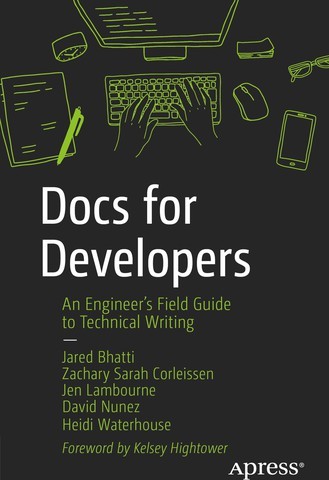
Docs for Developers: An Engineer's Field Guide to Technical Writing · Jared Bhatti ·
Key Takeaways
- The book is written for developers and covers the full documentation workflow, but its context is a product launch; FDEs have to adapt it to customer projects on their own.
- When applying these chapters in the field, three ideas are worth keeping: write for specific readers, measure whether customers can operate independently, and designate an owner on the customer side for every document.
- Read Chapter 1 first, then Chapters 8 and 9, and save Chapter 11 until close to the handover.
This is a serious book about technical documentation, yet the example running through it is Corg.ly: an API that translates dog barks into human language. Behind the joke lies the question every Forward Deployed Engineer (FDE) must answer: after you leave, can the customer team run this system on their own?
In the foreword, Kelsey Hightower writes that if developers are the superheroes of the software industry, missing documentation is their kryptonite. Put that kryptonite at a customer site, and it probably looks like this Slack message: "The token expired again—how do we rotate it?"
You can deliver on time and your demos can look great. But if every operational task requires a phone call to you, you haven't actually handed anything over, and it will be hard to free yourself up for the next customer. So this book is worth an FDE's time, even though it wasn't written for FDEs.
Written for engineers, but not for customer projects
Jared Bhatti, Zachary Sarah Corleissen, and several co-authors wrote this book to share decades of technical writing experience with the people who need it most, as they put it on the official website.
The Write the Docs podcast says the book is written specifically for developers, covering everything from analyzing readers to drafting, editing, and publishing.
The release post on the book's website is dated October 7, 2021. The second printing adds what the authors call "thoughts and advice on using AI in the writing process"; if you buy it, choose that edition.
The book's limitation lies in its setting: it follows a software team launching a new product. Readers of a new product are mostly strangers, while your readers have names, titles, and are one phone call away. That's actually an advantage, because everything you write can immediately be tested against real people.
So the three ideas below start from the book's chapters, but moving them to the customer site is work you have to do yourself. The examples and measurement methods in this article are applied suggestions, not processes printed in the book.
Idea 1: No document is written for "the customer team"
The table of contents opens with Chapter 1: Understand Your Audience. For FDEs, this is also the starting point, because "the customer team" is not a single reader.
Suppose you're integrating an agent into a logistics company's warehouse system. The engineer on call at 2 a.m. needs rollback steps, the analyst needs to know what each data field means, and the IT admin needs to know how to rotate tokens and assign permissions. A 40-page README will disappoint all three.
The first thing to do on site is write down three columns: who is reading, what they need to accomplish, and what situation they're in when they open the document. If you can't fill it in, your requirements research still has gaps.
Idea 2: Count the questions, but don't trust the number right away
Chapter 8 covers collecting feedback and incorporating it into documentation, and Chapter 9 covers measuring documentation quality. For FDEs, the cheapest source of feedback is already sitting in the Slack channel shared with the customer.
Here's a hypothetical example: over 2 weeks, the customer team asked you 40 questions, 26 of which clustered around three topics: token rotation, retry handling, and schema changes.
In other words, 65% of the support workload came from exactly three pages of documentation that don't exist. Write those three pages, and if questions drop to 18 over the next 2 weeks, the total is down by 22, a 55% reduction. That number can be reported, but it isn't yet evidence.
The more familiar the customer team becomes with the system, the fewer questions they'll ask, even if you never wrote another page. So break it down by topic: if the three documented topics drop from 26 to 4 while other topics stay at 14, the documentation probably worked.
If all topics decline together, the team may just have gotten used to the system. If a page already exists but people keep asking, first check whether it's in the right place and written for the right readers before deciding to write more.
Question counts alone aren't enough, because customers may feel embarrassed to ask and then do things wrong. Add one more test: hand the runbook to a customer engineer who has never touched the system, stand by silently, and note every point where they get stuck. Every time you're tempted to explain something, a line is missing from the documentation.
Idea 3: Documentation needs not just an author but a receiver
Chapter 11 covers maintaining and deprecating documentation. For FDEs, this may be the hardest chapter to put into practice: you will leave, but the documentation stays behind and goes stale with every configuration change the customer makes.
Before handover day, make sure every document names the person responsible on the customer side and the next review date. Clearly mark outdated pages, or delete them outright, because at 3 a.m. a wrong runbook is worse than no runbook.
Appendix A also raises the question of when to hire a dedicated technical writer. As documentation grows, this question is worth raising in customer meetings, because an FDE shouldn't be maintaining every page until the very end.
In what order should you read it?
This book is best suited for engineers who write their own documentation but have never learned how, especially those about to do their first handover. If you're a senior technical writer, a book aimed at developers may not offer you much that's new. Don't read it cover to cover like a textbook; read it according to your project's rhythm.
| Part of the book | When it's needed in the field | What the FDE should do |
|---|---|---|
| Chapter 1: Understanding readers | Week one, alongside requirements research | Make a table: who reads, what they need to accomplish, and in what situation |
| Chapter 8: Feedback | When the customer team starts using the system independently | Compile questions from Slack and email into a list |
| Chapter 9: Measuring quality | A few weeks before handover | Establish a baseline question count and run an unassisted test |
| Chapter 11: Maintenance and deprecation | Before leaving the project | Assign an owner and a review date |
| Appendix A: Hiring dedicated staff | When documentation outgrows the project team's capacity | Raise this question with the customer |
When you sit down to write the first page, read the sections on drafting, editing, and publishing. If you plan to use a model for drafting, also read the AI advice newly added in the second printing. Whatever tool you use, rerun every command yourself in the customer environment before delivery.
Turn documentation into evidence on your resume
If your resume only says "skilled at writing documentation," that claim is hard to believe. A line like this carries far more weight: "Wrote runbooks for the three most frequently asked topics: related questions dropped from 26 to 4 within 2 weeks, and new engineers could follow them without assistance"—provided you measured those numbers yourself.
Even without a real customer, you can write documentation for an open-source API, have a friend follow it, and then publish both the before and after versions.
When reading an FDE job description, watch for words like "handoff" and "enablement," then ask the recruiter: who maintains the documentation after the FDE leaves? If they can't answer, that work will most likely fall on you.
The real test of a deployment isn't while you're on-site, but in the week after you leave: when someone on the client side runs into a problem, what they open is your documentation, not Slack.
Was this article helpful?
Thanks for your feedback!