Last Saturday, the Yuandian Talk sharing session and the eighth "Upstairs and Downstairs Are Upstream and Downstream" year-end special edition was held in the PMI China conference room. Around the topic "Is an FDE a must for enterprise AI adoption," five roundtable guests split into two sides and debated for nearly two hours. Two show-of-hands votes were taken, one less than 20 minutes in and one before the debate ended, and both results were nearly even. The only consensus that grew over the two hours was this: the name of this role needs to change.
The event was co-organized by ZhiDing Tech (ZhiDing.com), PMI, the PEC community, and Haisheng Ruida. The debate broke the topic into three questions, which also framed the session: Can existing teams replace the FDE? Do AI projects require an FDE? Can project outcomes prove that necessity?
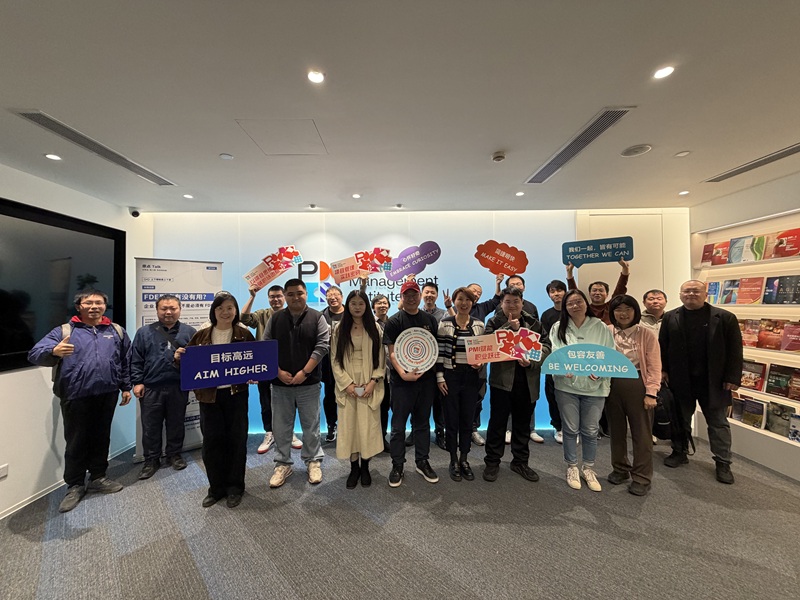
The affirmative side consisted of Jia Mu (Wang Zhaohua), founder of Yuanzhi Turing and co-founder of LangGPT, and Mo Xin, founder of Zhiti Epoch Technology Co., Ltd. The negative side consisted of Ma Chi (Swedish Magong), initiator of the Agent Special Zone; Lu Ken, head of commercialization at LoheHub; and Jia Fei, founding partner of Beijing Tongwei Management Consulting Co., Ltd. and initiator of the PMI China AI Project Management Community. Lufei hosted in his capacity as co-lead of the ZhiDing AI Lab.
FDE stands for Forward Deployed Engineer, commonly translated in China as Forward Deployed Engineer. The question this debate set out to answer was whether it should exist as a standalone role in enterprise AI projects.
Lufei opened without any preamble, cutting the question straight in two: "Which things absolutely require an FDE? And without an FDE, how should the project be done?" He asked both sides to bring reasons and cases, not just concepts.
The first argument wasn't about usefulness—it was about "what does FDE mean"
Jia Mu spoke first. His definition of an FDE included four things: staying close to the customer's real work and business processes; having hands-on engineering capability rather than talking in generalities; having a degree of authority within the business unit to influence where the solution goes; and iterating evaluation results from the production environment back into the enterprise.
The negative side didn't accept this definition. Swedish Magong opened by questioning the name itself: "We're not really doing FDE work at all—it just borrowed the name, and it's not at all the work of an engineer." He took apart the affirmative side's cases one by one: sorting out processes and optimizing and transforming workflows—"that's classic management consulting"; smoothing collaboration between departments—"that's the work of a top-tier consultant"; talking about a second growth curve—"that's business consulting again." The only part that resembled engineering—writing code—was, in his telling, handed off to the customer's own IT department.
He then pointed at the very problem the FDE is meant to solve: "If an AI agent is going to enter an enterprise, it enters as a digital employee. Then you have to give it HR, a mentor, a supervisor, KPIs. That's not a problem an engineer can solve at all—it's a massive management problem."
Jia Fei, who described himself as "only representing his role's position and personally neutral," pulled the discussion back to the most practical side. He didn't talk about competency models; he talked about customers' first impressions: "When our consultants, especially senior consultants, show up at a customer site and get mistaken for FDEs, their faces don't look too happy." In his view, if a role or a product fails to make a good first impression, pushing it afterward becomes very hard—"in this circle, that impression is very hard to reverse."
It's not about adding another engineer—it's about turning "built" into "used"
Jia Mu's response pulled the discussion from terminology back to the field.
He told an on-site case story: the customer had its own IT department and was already using AI to generate learner profiles and renewal recommendations, but frontline customer service staff found them awkward to use. It wasn't that the features hadn't been built—it was that the built features didn't match the real workflow. When the team arrived, the first thing they did wasn't write code; they shadowed frontline customer service staff for two days, mapped out which steps in the business chain were waiting, which were duplicated, and which were stuck, then verified each segment face-to-face with business leads and frontline employees, and then brought IT's product manager and R&D lead into the same room to settle on a solution.
The result was replacing a quality inspection team of several hundred people with automated QA built on ASR, TTS, and multimodal models, with senior inspectors' experience distilled into executable rules, and the system integrated with the customer's internal ERP and CRM. "There's a gap between getting a feature built and getting the business to actually use it," Jia Mu said. "Who closes that gap? I believe it's the FDE."
Mo Xin said the business side wants to know "can it be computed," while the system side can only answer "under what conditions, and with what probability, can it be computed accurately." What's missing in between is a role that can translate business rules into system constraints and, in turn, clearly explain the system's boundaries. In his view, an FDE is not a pure engineer but a composite of product, R&D, and business context: "What you're really delivering isn't a conclusion—it's that entire system behind it."
The real question isn't the role—it's authority, pace, and who owns the outcome
Swedish Magong's approach is heavier. He said that when he takes on a project, he tells the customer's top executive directly: "I'll be your interim CTO for three months." In those three months, he demands authority, builds a team (people and agents together), and sets up R&D management processes—how requirements are analyzed, what the quality and security standards are, when releases can ship. There's only one acceptance criterion: can the company produce its core products faster, cheaper, and with better quality.
To avoid the existing boundaries within the organization, he gave this approach two names: "Second R&D Department" and "Agent Special Zone"—the original R&D department stays untouched, he has full say among just these few people, and delivery happens fast within two months. "So if I absolutely had to choose someone, I'd lean toward a project manager rather than a brilliant FDE." Swedish Magong said engineers tend to think "I'll overcome this difficulty myself and tell you once it's done," while a project manager's first question is about resources and boundaries. "Delivering the project and ensuring its success is more useful than solving one specific technical problem."
Lu Ken pushed the argument down to a more fundamental level: don't obsess over whether it's one person or several—obsess over "contextual friction inside the organization."
"The biggest problem an FDE could solve in the previous era was that it was all done by one person—no need to pass context to anyone, no friction," he said. "As long as you have no friction, you can treat it as one person." If there were a set of tools or mechanisms that could stitch organizational context together in real time, this work could absolutely be split across a team.
He also touched on the role's current predicament: market expectations for the name have already exceeded what the role itself can carry. "When you walk in under that name, you first have to spend time aligning expectations."
Jia Fei laid out the costs: how much does an enterprise AI transformation actually cost, what's the ROI, how do you handle AI's uncertainty, how long is the payment cycle? "Does the FDE increase or decrease our costs? Everyone has to think about this question." His answer is a tiered structure: juniors handle entry-level problems, complex ones get escalated to seniors and experts—"consulting goes first, the FDE follows, and the delivery team follows after that"—only then is it a closed loop.
About the Yuandian Talk Sharing Session
The Yuandian Talk sharing session is an offline salon co-initiated by ZhiDing Tech and Haisheng Ruida, supported by the PEC community, and located in Beijing's AI Origin Community. Held monthly, it focuses on large language models, agents, AI application deployment, and enterprise intelligent transformation. The events don't just discuss AI trends—they focus on practical experience in real scenarios. As a regular exchange program of Beijing's AI Origin Community, the Yuandian Talk sharing session aims to continuously present the real changes AI is undergoing in an open, pragmatic way, connecting technology, industry, and the application front line. Beijing's AI Origin Community is one of the first AI innovation districts announced by the Beijing municipal government, serving as a source of AI innovation and an entrepreneurship vehicle.
If you'd like to participate in the Yuandian Talk sharing session, please add WeChat: hudianjie