To develop people who build AI systems in manufacturing, choose candidates who know the processes and quality well—such as production control or quality assurance staff—and pair them with employees from production engineering and information systems. Factory improvement has long been carried out by on-site employees. Building AI systems is the same: the goal is a setup where people who know the exceptions on the ground can build and fix things themselves. Decisions involving quality and safety are still made by people even after the system is in place.
Why grow on-site employees into system builders in manufacturing?
Building AI and digital systems is usually outsourced to the IT department or an external company. As a result, on-the-ground circumstances often fail to be fully communicated between the requester and the builder, and things get lost along the way.
There is also less capacity to rely on outside help. According to the outline of the 2026 Monodzukuri (Manufacturing) White Paper, the figure showing the surplus or shortage of employees at small and medium-sized enterprises was -17.9 in manufacturing in 2025—more companies report being short of staff. Those who train others are also in short supply. Among manufacturing workplaces with problems in human resource development, 62.8% answered "we lack personnel to provide guidance" and 45.4% answered "we have no time to conduct training."
Today, if you can describe the processing you want in words, AI can support the work of writing programs. We have entered an era where giving tools to employees who know the business makes it possible to build systems that fit the workplace faster.
Production control and production engineering: how should they be paired?
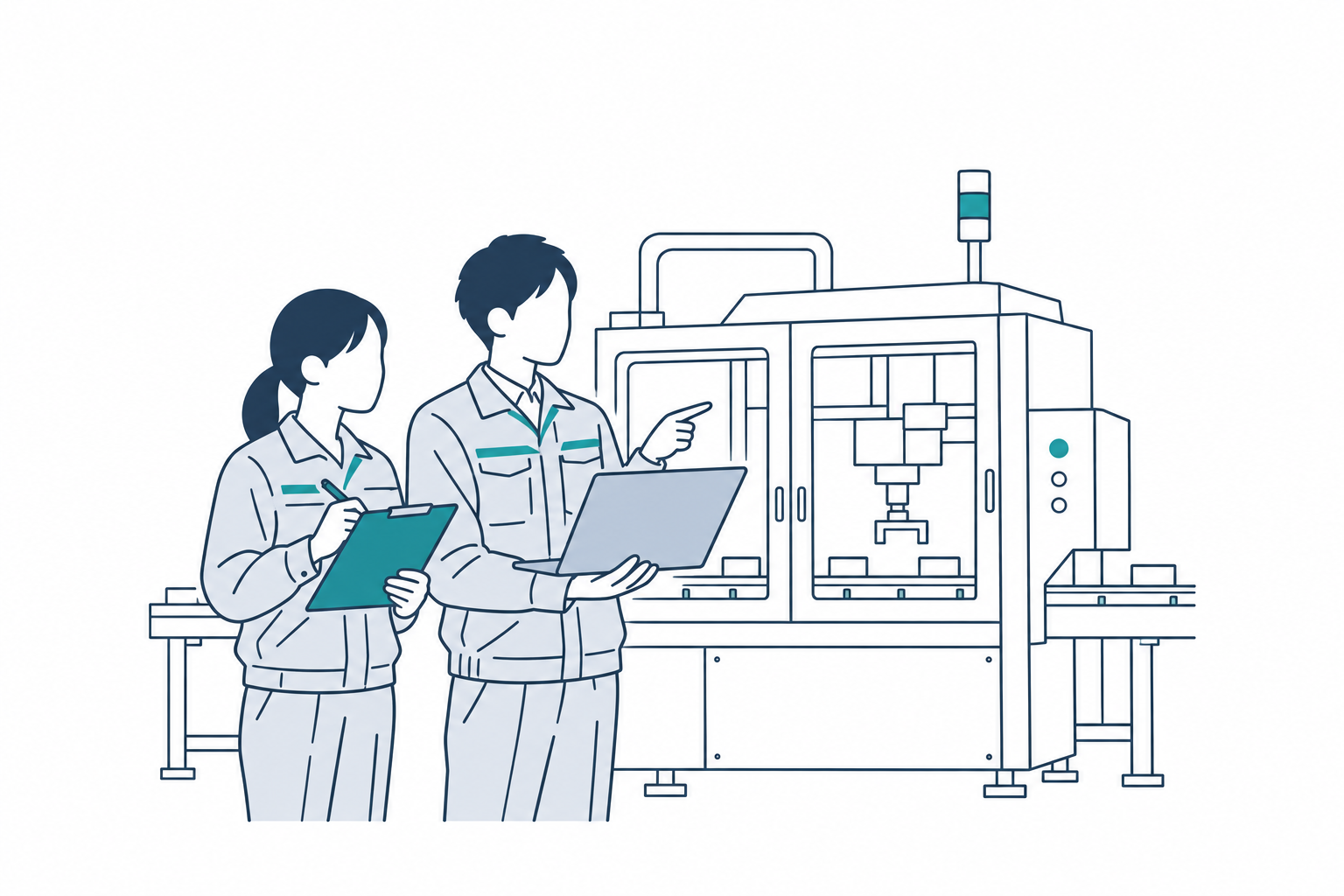
In-house FDEs fall into two types depending on their background.
| 業務部門型 | エンジニア型 | |
|---|---|---|
| Main background | Production control, quality assurance, procurement, sales administration | Production engineering, information systems |
| What they build | Summaries of daily and periodic reports, drafts of inquiry responses | Integration with production control systems and quality data |
| Goal after 3 months | Complete one system that is used in their own department | Run what the business department type built in a production environment |
With the business department type alone, systems may get built but never connect to factory systems. With the engineer type alone, systems may connect but never be used on the floor. By developing both at the same time, what is built can be taken all the way to running in the factory.
What did we learn by testing on maintenance reports from three factories?
At our company, we prepared five fictional maintenance reports from three factories and asked an AI tool to process them. Writing was not standardized—for example, the same equipment was written as "compressor" and "air compressor."
The AI produced a list of 13 issues in 65 seconds. When we then asked it to consolidate the same issues across factories, it organized them as follows in 101 seconds.
| Equipment and issue | Where it appeared |
|---|---|
| Compressor pressure drop | 3 factories, 4 cases |
| Belt misalignment on transport conveyors | 2 factories, 3 cases |
| Increase in false detections by inspection cameras | 2 factories, 2 cases |
The AI also noted that it had standardized the equipment names on its own judgment with no mention in the reports, and that the same issue across factories does not necessarily share the same cause. Identifying causes and deciding preventive measures is the job of people who know that equipment. Note that this is the result of a single run using fictional data.
How should you choose the first project?
Choose tasks that recur weekly or monthly, take more than 30 minutes each time, and have roughly fixed procedures. Candidates include tallying daily reports for each line, drafting defect reports, and cross-checking supplier certificates against internal standards. In factories short of trainers, a good project is also one that turns interviews with veterans into structured work instructions—since veterans then only need to review the content.
On the other hand, do not choose equipment control or pass/fail inspection decisions themselves as projects. Also, since factory PCs often cannot connect to AI tools, start with projects that can be handled on office PCs.
Frequently asked questions
Does experience in improvement activities help in developing in-house FDEs?
Yes. Repeatedly fixing prototypes that do not work as intended is similar to the iteration of improvement activities. For selection, choose people who have handled the work for at least two years and can articulate their pain points concretely.
Who guarantees the accuracy of quality records?
People, as before. AI produces drafts and lists; quality assurance staff make the pass/fail and cause judgments.
If the builder is transferred, won't the system become unusable?
Since this industry has frequent transfers and moves between factories, proceed with two people per department. Register built systems in a list with their name, builder, using department, and data handled, and establish a rule to hand them over to successors along with a manual—then no system will be left behind that no one knows how to use.
Read the details in the report
This article summarizes the key points of our report, "In-House FDE Development for Manufacturing: How-To Report." The report includes the full results of processing the maintenance reports, a list of projects by department with scoring sheets, an effect estimation sheet, and even materials for explaining the initiative to plant managers and IT departments.
Source: Ministry of Economy, Trade and Industry, Ministry of Health, Labour and Welfare, and Ministry of Education, Culture, Sports, Science and Technology, "2026 Monodzukuri (Manufacturing) White Paper, Outline" (May 2026)
If you are unsure which department to start with in your factory, use the free 30-minute "AI Business Diagnosis" to sort out who to develop and your first project together.