*Extreme Ownership* by two former Navy SEALs teaches FDEs how to run incident meetings when client projects go wrong, without letting them turn into blame sessions.
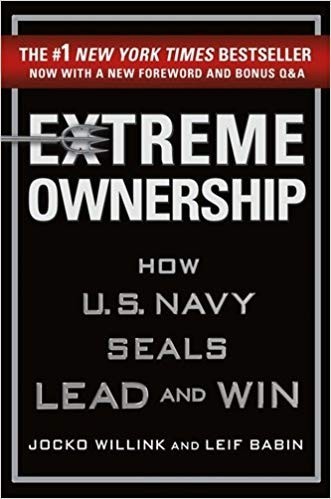
Extreme Ownership: How U.S. Navy SEALs Lead and Win · Jocko Willink ·
Key Takeaways
- *Extreme Ownership*, co-authored by Jocko Willink and Leif Babin, was published in hardcover in 2015 and uses the SEALs' combat experience in Ramadi to teach leadership.
- For FDEs, the book's greatest value is building the instinct not to assign blame: blame drags incident meetings toward "who got it wrong" instead of "what should be done."
- Taking ownership doesn't mean going it alone: priorities must be clear enough that the client team can execute them even when you're not there.
"There are no bad teams, only bad leaders." Jocko Willink and Leif Babin repeated this line in a 2016 Business Insider interview that was later syndicated on Yahoo Finance. It sounds like a slogan, yet it captures nearly the entire spirit of the book the two published a year earlier.
The book is *Extreme Ownership: How U.S. Navy SEALs Lead and Win*. St. Martin's Press released the 320-page hardcover on October 20, 2015; the Apple Books ebook went on sale on November 21, 2017.
The two authors served together in the SEAL task unit Bruiser. According to the bookseller, it was the most decorated special operations unit of the Iraq War and helped win the Battle of Ramadi. The two later co-founded the leadership consulting firm Echelon Front, with Willink as CEO and Babin as President.
For Forward Deployed Engineers (FDEs), this book is about the hardest moments of the job: a client project going off the rails, with plenty of people around to blame.
The product team, the client's data team, the infrastructure vendor—any of them could be the cause. What the book trains is the ability to steady the situation when a project is in trouble, keeping it from sliding into a scapegoating game.
Blame Stalls Meetings
The book recounts the experience of leading task unit Bruiser in Ramadi and applies its lessons to business and life. The core argument is clear: leadership at every level is the most important factor in a team's success or failure. In Echelon Front's words, when something goes wrong, you own it—no excuses, and no pushing responsibility onto others.
In 2018, a post on the Conductor blog brought this idea into software companies, boiling the response to failure down to three steps: take ownership, figure out the cause, then deliver a solution.
A hypothetical example shows the difference. In week three of a deployment, the client's ticket-classification AI agent's accuracy drops because the client's data team changed the ticket format without notice.
If the meeting opens with "you changed the schema without telling us," the whole meeting will spin around "who got it wrong," and no one will leave the room with concrete tasks.
Try a different framing: "Our deployment pipeline should have validated the schema before the data came in. The cause is that field X uses a new format. The fix will be ready Thursday, and we'll add a check to prevent recurrence." The facts haven't changed, but the meeting now turns toward what needs to be done.
Echelon Front suggests asking yourself one question before looking at others: "How is this my fault?" Examine your own role first, then figure out how to prevent the problem from happening again. For good engineers, this is often the hardest step, because technically speaking, you're usually right.
Does Taking Ownership Mean Carrying It Alone?
No. Conductor's definition explains why: extreme ownership means being responsible for everything in your world, including things you can't directly control. You can't order the client's data team around, but you can proactively pull them into the fix.
In the example above, owning the solution means personally inviting the client's data team to agree on a process for advance notice before format changes, and telling your own product team that the product lacks input validation. You take on the coordination responsibility, not other people's work.
Echelon Front also stresses clarifying and simplifying priorities: if the team didn't understand or remember what you said, the fault isn't theirs. So if the client team doesn't know to give advance notice before changing the schema, chances are no one explained it clearly to them—and the person who should have is you.
Doing the Client's Work Is the Easiest Trap to Fall Into
The most common mistake is interpreting "take full responsibility" as quietly doing the work yourself. The client's data team is slow, so you write the transformation script yourself; the client's lead can't approve in time, so you make the call for them. The incident passes, but the client team learns nothing and remains dependent on you.
Echelon Front describes the ideal outcome as the opposite: once the leader takes ownership, the team stops making excuses and focuses on execution. If you've already done everything, the client team has nothing left to execute.
There's a simple test: after each act of ownership, ask whether the client team could do it without you. Every FDE eventually leaves the client; if the answer is no, you've only treated the symptom.
Who Should Read It, and How to Get Value From It?
The book is best suited to two types of readers. One is FDEs starting to own projects independently, where you're accountable for outcomes at the client, not just for the code you write. The other is software engineers looking to move into an FDE role, because the biggest leap is precisely shifting from accountability for code to accountability for outcomes.
Keep one thing in mind while reading: the book tells battlefield stories, and translating them into lessons that apply to your client's company is your own homework. After finishing the core principles, pull up your most recent incident, think through which parts fall within your responsibility, and then keep reading.
The book also helps with job hunting. When interviewers ask about a project that went wrong, walk through the three steps above, then add what changes you made to prevent recurrence.
On your resume, a single line about a deployment you saved—clearly stating which part you were responsible for—impresses recruiters more than a list of technologies.
The next time a deployment goes wrong, start by asking yourself the book's most uncomfortable question: how is this your fault?
Was this article helpful?
Thanks for your feedback!
6 sources
- Extreme Ownership – Leadership Now
- Extreme Ownership – Apple Books · 2017-11-21
- About – Echelon Front
- What Are Extreme Ownership Leadership Strategies? – Echelon Front
- Former Navy SEAL commanders explain why 'there are no bad teams, only bad leaders' · 2016-10-02
- Effective Leadership Through Extreme Ownership – Conductor · 2018-05-11