The book's principle of "provide options, not excuses" is exactly how an FDE delivers bad news when no one has their back.
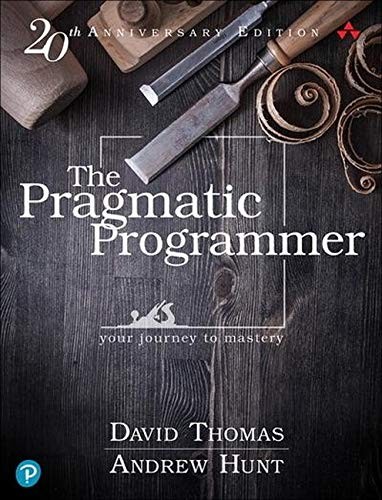
The Pragmatic Programmer · David Thomas ·
Key Takeaways
- Read the 20th Anniversary Edition (2019, 320 pages): it is a rewrite with new tips and topics, not just a reprint
- Three ideas worth remembering: provide options, not excuses; don't leave broken windows; build end-to-end tracer bullets early
- The book's value lies in habits, so record how you practice them to build material for your resume and interviews
Early in The Pragmatic Programmer there is a section called "The Cat Ate My Source Code." A Forward Deployed Engineer (FDE) in front of a customer cannot make excuses like that, because on site no one will take responsibility for you.
The book was co-authored by David Thomas and Andrew Hunt and first published in October 1999. One of the key points the publisher explicitly lists is taking responsibility for your work and your career. That is also the first thing an FDE must learn when working alone on someone else's systems.
If you are a developer with two to eight years of experience considering a move into FDE work, this book is worth reading ahead of many technical books. It does not teach tools; it teaches habits, and it is habits that determine whether you can hold up when working alone.
The recommended edition is The Pragmatic Programmer, 20th Anniversary Edition: your journey to mastery (Addison Wesley, September 2019, 320 pages). This edition is a rewrite with new tips and topics, revised throughout. The book does not build a grand theory of systems; instead it collects many short pieces of advice, not tied to any language, framework, or methodology.
Idea One: Provide Options, Not Excuses
The tip an FDE will use most is probably "Provide options, not excuses." It turns the "responsibility" mentioned above into concrete action.
Imagine a scenario: the customer wants an AI agent to finish reading all scanned contract files by Friday, but the older scans have poor optical character recognition (OCR) quality. If you only say "the data is too bad, we won't make it," that is an excuse.
Coming to the conversation with three options is different: process only the newer scans; process everything but flag low-confidence results for human review; or push the deadline back a week and clean the data first. Now you are helping the customer make a decision.
Each time something like this happens, write it down in your work log, about three lines per entry.
In an interview, that log entry can be rewritten as a STAR answer. Situation: the scanned contract files were too old to meet the demo deadline. Task: deliver results by Friday. Action: proposed three options and explained the cost of each. Result: the customer chose the human review option, and the demo went ahead as scheduled.
The corresponding resume bullet could read: "When old scans blocked a pilot, proposed three scope trade-off options; delivered the human review option by the original demo date." That single line shows both decision-making and results, rather than just listing technologies used.
Idea Two: Don't Leave Broken Windows, Even in Someone Else's System
Early in the book there is a section called "Software Entropy," which leads to the tip "Don't live with broken windows": when you see bad design or code, fix it immediately. Dan Lebrero's summary numbers it as tip 5; other summaries number it differently.
For an FDE, the difficulty is that broken windows are usually in the customer's system. Suppose you discover a hardcoded password in an extract, transform, load (ETL) script.
You may not yet have permission to change it, but you should record it, tell the owner, and propose a fix the same day. When the first breakage is ignored, later ones become easier to overlook.
Idea Three: Build a Tracer Bullet in the First Week
Tip 20 in Lebrero's summary is "Tracer Bullets," also known as a walking skeleton. The approach is to first build a thin path that runs end to end through the whole system, then gradually flesh out each part.
On a customer site, this means getting one document type through the entire pipeline in the first week: from upload to an answer appearing on the customer's own screen.
Running on real data and real infrastructure surfaces problems like firewalls, access permissions, and unusual formats early. Discovering them in week six is too late.
What Happens If You Get It Wrong?
These three habits are easy to do only halfway. The most common mistake is offering options without stating the costs: "process everything but flag it" sounds good, but if you don't say who will do the review and how many hours it will take, the customer still lacks the information needed to choose.
The second mistake is fixing the customer's broken windows without permission. Pushing a patch straight to that ETL script could break a job you didn't know about, turning good intentions into an incident. In someone else's system, "fix it immediately" should mean report immediately and propose a fix immediately.
The third mistake is building the tracer bullet on sample data or your own machine. Then it is no longer a tracer bullet, because it conveniently bypasses exactly the problems you needed to discover early.
In What Order Should You Read It?
First read through "A Pragmatic Philosophy." This part has seven short sections, covering responsibility for your career and no excuses, software entropy, good-enough software, your knowledge portfolio, and communication. The "Good-Enough Software" section is especially useful when a customer wants perfect results in too little time.
Next, before taking on your first project, read the section on tracer bullets. After you start working with the customer's team, read "Pragmatic Projects," which covers team collaboration and keeping users satisfied.
The tip "Be a Catalyst for Change" fits this stage: rather than forcing the customer's team to change how they work, show them what the new way looks like and let them want to change.
Finally, "Invest Regularly in Your Knowledge Portfolio." Every FDE project forces you to learn a new domain, so treat recording what you learn as a regular investment, not something to do when you have spare time.
The moment this book is most worth rereading is exactly when you need it most: standing alone in front of someone else's system, needing a better answer than "the cat ate my source code."
Was this article helpful?
Thanks for your feedback!