Essay 01
Salesforce Hires PMs to Say What Good Looks Like. The PM Is the Product Builder Now.
Salesforce's 700-person AI org hires PMs for prototyping and evals. The PM becomes the Product Builder, inside one loop under the CPO.

The Product OS · the product seat
Build what matters.
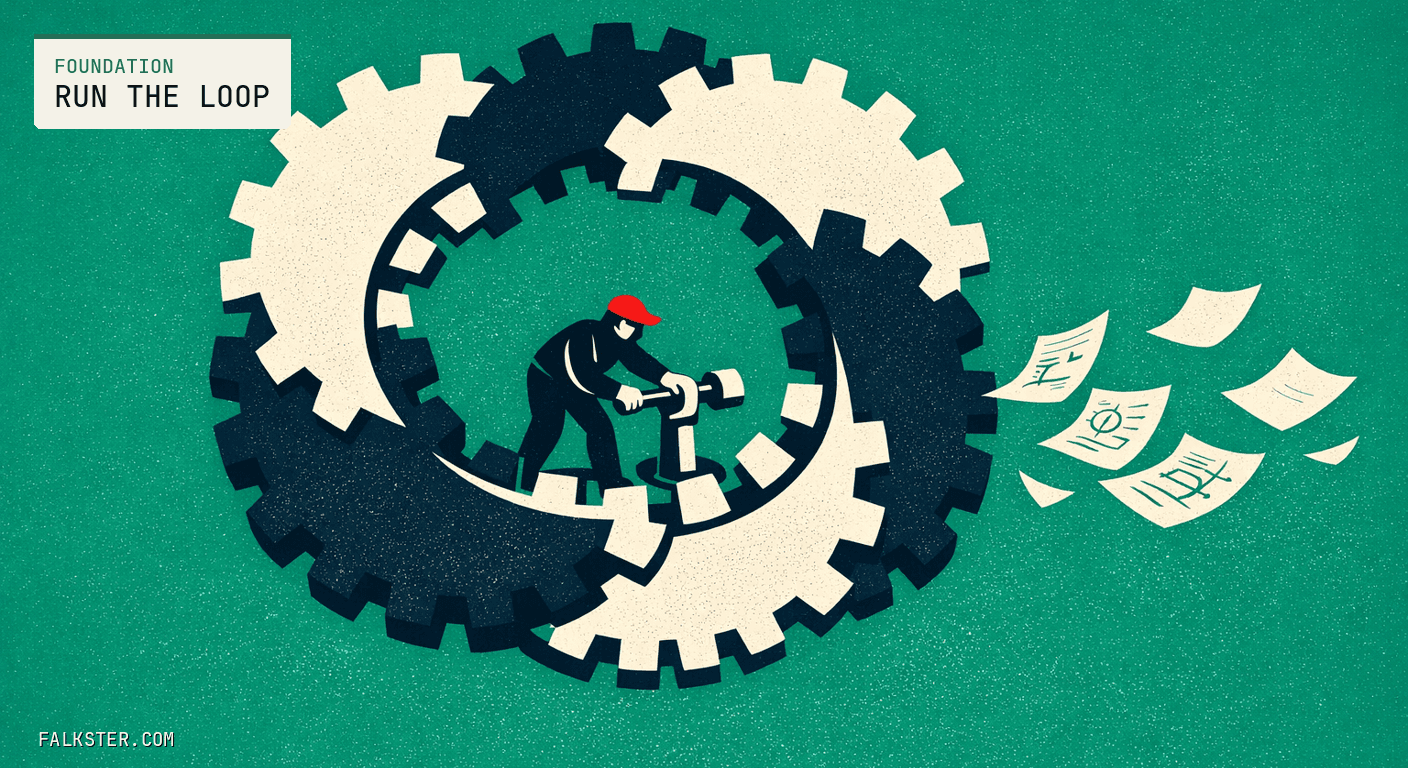
The PM becomes the Product Builder: one person who takes an outcome to a working product, runs the agents, and writes the eval that says it works.
What this seat owns
The spec and the build: Product Builders take an outcome to a working product in a day and run the agents that build it.
When building is cheap, the outcome is decided by the loop from customer to adoption. One loop needs one owner. The CPO owns the whole product outcome, and product, design, product marketing, and forward deployed engineering run it together. See the whole OS.
- 01CustomerField signal from deployments, support, and usage, read daily. Measured in hops and days from finding to fix.
- 02 · leadsSpecThe problem, the behavior, the claim, and the eval that says it works. Measured by the eval pass rate.
- 03 · leadsBuildAgents and Product Builders take the spec to working software. Measured by the repair rate in use.
- 04StoryPositioning and proof that buyers, sellers, and AI assistants read, shipped in the same release as the build. Measured in story lag, the days until assistants describe a change correctly.
- 05AdoptionVerified jobs done on every path, with the cost per job beside it. The number moves, or the loop runs again.
Start here
The argument, in 4 essays.
Written for product managers. Read them in order, or start with the question on your mind.
Essay 02
The FDE Is the Product Builder Wearing a Visitor Badge
OpenAI raised $4 billion for a deployment company. Anthropic launched a $1.5 billion one. The role they hire for is the Product Builder, from the services side.
Essay 03
The PM-as-Translator Is Dead
For 15 years, PMs were professional middleware reformatting customer input into decks for engineers. AI just stripped away every translation layer.
Essay 04
The Triad Is Dead. Pods Are Dead. Agent Departments Now.
Forrester still talks about human-with-agent teams. Wrong unit. Agents form their own departments and interface with human departments on exception.

The handbook
19 chapters for this seat.
How to do the work, chapter by chapter. Every seat starts from the same core.
See this section in the full handbook →
- 01Old PM vs Product Builder, The LedgerThe line-by-line ledger of what changes when product management gets rewritten by AI: output, cycle time, unit of work, deliverable, accountability.9 min read
- 02Continuous DiscoveryAI ingests every call, ticket, and email, extracts the signal, and hands you a prototype the same day. Continuous discovery is no longer a weekly ritual.18 min read
- 03The Interview Guide That Actually WorksCustomer interviews matter more than ever. Show up with full signal context, a working prototype, and AI that synthesizes the conversation in minutes.13 min read
- 04The Assumption Testing PlaybookStop debating what to build. Prototype it in hours, test with customers, and let their reaction decide. Assumption testing just went from weeks to 3-5 days.14 min read
- 05Continuous Listening: Every Customer, Every DayWeekly customer calls are the floor, not the ceiling. Pipe every support ticket, call, and churn survey into a daily digest and stop scheduling discovery.8 min read
- 06Build Your First Opportunity Solution TreeBuild your first Opportunity Solution Tree. AI populates the opportunity layer from 500+ signals. Prototype and test a solution in one week instead of eight.13 min read
- 07Prototype Before You SpecWhy the fastest way to get alignment, test ideas, and advance your career is to build something people can touch - and exactly how to do it in 2 hours.16 min read
- 08Building Evals: Error Analysis, Eval Types, the Loop, the GateTeresa Torres's three steps as a weekly routine, plus the fourth step that turns an eval from a scoreboard into what decides what an agent may do alone.7 min read
- 09Ship With Observability or Don't ShipNo feature leaves staging without the traces, metrics, and evals that will tell you whether it's working. Before your first customer hits it.7 min read
- 10Direction Metrics for AI-Native VelocityOutcomes lag by weeks. Direction moves with each iteration. The seven leading indicators that predict outcomes 4-8 weeks ahead, and the dual-cadence system.3 min read
- 11PM-as-Editor: Managing a Fleet of AgentsThe 39-agent chapter told you what to deploy. This is the skill you need once they're running: great editing at volume.8 min read
- 12PM AI Agent Fleet, Mapped to the 7-Stage Operating SystemA live index of every AI agent for product managers, mapped to the 7 stages of the PM Operating System: Sense, Discover, Decide, Build, Ship, Measure, Amplify.8 min read
- 13The PM Agent Stack: Open-Source Tools Mapped to PM WorkBuild a personal PM agent stack from open-source Claude repos. 18 tool categories mapped to the 7-stage PM operating system, with install order and how-tos.14 min read
- 14Agent-to-Agent DispatchThe listening agent does not file a ticket. It hands the outcome to a prototyping agent, and a working prototype is waiting before standup.6 min read
- 15Prompt OpsYour prompts are production code. Version, review, eval, stage, and roll back, or your product is one Notion edit away from breaking.7 min read
- 16When Not to Use AIThe senior PM move in 2026 isn't using AI everywhere. It's knowing when a regex, a query, or a form beats a model.7 min read
- 17The Anti-BacklogThe backlog is a graveyard pretending to be an inventory. Burn it. Replace with a live queue, signal-fed, capped at two weeks.7 min read
- 18The PM 30/60/90A week-by-week 90-day plan for PMs starting a new job: decision archaeology, a signal map, a manager contract, and one compounding artifact by day 60.8 min read
- 19The Builder PM 30/60/90The 90-day plan for making the shift from traditional PM to product builder. Done in order. In 90 days, you have a different job.8 min read
The running series · New parts every Monday, part of The Product OS
The PM Transition
Part 3
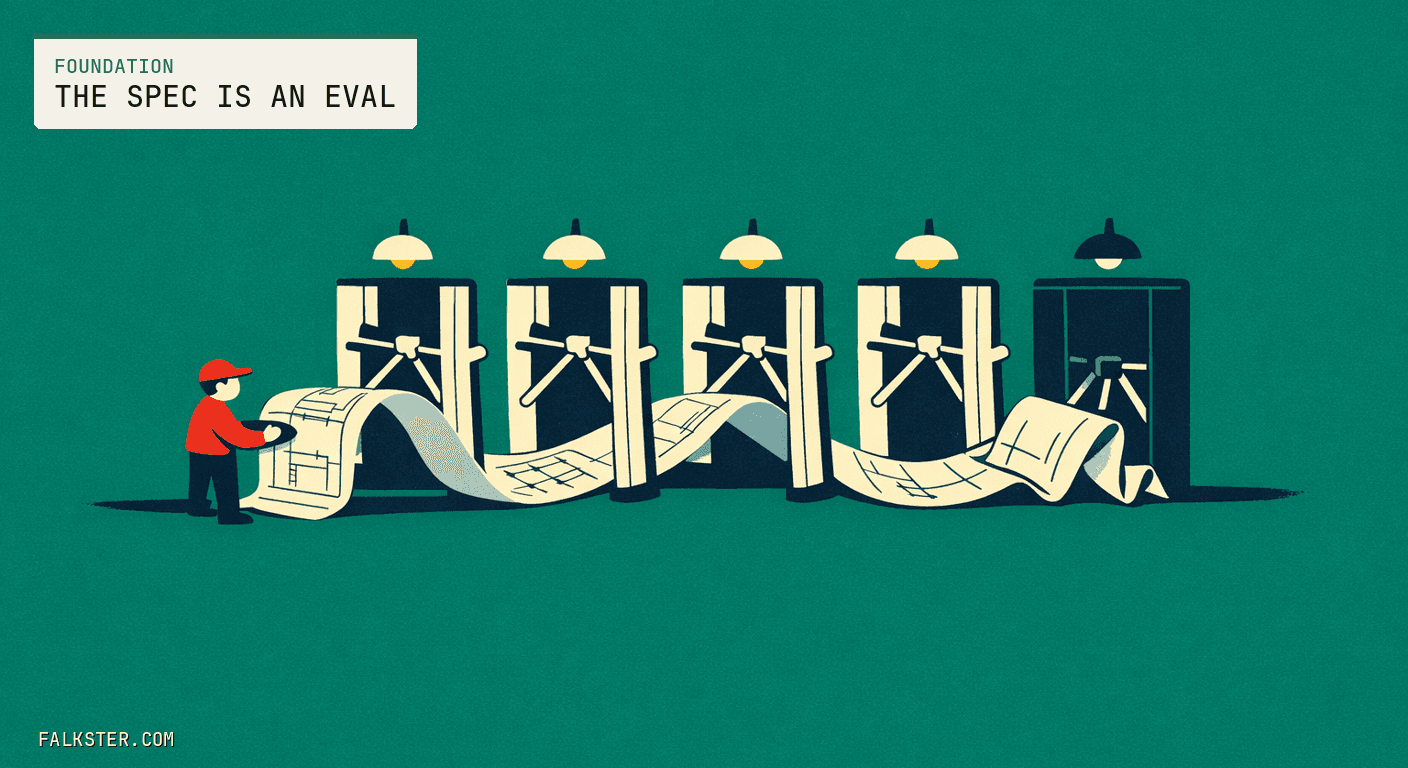
LangChain's Eval Loop Starts With a Spec. For PMs, the Spec Is an Eval Now.
LangChain's eval-driven development starts with a spec of good and an eval written before the build. That's the PM's artifact for the next five years.
Part 2
Ramp's Non-Engineers Shipped 7,000 PRs in a Quarter. The PM's Day Is Decisions Now.
Ramp's non-engineers shipped 7,000 PRs in a quarter and PostHog's agents open their own. The PM's day becomes a queue of decisions.
Part 1
Salesforce Hires PMs to Say What Good Looks Like. The PM Is the Product Builder Now.
Salesforce's 700-person AI org hires PMs for prototyping and evals. The PM becomes the Product Builder, inside one loop under the CPO.
Put it to work
The standard, a test, a course, and a try-it demo.
Product Builder OS is the working standard for the seat. Read it, score yourself, then practice.
Try it
Pick the AI primitive, the way a Product Builder does.
Pick the right AI primitive in three questions.
Walk the tree. Each yes/no narrows the cheapest primitive that fits. Or skip the tree and pick directly — either path lands the same five-minute defense.
Q1Does the logic follow a fixed if/then pattern with no language understanding required?
Answer the first question to see the trade-offs.
Keep reading
More arguments.
- The PM Agent Stack: A Bridge to the Enterprise AI BrainFive-part series for PMs whose company is 6-18 months from an enterprise-wide AI brain. Build the personal PM agent stack today with open-source Claude repos.
- Build a Discovery Agent Stack: Continuous Customer ListeningDiscovery agent stack: seven open-source Claude repos turn customer interviews, support tickets, and public reviews into a continuous loop. Install + recipes.
- Build a Prototype Agent Stack: PRD to Working Demo in a DayBuild a prototype agent stack: eight open-source Claude repos take a PM from idea to working prototype in a day, with TDD, design, and security review.
- Build a Measurement Agent Stack: End the Dashboard Hamster WheelMeasurement agent stack: seven open-source Claude repos turn dashboards into a daily outcome digest, a variance detector, and a stakeholder update writer.
- Which of LangChain's three eval-driven steps is the PM's?Step one, and the reading in step three. As Divya Santhanam describes LangChain's eval-driven development on November 9, 2026, the loop is: write a short spec of what good looks like for one behavior, write the eval before you build and confirm it fails, then make the change and compare results row by row. The spec and the examples are the PM's work, because they say what the product should do and which cases matter. Engineering owns the harness that runs them. My prediction: by the end of 2027, at AI-native software companies, most rows in a product area's eval file will have been written by people outside engineering.
- What do Ramp's 7,000 non-engineer PRs mean for PMs?They mean the build no longer waits on the PM, so the PM's day becomes a queue of decisions. As Rich Holmes reports in Department of Product on November 1, 2026, Ramp's CEO, Eric Glyman, says non-engineers shipped more than 7,000 pull requests last quarter, and about 11% of PostHog's October merged PRs were opened by its own product after a scheduled agent found something to fix. The PM's job is deciding which proposals ship, which die, and when the bar itself is wrong. My prediction: by the end of 2027, at AI-native software companies, most changes a PM approves in a week will have been proposed by an agent.
- What does Salesforce look for when it hires AI PMs?Two skills and five traits. As Aakash Gupta reports from his November 3, 2026 conversation with Jayesh Govindarajan, who runs Salesforce's roughly 700-person Agentforce org, the core AI PM skills are AI prototyping and AI evals. The traits are agency, an agent-native mindset, skepticism, craftsmanship, and setting the bar, and the last one, can you say what good looks like, is the one he calls most important. None of it is about writing requirements.
- What should the first lines of an agent-written PR description say?Three things, above a collapsed block that holds everything else: what changed, what was not checked, and what the reader is being asked to decide. Simon Willison's November 9, 2026 post folds the agent's full description inside a details element labeled with the model and effort level and puts a short human-chosen opener on top. By his own list the agent's essay holds the steps taken to verify, so the verification is now under the fold, and the five example openers he quotes all describe the change. The second line should come from the run's record, not the agent's prose. In my own repository 343 of 401 commits since September 1 carry an agent co-author line, and the run reports are the long ones: last week's five creator scan digests ran 66,349 to 82,798 characters with the list of what was not read starting as late as character 74,764. The November 9 digest is the first to lead with it.
- Who owns the deployment agent when agents do the forward deployed build?Product, under the CPO. On November 10, 2026, IBM and Microsoft announced Imagine Enterprise with a fleet of more than 6,000 AI agents and assets and forward-deployed engineers attached for qualifying engagements. Microsoft's Kevin Shatzkamer describes FDE teams augmented with coding assistants and deployment agents, and ServiceNow's chief product officer, Amit Zavery, said on October 28, 2026 that the company is building AI implementation agents that do a lot of the heavy lifting at go-live. Software that every deployment runs is a product, so it needs a product manager, a backlog, and a quality bar. The human forward deployed engineer keeps four decisions: the choice of workflow, the judgment of the customer's senior people, the bar for go-live, and the handback to the roadmap. Falk's number for the field is human hours per go-live, sorted into decision hours and gap hours, where every gap hour is a bug report against the deployment agent.
- Did the 2026 midterms reject AI?No. The 2026 midterms rejected the bill for AI infrastructure, not AI. Voters in ten states decided 41 data center measures and went against development in 40 of them; only Harwood, North Dakota, said yes. NBC's exit poll put AI and data centers as a crucial or major factor for 56% of voters, but the AP Voter Poll found only about a quarter called it crucial, behind cost of living and corruption. The verdict was on who pays for power and what a town gets for hosting the building. Falk's read: that priced the compute moat and moved the scarce resource to adoption, which is a product problem.
Part of The Product OS
One loop. Five seats.
This seat runs one part of the loop from customer to adoption, under the CPO. See how the other seats connect to it.