NBD (National Business Daily) 2026-11-19 20:45:46
NBD Reporter | Zheng Xinwei, NBD Editor | Wei Guanhong
This summer, Wei Quyun attended an industry conference for FDEs (Forward Deployed Engineers). For three hours, the entire session kept circling back to one core question: what exactly is an FDE? By the time the conference ended, there was still no answer.
But that hasn't stopped it from becoming the most sought-after role in the AI (artificial intelligence) circle.
The original form of this role traces back more than 20 years to Palantir's on-site delivery model; in May this year, US AI companies Anthropic and OpenAI simultaneously launched enterprise AI deployment businesses, and the FDE flame spread from Silicon Valley all the way to China.
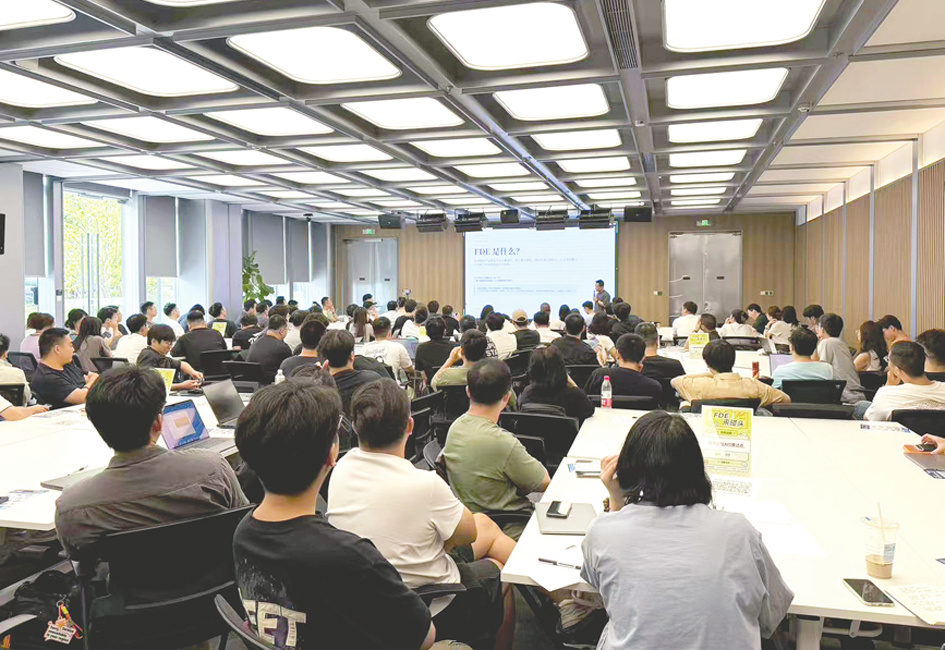
Image provided by interviewee
A report released by the job-hunting and recruiting platform Maimai shows that in the first seven months of this year, FDE job postings on the platform grew 1522.73% year over year, topping the list of expanded AI technology positions. According to statistics from Liepin Big Data Research Institute, the average annual salary for FDE-related positions is 408,000 yuan, with 28.25% offering more than 500,000 yuan. Tech giants like Tencent, ByteDance, and Meituan offer annual salaries as high as one million yuan.
Behind the high salaries and expansion lies the complex reality of frontline implementation. Recently, National Business Daily reporters (hereinafter referred to as NBD reporters) spoke with multiple FDE practitioners, glimpsing the true picture beneath the glamorous hype: they handle all kinds of technical chores at companies, talk with CEOs (chief executive officers) to uncover needs, dive into frontline stores shaking milk tea to find implementation scenarios; and some small teams struggle to collect 70-80% of final payments after taking on orders...
The Complex Underbelly of FDEs: All-Purpose Outsourcing and "Makeshift Teams"
Wei Quyun once served an AI startup as an FDE. His work was highly varied: helping the company build marketing automation workflows, iterating product AI capabilities, connecting store AI monitoring systems—anything touching software or hardware. "In a not-so-mature company, an FDE is essentially all-purpose technical outsourcing."
This is not an isolated case. Multiple interviewees candidly admitted that they are essentially "technical outsourcing." Zhou Ziyao, an FDE entrepreneur and founder of Yaohan Digital Technology, told NBD reporters that a large number of FDE teams have emerged in the market this year, and people in the industry even often self-deprecatingly call themselves "makeshift teams"—everyone is crossing the river by feeling the stones.
In the view of the multiple practitioners interviewed by NBD reporters, FDE work does indeed overlap with many traditional roles. The greatest common denominator they offer is: someone who can translate AI capabilities into business results for enterprises and connect AI into real workflows.
Gan Yifan, co-founder of Rolling AI, doesn't even view the FDE as a specific job title, but rather as a "capability package." "Just as electrical engineers in the electrical age replaced human physical labor with electricity-driven machines, the core of the FDE is using AI to replace repetitive intellectual labor." he explained to NBD reporters.
Gan Yifan broke down this "capability package" using Palantir's Echo-Delta pairing system (mainly referring to a pair of collaborative roles in the FDE model): Echo stays close to the business, finding opportunities from the frontline where AI can amplify value and making it run within new and old workflows; Delta handles technical implementation, using various engineering methods to turn opportunities into runnable systems. In addition, he proposed that Chinese enterprises also need a third capability role—the "knowledge governance steward"—because Chinese enterprises generally lack the organization and consolidation of explicit knowledge, processes, and expert experience.
"There are two thresholds for companies hiring FDEs." Gan Yifan told NBD reporters: first, being a small expert in a certain field who understands how the industry operates; second, having experienced transformation projects in the industry and knowing what happens when new productivity enters an enterprise. Compared to technical experts, business-savvy experts are more critical: "The business expert is the '1', and technology is the '0's that follow—without the '1', nothing can be added."
Two Weeks On-Site, Interviewing 12 Departments: Earning Trust Is Harder Than Uncovering Needs
Familiarity with industry business is a quality widely valued in FDEs. Wei Lei, an FDE entrepreneur and founder of OpenFDE, said in an interview with NBD reporters that to sustain a long-term career, FDEs should focus on specific verticals—ultimately, "you need to understand your customers." And "reading the customer" is often the first challenge FDEs face after entering a company.
Although many business leaders are anxious about AI applications, they don't clearly understand the actual effectiveness and pathways of AI implementation, so requirements are often vague, making consultation and research the first step after entering.
Gan Yifan gave an example: the first thing his team does upon entering is to reach consensus with the client from a management consulting perspective on issues like AI capability boundaries, application expectations, the company's financial situation, and business goals. After aligning understanding, they go to the frontline: when serving a fast-moving consumer goods company, they follow along on channel visits; when serving a milk tea chain, they get health certificates and go to stores to shake milk tea. They spend two to three weeks on the business frontline forming hypotheses about how AI can optimize systems and improve processes, then two to three weeks building prototypes and testing and evaluating them. After confirming feasibility, they iterate rapidly, promote during iteration, and within two months expand from small-scale implementation to the entire company.
This process—from consultation and research to prototype design, implementation trial and error, and iterative maintenance—is the FDE work path described by most interviewees, but this long chain is not easy from the very start.
After the National Day holiday, Wei Quyun and five colleagues entered a subsidiary of a state-owned central enterprise for an FDE project. The team spent two weeks interviewing employees from 12 departments and compiled 800-900 issues. "You could feel that employees were more venting emotions than offering constructive suggestions." Wei Quyun said the interviews were mentally draining, because 80%-90% of the information was useless and couldn't help the team analyze the company's pain points or find the next direction.
"The core of FDE on-site work is becoming an expert who understands the customer's business." Wei Lei shared his experience serving a company with 7 billion yuan in annual revenue: "Including in-depth business discussions with the CEO, thorough communication with all levels of the company, uncovering needs, and earning trust."
"Earning trust" can be even harder than "uncovering needs." "Organizational resistance" is an obstacle consistently mentioned by interviewees. Gan Yifan's team once did AI-based store scheduling for a company, trying to save labor costs through refined operations. The results were significant, but implementation was hindered because employee incomes dropped: "Without incentives, store managers simply won't push it."
Gan Yifan said that AI applications can't just run in an enterprise by simply building technical tools; they inevitably encounter resistance during organizational change, requiring deep work within the organization on coordination and incentives. "AI has difficulty understanding emotions and context between people. A change that is completely reasonable on paper may still fail to move forward—a certain business department may be underperforming, but since they've been with the boss since day one building the business, they have to stay."
To overcome resistance to change, the determination of the "top leader" is crucial. Multiple interviewees said they only take orders where they can "reach agreement with the top leader," because "without the boss's strong determination, nothing can be pushed forward." Wei Quyun was deeply impressed by the kickoff meeting on his first day at the central enterprise subsidiary: "All mid- and senior-level managers gathered—it was quite a grand occasion. The chairman spoke personally, requiring every department to cooperate with us."
Payment Pressure, Pricing Chaos, and Training Courses Accused of "Harvesting Suckers"
"Real FDE implementation services are extremely delivery-heavy and results-driven." Zhou Ziyao said that developing a single pain-point scenario takes 1 to 2 months, while deeper transformation requires a year or even longer of accompaniment. "We do all the dirty, tiring work, earning hard-earned money, and clients often don't understand." He had just quoted 200,000 yuan for a first phase to a semiconductor company, and the young boss, who had originally been very determined, wavered a bit after hearing it.
Currently, the FDE market has no unified pricing standard. Different teams serve different clients, in different forms, with different client standards, resulting in varied pricing systems. Zhou Ziyao's team mainly serves medium-sized enterprises with annual revenue between 50 million and 300 million yuan, with on-site rates varying by city, averaging 1,800 yuan per person per day (a common workload unit in the software and IT services industry).
Rolling AI targets private enterprises with annual revenue above 5 billion yuan. Clients subscribe monthly to a small team of several FDEs to obtain services like data analysis and causal inference, plus knowledge assets such as AI employees and industry know-how accumulated from previous cases. "A single enterprise's annual subscription is in the high single-digit millions of yuan." Gan Yifan said the team typically accompanies an enterprise for at least six months.
Gan Yifan observed that this "heavy business" is facing real-world difficulties of varying degrees: more and more small teams and even individuals are taking on contracts as FDEs, and winning contracts is not hard, but "70 to 80 percent of them never collect the final payment." This problem was corroborated by some interviewees. "The problem often lies in misaligned expectations—enterprises can't articulate their needs, and FDEs lacking the capability to judge them either fail to assess them properly or over-promise just to sign the deal, leaving both sides unable to back down."
Gan Yifan expressed his concern: many people rush into the field after seeing only the surface-level hype around FDEs. Without familiarity with an industry, they may actually use AI to amplify their own misconceptions when serving clients, producing the opposite of the intended effect. "Having reverence for an industry is a basic professional ethics standard for service work."
The market chaos doesn't stop there: pricing systems are chaotic, and practitioners without real implementation cases either charge exorbitant prices or undercut competitors with low bids, while the services they actually deliver don't match.
More consistent criticism is aimed at "exploitative" training courses. Xie Yao, an FDE entrepreneur and founder of OpsGo AI, categorizes these courses into three types: those targeting laid-off tech workers in their 30s and 40s who want to become FDEs, claiming "enrollment guarantees a job"; those selling FDE certificates to fresh graduates, even though the certificates have nothing to do with actual work; and "AI executive bootcamps" for business owners, where the instructors themselves have no implementation experience and the tools they promote can hardly be made to work.
"Being at a company is like being a maternity nurse"—companies need to learn to "raise the child" themselves
"There have indeed been some rather hasty practices in the market, and some low-quality FDE services have damaged the industry's reputation. But in China's environment where enterprise management is not standardized, FDE will still be a fragmented market with enormous room for growth." Wei Lei told NBD reporters.
"AI transformation is like teaching people to use computers and Office 20 years ago," Xie Yao said. "Companies founded ten years from now will be born natively into a business environment adapted to AI, and won't need anyone to teach them how to use AI at all."
Gan Yifan also believes that FDE services that purely sell "person-days" and deliver by project will struggle to become a sustainable business model in China; in the future, every enterprise will have native FDE teams that grow out of its own business. "It may not even be a formal organization—it could just be certain people who possess an FDE capability package, becoming the key players driving AI transformation within small business units. This will happen at scale in the next six months." In his vision, external FDE companies in the future may no longer live on service fees, but instead ride the capital-driven asset transformation logic, working with venture capital firms to transform companies and industries with AI capabilities and earning a share of equity appreciation.
"An FDE's role at a company is very much like that of a 'maternity nurse,'" Gan Yifan said by way of analogy. The company has given birth to a child called AI, which is extremely "disruptive" and upends many household routines. A good "maternity nurse" must have professional skills and also be able to read the room—knowing who makes decisions on what matters and who can cooperate. And the "maternity nurse" won't stay forever; the goal is to teach the family to "raise the child" themselves.
For the "parents," what matters more is proactively learning how to "raise the child," rather than dumping everything on the "maternity nurse." Gan Yifan has met many owners of companies worth tens of billions of yuan. "We also 'force' them to learn cutting-edge tools, so they can form an accurate judgment of AI's effectiveness," Gan said. "But business owners who can truly succeed at AI implementation are always those with a sense of ownership."
A "maternity nurse" who grows alongside the "parents"—this may be the truest portrait of the FDE business at its current stage: what it sells is not a technical tool, but a stretch of time accompanying an enterprise through the transition of AI-driven productivity.
Cover image source: provided by interviewees
For republication, please contact the National Business Daily. Without authorization from the National Business Daily, republication or mirroring is strictly prohibited; violators will be held liable.
Reader hotline: 4008890008
Special reminder: If we have used your images, please contact this site to request payment. If you do not wish your work to appear on this site, you may contact us to request its removal.
 Optics Valley offers 800,000 yuan annual salary to recruit PhDs
- Understanding the new metric in mutual fund interim reports! How is the "percentage of profitable investors" calculated? Why do some funds with large drawdowns still see over 90% of investors profit?
- The pain point of AI implementation's "last mile" fuels demand for FDE roles, with some salaries reaching 1 million yuan. Alibaba Cloud VP Huo Jia: more optimistic about two commercialization models
- AI short dramas start competing on storytelling—those coasting on imitation should start worrying
- Where will Sichuan's state-owned assets and enterprises invest during the "15th Five-Year Plan"? The key lies in "focusing on core business, real industry, and real sectors"
- Turning emerging fields into new investment products: Sichuan issues 21 measures to boost private investment
- 2026 Sichuan Platform Economy Industry Chain Partner Conference and the 8th Sichuan Products E-commerce Festival to open in Chengdu on November 18
- Chengdu intelligent connected vehicle industry "1+N" matchmaking event held; Zeng Qinglin: Yijing X9 pure electric version to debut at Guangzhou Auto Show
- Turkish Airlines launches Chengdu–Istanbul passenger route
Follow the National Business Daily APP