Many companies are interested in FDEs (Forward Deployed Engineers), but they have a question in mind: How is an FDE project delivered? How is it different from traditional outsourcing?
The delivery process of traditional outsourcing is familiar to everyone: requirements research → solution design → development → testing → launch → acceptance. But the FDE model's process is completely different—it emphasizes embedding, iteration, and results orientation rather than linear, stage-by-stage progression.
This article breaks down the standard delivery process of an FDE project, from initial diagnosis to knowledge transfer—what each stage does, what it delivers, and how to measure results—helping you build a complete understanding.
Core Characteristics of the FDE Delivery Process
Before diving into the specific stages, first understand the fundamental differences between FDE delivery and traditional delivery:
| Characteristic | Traditional Waterfall | FDE Model |
|---|---|---|
| Approach | Linear progression; the next stage starts only after the previous one ends | Iterative progression; each iteration is a complete closed loop |
| Requirements management | Fixed upfront; changes go through formal processes | Continuously evolving; adjustable every two weeks |
| Delivery frequency | One-time delivery at the end of the project | Demonstrable results every week |
| Acceptance method | Final acceptance against a requirements checklist | Continuous acceptance based on business outcomes |
| Customer involvement | Research upfront + acceptance at the end, with little involvement in between | Deep involvement throughout, with daily communication |
| Risk control | Scope fixed upfront; risks borne later | Small, fast steps; identify and adjust issues promptly |
In one sentence: Traditional outsourcing is "delivering features per the contract," while FDE is "achieving results together with the customer."
The Five Stages of the Standard Delivery Process
Stage 1: Diagnosis and Planning (Week 1)
This is the starting point of the project and also the most critical stage. Many projects fail because the diagnosis wasn't done thoroughly.
Core Tasks
| Task | Description | Roles Involved |
|---|---|---|
| Business status diagnosis | Gain a deep understanding of current business processes, pain points, and goals | FDE + business owner |
| System status assessment | Existing system architecture, data situation, tech stack | FDE + technical lead |
| Data quality assessment | Data completeness, accuracy, and availability | FDE + data/business team |
| Success criteria alignment | Define the metrics for project success | FDE + project sponsor |
| Prioritization | Determine what to do first and what to do later | FDE + business + technical teams |
| Risk identification | Identify potential risks and obstacles in advance | FDE + customer team |
Deliverables
- Status diagnosis report: current business processes, system status, data quality assessment
- Project proposal: goals, scope, technical solution, implementation plan
- Success metrics definition: quantifiable success criteria (e.g., "increase lead conversion rate by 15%")
- Risk list and mitigation plan: identified risks and corresponding countermeasures
Key Points
- Always meet the decision-makers: without their involvement, driving the project forward later will be difficult
- Success criteria must be quantified: vague statements like "improve efficiency" won't do—there must be numbers
- Data is a core prerequisite: for AI projects especially, data quality must be assessed first—if the data is too poor, even the best FDE can't deliver results
- Don't promise what can't be done: a good FDE will tell you at this stage "what can be done and what can't," rather than agreeing to everything
This stage is often called "Discovery Week"—use one week to thoroughly understand every aspect of the project, then decide whether to continue and how to proceed.
Stage 2: Design and Prototyping (Week 2)
Once the diagnosis is clear, move into the design and prototyping stage. The goal of this stage is to quickly build a demonstrable prototype to validate the feasibility of the solution.
Core Tasks
| Task | Description | Roles Involved |
|---|---|---|
| Detailed solution design | Architecture design, data flow design, interface design | FDE + technical team |
| Prototype development | Build a runnable prototype of the core features | FDE (customer technical team may participate) |
| Data integration validation | Verify whether key data can be obtained and whether quality is sufficient | FDE + data team |
| Prototype demo and feedback | Demo to the business team and collect feedback | FDE + business team |
| Solution adjustment and optimization | Adjust the solution based on feedback | FDE |
Deliverables
- Technical solution document: architecture diagrams, data flow diagrams, interface definitions
- Runnable prototype: a demo version of the core features
- Data integration plan: data sources, integration methods, cleaning rules
- Iteration plan: the iteration schedule for subsequent development
Key Points
- The prototype must actually run: not a PPT mockup, but a runnable prototype you can click through and see data in
- Use real data: use the customer's real data for the prototype whenever possible, not fake data—fake data looks good but masks problems
- Iterate quickly: the prototype isn't finalized in one version; it may take 2-3 revisions
- Don't chase perfection: the purpose of the prototype is to validate the direction, not to build the final product—as long as it works, details can be refined later
At the end of this stage, the customer can clearly see "what the final result will roughly look like" and decide whether to keep investing. This is an important decision point—if the prototype doesn't validate well, you can cut losses early, and the loss is small.
Stage 3: Development and Iteration (Weeks 3-5)
This is the main body of the project and also the stage where the FDE model differs most from traditional outsourcing.
Traditional outsourcing is "develop everything, then test together," while FDE is "one iteration per week, with each iteration having a complete develop-test-demo-feedback loop."
Iteration Rhythm (a two-week cycle)
| 1 2 3 | Monday: iteration planning meeting → determine what this iteration will do; Tuesday-Thursday: development + continuous testing; Friday: demo + retrospective + priority adjustment |
Core Activities in Each Iteration
| Activity | Frequency | Roles Involved | Purpose |
|---|---|---|---|
| Daily standup | 15 minutes daily | FDE + point of contact | Sync progress, surface blockers |
| Iteration planning | Every two weeks | FDE + business + technical teams | Set the iteration's goals and tasks |
| Iteration demo | Every two weeks | FDE + business team + sponsor | Showcase results, collect feedback |
| Iteration retrospective | Every two weeks | FDE + core team | Summarize lessons learned, improve the process |
| Code review | Ongoing | FDE + customer technical team | Ensure code quality, enable knowledge transfer |
Deliverables
Each iteration delivers:
- Runnable incremental features: new features completed in this iteration
- Iteration demo record: demo content, feedback, action items
- Updated documentation: technical docs, user manuals, etc.
At the end of the entire stage:
- A complete functional system: all planned features fully developed
- Test report: functional, performance, and security test results
- User operation manual: a usage guide for business users
- Operations Manual: An Operations Guide for Technical Teams
Key Points
- Small steps, fast pace, timely feedback: Don't wait until it's "done" to review—review results every week
- Priorities can be adjusted: If the business side discovers new, more important requirements, the priorities of the next iteration can be adjusted
- The client team must participate in development: It's not the FDE coding alone in isolation—the client's technical team should do code reviews and testing together
- Quality cannot be compromised: Fast iteration doesn't mean poor quality—every iteration must include complete testing
The standard development cycle for an FDE organization is 6 weeks to deliver an end-to-end AI workflow in production. The first 2 weeks are diagnosis + prototyping, and the last 4 weeks are development + iteration. This rhythm has been validated across many projects—it ensures both speed and quality.
Phase 4: Launch and Validation Period (Week 6)
After development is complete, the project enters the launch and effectiveness validation phase.
In traditional outsourcing, launch means "deploy it and you're done." For an FDE, launch means "not only getting it up, but also getting it running and delivering results."
Core Tasks
| Task | Description | Roles Involved |
|---|---|---|
| Production environment deployment | Deploy the system to the production environment | FDE + operations team |
| Data cutover/integration | Connect real data and verify data accuracy | FDE + data team |
| User training | Train business users on how to use the system | FDE + business owner |
| Trial run observation | Observe the system after launch and address issues promptly | FDE + everyone |
| Effectiveness validation | Verify actual results against success metrics | FDE + sponsor |
| Issue fixes and optimization | Fix issues based on the trial run | FDE |
Deliverables
- Production-ready system: Officially launched and running
- Training materials: User manuals, video tutorials, FAQs
- Effectiveness validation report: Comparative analysis of actual results vs. expected goals
- Launch issue list and fix log: Issues discovered during launch and how they were handled
Key Points
- Launch is not the finish line—it's the starting point: The first week after launch is the most critical; monitor operations closely
- Have a rollback plan: If something goes wrong, you should be able to quickly revert to the old system
- User training must be thorough: No matter how good the system is, it's useless if users don't know how to use it
- Effectiveness validation must be objective: Let the data speak, not "it feels pretty good"—check against the success metrics defined at the start of the project, one by one
The core goal of this phase is to "ensure the system actually works, is actually being used, and actually delivers results." Many projects die from "launched but unused"—this is exactly where the FDE model shines: launch isn't the end; meeting the effectiveness targets is.
Phase 5: Knowledge Transfer and Handover Period (Weeks 6-8)
This is one of the biggest differences between the FDE model and traditional outsourcing.
In traditional outsourcing, handover means "hand over the code + hand over the docs," and then goodbye. FDE knowledge transfer means "teaching hands-on, ensuring the client team can independently maintain and iterate."
Core Tasks
| Task | Description | Roles Involved |
|---|---|---|
| Code walkthrough | Explain the code architecture and implementation logic module by module | FDE + client technical team |
| Operations training | Deployment, monitoring, alerting, troubleshooting | FDE + operations team |
| Iteration methodology training | How to continue iterating features using agile methods | FDE + product/technical team |
| Documentation completion | Complete all technical and operations documentation | FDE (with client team participation) |
| Handover acceptance | Confirm that all knowledge and documentation have been delivered | FDE + project sponsor |
| Ongoing support agreement | Determine the support arrangements after the project ends | FDE + client |
Deliverables
- Complete codebase: Source code with standardized comments
- Comprehensive technical documentation: Architecture docs, API docs, database docs, operations manual
- Knowledge transfer confirmation checklist: Item-by-item confirmation of knowledge transfer completion
- Ongoing support plan: If needed, agree on post-project support arrangements and costs
Three Levels of Knowledge Transfer
| Level | Content | Importance |
|---|---|---|
| Level 1: Artifacts | Code, documentation, tools | The foundation—essential |
| Level 2: Methods | How to do things, why they're done this way, how to troubleshoot problems | Core—determines whether the team can maintain the system independently |
| Level 3: Mindset | How decisions are made, the logic behind trade-offs, future evolution direction | The highest level—determines whether the team can continue iterating |
Many outsourcing projects only reach Level 1; FDE projects must reach Level 2, and excellent FDEs can reach Level 3.
Key Points
- Knowledge transfer starts on day one: It's not something done at the end of the project—it happens in parallel throughout the process
- Replace "telling" with "doing": Don't just explain—have the client team do it hands-on while the FDE guides them
- Have a handover checklist: Check items one by one to make sure nothing is missed
- Leave a safety net: Agree on post-project support arrangements, such as 1 month of free support or on-call support billed hourly
Full Process Timeline Overview
Take a standard 6-week FDE project as an example:
| Week | Phase | Key Outputs | Decision Points |
|---|---|---|---|
| Week 1 | Diagnosis and planning | Current-state diagnosis report + project proposal + success metrics | Continue or not? Is the proposal approved? |
| Week 2 | Design and prototyping | Working prototype + technical plan + iteration plan | Does the prototype meet expectations? Proceed to development? |
| Week 3 | Iterative development 1 | First incremental feature release | — |
| Week 4 | Iterative development 2 | Second incremental feature release, mid-term review | Does the direction need adjustment? |
| Week 5 | Iterative development 3 | Complete features + test report | — |
| Week 6 | Launch and validation | System launch + effectiveness validation report | Are the targets met? Accept the delivery? |
| Weeks 7-8 | Knowledge transfer | Complete handover + knowledge transfer confirmation | Project officially closed |
Note: This is the standard 6-week delivery cycle (plus 2 weeks of knowledge transfer, 8 weeks total). In actual projects, the timeline varies depending on complexity and scope. Simple scenarios may be done in 4 weeks, while complex projects may take 3-6 months.
Time Allocation Across Phases
| Phase | Share of a 6-week project | Share of an 8-week project | Key Work |
|---|---|---|---|
| Diagnosis and planning | ~17% (1 week) | ~12.5% (1 week) | Research, planning, goal alignment |
| Design and prototyping | ~17% (1 week) | ~12.5% (1 week) | Prototype development, plan validation |
| Development and iteration | ~50% (3 weeks) | ~37.5% (3 weeks) | Feature development, iterative optimization |
| Launch and validation | ~16% (1 week) | ~12.5% (1 week) | Deployment, training, effectiveness validation |
| Knowledge transfer | — | ~25% (2 weeks) | Code handover, training, documentation |
Consolidated Checklist of Deliverables Across All Phases
| Deliverable Type | Diagnostic Phase | Prototype Phase | Development Phase | Launch Phase | Handover Phase |
|---|---|---|---|---|---|
| 文档类 | |||||
| 现状诊断报告 | ✅ | ||||
| 项目方案书 | ✅ | ||||
| 成功指标定义 | ✅ | ||||
| 技术方案文档 | ✅ | 更新 | |||
| 用户操作手册 | 草稿 | ✅ 终版 | |||
| 运维手册 | 草稿 | ✅ 终版 | |||
| 代码类 | |||||
| 可运行原型 | ✅ | ||||
| 增量功能代码 | 每个迭代 | ||||
| Complete Production Code | ✅ | ✅ Final version | |||
| 自动化测试 | 持续补充 | ✅ | |||
| CI/CD 配置 | ✅ | ||||
| 验证类 | |||||
| 迭代演示记录 | 每个迭代 | ||||
| 测试报告 | ✅ | ||||
| 效果验证报告 | ✅ | ||||
| Knowledge Transfer Confirmation Checklist | ✅ | ||||
| 培训类 | |||||
| 用户培训材料 | ✅ | ||||
| Technical Training (code walkthrough) | ✅ | ||||
| Operations Training | ✅ |
Total: A complete FDE project typically has 15-20 deliverables, covering the full chain from design to code, from testing to training.
Timeline and Resource Allocation for Projects of Different Sizes
FDE projects can be large or small. Here are typical configurations for projects of different sizes:
| Project Size | Typical Scenario | Number of FDEs | Total Duration | Diagnostic Phase | Development Phase | Launch + Handover | Suitable Customers |
|---|---|---|---|---|---|---|---|
| Small (rapid validation) | Single-scenario AI pilot, such as AI customer service or lead scoring | 1 person | 4-6 weeks | 1 week | 2-3 weeks | 1-2 weeks | SMEs, startups |
| Medium (standard delivery) | 2-3 linked scenarios, such as a CRM AI upgrade | 1-2 people | 8-12 weeks | 1-2 weeks | 5-7 weeks | 2-3 weeks | Mid-sized companies, department-level in large enterprises |
| Large (system transformation) | Multi-system integration + multiple scenarios, such as end-to-end AI transformation | 2-3 people | 3-6 months | 2-4 weeks | 2-4 months | 4-6 weeks | Large enterprises, group-level companies |
| Extra-large (full transformation) | Enterprise-wide AI transformation, multiple departments and systems | 3-5+ people | 6-12+ months | 1-2 months | 4-9 months | 1-2 months | Large conglomerates, multinational companies |
Note: The above are standard references; actual timelines depend on factors such as data readiness, system complexity, and customer cooperation. The worse the data, the older the systems, and the slower the cooperation, the longer the timeline.
Efficiency Advantages of Iterative Development
Why do FDEs use agile iteration instead of waterfall? Because the iterative model is more efficient overall:
| Metric | Waterfall Development | FDE Agile Iteration | Improvement |
|---|---|---|---|
| Time to first usable feature delivery | End of project (after 3-6 months) | Week 2-3 | 80-90% earlier |
| Response time to requirement changes | 2-4 weeks (change process) | 1-3 days (handled in the next iteration) | 80-90% shorter |
| Time to discover a wrong direction | Mid-to-late project (large losses) | Checked every two weeks (small losses) | 5-10x faster course correction |
| Customer engagement | Low (only at the beginning and end) | High (weekly communication) | Significantly improved |
| Final product fit | 60-70% (requirements changed but weren't tracked) | 85-95% (continuously adjusted throughout) | 20-30% improvement |
| Rework rate | 20-30% (problems discovered all at once at the end) | 5-10% (corrected promptly during the process) | 60-70% reduction |
| Team morale | Low (no visible results for a long time) | High (sense of accomplishment every week) | Significantly improved |
Data sources: Aggregated agile development industry research (Standish Group Chaos Report, Forrester Agile Benchmark) and FDE project practice data. For AI projects, where requirements are highly uncertain, the advantages of the iterative model are even more pronounced—the failure rate of waterfall AI projects exceeds 70%, while the agile iteration model can achieve a success rate above 80%.
Roles in an FDE Project
A typical FDE project requires the following roles:
Customer-Side Roles
| Role | Responsibilities | Time Commitment |
|---|---|---|
| Project Sponsor | Decision-making, resource coordination, acceptance of results | 1-2 hours per week |
| Business Owner | Requirements liaison, business confirmation, user coordination | 5-8 hours per week |
| Technical Liaison | System integration, data permissions, technical discussions | 5-10 hours per week |
| End User Representative | Testing, feedback, training participation | 2-4 hours per week |
FDE-Side Roles
| Role | Responsibilities | Notes |
|---|---|---|
| FDE Lead | Overall project ownership, solution design, key development | At least 1 per project |
| FDE Engineer | Hands-on development, integration, testing | Allocated based on project size |
| Technical Consultant (as needed) | Expert support in specific domains | E.g., AI algorithm experts, security experts, etc. |
Collaboration Model
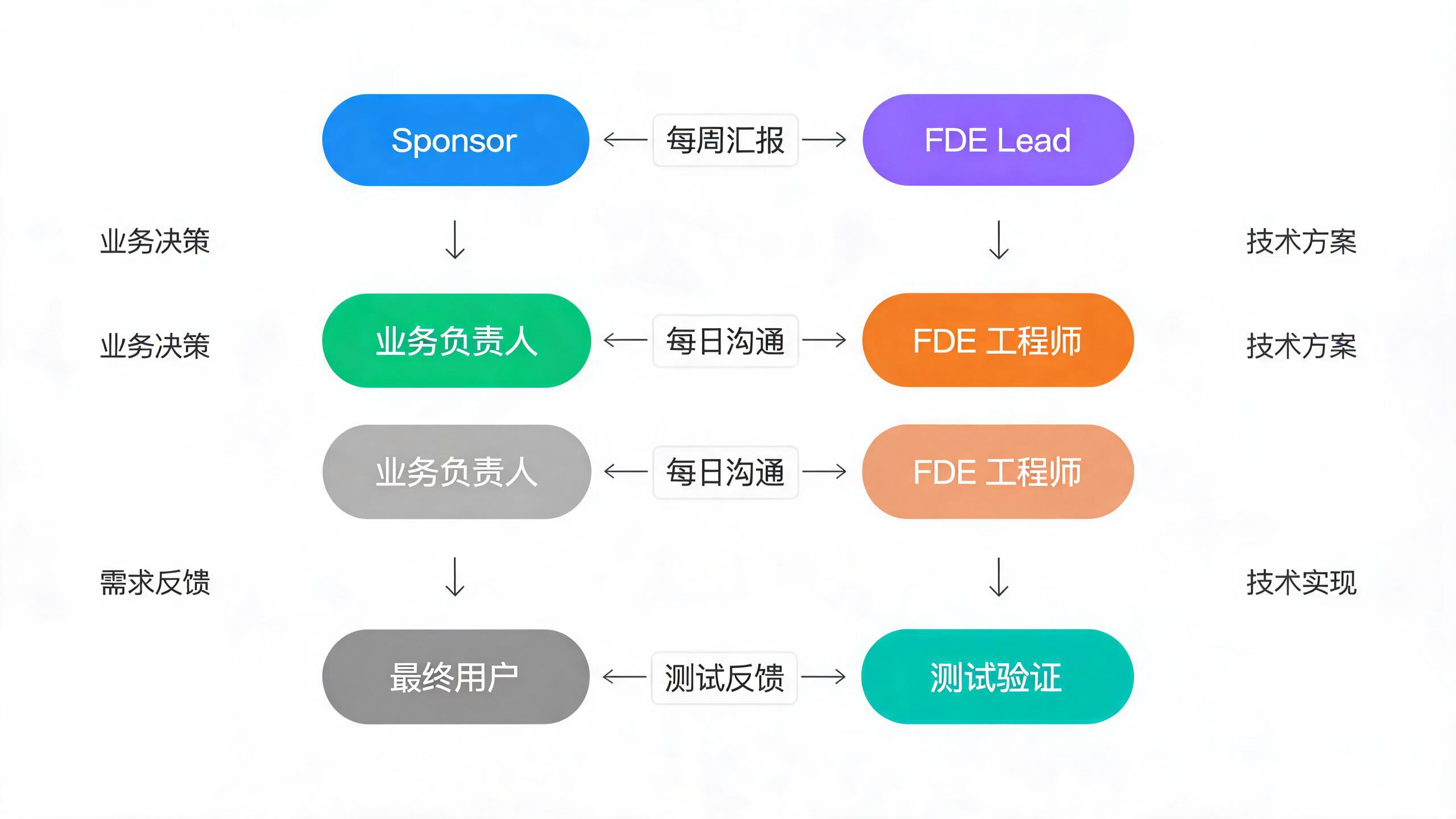 Figure: Three-tier collaboration and communication model for FDE projects
Key Success Factors for FDE Projects
Based on lessons learned from many projects, several key factors drive FDE project success:
1. A clear Sponsor with decision-making authority on the customer side
This is the most important factor. Without support from a decision-maker, even the most capable FDE can't move things forward. The Sponsor doesn't need to be involved every day, but must be able to make the call and coordinate resources at critical moments.
2. Data and system access secured in advance
Especially for AI projects, data is the foundation. Before the FDE arrives, data permissions, system access, and API interfaces should be coordinated in advance. Otherwise, the first week is spent entirely on approval processes with nothing getting done.
3. Reliable liaisons with time to invest
FDEs don't come to "do it for you"—they come to "do it with you." If the customer-side liaison is busy with other things every day and can't be reached, the project will definitely be slow.
4. Clear success criteria, aligned by both parties
Define "what counts as success" before the project starts. The more specific, the better—for example, "after the lead scoring system launches, sales follow-up efficiency improves by 20%," rather than "improve sales efficiency."
5. An atmosphere of trust and transparent communication
The FDE model is built on trust. Customers must trust the FDE's professional capabilities, and FDEs must be transparent with customers—raise difficulties promptly instead of hiding them until the end.
Common Pitfalls and How to Avoid Them
FDE Project Risk Matrix
In project management, risk = probability of occurrence × degree of impact. Below are the most common risks in FDE projects and how to address them:
| Risk | Probability | Impact | Risk Level | Mitigation Strategy | Responsible Phase |
|---|---|---|---|---|---|
| Data quality is too poor, model performance can't improve | High | High | 🔴 Extremely High | Run a data diagnostic in the first week; if it fails, do data remediation first instead of forcing ahead | Diagnostic phase |
| Scope creep, project keeps growing | High | Medium | 🟠 High | Set clear priorities for each iteration, add new requirements to the backlog, review scope every two weeks | Full cycle |
| Users don't accept it, system goes unused | Medium | High | 🟠 High | Involve users from day one, find seed users, demonstrate results with data | Full cycle |
| Point of contact has no time, poor communication | Medium | Medium | 🟡 Medium | Agree on a communication cadence in advance, have the sponsor push for resources | Diagnostic + development phases |
| Slow system access approvals, delaying progress | High | Low | 🟡 Medium | Coordinate access permissions before starting, run work in parallel to avoid blockers | Diagnostic phase |
| Inadequate knowledge transfer, no one to maintain after handover | Medium | High | 🟠 High | Start knowledge transfer from day one, confirm each item with a checklist, leave a warranty period | Handover phase |
| Key person leaves, project interrupted | Low | High | 🟡 Medium | The FDE organization has a backup mechanism, complete documentation allows quick takeover | Full cycle |
| Results fall short of expectations, acceptance is difficult | Medium | Medium | 🟡 Medium | Quantify and align success metrics upfront, validate continuously throughout, adjust promptly | Launch phase |
Risk level legend: 🔴 Extremely High (requires close attention, prevent in advance) | 🟠 High (prepare a mitigation plan) | 🟡 Medium (monitor regularly)
FDE agile delivery vs. traditional waterfall delivery: a comprehensive comparison
Many people ask: how is the FDE process different from traditional project management? One table makes it clear:
| Dimension | Traditional Waterfall | FDE Agile Delivery |
|---|---|---|
| Approach | Linear: research → design → development → testing → launch, step by step | Iterative: each iteration is a complete develop-test-demo loop |
| Requirements management | Fixed upfront, changes go through formal processes, costing extra money and time | Continuously evolving, priorities can be adjusted every two weeks, flexibly responding to change |
| Delivery cadence | All features delivered at once at the end of the project | Demonstrable results every week, incremental delivery every two weeks |
| Customer involvement | Upfront research + mid-term reviews + final acceptance, little involvement in between | Deep involvement throughout, daily standups, demos every two weeks |
| Acceptance criteria | Checked against the requirements list; features built = pass | Checked against business metrics; results meeting targets = pass |
| Risk control | Scope fixed upfront, problems discovered late, heavy losses | Small fast steps, check every two weeks, adjust and cut losses promptly |
| Documentation volume | Heavy documentation, requirement and design documents running dozens to hundreds of pages | Light documentation, just enough; code and a running system are the best documentation |
| Team collaboration | Clear division of labor, everyone in their own role, communication through processes | Close collaboration, FDEs working together with the client team |
| Cost of change | The later the change, the higher the cost (exponential growth) | Cost of change is relatively stable, adjustments can be made anytime |
| Best suited for | Standardized projects with very clear requirements | Exploratory projects with dynamic requirements (AI, innovation projects) |
| Failure mode | "All or nothing" — you only find out at the end whether it works | "Incremental" — discover and adjust early; at worst, you still have partial results |
| Fit for AI projects | ⭐⭐ Very low | ⭐⭐⭐⭐⭐ Best |
The essence of the core difference: waterfall assumes "requirements are certain, and success comes from executing the plan"; FDE agile assumes "requirements are uncertain, and require continuous exploration and adjustment along the way."
For AI projects, the latter is clearly closer to reality.
Symptom: as work progresses, requirements keep growing, the project keeps expanding, and timelines keep stretching.
How to avoid it:
- Set clear priorities for each iteration and only work on the highest-priority items
- Put new requirements in the backlog and evaluate them in the next iteration
- Review scope every two weeks to ensure alignment with the goal
- Remember: doing fewer, better features is more valuable than doing many, rough ones
Pitfall 2: Data quality is too poor
Symptom: the model performs poorly, and after much investigation you find the data is terrible.
How to avoid it:
- Run a data quality assessment in the first week; don't wait until the development phase to find out
- If data quality is poor, do data remediation first before talking about AI
- Manage expectations — garbage in, garbage out; that's a law, not something an FDE can fix
Pitfall 3: Users don't accept or use the system
Symptom: the system is built, but the business team doesn't use it, making it a waste of effort.
How to avoid it:
- Involve user representatives from day one, rather than pushing the finished product on them
- Provide thorough training and patiently answer questions
- Find "seed users" — get a small group using it first to create a demonstration effect
- Show results with data — when users see it genuinely saves them time and effort, they'll naturally accept it
Pitfall 4: Inadequate knowledge transfer
Symptom: after the FDE leaves, no one can maintain the system, and it gradually falls into disuse.
How to avoid it:
- Start knowledge transfer from day one, not at the very end
- Have the client's technical team participate in development throughout, not just look at the code at handover
- Maintain a detailed handover checklist and confirm each item
- Leave a 2-4 week "warranty period" with remote FDE support to ensure a smooth transition
Closing thoughts
The FDE delivery process is complex if you want it to be, and simple if you want it to be.
What's complex: it requires FDEs to have a comprehensive mix of skills — technical, business, communication, and project management — to collaborate deeply with the client team, and to keep iterating amid uncertainty.
What's simple: the core logic is just one thing — stand in the client's shoes, take responsibility for the outcome, and get it done.
Traditional outsourcing operates on the logic of "doing what the contract says" — I do what's written in the contract and ignore what isn't. FDE operates on the logic of "delivering results" — do whatever it takes to achieve the goal.
These are two completely different mindsets, and that's the fundamental reason the FDE model is becoming increasingly popular.
📚 FDE article series
| Article | Core content |
|---|---|
| The Complete Guide to the FDE Forward Deployed Engineer | A full breakdown of the role definition, value, competency model, and pricing models |
| FDE vs. Traditional Outsourcing vs. In-house Teams: An In-depth Comparison and Selection Guide | A comprehensive comparison of the three models to help you choose the right delivery approach |
| The FDE Project Delivery Process (this article) | A breakdown of the standard delivery process: what to do and what to deliver in each phase |
| Why Do AI Projects Need an FDE? Avoiding 70% of Implementation Failures | The core pain points of AI implementation, and how FDEs solve them |
❓ FAQ
Q1: Why is the FDE project 6 weeks? Can it be faster? 6 weeks is the standard cycle that FDE agencies have summarized for "single-scenario AI implementation" — 1 week of diagnosis + 1 week of prototyping + 3 weeks of development + 1 week of launch validation. Can it be faster? It depends on project complexity. Simple scenarios (e.g., integrating an AI API) can be done in 2-3 weeks; complex scenarios (e.g., a full CRM AI upgrade) may take 2-3 months. The key is not speed, but that each stage has clear deliverables and decision points, allowing the client to choose to continue, adjust, or stop at any time.
Q2: What if we discover halfway through that the direction is wrong? This is exactly the advantage of the FDE model — cutting losses in time. With a biweekly iteration review, you can assess whether the direction is correct. If the direction turns out to be wrong, you can adjust immediately, or even terminate the project. What you lose is only 2-4 weeks of time and fees, not the huge loss of traditional outsourcing where "after six months of work, everything turns out to be wrong." A good FDE will proactively tell you "this direction may be wrong, should we try a different approach," rather than stubbornly pushing through to the end.
Q3: How much client staffing does an FDE project require? It depends on the project size and stage. Taking a standard 6-week project as an example: the business owner spends about 5-8 hours per week, the technical liaison about 5-10 hours per week, and the sponsor about 1-2 hours per week. In total, that's roughly "0.5 of a person" of workload. This investment is worthwhile — the more the client invests, the better the project results and the more thorough the knowledge transfer. If the client is completely hands-off, what the FDE builds may well not match actual needs.
Q4: How is an FDE project accepted? By what criteria? Unlike traditional outsourcing, which is accepted against a "feature checklist," FDE projects are accepted based on "business results." Quantified success metrics are defined at the start of the project, such as "increase lead conversion rate by 15%," "reduce customer service response time by 50%," or "cut contract review time from 2 days to 2 hours." After launch, the system runs for 2-4 weeks, and the metrics are checked against real data — meeting them means passing. Of course, feature completeness is also part of acceptance, but the core is results, not a feature checklist.
Q5: What if there are new requirements after the project ends? Several options: first, continue on a "per person-day/hour" basis, engaging the FDE for a few days whenever needed; second, a "subscription model," with a fixed number of FDE days per month for continuous iteration; third, a "new project model," where new requirements are handled as a separate FDE project. Many companies choose the subscription model — it's like having a senior expert on call, used when needed and not wasted when not.
If you'd like to learn about the specific delivery arrangements of FDE projects, or want to assess whether your project is a good fit for the FDE model, feel free to reach out and connect.