Many companies have launched AI projects—money spent, models running, but the business never took off.
Data shows that 70% of enterprise AI projects remain stuck at the PoC (proof of concept) stage and never make it into production. Where does the problem lie? Not in the models, which are good enough, but in the fact that no one walks the last mile—engineers in AI labs understand the technology but not the business, while business teams understand the requirements but not the technology, leaving a huge gap in between.
The FDE (Forward Deployed Engineer) was created precisely to bridge this gap.
This role was first created by Palantir in 2010, originally to serve government and defense clients. When large models exploded in 2023, surging demand for AI deployment brought FDEs into the spotlight. 2025 became a key turning point: OpenAI invested $4 billion to establish a Deployment Company, and Anthropic partnered with Blackstone to set up a $1.5 billion joint venture, elevating the FDE from a functional role to a strategic business unit.
Explosive growth in the FDE market
FDE is evolving from a niche role into one of the hottest tech jobs of the AI era:
| Metric | 2024 | 2025 | 2026 (YTD) | Growth rate |
|---|---|---|---|---|
| Number of FDE job postings in the US | ~140 | ~1,260 | Projected 2,400+ | 729% growth in 12 months |
| FDE jobs on LinkedIn | ~400 | ~3,600 | Still growing | 800% year-over-year growth |
| Active FDE jobs on Indeed | 643 (April 2025) | — | 5,300 (April 2026) | 7.3x growth in one year |
| Median FDE salary (US) | ~$145K | ~$174K | ~$238K | 64% growth in two years |
Data sources: Indeed, Perspective AI, Bloomberry, and public LinkedIn data, 2026
For comparison, ML Engineer roles grew about 50% over the same period, Software Engineer about 20%, and AI Researcher about 30%. FDE growth is 10-30 times that of other tech roles.
This is not a new concept, but as the difficulties of AI deployment become increasingly apparent, its value is being rediscovered. This article systematically breaks down the FDE role definition, core value, competency model, pricing models, and applicable scenarios, to help you decide whether the FDE is the answer you need.
What is an FDE?
An FDE (Forward Deployed Engineer) is a senior software engineer embedded directly within the customer's organization, responsible for taking AI/software products from prototype to production and delivering business value end to end.
Several key phrases in this definition:
- Forward deployed: not writing code remotely, but working on the front lines with the customer, alongside the business team
- Engineer: not a consultant who only makes slides, but someone who can write code, ship to production, and solve real technical problems
- End-to-end delivery: responsible for the whole journey from requirements diagnosis to development, launch, and operations—not just handing over code and leaving
Palantir defines the FDE as: "Working shoulder to shoulder with senior client teams to rapidly prototype and deliver high-impact solutions, producing measurable business impact from day one."
Deloitte puts it more bluntly: "FDEs don't just build AI solutions—they help customers turn their AI vision into actual business outcomes."
A typical day for an FDE
| Time | Work |
|---|---|
| Morning | Stand-up meeting with the client's business team to understand current pain points and requirement priorities |
| Midday | Writing code—could be data pipelines, feature modules, or model integration |
| Afternoon | Working with the client's IT/data team on system integration, permission configuration, and data connectivity |
| Evening | Code review, deployment testing, preparing the next day's demo |
Compared with purely back-end engineers, FDEs spend 30%-50% of their time on communication, alignment, and demos; compared with pure consultants, FDEs spend 50%-70% of their time writing code, building integrations, and running systems.
An FDE is a hybrid of "half engineer + half consultant," but must be deep enough on both sides.
What problems does the FDE solve?
Problem 1: The "PoC valley of death" for AI projects
70% of enterprise AI projects remain stuck at the prototype stage and never reach production. The reasons are complex:
- The model performs well on lab data but falls apart once connected to real business data
- After the demo is built, no one knows how to integrate it into existing systems
- The business team feels "this isn't what I asked for," while the tech team feels "the requirements keep changing"
- The vendor delivers and leaves, leaving behind a pile of unmaintained code
The FDE solution: go deep into the customer's business front lines, validate with real data and real scenarios from day one, iterate as you build, and ensure that what gets built is genuinely usable by the business.
Problem 2: Traditional outsourcing's "delivery means done" mindset
The traditional software outsourcing model is: client states requirements → vendor quotes → contract signed → development → delivery → project closed. The problems:
- Requirements are locked into the contract, but the business keeps changing
- Once delivery is complete, the outsourcing team leaves, and no one handles ongoing maintenance
- The outsourcing team is accountable only for "the features in the contract," not for "business outcomes"
- Knowledge accumulates entirely within the outsourcing company, and the client team learns nothing
The FDE solution: not "build and deliver," but "stay until it runs." FDEs are accountable for the final business outcome, not just a feature checklist. Moreover, during delivery, FDEs transfer knowledge, tools, and operational practices to the client team.
Problem 3: Internal teams that "can't learn it and can't build it"
Many companies want to hire their own people to do AI, but face practical difficulties:
- Top AI talent is hard to recruit and retain, with extremely high salary costs
- Even after hiring, people need time to learn the business and understand the systems
- After the project ends, what do these people do? You can't just disband them
- A single project can't sustain a full AI team
The FDE solution: essentially "renting" a senior team for a period of time; once the project is done and knowledge transfer is complete, there's no need to keep people on long term. Lower cost, faster startup, less risk.
The core value of FDEs
Value 1: Speed—from "quarters" to "weeks"
Traditional software project: requirements review 2 weeks → solution design 2 weeks → development 4 weeks → testing 2 weeks → launch 2 weeks = at least 3 months.
FDE model: week 1 on-site research → week 2 prototype → weeks 3-4 iterative development → week 6 launch and delivery.
FDE agency, an FDE services firm, has a standard delivery cycle of 6 weeks—from a real AI workflow prototype to production deployment, completed in 6 weeks. Why so fast? Because FDEs are senior engineers who get hands-on directly, with no layers of reporting or lengthy processes; when a problem is found, it's fixed on the spot.
Value 2: Outcomes—accountability for business results
Traditional outsourcing is accountable for "feature delivery"; FDEs are accountable for "business outcomes."
For example, upgrading a CRM with AI:
- Traditional outsourcing: the AI scoring feature gets built and shipped, and the project is closed. Whether it's used or how well it performs—nobody cares.
- FDE: not only builds it in, but also ensures the sales team actually uses it and lead conversion rates actually improve. If the results aren't good, they keep tuning until they are.
These are two completely different billing logics: one charges by "workload," the other by "value."
Value three: knowledge transfer—teaching a man to fish
FDEs don't come to replace the client's team; they come to "empower" it.
During the project, the FDE will:
- Hand over code, documentation, and evaluation methods to the client team in full
- Train the client's engineers on how to maintain and iterate
- Set up operations processes and monitoring/alerting
- Leave behind reusable templates and best practices
At the end of the project, the client team doesn't receive a "black box"—they own a system and the capability to maintain and iterate on it themselves.
Value four: risk control—small steps, fast iterations, cutting losses early
The risk of traditional projects is "waterfall-style": requirements are set wrong early on, only discovered late, with huge losses.
The FDE model is "agile-style": there's a demoable result every week and a value assessment every two weeks. If the direction turns out to be wrong, adjust immediately to avoid investing more resources.
For enterprises, this means lower trial-and-error costs: spending 6 weeks validating whether an AI use case works carries far less risk than spending 6 months on a big project only to find it's useless.
The FDE competency model: what skills does a qualified FDE need?
An FDE is neither an ordinary engineer nor an ordinary consultant. It requires "T-shaped" skills—broad knowledge across many areas plus deep technical expertise.
| Competency | Specific requirement | Why it matters |
|---|---|---|
| Full-stack development | Comfortable with frontend, backend, databases, and DevOps | Frontline environments are complex with no full team support, so you need to know a bit of everything |
| AI/ML engineering | Model integration, data pipelines, evals, prompt engineering | AI projects are the FDE's main battlefield; without AI knowledge, nothing gets deployed |
| Business understanding | Quickly grasping the client's business processes and pain points | Only by understanding the business can you connect technology with it |
| Communication and coordination | Communicating effectively with everyone from C-level to frontline staff | Aligning requirements, driving decisions, and training users—communication is core work |
| Problem diagnosis | Quickly pinpointing issues and proposing solutions | New problems arise daily on the frontline; you can't wait for headquarters support for everything |
| Project management | Prioritization, progress control, risk identification | No one manages the project for you—you have to manage yourself |
| Resilience and adaptability | Handling change and uncertainty | Client requirements change, systems break, plans shift—you need to stay steady |
FDE vs. traditional engineers vs. consultants
| Dimension | Traditional software engineer | FDE | Consultant |
|---|---|---|---|
| Core output | Code/features | Business outcomes/deployed systems | Proposals/reports/recommendations |
| Work location | In-house | Client site/embedded | Mostly client site |
| Time spent coding | 70-90% | 50-70% | 10-30% |
| Time spent communicating | 10-30% | 30-50% | 70-90% |
| Accountability for results | Responsible for technical quality | Responsible for business outcomes | Responsible for proposal quality |
| Knowledge transfer | Usually not involved | One of the core tasks | Present but methodology-focused |
| Compensation level | Baseline | 10-20% higher than peers | Usually higher but less coding |
Reference data: FDEs typically earn 10-20% more than software engineers at the same level, reflecting the additional client-facing demands and broader scope of responsibility.
Global FDE salary benchmarks (2026 data)
| Region/company type | Junior (0-2 yrs) | Mid-level (3-6 yrs) | Senior (7+ yrs) | Staff/Principal |
|---|---|---|---|---|
| US - Palantir FDSE | ~$171K | ~$211K | ~$295K | $400K+ |
| US - AI labs (OpenAI/Anthropic) | ~$250K | ~$485K | ~$785K | $1.2M+ |
| US - ordinary tech companies | ~$130K | ~$175K | ~$240K | $320K+ |
| India | ₹18-28 LPA | ₹28-55 LPA | ₹55-90 LPA | — |
| Australia | AUD $130K | AUD $175K | AUD $220K+ | — |
| China (estimated) | 300-500K RMB | 500-800K RMB | 800K-1.5M RMB | 1.5M+ RMB |
Sources: Levels.fyi, Perspective AI (n=423), BuildFastWithAI, ClavePrep, 2026. Note: figures are total compensation (base + bonus + equity); China figures are industry estimates; FDEs in AI generally earn 20-50% more than those in traditional software.
FDE salary comparison with related roles
| Role | US median salary | vs. same-level SWE | Time spent coding |
|---|---|---|---|
| Software Engineer (SWE) | $160K | Baseline | 70-90% |
| Forward Deployed Engineer (FDE) | $195K | +10-20% | 50-70% |
| Solutions Engineer (SE) | $150K | -15% to -30% | 10-30% |
| Technical Consultant | $210K | +25% to +35% | 5-15% |
| ML Engineer | $200K | +15% to +25% | 60-80% |
The FDE's compensation sits between software engineers and technical consultants, but with far more coding than consultants and far more business involvement than pure engineers—it's a role with dual "technology + business" value.
FDE use cases: which projects suit an FDE?
FDEs aren't a panacea. Some scenarios are a great fit; others may not be.
✅ Scenarios best suited to FDEs
| Scenario | Why it fits |
|---|---|
| AI deployment projects | The core challenge of deploying AI is the "last mile"—exactly the FDE's strength |
| System upgrades and refactoring | Requires deep understanding of existing systems and business processes, adjusting as you go |
| Zero-to-one new projects | Direction is uncertain; requires rapid validation and iteration |
| Filling capability gaps | The internal team lacks expertise in some area (e.g., AI, big data) |
| Digital transformation | Requires an external perspective plus delivery capability to drive internal change |
| Urgent projects | Requires fast startup and delivery with no time to hire slowly |
❌ Scenarios less suited to FDEs
| Scenario | Why It's Not a Good Fit |
|---|---|
| Large-scale standardized development | For example, a 50-person outsourcing project—the FDE model is too costly |
| Pure maintenance work | Routine bug fixes and operations support—using an FDE is wasteful |
| Very clear and fixed requirements | Traditional outsourcing may be cheaper |
| Pure strategic consulting | For projects that don't require code implementation, management consulting is a better fit |
Fit by Company Size
| Company Size | Fit | Typical Use |
|---|---|---|
| Large enterprises | ⭐⭐⭐⭐⭐ | Have internal teams but lack AI experts; FDEs embed and mentor, accelerating implementation |
| Mid-sized enterprises | ⭐⭐⭐⭐⭐ | Want AI upgrades but can't afford a full team; FDEs are the optimal solution |
| Small enterprises | ⭐⭐⭐ | Limited budgets; lightweight FDE services are an option (e.g., remote FDEs, daily billing) |
| Startups | ⭐⭐ | Useful for rapid early product iteration, but a long-term in-house team is still needed |
FDE Pricing Models
FDE pricing models are far more flexible than traditional outsourcing. Common ones include:
| Model | Billing Method | Applicable Scenarios | Risk Allocation |
|---|---|---|---|
| Per person-day/person-month | Fixed daily/monthly fee | Unclear requirements, exploratory projects | Client bears most of the risk |
| Fixed-fee project-based | Total project price, paid in stages | Projects with relatively clear requirements | Risk shared by both parties |
| Pay-for-performance | Base fee + performance share | Projects with clear business goals (e.g., conversion rate improvement) | FDE bears more risk |
| Subscription/long-term on-site | Monthly fee, long-term partnership | Continuously iterating projects (e.g., ongoing AI capability upgrades) | Long-term partnership, shared risk |
Price Range Reference
| Model | Domestic Price Range | Notes |
|---|---|---|
| Per person-day (senior FDE) | 3,000-8,000 RMB/day | Depends on experience and domain expertise |
| Per person-month (senior FDE) | 50,000-150,000 RMB/month | Discounts usually available for long-term engagements |
| Fixed project-based | 150,000-500,000 RMB/project | Standard 6-8 week delivery cycle |
| AI implementation special project | 200,000-800,000 RMB/scenario | End-to-end implementation, including model integration + business integration + effectiveness validation |
Note: The above are market reference ranges; actual prices vary depending on FDE experience level, project complexity, and industry domain. FDEs in the AI space generally command higher prices than those in traditional software.
FDE Compared with Other Models
FDE vs Traditional Software Outsourcing
| Dimension | Traditional Outsourcing | FDE |
|---|---|---|
| Relationship | Client-vendor, adversarial | Partners, win-win |
| Goal | Deliver features per contract | Achieve business outcomes |
| Location | Outsourcing company's office | Embedded in the client's team |
| Communication | Messages relayed by project managers | Direct contact with business and technical teams |
| Iteration speed | Slow (changes go through processes) | Fast (fix issues as soon as they're found) |
| Knowledge transfer | Weak (delivering documents) | Strong (mentoring + training + documentation) |
| Risk | Client bears most of the risk | Shared risk |
| Best for | Standardized projects with clear requirements | Innovative projects with dynamic requirements |
FDE vs In-House Hiring
| Dimension | In-House Hiring | FDE |
|---|---|---|
| Time to start | Slow (2-6 months of recruiting) | Fast (can start in 1-2 weeks) |
| Cost structure | Fixed cost (salary + benefits + management) | Variable cost (paid per project) |
| Breadth of expertise | Limited by who you can hire | Can choose FDEs with different specialties as needed |
| Flexibility | Low (easy to hire, hard to let go) | High (ends when the project ends) |
| Knowledge retention | Knowledge leaves when people leave | Knowledge is transferred to the whole team |
| Best for | Long-term, stable business needs | Phased projects, capability augmentation |
FDE vs Management Consulting
| Dimension | Management Consulting | FDE |
|---|---|---|
| Output | PPT reports, recommendations | Working systems, actual business change |
| Implementation | Gives advice, not responsible for implementation | Not only provides solutions, but builds them hands-on |
| Personnel | MBAs, industry experts | Senior engineers, AI experts |
| Cost | High (top consulting firms charge astronomical fees) | Medium-high |
| Best for | Strategic planning, organizational change | Technical implementation, system building |
How Can Companies Tell If They Need an FDE?
Self-Assessment Checklist
If you answer "yes" to more than 3 of the following questions, an FDE may be a good choice for you:
- We have an AI/software project, but it's stuck at the prototype stage and can't reach production
- We want a digital upgrade, but lack the relevant technical experts internally
- A previous outsourcing project performed poorly—delivered, but never actually used
- We have an urgent project that needs a fast start and quick results
- We want to validate a new direction, but aren't sure it's worth committing a large team
- Our internal team has a foundation, but needs expert mentoring for a while
- We've tried building AI ourselves, but the results were disappointing
Decision Path
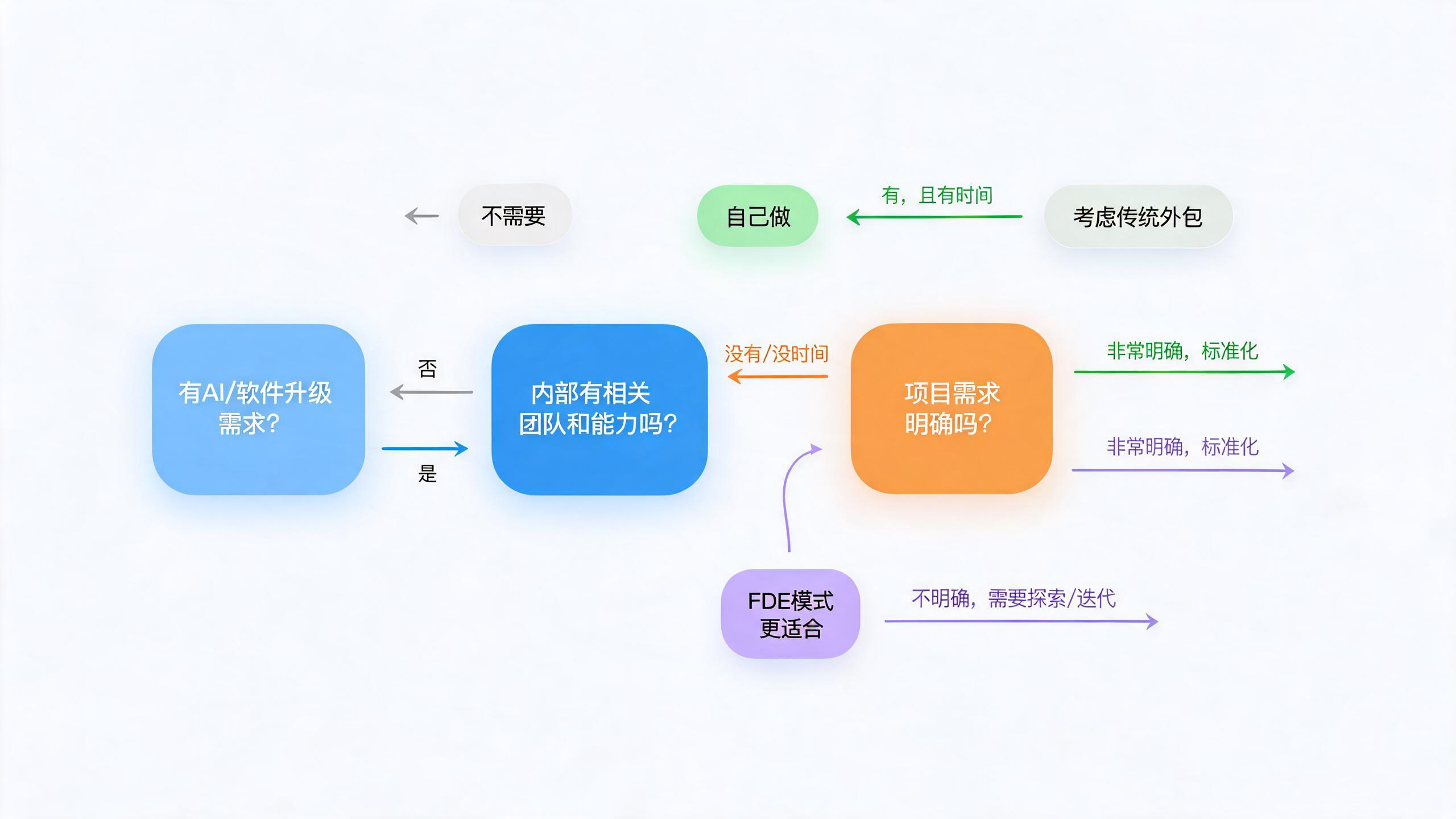 Figure: Decision tree for delivery models of enterprise AI/software upgrade projects
Key Success Factors for FDE Projects
1. The client side needs a clear sponsor and point of contact
No matter how capable an FDE is, someone inside the client organization needs to drive things forward. There must be a sponsor with decision-making authority, plus a business lead and a technical lead for day-to-day contact. Otherwise, the FDE won't even know who to ask to confirm requirements.
2. Data and system access should be arranged in advance
Data is the core of AI projects. Before the FDE arrives, data permissions, system access, and API access should be coordinated in advance. Otherwise, the FDE spends the first week doing nothing but going through approval processes.
3. Maintain high-frequency communication and iterate in small steps
Hold at least one stand-up per week and a demo every two weeks. Don't wait until it's "done" to review—by then, if something's wrong, far more time has been wasted. The FDE model's advantage is speed and flexibility, so make the most of it.
4. Define success criteria and acceptance methods clearly
Before the project starts, make it clear: What counts as success? How is it measured? How is it accepted? Is it about features going live, or business metrics improving? The more specific, the better—this avoids disputes later.
5. Prioritize knowledge transfer; don't depend on individuals
Knowledge transfer should happen throughout the project, not just at handover at the end. Coding standards, architecture design, operations processes, monitoring and alerting—all of these should be gradually passed to the client team during the project, ensuring the system keeps running after the FDE leaves.
Future Trends for FDEs
Trend 1: AI Is Driving Explosive Demand for FDEs
In the era of large language models, demand for enterprise AI implementation is surging, but the supply of AI talent falls far short. As the key role in "the last mile of AI implementation," demand for FDEs will keep growing. OpenAI investing $4 billion in deployment and Anthropic forming a joint venture with BlackRock are both signals of this trend.
Trend 2: From "Job Function" to "Service Category"
The FDE role originated as an internal position at large companies (Palantir), and is now becoming an independent service category. More and more FDE agencies and independent FDE consultants are emerging, and enterprises can purchase FDE services the way they buy cloud services.
Trend 3: Vertical Specialization
Generalist FDEs will differentiate into vertical domains—healthcare FDEs, finance FDEs, manufacturing FDEs, CRM FDEs, and so on. The deeper the domain, the more important business knowledge becomes, and generalist FDEs can hardly cover every industry.
Trend 4: The Rise of Remote FDEs
Traditional FDEs work on-site, but as remote collaboration tools mature and AI tools provide assistance, the efficiency of remote FDEs is getting closer to that of on-site ones. For small and medium-sized businesses with limited budgets, remote FDEs are a highly cost-effective option.
FDE Service Industry Distribution
Not every industry needs FDEs; they are mainly concentrated in industries that are "data-intensive + business-complex + heavily regulated":
| Industry | FDE Demand Intensity | Typical Scenarios | Core Drivers |
|---|---|---|---|
| Financial Services/Insurance | ⭐⭐⭐⭐⭐ | Risk model deployment, intelligent customer service, compliance review | Strict regulation + large data volumes + clear ROI |
| Healthcare | ⭐⭐⭐⭐⭐ | Clinical decision support, medical imaging, insurance settlement | HIPAA compliance + data sensitivity + high value |
| B2B SaaS / Tech | ⭐⭐⭐⭐⭐ | AI feature integration, customer success, enterprise customization | Productized AI + diverse customer needs |
| Government/Defense | ⭐⭐⭐⭐⭐ | Intelligence analysis, command systems, logistics optimization | Classified scenarios + high complexity + Palantir's birthplace |
| Manufacturing | ⭐⭐⭐⭐ | Predictive maintenance, quality inspection, supply chain optimization | Industry 4.0 + connected equipment + large cost-saving potential |
| Legal/Compliance | ⭐⭐⭐⭐ | Contract review, legal research, compliance checks | Document-intensive + high professional barriers + clear cost savings |
| Logistics/Operations | ⭐⭐⭐⭐ | Route optimization, inventory forecasting, scheduling systems | High operational pressure + clear data-driven value |
| Retail/E-commerce | ⭐⭐⭐ | Personalized recommendations, demand forecasting, intelligent customer service | High standardization + many SaaS products |
| Education | ⭐⭐ | Intelligent tutoring, learning path planning | Limited budgets + tightening regulation |
Data compiled from industry distribution reports by FDE service agencies such as FDE agency, Entrans AI, and glocomms, 2025-2026.
FDE Work Content Distribution
Where do FDEs spend their time? The typical work content distribution of an FDE focused on AI deployment looks like this:
| Work Type | Time Share | Specific Content |
|---|---|---|
| Coding and Development | 30-40% | Backend development, frontend integration, data pipelines, model integration |
| Client Communication and Requirements Alignment | 20-25% | Requirements interviews, solution demos, progress reports, answering questions |
| Data Governance and Integration | 15-20% | Data ingestion, cleaning, quality checks, system integration |
| Model Tuning and Evals | 10-15% | Prompt optimization, performance evals, model iteration, A/B testing |
| Knowledge Transfer and Training | 5-10% | Code walkthroughs, operations training, documentation |
| Project Management and Coordination | 5-10% | Schedule management, risk identification, cross-team coordination |
Compared with pure software engineers, FDEs spend about 30% less time coding, but significantly more time on communication, data, and training. This is why FDEs need stronger overall capabilities—not just writing code, but also handling people, data, and business.
Final Thoughts
FDEs are not a silver bullet and cannot solve every problem. But for the increasingly common pain point of "the last mile of AI deployment," the FDE may be one of the best solutions available today.
The core contradiction of enterprise digital transformation has never been "whether you have the technology," but "whether the technology can truly integrate into the business." The traditional vendor model cannot resolve this contradiction—because vendors are "outsiders" who leave once the work is done. The internal team model also has limitations—because talent is too expensive, too slow, and too scarce.
The FDE model offers a third path: using external experts' capabilities to do an internal team's work. It retains the flexibility and expertise of external resources while providing the depth and sense of ownership of an internal team.
For small and medium-sized businesses, this is especially valuable—you don't need to maintain an expensive AI team to gain top-tier AI deployment capabilities.
📚 FDE Article Series
| Article | Core Content |
|---|---|
| The Complete Guide to Forward Deployed Engineers (this article) | A full breakdown of the role definition, value, competency model, and pricing models |
| FDE vs Traditional Outsourcing vs Internal Teams: An In-Depth Comparison and Selection Guide | A comprehensive comparison of the three models to help you choose the right delivery approach |
| The FDE Project Delivery Process: A Full-Chain Breakdown from Requirements Diagnosis to Knowledge Transfer | A breakdown of the standard delivery process—what to do and deliver at each stage |
| Why Do AI Projects Need FDEs? Avoiding 70% of Deployment Failures | The core pain points of AI deployment and how FDEs solve them |
❓ Frequently Asked Questions FAQ
Q1: What's the difference between an FDE and a Solutions Engineer? A Solutions Engineer is mainly a pre-sales role—working with sales on solution demos and technical discussions, with the goal of winning deals. An FDE is a delivery role—after the deal is signed, they actually go to the customer site to build things and get them running. Simply put: the SE is responsible for "selling it in," while the FDE is responsible for "building it." In terms of salary, FDEs at the same level typically earn 15-30% more than SEs, because FDEs need stronger coding skills and delivery accountability.
Q2: How many people does an FDE project need? It depends on the project size. Small projects (e.g., AI deployment for a single scenario) need just one senior FDE; medium projects (e.g., a comprehensive AI upgrade of a CRM) need an FDE team of 2-3 people (1 lead + 1-2 engineers); large projects (e.g., company-wide digital transformation) may require an FDE team of 5 or more. FDE teams emphasize being small and elite, not headcount—a small FDE team of a few people can be far more efficient than an outsourcing team of dozens.
Q3: Who maintains the system after an FDE project ends? Good FDE services treat knowledge transfer as one of the core deliverables. During the project, the FDE trains the client's engineers, developing and operating together. By the end of the project, the client team should be capable of independent maintenance and basic iteration. If major feature upgrades or new scenarios come up later, the client can engage the FDE again for phased collaboration.
Q4: Is there a big difference in results between remote FDEs and on-site FDEs? It depends on the project type. For technology-driven projects like system integration and AI deployment, remote FDEs can achieve 80%-90% of on-site efficiency. For projects requiring extensive face-to-face communication and driving organizational change, on-site work is more effective. The current trend is a "hybrid model": on-site for key milestones (kickoff, acceptance, major decisions), remote for daily development—ensuring results while controlling costs.
Q5: Can SMEs with limited budgets afford an FDE? Yes. FDE isn't something only large enterprises can afford. There are several ways to reduce costs: first, choose a remote FDE, which is 20-30% cheaper than on-site; second, pay per scenario—start with a minimal scenario validation (2-4 weeks) and expand only if the results are good; third, choose an independent FDE consultant or a small FDE firm, which is much cheaper than large companies. The key is to start small, validate the value first, and then invest gradually.
If you are considering an AI upgrade or a system transformation project but are unsure which model to use for implementation, feel free to contact me to discuss.