Drawing on Wikipedia, OpenAI, and Fan Bing's open-source handbook, this explains how Forward Deployed Engineers close the deployment gap and turn a single customer-site success into reusable capability.
This article cross-checks three sources. Wikipedia: Forward deployed engineer gives the encyclopedic definition of the role and its position in the industry in 2026; OpenAI's "What forward deployed engineering means at OpenAI" (Colin Jarvis, 2026-10-22) shows how a model company turns field work into product and research directions; Fan Bing's open-source handbook Forward Deployed Engineer (official site fde4.ai, print edition published by Posts & Telecom Press in October 2026) walks a delivery from finding the problem to scaled replication. For how the model side makes a single task run reliably, see Harness Engineering and Codex in Action.
Model demos are already easy to do. But when enterprises connect a demo to their own data, permissions, compliance, and daily workflows, they often still stall at the pilot stage. The Forward Deployed Engineer (FDE; some companies write it as Forward Deployed Software Engineer, FDSE) is the person sent to fill that distance: he works for the company that makes the product, and for a defined period of time works alongside the customer's employees to turn the product into a system genuinely used in the customer's production environment.
 Figure: Forward Deployed Engineer (FDE) by Fan Bing. The full open-source text is on GitHub.
Principles and core concepts
The deployment gap is closer to the business than model leaderboards
Colin Jarvis, who leads forward deployed engineering at OpenAI, formed the team in early 2025. The mission he gave the team was to bridge what he calls the deployment gap: the drop-off between capabilities models appear to already have and the capabilities people can reliably use in their work, with systems and processes in between. Sometimes what's missing is a product. Sometimes the model performs well on benchmarks, but once it enters real-world constraints it cannot finish the task.
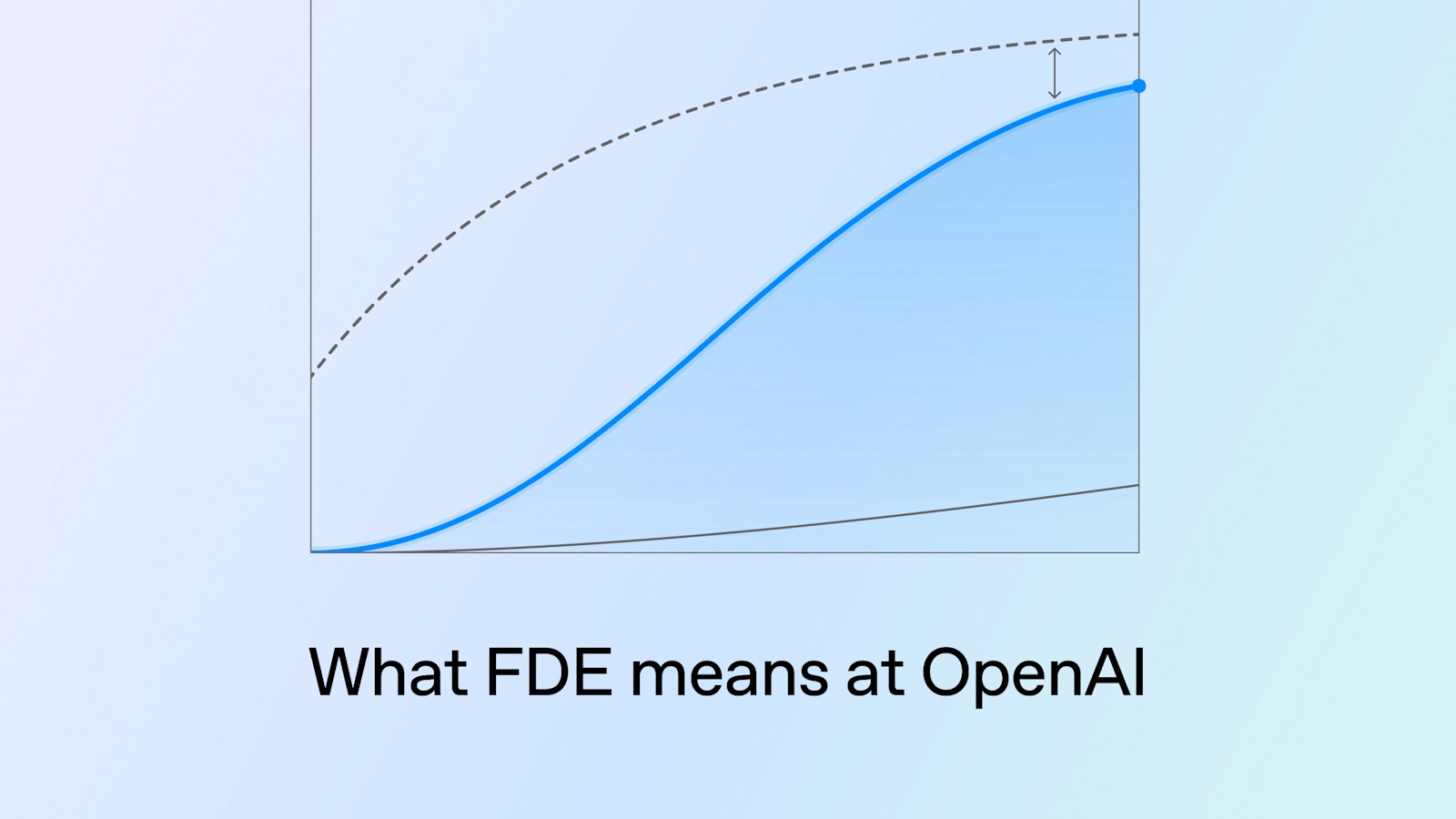 Figure: the dashed line at the top rises fastest, the solid line in the middle bends upward after it, and at the bottom there is a line almost hugging the horizontal axis. An arrow at the right end marks the distance the dashed and solid lines still have not closed — this is the deployment gap. Source: What forward deployed engineering means at OpenAI.
This distance determines the FDE's order of work. For things customers can already accomplish with models, the FDE works with the product team to turn them into a solution the next customer can reuse. For things models cannot yet do, the FDE works with the customer and the research team to write the gap down as a testable task. Jarvis sums it up with one working standard: if every few months the team can make itself no longer necessary for that class of problem, the team has done its job.
Wikipedia places the same role in a longer professional lineage. "Forward deployed" comes from US military usage, referring to putting combat-capable people closest to the problem. Palantir was using the title by 2009 at the latest. From 2024 to 2025, job postings with this name increased noticeably, and they kept growing in 2026. In the same year, Anthropic, OpenAI, Amazon Web Services, Microsoft, and Google Cloud all announced organizations built around forward deployed engineering. The role has thus become part of how large AI companies go to market with large enterprises.
 Figure: the deployment gap is closer to the business than model leaderboards.
The role fills the seam between a product and one specific customer
Fan Bing's handbook adopts Bob McGrew's definition. McGrew was an early Palantir executive and later served as OpenAI's Chief Research Officer. Under this definition, a Forward Deployed Engineer is embedded in the customer's working context, filling the seam between "what the product can do" and "what the customer needs." Being embedded does not necessarily mean sitting in the customer's office every day. It means joining the customer's chat groups, reading the customer's data, attending the customer's meetings, and getting to know the person who knows why the process is the way it is. The word "engineer" constrains the deliverable: what gets handed over is code and systems running in production.
Shyam Sankar, Palantir's 13th employee, later publicly claimed the name. His job description was short: eat the pain, produce the product. The early approach was set by this. Customers often cannot articulate what they want before they see something usable. To find out where the differences are, put the people who write software next to the people who use it. Changes made on site for one customer are recorded as product discovery. When three customers hit the same gap, that is a piece of product intelligence.
Wikipedia also records two sober readings. One management professor argues that such an unusual title is a strategy for organizations to project identity outward, influencing how job seekers, employees, and customers view the company. The venture capital firm Andreessen Horowitz calls the FDE "title arbitrage": using a new title to rebrand work that used to be called Solutions Engineer or integration engineer. Both readings can hold at once. Titles package identity; whether the role is real depends on whether field learning flows back into the product.
Adjacent roles each deliver different things
The FDE's responsibilities overlap with those of Solutions Architects, Sales Engineers, customer engineers, professional services engineers, system integrators, and IT consultants. What overlaps is "understanding the customer and the systems." What differs is the deliverable, the billing, and the end condition.
| Role | Main deliverable | When the work ends |
|---|---|---|
| Pre-sales / Sales Engineer | Proposals and demos that convince the customer it can be done | Contract signed |
| Solutions Architect | Validating the architecture is feasible with sample or anonymized data | Solution boundaries and integration paths written out |
| Professional services / system integration | Connecting systems and delivering features per contract | Acceptance checklist checked off |
| On-site outsourcing | Writing custom code on-site, billed by person-days | Person leaves, or the contract keeps them there |
| Consultant | Advice, roadmaps, and change plans | Report accepted |
| Platform engineer | One capability serving multiple customers | The capability is reusable everywhere |
| Forward Deployed Engineer | A production system running in the customer's environment on the customer's real data | Customer team can use it independently, and customization for similar problems declines |
Inside Palantir, platform engineers and Forward Deployed Engineers are two separate headcount tracks. Platform engineers own one capability and serve multiple customers. Forward Deployed Engineers carry the internal codename Delta, owning one customer and drawing on multiple capabilities. On the business side there is also the Deployment Strategist, internal codename Echo, responsible for understanding the customer's mission, stakeholders, and adoption path. One diagnoses; one builds.
Chinese readers should also look again at billing models when comparing with "on-site engineers." Qimeng Tech states the boundary on its website in three sentences: on-site staffing is paid by hours, while an FDE delivers by phase and is accepted on results; on-site staffing writes from scratch, while an FDE does engineering on top of a product foundation; on-site staffing stays longer and longer, while an FDE leaves when done, leaving the capability in the systems and the customer team. Cresta's head of FDE added one technical boundary: the role must be tied to an AI platform. If it only does traditional data integration and system setup, it becomes hard to distinguish from traditional implementation.
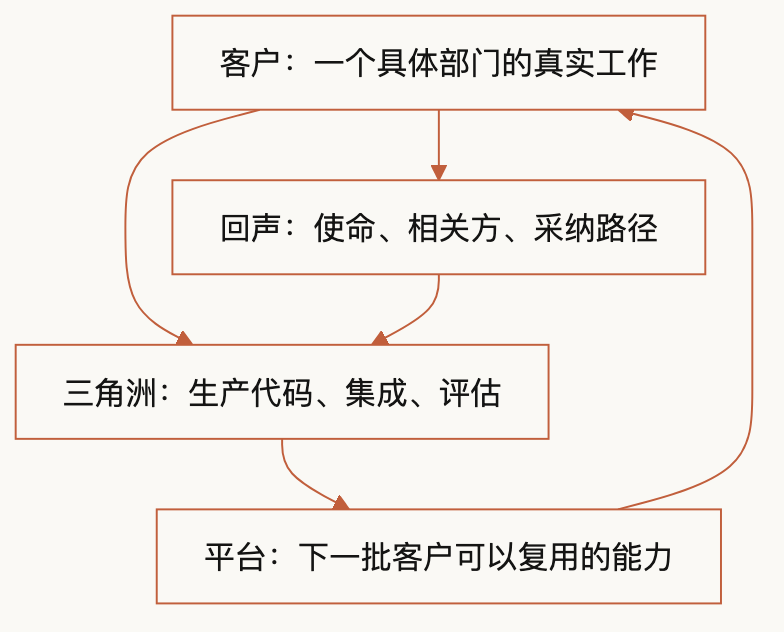 Figure: adjacent roles each deliver different things.
An FDE therefore faces four sides at once. Toward the customer, he observes real work and turns observations into something that runs, on site. Toward the product line, he sends recurring gaps back. Toward sales, he builds clickable prototypes with the customer's own data, and dares to point out errors in the customer's premises. Toward the organization, this role finishes a task amid ambiguous requirements every day and gets people using it, so it also trains people who will later build products, start companies, or return to the buyer's side.
The time split looks roughly like this: forty to fifty percent writing code and tuning systems on the customer side, twenty to thirty percent aligning direction with customer management, breaking down problems, and making architecture decisions, ten to twenty percent feeding field patterns back into the company's product line, and the rest on evals, writing playbooks, and training the customer's team. The two-way mission lives in this schedule. Deliver without feeding back, and field work becomes a sales cost. Feed back without delivering, and the product line never hears whether customers actually changed how they work.
Start from the target outcome, then turn one success into a capability
At every team meeting, Jarvis opens with a page of values: start from the target outcome, take the actions necessary for success, then scale. Demos can win applause. The responsibility is to bring a solution up to a standard the team is willing to be accountable for in production.
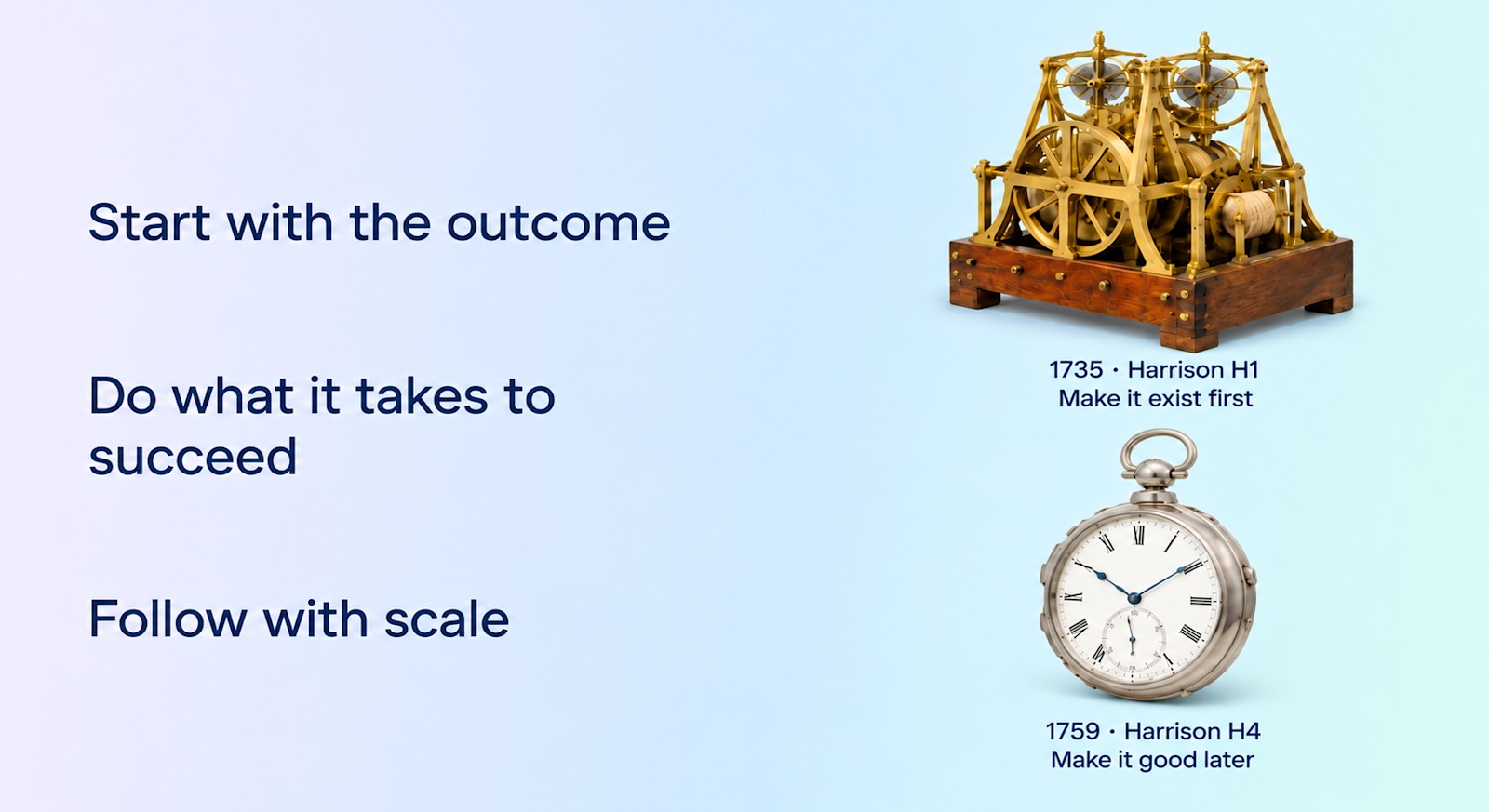 Figure: OpenAI uses Harrison's marine chronometers to illustrate the order of these three statements. The 1735 H1 was large and complex; the task was first to make timekeeping at sea possible. The 1759 H4 was the portable finished product. Source: What forward deployed engineering means at OpenAI.
The order cannot be reversed. Large models let you build a seemingly complete system very quickly. Use that speed to first put a valuable narrow solution into users' hands, see which parts hold up under real use, then harvest the parts that hold up into platform capabilities. McGrew uses another set of metaphors for the same idea: Forward Deployed Engineers build gravel roads one by one at customer sites; product teams decide which roads are worth paving into highways for the next ten customers.
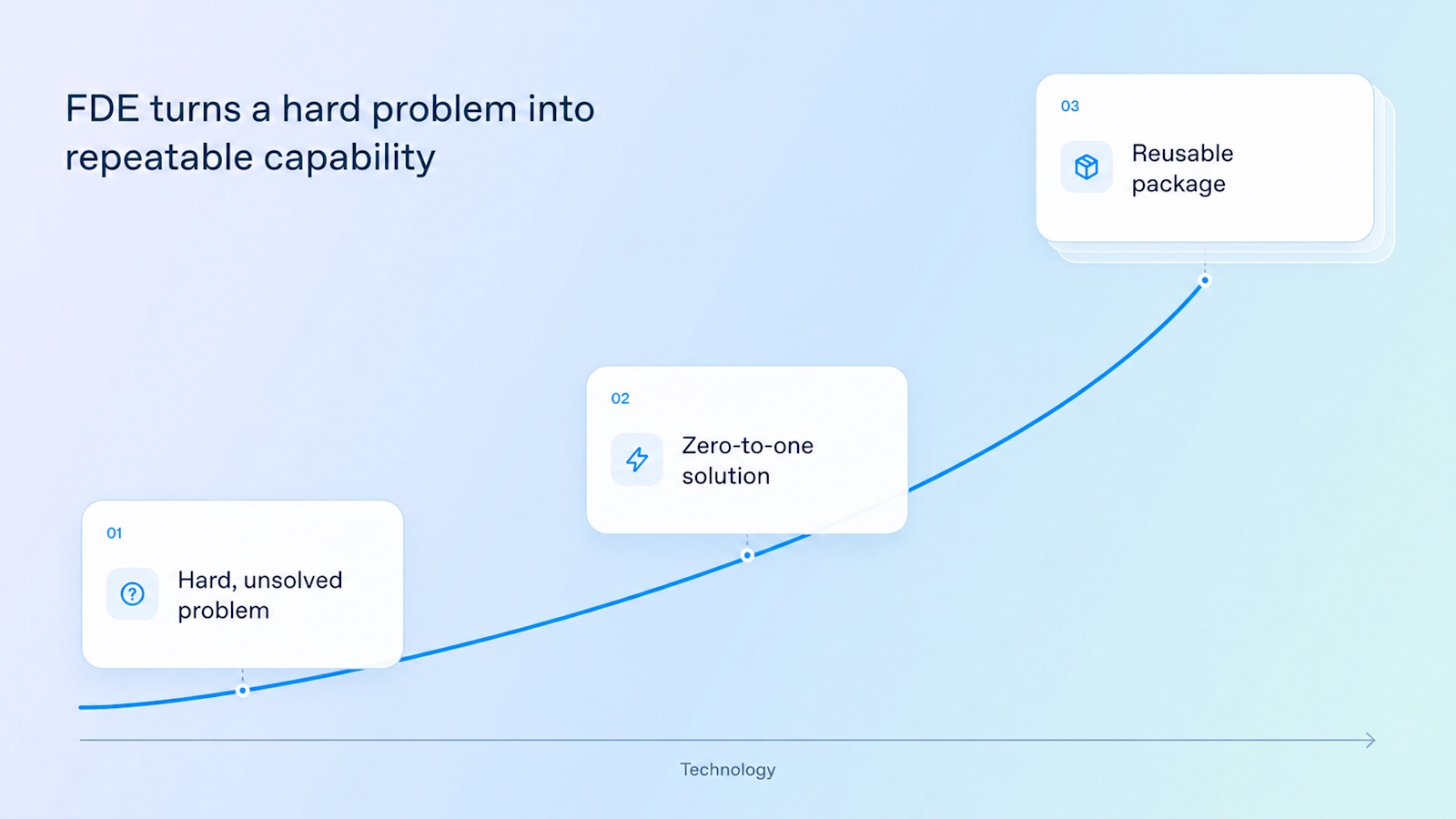 Figure: An FDE turns an unsolved hard problem into a zero-to-one solution, then, as the underlying technology improves, harvests it into a reusable solution package. Source: What forward deployed engineering means at OpenAI.
There are two paths to making yourself no longer necessary. One is that once the product improves, most of the custom implementation gets replaced while the value remains. The other is to turn problems the model cannot solve today into evals that the research team can progressively raise. One customer's hard problem thereby becomes the starting point for the next batch of customers.
How to use it
Walk through six stages along a single delivery
The playbook distills a real delivery into six stages. Each stage has checkable outputs. Without output from the previous stage, the next stage is just scope inflation.
 Figure: Walk through six stages along a single delivery.
- Find the right problem. Lock onto a specific pain of a specific person, calculate what it is worth, and use existing data and model capabilities to estimate how much of it can be achieved.
- Win the customer. Be present in person at key junctures, and get your hands on real data and real processes. Early on, tackle a small problem the customer themselves admits is tricky, in exchange for a real map of the organization.
- Activate the deployment. On launch day, all that is demonstrated is that the system is accessible. Activation happens the day the customer's employees change how they work.
- Protect the renewal. Use the metrics both sides agreed on before kickoff, and review usage, value, and the relationship in quarterly reviews.
- Expand revenue. Extend the proven process to adjacent teams or adjacent document types, reusing connectors, evals, and skills.
- Scale and replicate. Leave this engagement's playbook, components, and platform capabilities to the next customer. The next customer should need less customization than this one.
Hybrid delivery narrows "a person must be on site" to three situations: relationship-building at the start, including first meetings, shadowing users for a day, and building trust with executives; high-intensity co-creation, including joint building sessions and whiteboard discussions of key architecture; and politically sensitive periods, including solution promotion and cross-department coordination. Deep coding, documentation, and routine iteration happen remotely. These are done remotely precisely because they require continuous, uninterrupted time.
Pass three gates before kickoff
The playbook narrows product-market fit down to problem-solution fit (PSF). Inside an enterprise you can list a hundred "AI might be able to do this" opportunities. The opportunities worth sending an FDE for must pass three gates at once.
The pain-point gate requires two specifics. "Improve customer service efficiency" is a direction. A customer service manager spending three hours every Monday morning manually aggregating escalated tickets from four systems—that is pain. McGrew also offered a steeper filter: go after one of the few problems the CEO cares about most. Only problems of that magnitude can push through an enterprise's internal process friction. Sierra's standard is two sides of the same coin: the problem must be hard, and the business impact must be large. Hard but without impact is showing off. Impactful but technically shallow does not warrant forward deployment.
The economics gate converts pain into money. How many person-hours does this problem consume per week, how much does one error cost, and what will the saved people do next week. Projects whose numbers cannot be computed will not survive the next budget season. The MIT NANDA report "The GenAI Divide" contains a comparison the playbook cites repeatedly: more than half of budgets go to front-office sales and marketing, yet measurable returns show up more often in back-office processes unsuited to demos, such as contract review, procurement, and risk control.
The feasibility gate answers two things on site. Where is the data, what condition is it in, and which copy is the authoritative version. Is the accuracy threshold 99%, or 90% plus human review. The engineering effort between the two tiers differs by an order of magnitude. In many businesses, the latter tier is the economical one. The threshold must be measured with test questions. OpenAI's enterprise deployment guide puts "start with a test question bank" up front. Test questions must be run repeatedly, because when these systems fail they often do not report an error—they just quietly become unreliable.
Draw five maps before entering
Before writing the first line of production code, the playbook calls for one to two weeks of entry due diligence. Echo and Delta do it separately and reconcile daily. The five maps answer different questions.
| Map | What to find |
|---|---|
| Data map | Data sources, owners, quality, permissions, and the copy employees actually trust. It is often a different copy from the official data source |
| Process map | The real process revealed by shadowing, including undocumented exceptions. Mark the three points that are most time-consuming, most costly when wrong, and most emotionally charged |
| Organization map | Who initiates, who pays, who uses, who vetoes, and the knowledge hubs who hold no high title yet whom everyone turns to when trouble arises |
| System map | Systems to integrate with, interface status, security boundaries, change processes. If the customer takes six weeks to release a version, the schedule must be written around that from day one |
| Political map | Whose power source this process is, and whose work will look redundant after automation. Leave these people a new work path |
What two weeks of due diligence buys you is avoiding three months of running on the wrong battlefield.
Replace the endless pilot with a minimum viable deployment
Projects in PoC purgatory are neither fully dead nor fully alive. They keep "progressing" in quarterly reports. The NANDA report ranks the most common roadblocks to scaling: employees unwilling to use new tools, worry about output quality, poor experience, lack of executive support, and difficulty of change. "The model isn't smart enough" is not on the list. One enterprise spent fifty thousand dollars on a contract analysis tool, yet senior lawyers still draft with free ChatGPT, because the purchased summaries cannot be edited the way she prefers. The report says deployed; the daily reality is the official system idling.
A Minimum Viable Deployment (MVD) uses the smallest engineering investment to verify, in this customer's real environment and for this pain point, that value actually happens. It differs from a minimum viable product in the judge. An MVP asks the market whether it wants this product. An MVD asks whether this one customer's one business process got better because of it. A solution validated by ten customers can still fail at the eleventh, because the shape of the data, the organization, and the pain point have all changed.
The MVD has three enforceable rules.
Real data, no exceptions. Sanitized samples and demo data hide missing fields, outdated encodings, and mutually contradictory "correct answers." OpenAI's internal division of labor follows this same line: a Solutions Architect may demo with anonymized samples, while an FDE writes production code with the customer's real data on the customer's infrastructure.
Narrow the coverage, keep the depth. Company-wide intelligent customer service is a big program. Doing only the returns-and-exchanges ticket category, end to end, is a minimum viable deployment. Make the cut small enough that the business unit can see it with the naked eye, and they will start telling others about it themselves.
Deadlines are measured in weeks. Palantir's AIP bootcamp runs one to five days. Sierra's fastest publicly reported go-live was about four weeks, and Decagon's typical deployment is about four to eight weeks. Anything that doesn't show value within these weeks is not the core value of this engagement. A project that claims to be minimal but requires six months of validation will grow back into a everything-wants-to-be-included project.
The bootcamp turns these three steps into an assembly line. On day 0, both sides lock in an extremely narrow battlefield, such as reducing scheduling conflicts on a production line, and set a quantified target. On day 1, they connect to the customer's existing systems, extract data, and build a preliminary ontology. Over the following days, they build a prototype on real data that executives can click with their own hands. The handbook cites company figures: paid conversion from early bootcamps was roughly 5% to 10%, while later disclosed conversion approached 75%. Conversion measures two things at once: whether the customer was chosen well, and whether delivery can succeed.
Evals, toolboxes, and a one-week rhythm
The craft difference between the AI-era FDE and the traditional implementation engineer centers on evals. Evals give fuzzy business quality a ruler, and give outcome-based pricing a foundation. In customer service scenarios, resolution rate and deflection rate are the easiest to drown in definitional disputes. Before citing any percentage, write down three things clearly: what the denominator is, how long the judgment window is, and who makes the judgment.
Tools will change, but the capability layers are relatively stable. The five layers, from bottom to top, are:
- Platform foundation. The ontology in Foundry and AIP, OpenAI's model APIs and agent toolchain, and Sierra's agent platform. Without this layer, field work falls back into custom development.
- AI engineering. Prompts and context, retrieval augmentation, evals, tool calling, human checkpoints at critical steps, plus cost and latency. The on-site Prompt in Action, Agent Skills, and MCP in Action cover the components in this layer.
- Data and integration. Pipelines, connectors, identity, permissions, vector stores, and data masking. Former Palantir engineer Nabeel Qureshi's experience is that the vast majority of enterprise data problems are access, cleaning, and joining. The bulk of project delays gets stuck here, invisible in demos.
- Delivery and collaboration. The customer's security perimeter may have no public internet, and code hosting may be inaccessible. Containers, infrastructure as code, and contingency plans for getting the environment running in an offline conference room belong to this layer.
- Knowledge accumulation. Playbooks, component libraries, checklists, and rewriting "this customer's solution" into "a pattern for this type of customer." Without this layer, revenue grows linearly with headcount.
A week can follow this rhythm. On Monday, use five maps to check whether scope has drifted. From Tuesday to Thursday, iterate on the system with real data, add eval questions, and review failure samples. On Friday, write the cases still requiring human handoff this week into three categories: missing data, missing tools, missing model capability. The first two go into the engineering backlog. The third becomes a gap statement for the research or platform team. The customer-side business owner only needs to look at one comparison each week: baseline, this week, and how far from target.
Usage examples
A contract ready to start work
The contract below writes "what counts as done" before the first line of code. The numbers are examples to illustrate the structure. In a real project, the baseline must be counted from the customer's ticketing system on day one, and the target and window are signed off by the business owner together with the FDE.
engagement:
  customer: 零售客服部
  battlefield: 退换货工单
outcome:
  owner: 客服主管
  metric: 退换货工单一次解决率
  baseline: 0.31
  target: 0.55
  window: 6w
  judge: 业务抽检 50 单
  excluded:
    - 模型给自己打的分
scope:
  in:
    - 退换货
    - 客户真实工单
    - 现有知识库里被主管标为可信的文章
  out:
    - 全渠道客服
    - 语音
maps:
  trusted_data: 主管每周维护的退换货条款表(一线实际采用的版本)
  change_lead_time: 客户生产发布需要 10 个工作日
exit:
  customer_runs_eval: true
  custom_glue_replaced_by_skill: true
  next_team_onboarding: 1d
This contract directly excludes two common kinds of fake success. Model self-evaluation doesn't count, because when it errs it often doesn't report the error. Omnichannel customer service is out of scope for this engagement, because that would turn a six-week validation back into a big project. Exit conditions are also spelled out: the customer team can run evals themselves, custom glue has been replaced by skills, and the next team can take over within a day.
John Deere: first define value as advice farmers can actually use
In OpenAI's article, John Deere is an agricultural company with two hundred years of history. The hard problem is how to give farmers personalized advice at scale. See & Spray uses cameras and machine learning to identify weeds and spray only the weeds, reducing chemical usage by up to 70%. For the benefit to materialize, farmers still need to configure the equipment, schedule farming operations, and adjust work as conditions change.
What the FDE does here is connect the model APIs into this existing equipment, so farmers can ask in natural language for setup guidance and advice specific to their fields, and see when the equipment isn't reaching its full potential. Value occurs across the entire usage lifecycle, including configuration, operation, and reviewing results afterward. This is one concrete shape of the deployment gap: the weed-identification model is already on the machine; whether farmers will use this capability in the next day's farm work is another matter.
Semiconductor verification: custom systems harvested into skills and connectors
In mid-2025, about 15 Forward Deployed Engineers worked with a large semiconductor customer on more than ten use cases, aiming to make verification a part of daily work that AI could participate in. Use cases included targeted test generation, root cause analysis and debugging, and an architecture assistant. In this industry, verification accounts for roughly 70% of project workload.
Some engineers had joined only days earlier and had never done chip design before. They joined the customer's verification team, caught up on chip design in their spare time, and built evals together with customer engineers: whether AI-generated tests were useful, and whether fault diagnoses were correct. Within the first three to six months, these use cases went into production and started being used. The article's reported results: targeted test generation saved about 48% of time, the median performance improvement from kernel optimization was 22%, and weeks of debugging were compressed to hours. The customer's chief hardware officer asked whether they had done chip design before arriving. Jarvis's answer was that an FDE doesn't need to know the industry on day one, but has a responsibility to proactively learn it.
After these workflows proved valuable, rolling them out to the next team still required substantial custom integration. Once Codex's capabilities came online, one FDE first rebuilt the application around it, then worked with the team to migrate the use cases to a general execution framework centered on Codex. The original custom application became plugins and skills. About 90% of the custom code in each project was removed. Unified product improvements could flow directly to every use case. Key functionality was harvested into skills and plugins, so when switching to another team, the main work became swapping connectors or MCP servers and building a new set of evals. The article cites an August 2026 use case: the first deployment took two months, while rolling out to the second team took one day.
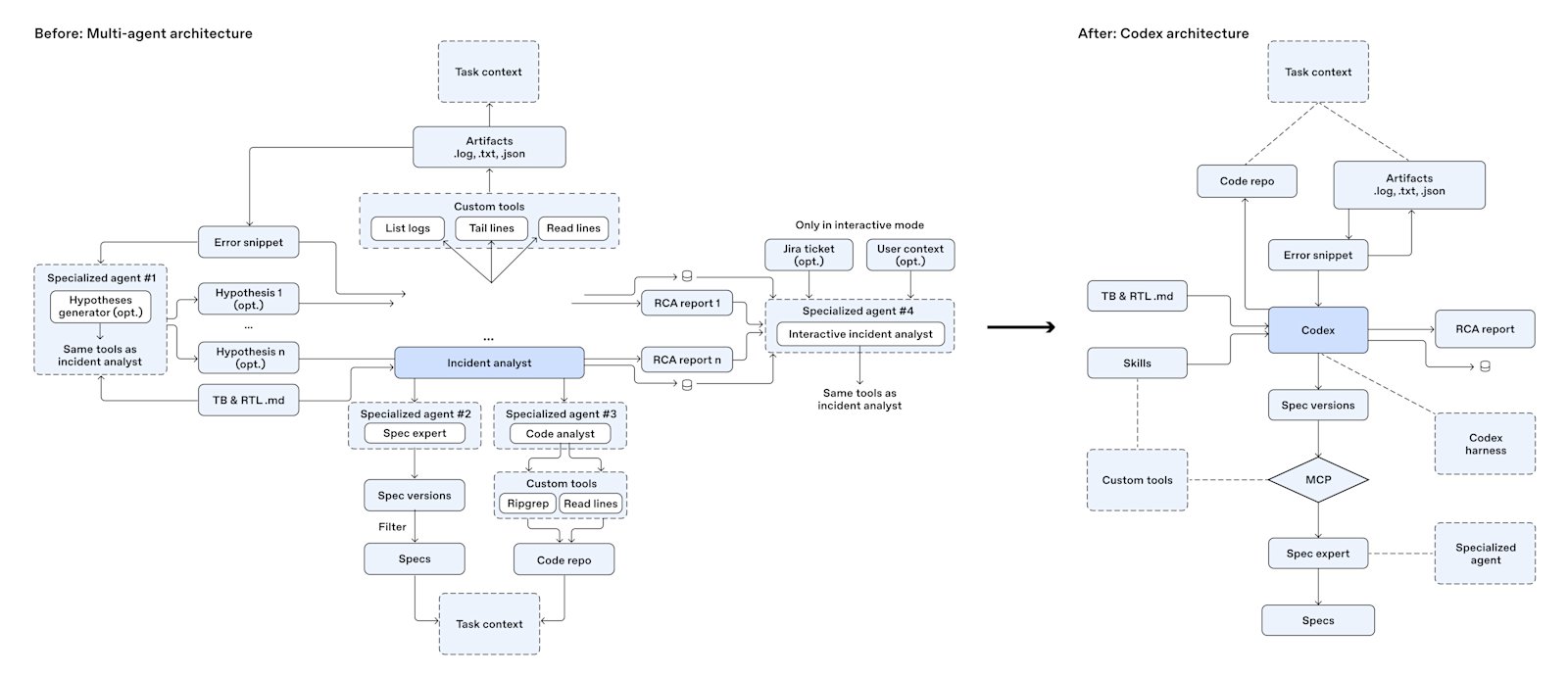 Figure: on the left, a set of specialized agents, custom tools, and an interactive analyst. On the right, tasks, repositories, skills, MCP, and specs are gathered around Codex, with root cause reports still remaining as output. Source: What forward deployed engineering means at OpenAI.
The engineering actions behind this figure can be taken apart. On the left, each specialized agent has to wire up its own logs, specs, and code repositories, so every team switch means rewriting a set of glue. On the right, these differences are pushed to the edges: repositories and skills express ways of working, MCP expresses connections to customer systems, and evals are still built separately. Every time the product improves, the use cases at the edges improve together. The on-site OpenAI Skills best practices covers how to write skills so they actually load; the figure above shows where skills sit in FDE work: they are the container for handing one-off field customizations back to the platform.
The same sequence also appears in OpenAI Presence. This product for enterprise voice and chat grew out of customer deployments, starting from Swarm and later evolving along the Agents API. The article notes that one customer already handles more than half of inbound calls with AI. Only after deployment into production could the team tell which problems still required customization and which components could be reused by other teams.
Tax and voice: separate the outcome numbers from the capability gaps
In the partnership with Thrive Holdings, OpenAI's FDEs worked with researchers, engineers, and accountants to build Tax AI for the accounting firms under Crete. The pilot processed 7,000 tax returns, with throughput increasing by roughly 50% at the same processing capacity. Rental property filings were the hardest part. After six weeks of engineering development and review by tax staff, both precision and recall reached 90%. This approach was then used to support other complex schedules. The teams applied the same method to bookkeeping, audit, and IT support.
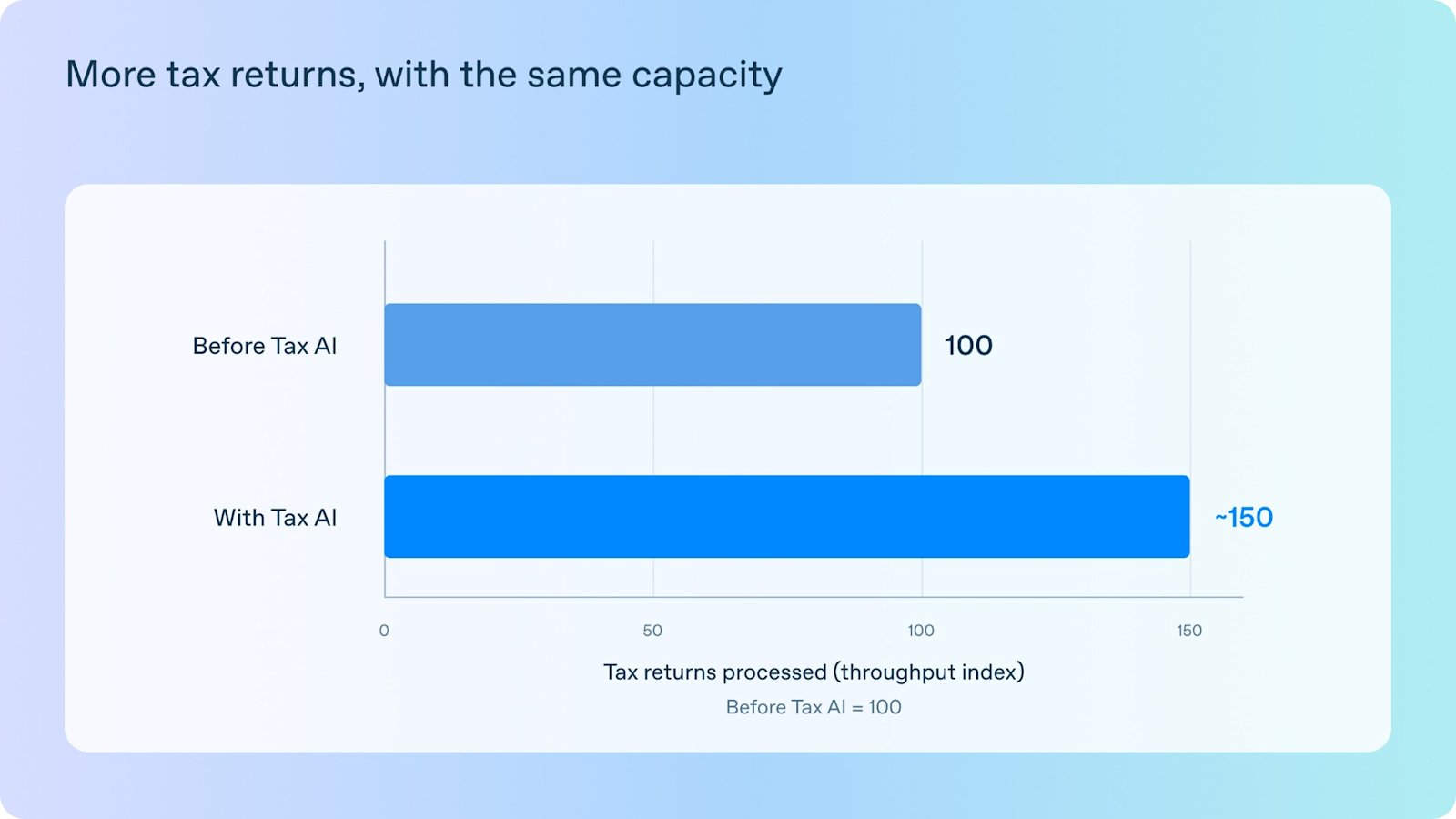 Figure: A/B comparison of the Tax AI pilot. The vertical axis is the throughput index at constant processing capacity, with the pre-pilot baseline set to 100 and roughly 150 after adopting Tax AI. Source: What forward deployed engineering means at OpenAI.
Voice was a different kind of problem: productization was not mature enough, and the models themselves could not pass the production bar at the time. A large telecom customer already had a chat-based customer service platform and wanted to extend it to voice. Voice accounted for about 90% of its customer service volume. Accents, tone, latency, and accuracy together became new constraints. At project kickoff, the key evals scored around 60, already at the ceiling of the models available then. Function calling and instruction following were both insufficient.
The FDEs and the customer first built the platform and clearly defined the tasks the models had to complete. The research team released model snapshots against these tasks, and the field team measured them against customer requirements. Within six months, the key evals went from roughly 60% to 80%, then exceeded 90%, meeting production requirements. The voice models built this way later served not only this customer but also other custom customer service deployments and managed deployments on Presence.
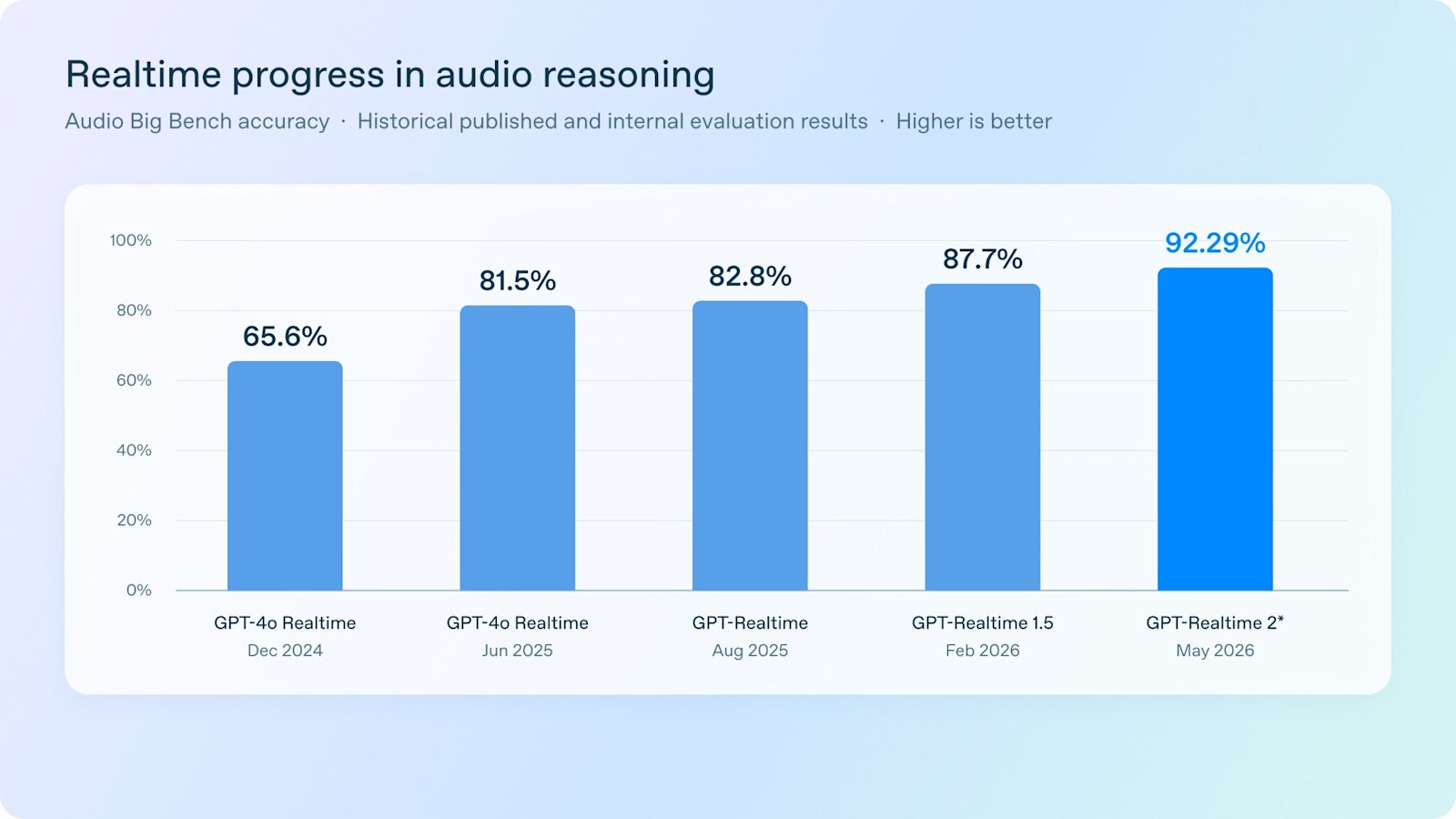 Figure: Audio Big Bench accuracy. The bars mix published results and internal evals, with the May 2026 bar marked with an asterisk. The customer-site "roughly 60% to over 90%" refers to a separate set of key evals; the two sets of scores each have their own test questions and denominators. Source: What forward deployed engineering means at OpenAI.
Looking at the two figures together, the FDE contribution splits into two kinds. The tax figure measures business throughput: no additional headcount, yet more returns processed. The voice figure measures model capability being pulled upward by customer tasks. The former makes existing capabilities reusable. The latter turns today's gaps into tomorrow's model capabilities. The article counts both as part of "making ourselves no longer necessary."
Best Practices
Making the next engagement require less of the same customization
Replicability is the dividing line between FDE and consulting or outsourcing. Barry put it this way: if field learning does not become a product asset, what you get is a pile of custom projects. McGrew's marker is more quantifiable: the amount of customization per subsequent customer should decline. If it does not, then whatever the billing model is called, the behavior is selling people by the person-day.
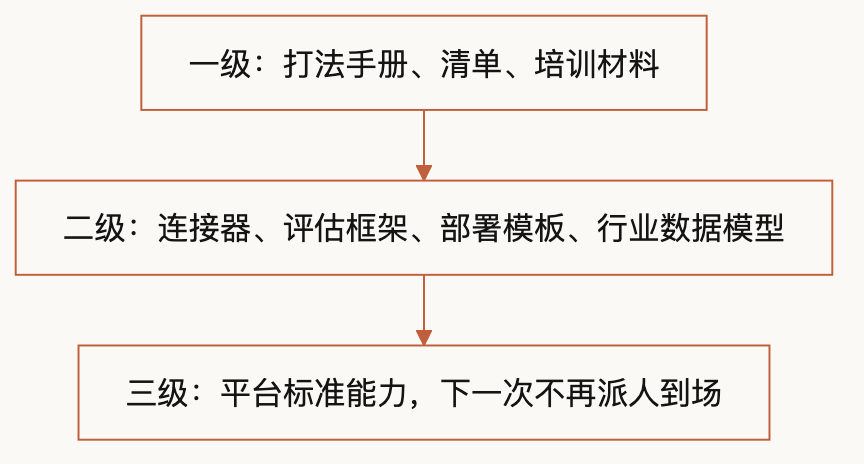 Figure: Making the next engagement require less of the same customization.
The first-order lever turns individual experience into organizational memory, cutting new-hire ramp-up from roughly a year to roughly three months. The second-order lever lets the next team start from the components left behind by the previous team. The third-order lever distills recurring customizations into platform capabilities, turning reduced delivery cost into eliminated delivery cost. Palantir's ontology, Decagon's agent operations workflows, and Sierra's agent platform are all examples of the third level.
Failures must also enter these three levels of assets. Pilots can be run like venture investments; most will die. If retrospectives are tied to performance, people will polish their failures, and polished failures teach the next team nothing. The handbook recommends that retrospectives focus on the work, not the person, and that lessons bought from crashed projects be written into checklists.
Track only three to five numbers per project
With too many metrics, no one looks at any of them. Each customer project locks in a small set of core numbers, usually one value metric, one usage metric, and one relationship metric. Baselines are captured on day one. Metrics are agreed with the customer so that at renewal time they qualify for a seat at the table.
| Metric | What it looks at | Reference scale |
|---|---|---|
| Time to value | From kickoff to the first measurable business value | Minimal validation in weeks, roughly 2 to 6 weeks; full deployment roughly 1 to 4 months |
| Pilot conversion rate | Whether validation turns into a paid, used deployment | Too low means screening failed; near 100%, check whether you are only taking easy deals |
| Evals pass rate | Whether outputs pass business test questions, and whether there is drift after launch | Rerun old test questions daily to catch regressions before users notice |
| Declining customization | How much less glue code the Nth customer needs than the first | If it does not decline, you are still doing outsourcing |
| Field feedback | The number of components, playbooks, or platform proposals accumulated over a period | When this number stops, the product side of the model has stopped |
| Team sustainability | Monthly travel days, on-call, attrition, and burnout signals | Once people burn out, all the preceding business metrics become one-offs |
Resolution rate and deflection rate need their definitions attached. Take ServiceNow's public definition as an example: a deflection counts only if no ticket is submitted within 24 hours after the interaction and the user shows a positive signal about the outcome. A clearly defined 51% is more useful than an ill-defined 86%.
Three questions to ask when joining or building a team
For engineers who want this role, the handbook suggests first rewriting the resume around customer outcomes. If you built a retrieval-augmented system, write down the changes the customer could verify: first-response time for customer service dropped from 4 hours to 8 minutes, and the customer asked to expand the deployment at renewal. Prepare two kinds of stories for interviews: one where you turned unclear requirements into order, and one honest failure.
Ask three questions in return when choosing a team. What is the product platform? What is the most recent example of field work becoming a product feature? Do FDEs report to product or engineering, or to sales? If there is no platform to point to, no examples of field-to-product flow, and the headcount sits under sales, the title is most likely a pre-sales labor pool or person-day outsourcing. Compensation structure is the other side of the same coin: bonuses can be aligned with customer expansion, but when hard sales commissions dominate, behavior gets steered toward signing deals.
The hiring profile has a corresponding screen. a16z's advice for startups is to look for curious, hands-on people with a certain irreverence for the status quo. Red flags are people who put code elegance ahead of customer outcomes, and people who treat every customer utterance as a must-build requirement. OpenAI and Palantir interviews share a common element: give a huge, fuzzy, business-edged problem, sixty minutes with no code, and watch how the candidate asks follow-up questions, scopes the problem, and establishes order within constraints.
Caveats
Wikipedia records one job seeker's own assessment: some software engineers consider the role less than ideal because it requires travel and solving customer problems within relatively short timeframes. OpenAI's job postings have stated that travel can reach up to half of working time. The pace is defined by the customer's urgency. The handbook puts it as glamour and cost being the same thing. If a company keeps field learning in its products, this grind becomes judgment and customer trust. If a company sells people as person-days, what accumulates is mostly travel days.
The 95% figure needs to be used with its definition attached. The NANDA report says that of the roughly $30-40 billion enterprises invested in generative AI, 95% produced no return that could be written into financial statements. The handbook itself lists three criticisms raised after the report's release: failure was defined as no financial statement impact within six months; value counted only profit, cost, and revenue, with faster processes and employee adoption excluded; and the sample skewed toward large enterprises, with failure data coming mainly from project sponsors. The report's direction is consistent with surveys from other institutions, but a failure rate precise to a single digit should not be treated as a measurement. It is cited to illustrate that many projects stall at "no one uses it." The percentage itself is taken only for its direction.
A few specific things can easily turn FDE work back into the old model.
Validating on demo data. On launch day you will meet fields that do not exist in the documentation, and by then the money has already been spent.
Interpreting scope as cutting features from a big plan. The resulting system is a Frankenstein that business units see no value in and will not help you spread.
Treating launch as acceptance. The milestone is the day the customer changes how they work. When official tools sit idle and employees detour to consumer products, the dashboards can be all green while no outcome has happened.
Flying the FDE flag without a platform foundation. Every step on-site is written from scratch, and the amount of customization for the next customer never shrinks.
Ignoring the political map. People whose existing workflows get automated away, with no new path for their work, become the most determined opponents at renewal time.
Disguising a model gap as engineering progress. The telecom voice project had already hit the model ceiling at 60 points. Piling on more custom interfaces cannot fill the holes in function calling and instruction following. The right move is to hand the test questions to the research team and re-test with subsequent model snapshots.
Gartner once made a prediction that has been quoted by the manual: by 2028, a significant share of enterprises will abandon FDE-led agent solutions and ask who is supposed to pay for the cost. Whether that prediction comes true remains to be seen. But the structural problem it points to exists right now: if every customer permanently occupies one engineer, the cost structure of this model is that of a consulting firm. The whole point of the three levels of leverage is to avoid that outcome.
The success criterion for an FDE project is that the same class of problem no longer requires the same customization next time, and the customer's own team can run the evals. If the person stays but the system stops turning, the delivery stopped at outsourcing.
Whether the title contains FDE cannot substitute for three pieces of evidence: a platform foundation, an on-site case that has already flowed back into a product feature, and contracts accepted on outcomes.
Reference resources
Official and encyclopedic:
- Forward deployed engineer: the role's definition, its military origins, Palantir's early usage, and the headcounts at major companies in 2026.
- What forward deployed engineering means at OpenAI: Colin Jarvis, 2026-10-22. The deployment gap, outcomes in order, John Deere, semiconductors, tax, and voice.
- OpenAI Codex and the on-site Codex in Action: the product layer that replaced the custom interface in the semiconductor case.
Manuals and cases:
- xdash/FDE-the-Guidance-Book-of-Forward-Deployed-Engineer: by 范冰 (Fan Bing), full text open-sourced. The definition, PSF, MVD, the five maps, the three levels of leverage, and the metrics all come from here.
- fde4.ai: a reading site synced with the repository, plus a knowledge graph and a case library.
- Print edition: 《前线部署工程师(FDE)》 (Forward Deployed Engineer (FDE)), Posts & Telecom Press, October 2026.
Further reading on this site:
- Harness Engineering: the runtime and control system outside the model. The evals, skills, and connectors that FDEs patch together on-site at customers are the customer-side version of this system.
- Agent Skills in Action and OpenAI Skills best practices: turning an on-site practice into a loadable playbook.
- MCP in Action: the layer of external tool connections that gets swapped when changing teams.
- LLM in Action and Prompt in Action: the layer of model capabilities and prompts. The FDE's work starts from this layer and moves outward into data and organization.
- AI Coding in Action: once coding assistants speed up implementation, understanding the customer's business becomes more expensive, and more decisive for whether the delivery holds up.