What is an FDE? Using enterprise AI adoption cases, understand the workflow of a Forward Deployed Engineer, how the role differs from other engineering positions, the required skills, job openings in Taiwan, and what to confirm before making the career switch.

When a company buys AI tools, it still has to deal with where data is stored, who can access it, how to connect it to existing systems, and how to take over when things go wrong. Getting these issues resolved until the system can be delivered is the most important part to look at first when learning about FDE work.
What is an FDE?
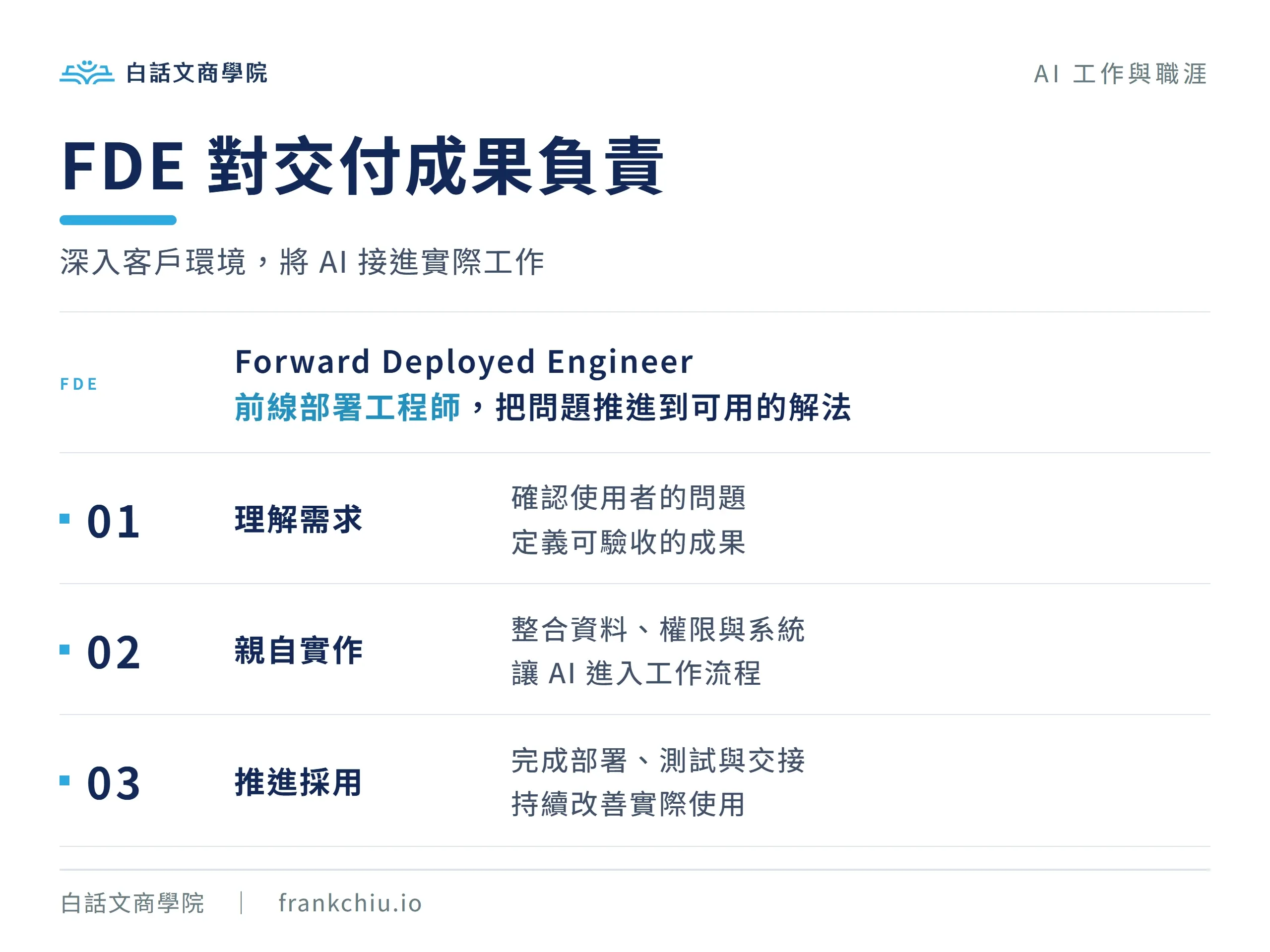
FDE stands for Forward Deployed Engineer, often translated into Chinese as "Forward Deployed Engineer." It is an engineering role that works deep inside a customer's business and technical environment, responsible for turning software capabilities into usable systems. The work typically covers understanding requirements, organizing data, developing integrations, deployment, and improving outcomes; engineers must handle both on-site processes and technical issues. In AI projects, this includes connecting models to enterprise data and tools, arranging permissions and exception handling, so applications can enter daily work; the role's focus is being accountable for delivery and adoption, while being stationed on-site or traveling is just an arrangement of the work.
For example, if the sales team wants to directly ask why an order hasn't shipped, the FDE first needs to understand the inquiry process, then connect order, inventory, and production data, build an answer feature that includes sources, and observe whether colleagues can use it smoothly. The outcome is getting this piece of work truly done, so the engineer must handle requirements, implementation, and post-launch issues end to end.
Further reading: OpenAI FDE job posting.
What does the "Forward Deployed" in FDE mean?
The "forward deployed" in the FDE title refers to where customers actually work. It could be a factory production line, a sales department, or a company's data center and engineering team; the core is staying close to where problems occur.
Palantir is an important starting point for understanding this role. On its official recruiting page, it explains that the company pioneered this position so engineers can go directly into customer environments and own the entire span of work from initial discussions to delivery. FDEs need to understand how users do their work, then develop applications, handle data, and deploy software based on on-site conditions. Palantir FDE job posting
Therefore, FDEs don't only exist in the generative AI field. Data platforms, enterprise software, and industry applications may all adopt this engineering delivery approach. At AI companies, the work further focuses on the integration between models, enterprise data, and business processes.
FDE on-site arrangements and travel depend on the company and project. The Palantir London job posting mentioned above lists roughly 25%–50% travel.
FDE also means something different from "resident engineer." Resident describes a work arrangement, while FDE involves the engineering delivery approach and responsibilities. When evaluating, check whether the role participates in requirements clarification, development, deployment, and outcome improvement.
What does an AI FDE do? Understand it through an order inquiry project
Suppose a manufacturing company wants to build an internal AI assistant so sales staff can ask: "Why hasn't this order shipped yet?"
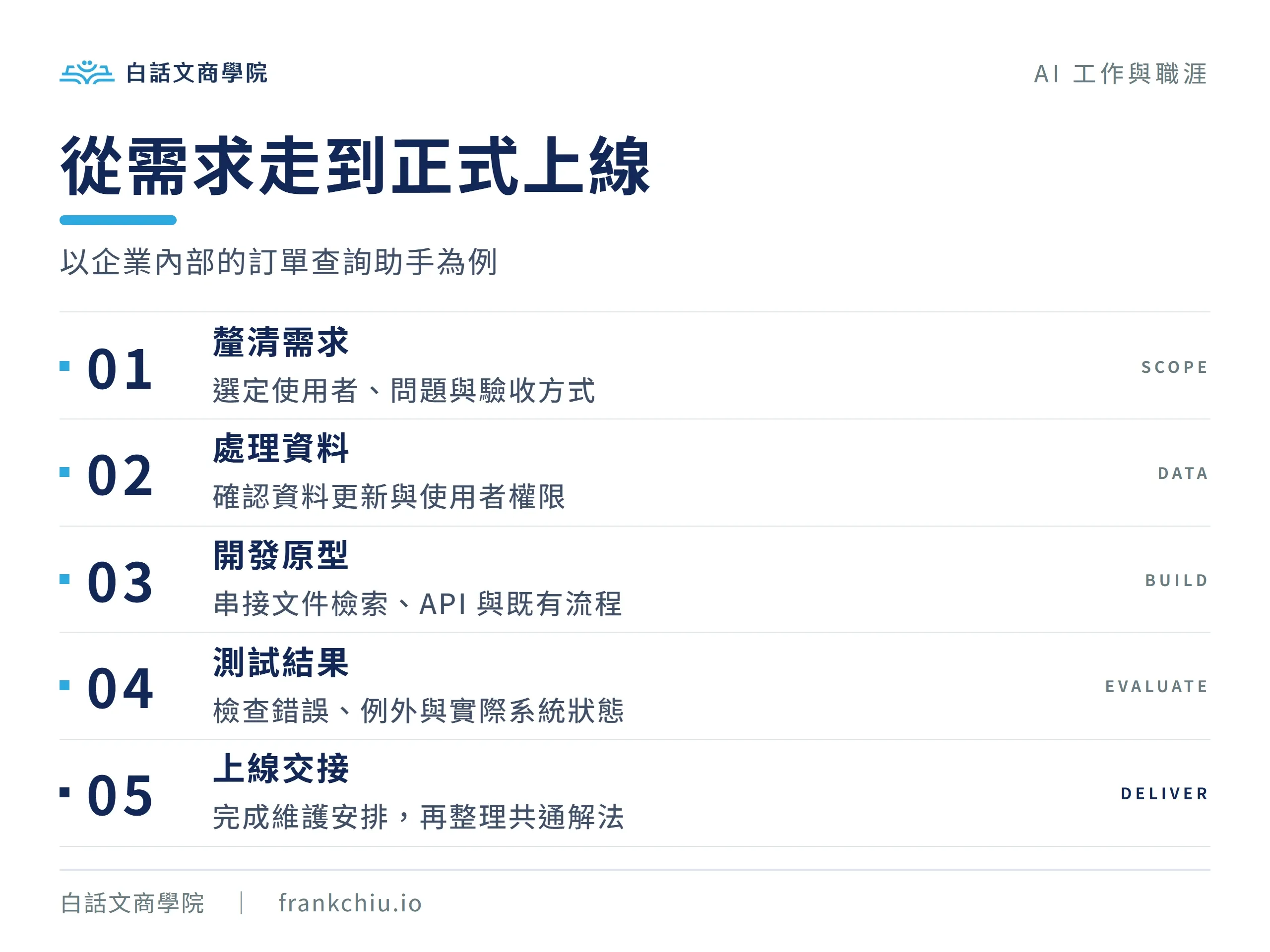
To answer this question, the AI assistant needs access to order, inventory, and production schedule data. The FDE would start with the following five tasks to build the inquiry feature into the sales workflow.
1. Clarify requirements and define acceptance criteria
"We want to adopt AI" is not yet a buildable specification. The FDE needs to work with sales, IT staff, and process owners to confirm: Who will use it? Which systems do they currently query? Where do things most often get stuck? Which answers must be judged by humans?
In this example, the first version could be limited to "query order status with data sources attached," then confirm whether the data is correct, whether updates are timely, and whether sales can complete inquiries more easily.
2. Organize data and handle access permissions
Order status may be in the ERP, production progress in the MES, and the reasons for exceptions written in another record. ERP can be understood as the system a company uses to manage orders, inventory, and other resources; MES is used to manage execution information on the manufacturing floor.
At this point, you need to confirm whether order numbers can be matched, when data is updated, and which customer information different users can see.
3. Build a prototype and connect the AI to the workflow
If the question requires searching documents, you can evaluate RAG (Retrieval-Augmented Generation), which means first finding relevant data and then having the model answer based on it. If querying real-time orders, you may need to integrate the system's API so the program can get the current state.
Fixed query rules can be handled by regular code.
Anthropic's engineering guide recommends finding the simplest viable solution first, then adding complexity as needed; adopting a more autonomous AI agent also requires weighing the extra cost and waiting time. Anthropic: Building effective agents
Pegatron's EdgeAI FDE job posting lists similar work: building proofs of concept for customer scenarios, setting up RAG, developing backend APIs, and integrating with existing systems such as MES and ERP. Pegatron EdgeAI FDE job posting
4. Test failure scenarios and confirm the results can be trusted
Back to the order example: before launch, you need to test the responses when the order doesn't exist, the user lacks permissions, data conflicts across systems, and the system is temporarily unreachable.
This is what evals are for: first define inputs, expected results, and judgment criteria, then use repeatable tests to check the system. If an order-editing feature is added later, validation must also include whether the system actually updates correctly.
Anthropic's evals guide specifically distinguishes between conversation transcripts and final outcomes in the environment. Anthropic: Demystifying evals for AI agents
5. Launch, hand over, and bring common issues back into the product
After this hypothetical project goes live, it still needs a clear maintenance window, usage documentation, and a process for handling issues. For example, when a query fails, it should be possible to identify whether the problem lies in the data, the connection, or the model's answer, so the person in charge knows how to troubleshoot.
Practices accumulated from customer projects may also become reusable components. OpenAI's FDSWE (Forward Deployed Software Engineer) job posting emphasizes that engineers co-develop with customers and build abstractions and solutions that improve delivery on other projects. OpenAI FDSWE job posting
SEO Ranking Strategy Guide》 and
AI SEO Traffic Transformation》.
Through
SEO Ranking Strategy Guide》, gain steady SEO traffic and hands-on experience.
Then pair it with
AI SEO Traffic Transformation》 to understand AI search trends and capture the AI search opportunity.

How does an FDE differ from a software engineer, AI engineer, or technical consultant?
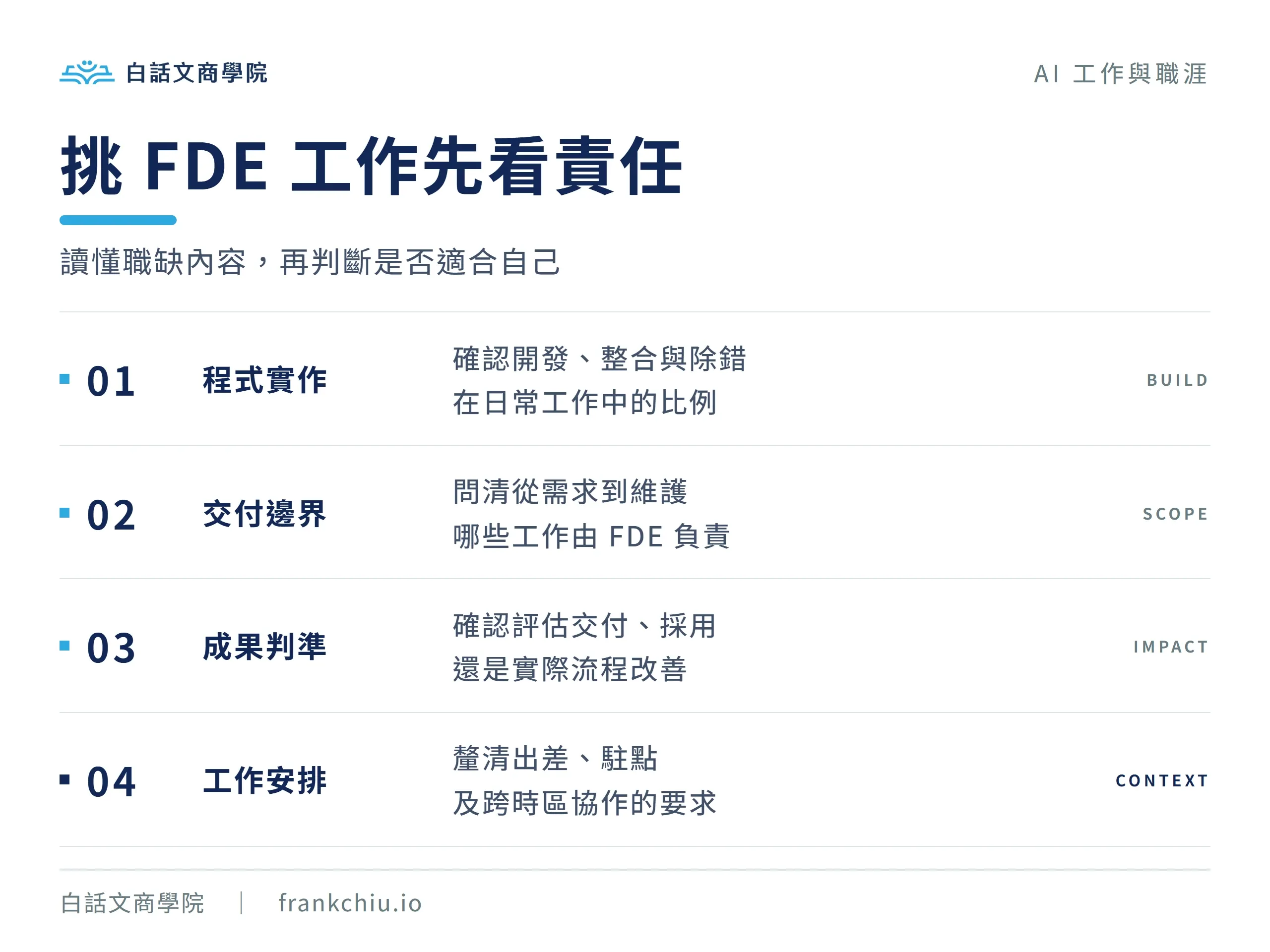
The most useful way to compare is to look at "what outcome the role is primarily accountable for." Below is a summary of common work focuses to help you compare delivery scope when reading job postings.
| Role | Common work focus | What to check when reading a job posting? |
|---|---|---|
| Software Engineer (SWE) | Developing and maintaining products, services, or platforms | Which systems are they mainly responsible for? Do they work directly with customers? |
| AI/ML Engineer | Developing AI applications, or working on models, data, and inference systems | Is it more application integration, model training, or infrastructure? |
| Solutions Engineer/Architect | Clarifying requirements, planning solutions, validating technical feasibility | Does it include actual development and post-launch responsibility? |
| Technical Consultant/Implementation Engineer | Providing advice, integration, or delivery based on project scope | Is the deliverable a report, a configuration, or a working system? |
| FDE | Working deep in customer environments, driving engineering delivery from requirements to actual use | Do they write code themselves? Are they accountable for customer adoption and outcomes? |
OpenAI lists both FDE and FDSWE: the former's job description emphasizes overall deployment and advancement, while the latter highlights custom software and reusable engineering solutions; both include hands-on implementation.
When job hunting, treat job titles as search entry points, then read the job responsibilities carefully. OpenAI FDE, OpenAI FDSWE
What skills do you need to prepare to become an FDE?
Based on the job postings above, preparation can be divided into four areas: engineering, AI applications, problem clarification, and delivery.
First, be able to deliver maintainable software. Beyond writing features, you should also be able to read existing code, integrate APIs, handle data, debug, and deploy. Pegatron's job posting explicitly lists Python, version control, containerization, and Linux experience, which can serve as a concrete reference for industry-oriented AI deployment roles.
Looking at the OpenAI, Palantir, and Pegatron postings verified in this article, hands-on coding is an explicit requirement. If your goal is this type of engineering role, prepare portfolio pieces that demonstrate your development, integration, and debugging abilities.
Second, understand the limitations of AI applications. You need to be able to judge when to retrieve information, when a fixed workflow is more appropriate, and how to trace the cause when answers are wrong. Focus your learning on how complete applications work, then go deeper into models or specific frameworks based on job requirements.
The jobs verified in this article value application and deployment more than training large language models (LLMs) from scratch. Some industry roles also include model fine-tuning; for example, Pegatron lists vision model fine-tuning. When preparing portfolio pieces, choose which abilities to showcase based on the target role's requirements.
Third, be able to turn vague requests into engineering problems. When a client says "I want to save time," you need to follow up on which step, which people, and what data is involved, then organize it into a testable scope of deliverables. This requires communication skills as well as understanding the other party's work. To understand what the client truly wants to accomplish, you can also refer to the questioning approach of JTBD (Jobs to Be Done) theory.
Fourth, be able to complete delivery and handover. Whether a system gets adopted also involves user education, operational documentation, and issue handling. Foxconn's FDE job posting lists deployment, proposal-to-launch delivery, as well as training and SOPs in its responsibilities. Foxconn FDE job posting
If you already know how to code, this article recommends picking a small business problem and building a complete portfolio piece. For example, use public or self-created mock data to build an internal document search tool, covering users, data sources, permissions, testing methods, and failure handling.
Your project write-up should show the trade-offs you made: why did you start with this scope? Under what conditions would it refuse to answer? What problems did testing uncover? If there are no real users yet, clearly label it as a mock project.
Those without an engineering background should first compare themselves against job requirements. If you currently cannot code at all, this article recommends first building software fundamentals, completing a small deployable and testable application, then comparing against the engineering bar of your target roles.
SEO Ranking Strategy Guide》 and
AI SEO Traffic Transformation》.
Through
SEO Ranking Strategy Guide》, gain steady SEO traffic and hands-on experience.
Then pair it with
AI SEO Traffic Transformation》 to understand AI search trends and capture the AI search opportunity.
Are there FDE jobs in Taiwan? How should you evaluate salaries?
Taiwan also has FDE-related jobs. Taking the recruitment pages verified on September 7, 2026 as an example, Pegatron lists an "EdgeAI Forward Deployed Engineer" role covering computer vision, LLMs, and customer system integration; Foxconn lists a "Forward Deployed Engineer (FDE)" role that emphasizes deployment, delivery, and adoption of enterprise apps.
When searching for jobs, use terms like "FDE," "Forward Deployed Engineer," "Forward Deployed Engineer," and "AI implementation engineer" together, then confirm whether the role includes requirements gathering, hands-on coding, deployment, and accountability for outcomes.
As for salaries, the postings found in this article are not enough to establish a reliable range for the Taiwan market. Foxconn's page lists pay as negotiable; when comparing compensation at US AI companies, also factor in location, seniority, and equity. Foxconn job posting compensation field
When comparing offers, beyond salary, it is also advisable to clarify business travel, on-site assignments, cross-timezone collaboration, and post-launch maintenance responsibilities. These conditions directly affect your daily work arrangements.
Before switching to FDE, first figure out which kind of engineering work you enjoy
What makes FDE worth considering is that you can see how technology changes users' work, and you have the chance to participate in the full process from requirements to implementation and delivery. On the other hand, you also need to deal with insufficient information, changing requirements, and cross-department coordination.
This article recommends confirming the following in interviews:
- For the team's most recent project, from requirements discussion to official launch, what work was the FDE actually responsible for?
- What proportion of your time goes to coding, requirements meetings, technical support, and business travel?
- How does the company judge project success—by delivery, adoption, process outcomes, or revenue?
- Who maintains the system after delivery? When a client suddenly expands requirements, who decides the scope?
- How do outcomes from client projects flow back to the core product and engineering teams?
If you enjoy deeply understanding users, solving problems hands-on, and are willing to follow through until systems are actually adopted, FDE may fit your work preferences. If you prefer long stretches of focus on specific technical problems, you may want to prioritize comparing product engineering, model research, or infrastructure roles.
The value of an FDE is built on understanding problems clearly, building systems well, and making them continuously effective in the client's environment. Choosing jobs from this angle makes it easier to find a position that suits you than simply looking at whether the title keeps up with AI trends.
Data verified on: September 7, 2026. This article is compiled from official engineering articles and company recruitment content. The order project in the text is a hypothetical scenario for illustration; the portfolio and interview preparation approaches are this article's recommendations.