Josh Doody's free book points out that recruiters usually have to take a written request to higher-ups for approval.
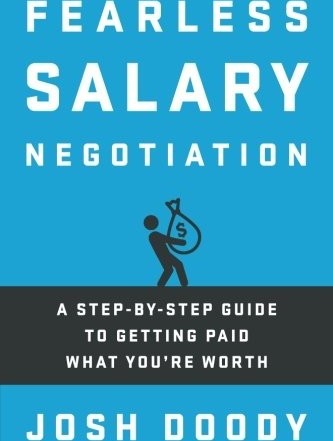
Fearless Salary Negotiation · Josh Doody ·
Key Takeaways
- Josh Doody recommends counter-offering by email, because counter-offers usually need approval from higher-ups.
- Set the minimum salary you can accept before the offer arrives; counter-offer even if the offer looks good.
- Your counter-offer should be 10% to 20% above the base salary in the offer. The full book can be read free online.
The most valuable advice in Josh Doody's book can be summed up in one sentence: counter-offer by email. This isn't to avoid an awkward face-to-face conversation. Your request will most likely need approval from someone higher up, and the recruiter needs a written document to pass along.
If you've ever written an email that someone else took to their manager for approval—for example, an email written on behalf of a client—you already have half the skill. What this book provides is a process for applying that same skill to your own offer.
A free book that works like a checklist
The book is Josh Doody's Fearless Salary Negotiation. The subtitle states the goal directly: a step-by-step guide to getting paid what you're worth. The full book is free to read at fearlesssalarynegotiation.com, and there is also a 174-page print edition.
The book covers the entire process, from understanding your market value to counter-offering on an offer. The website doesn't list a publication year, but the book has existed since at least 2016: on August 24, 2016, Doody appeared on episode 274 of the Ruby Rogues podcast, which included a segment specifically on counter-offering in writing.
What order should you read it in?
If an offer is imminent, go straight to Chapter 4, "How to negotiate your new salary," then open the page in that chapter about counter-offering by email, which contains a complete sample email. The earlier chapters on market value can wait until you have time to prepare for your next job change.
If you're taking the Coding Career Handbook course on Educative, you'll see a lesson taught by Doody himself. In it, he reiterates the core point: the best way to open a negotiation is to send a counter-offer email.
Point 1: Set your floor before the offer arrives
Chapter 4 opens with a clear requirement: before you receive an offer, determine the minimum salary you can accept. Doody also advises counter-offering even if you love the offer, otherwise you may leave money on the table.
For a Forward Deployed Engineer (FDE), the floor can't just be a single number. Imagine an offer made up of base salary, equity, and terms about travel or working on-site at clients. The sensible approach is to first write down your floor for base salary, then separately list any on-site conditions you can't accept, so you're not starting from scratch when the offer arrives.
Point 2: Calculate your counter-offer number, don't guess it
In a guest post on Lewis C. Lin's website, Doody suggests countering 10% to 20% above the base salary in the offer. The sample email in the book falls right in that range: the offer is $50,000, and the candidate asks for $56,000. 50,000 times 1.12 gives 56,000, meaning the counter-offer is 12% higher.
Practice with hypothetical numbers. The offer's base salary is $100,000, and the floor you wrote down in advance is $105,000. By Doody's range, your counter-offer should be between $110,000 and $120,000. Both ends are above your floor, so pick a number within the range, say $112,000.
If your floor is even above $120,000, the gap with this offer is still too large, and you should think carefully before moving forward.
Point 3: Write an email that's easy to forward
Doody's sample email opens by saying the writer spent a weekend considering the offer and is happy with everything, then asks to discuss the base salary further. Next come the number in the offer, the counter-offer number, and a brief reason. The entire email discusses only base salary.
Faced with an FDE offer made up of multiple parts, the sensible approach is to keep this mindset: make base salary the main counter-offer number, and only mention on-site or travel terms if they genuinely change your costs.
An email containing multiple requests is harder to forward than one with a single number. Use the draft below as a reference and fill in the blanks yourself:
[招聘方姓名],您好:

我认真考虑了前线部署工程师(Forward Deployed Engineer)岗位的 Offer,对各方面都非常满意。我希望能再就基本工资沟通一下。

目前 Offer 中的基本工资是 [Offer 金额]。如果能定在 [还价金额],我会更安心,因为 [一个具体理由,例如我最近的部署经验]。

如果方便,我很乐意在 [时间] 电话详谈。
The person who ultimately reads this email may be a manager who has never spoken with you. The draft tells them what the current offer is, what you're asking for, and why—no further explanation needed from anyone.
Two mistakes that weaken your counter-offer
The book doesn't explicitly say your counter-offer must be above your target, but the logic of the 10%–20% range points that way: the gap between the offer and the counter-offer is exactly the space in which both sides can reach agreement. If the counter-offer equals your target, that space disappears.
The other mistake is cramming multiple requests into one email: higher base salary, more equity, a different start date, fewer on-site days. The approver has to weigh each item, and if any one is rejected, the whole email can get stuck. Doody's sample discusses only base salary, avoiding this problem.
This email structure works beyond salary too
Strip out the salary, and what remains is a structure: first confirm what has already been agreed on, then calmly and clearly state your request and the reason for it, and finally agree on next steps.
When writing a proposal email to a client, you need exactly the same sequence. So practicing this email for your own offer is also practicing a skill you'll use repeatedly in deployment work.
In an FDE interview, if you've written an email that helped someone get approval from their manager, describe it concretely: who approved it, what the email said, and what the outcome was. That story is far more persuasive than a line on your resume saying "strong communication skills." And the next time you receive an offer, you'll use the same skill to negotiate for yourself.
Was this article helpful?
Thanks for your feedback!