The original piece thoroughly explains the "architecture relationship" layer, but it doesn't expand on the part where things most easily go wrong in the field: not vendor selection or PoCs, but evals and exit. Whoever writes the eval set effectively controls acceptance — when a vendor enthusiastically offers to "help you build the eval framework," that's the moment the client hands over the baseline. In the projects I've handled, failures mostly weren't about being unable to build the system, but about the handover period having no successor: runbooks become obsolete after six months without updates, key internal client staff get pulled away mid-project, and "exit" ends up becoming a de facto permanent subscription — the vendor can't exit, and the client can't afford to switch. There's also a hard constraint the original never touched: cross-border compliance. The premise of this whole value chain is that client context can flow upward and become reusable assets for partners and vendors; but once delivery crosses a border, data export assessments, PIPL, and GDPR cut that upward flow off entirely — eval samples, logs, and context graphs legally cannot leave the client environment. So the "permanently partner-held" harness has to be regrown from scratch in every market, and the compounding effect is severely discounted. For Chinese companies going overseas and foreign firms doing AI delivery in China, this constraint must be on the table from day one of architecture design, not discovered during the security review when the assets can't be brought back. Here's an actionable suggestion: before signing your next FDE project, nail down three things in writing — ownership of the eval set and domain ontology belongs to the client; the desensitization scope for context backflow and the export whitelist are written into the data processing agreement; and the exit acceptance criterion is "the client's internal team runs independently for a full 90 days." If you can negotiate these three, you'll be able to tell whether the party across the table treats delivery as a channel, or is truly a long-term partner who intends for you to hold your own architecture. — FDEChina Editorial Team · Practitioners
# FDE is turning from a job title into an industry chain
Source: FDE Brainstorm Bureau · August 31, 2026, 08:08
"
FDE Research File 10 | The architecture relationships among cloud vendors, partners, service providers, and enterprises
This issue studies only one question: as more and more companies embed engineers at client sites, are they expanding a job title, or competing for the entry point to enterprises' next round of technical architecture?
— AFN
Over 57 days, four companies gave four very tidy signals with completely different statistical bases.
On June 30, AWS announced a $1 billion investment to establish a dedicated Forward Deployed Engineering organization, embedding thousands of experts into client teams. The partner briefing released the same day extended this model to consulting partners: partners form independent teams, engineers first pass AWS-defined technical thresholds, AWS is deeply involved early on, and then delivery gradually becomes independent.
On July 29, at its FY2026 Q4 earnings call, Microsoft announced the formation of Microsoft Frontier Co., planning to embed 6,000 industry and engineering experts into clients. Microsoft said that over the past year it had already used this model to complete more than 330 projects at 164 clients; the same remarks also referred to the delivery team on the Novo Nordisk project as an FDE team.
On August 20, AI professional services firm Blend disclosed that it currently has 500 Forward Deployed AI Engineers, with plans to grow to 750 by 2027. Six days later, financial data platform FINBOURNE launched its first FDE cohort of 30 people, with engineers joining clients' operations and technical teams to handle legacy systems, data silos, governance, audit, and controls.
These four sets of numbers cannot be added together. AWS disclosed investment and organizational scale direction, Microsoft spoke of a group of industry and engineering experts, Blend gave current headcount and an expansion plan, and FINBOURNE described its first cohort. Writing them up as "7,280 FDEs entering the field" is arithmetically convenient, but the research disappears.
Beyond headcount, AWS wrote FDE and "architecture relationships" into the same partner mechanism.
The partner briefing is blunt: partners who deliver results first will win clients' future architecture relationships. It also lists what each project should leave behind: domain ontologies, eval frameworks, MCP services, agent operations tooling, and context graphs recording architecture choices, eval criteria, and industry patterns.
Domain ontologies, evals, and context graphs describe a delivery mechanism that already goes beyond an individual's job description.
FDE is becoming a delivery channel through which vendors gain enterprise architecture relationships.
FOUR MOVES
Which layer each of the four companies is moving on
AWS's move comes closest to "turning delivery capability into a channel."
It is expanding its own FDE team while handing production methods, technical thresholds, and early accompaniment to partners. Partners must form independent, AWS-certified engineering teams; delivery tools developed during projects are held long-term by the partners and can later be reused on other projects. AWS provides products, methods, and standards; partners provide client relationships, industry knowledge, and delivery coverage.
The classic moves of the old cloud channel were resale, implementation, migration, and managed services. Here there's an extra layer: partners and cloud vendors jointly enter business processes, build working agent systems, and then turn the experience into their own delivery assets.
Microsoft has elevated "outcome-based engineering" to a company-level organization.
The 6,000 figure cannot be directly written as 6,000 FDEs. Microsoft's exact words were "industry and engineering experts," and the company did not provide job composition, full-time headcount, regional distribution, or ramp-up pace in this disclosure. Still, it named the organization Microsoft Frontier Co., defined the working method as co-designing, co-innovating, and continuously improving AI systems with clients, and used an FDE team to explain one of the projects.
At minimum, this shows that embedding into clients is no longer a special play by a few product teams, but is becoming an organizational capability that large companies can deploy at scale.
Blend is turning FDE into talent supply and service capacity.
The company plans to grow its 500-person team to 750 through its own ForwardAI Academy, global recruiting, and targeted acquisitions. This expansion path covers training, screening, team formation, and entering client environments, with project results then fueling the next round of expansion.
Blend also disclosed PoC-to-production conversion and NPS figures. This article does not use those numbers as proof of effectiveness, because they are self-reported by the company, and the public pages provide no per-project samples, statistical methods, or independent verification.
FINBOURNE is taking a vertical software path.
It starts from data, reconciliation, trading workflows, governance, and audit in the investment management industry. The first 30 engineers are required to sit inside client organizations, becoming an extension of operations and technical teams. The project lead previously spent years running professional services and new client implementations.
This kind of FDE sits very close to industry workflows. While selling platform capabilities, it also participates in how the platform enters legacy systems, how controls are written into the architecture, and how data is continuously reconciled. Vertical software thus grows toward professional services, and professional services start carrying products and agents back with them.
The four companies are taking different paths. The common thread: FDE is beginning to simultaneously carry product implementation, client delivery, partner expansion, and the backflow of industry knowledge.
ARCHITECTURE RELATIONSHIP
After the order ends, the architecture relationship continues
When an enterprise purchases a model seat, the vendor gets an order. When FDE connects the model into procurement, customer service, R&D, risk control, or investment data workflows, the vendor enters the enterprise's dependency relationships.
That relationship includes at least five things: how business processes are decomposed, where data comes from, what permissions systems can get, what results count as passing, and who maintains things after go-live.
Whoever continuously participates in these decisions is better positioned to influence the next model selection, cloud resource usage, data architecture, security controls, and partner list. Even after the contract expires, the eval sets, domain ontologies, connectors, runbooks, and architecture decisions left behind by the project will continue to influence subsequent choices.
This is why "architecture relationships" are worth more than a single project.
AWS's partner mechanism makes this especially clear. Every delivery must produce a reusable harness that the partner permanently owns; AWS engineers participate deeply in the early stages, and once the pattern stabilizes, they shift to helping partners scale. As a result, a single project generates three kinds of returns: the customer gets a production system, the partner gets reusable delivery assets, and AWS gets cloud architecture and product usage.
The distribution unit of the channel will change accordingly.
Traditional channels often distribute licenses, leads, or implementation projects. The FDE channel distributes a runnable business process. Models, cloud, data services, security tools, and operations capabilities enter the enterprise along this process.
The service fee is only the visible money. Behind it are cloud consumption, product adoption, renewals, expanded scenarios, and technology roadmaps.
TWO FLOWS
This industry chain has two flows, competing for the layer of assets in the middle
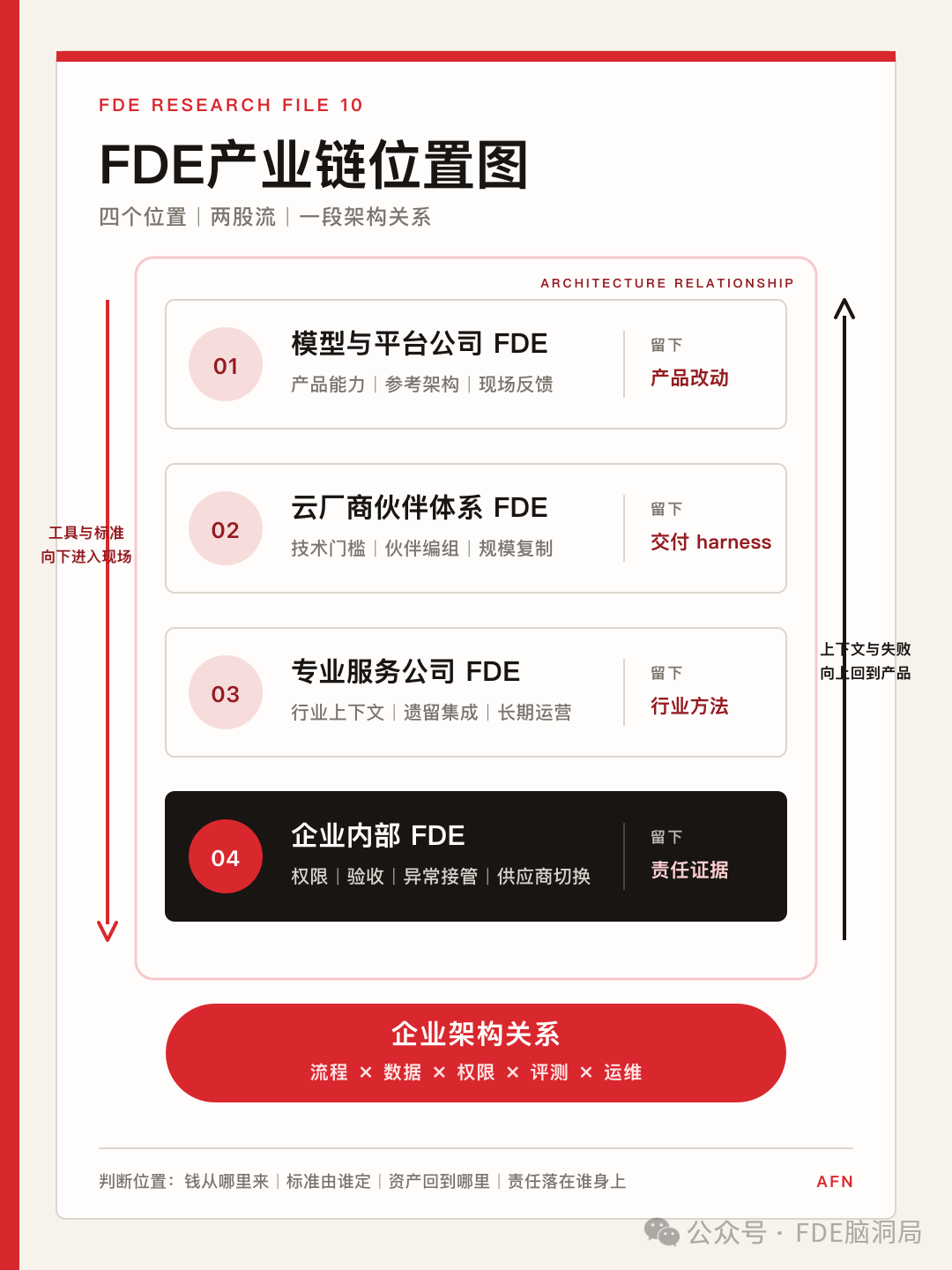
— FDE industry chain position map: the two flows and architectural relationships among model and platform vendors, cloud provider partners, professional services, and in-house enterprise FDEs
Flowing from the top down are models, platforms, tools, methods, certifications, and production standards. Vendors want these things to pass through partners and service providers into the real processes of more customers.
Flowing from the bottom up is customer context: legacy system constraints, permission conflicts, eval failures, industry rules, exception handling, and frontline usage feedback. These flow back to delivery teams, and then into the partner's reusable assets or the vendor's product roadmap.
What is contested in the middle is the architectural relationship, and the ownership of the assets left behind by projects.
AWS says partners permanently own the delivery harness. Customers, meanwhile, need to receive the system, knowledge graph, runbooks, architecture documentation, and an internal team capable of operating independently after the project ends. Both sides are reasonable, and there is inherent tension between them.
Partners want to accumulate industry methods reusable across projects, platforms want field feedback to flow back into products, and enterprises want to retain their own data, evals, permissions, and switching capability. Within the same "context," what can be abstracted and reused and what must stay in the customer environment cannot be glossed over with a phrase like "co-innovation."
Once the industry chain truly takes shape, the hardest things to negotiate in contracts may no longer just be person-days and model unit prices, but four more concrete matters: who defines production standards, who owns the delivery assets, who can carry experience to the next customer, and who bears operational responsibility after the vendor exits.
FOUR POSITIONS
Four kinds of FDEs, same name, different positions
FDEs at model and platform companies: sending field failures back into the product
These FDEs are closest to the product roadmaps of models, cloud services, or vertical platforms.
Their advantage is direct access to product teams: changing interfaces, adding tools, and building reference architectures. Getting a customer into production is one output; identifying recurring problems and turning the corresponding capabilities into product defaults is another.
To judge how well these FDEs are doing, look at two kinds of evidence: whether customer systems stably reach production, and whether field failures actually turn into evals, tools, or product changes.
The risks are also clear. Product companies both provide capabilities and participate in selection and acceptance, making it easy for their own technology roadmap to become the default answer. Customers need to keep an independent baseline and alternatives.
Vertical platform FDEs like FINBOURNE also sit at this layer. What they bring back to the product includes technical feedback, but also the controls, audits, and data semantics of the investment management industry.
FDEs in cloud provider partner systems: replicating production methods outward
What this layer tests is whether a cloud provider can hand production standards to partners without diluting them into a certificate. How long a particular engineer stays on site is a secondary question.
AWS's approach offers several inspectable components: independent cohorts, engineer admission criteria, early co-delivery, a unified production bar, reuse of project assets, and partners gradually becoming independent.
When this kind of FDE succeeds, the cloud provider gains scale, and partners gain capabilities and customer assets. When it fails, it falls back into the familiar old path: a rebranded implementation team, with "agent" written on the slides but staffing still scheduled by headcount on site.
So the most important evidence for partner FDEs is what remains after independent delivery. Whether the next similar project can skip part of the journey is what shows the method is starting to be reused. Certification headcounts cannot answer this question.
FDEs at professional services firms: turning industry context into production systems
Blend represents a different kind of advantage: it does not have to bind to a single model or cloud, and can take on complex transformations with industry knowledge, data engineering, and customer relationships.
Professional services firms are closer to legacy systems and organizational coordination, and can more easily cover multiple vendors. Their difficulty lies in the business model. FDEs are usually more expensive than traditional consultants, and projects require long-term involvement in production; if every customer starts from scratch, the more people you add, the more honest the costs become.
Therefore, whether this layer can generate profit depends on whether project knowledge can be converted into evals, connectors, domain models, deployment tools, and operations methods. Blend plans to expand headcount through an academy, hiring, and acquisitions, which addresses supply scale; whether delivery assets can be reused determines whether scale can become efficiency.
In-house enterprise FDEs: preserving the final authority and takeover capability
Enterprises may not call the role FDE. Platform engineering, enterprise architecture, AI product, data, security, and business operations teams may all carry part of this work.
Their biggest difference from external FDEs is that they stand at the endpoint of responsibility. Vendors can build systems, give advice, and run evals, but the in-house team still has to decide whether data can be used, whether agents can write, who takes over exceptions, when to roll back versions, and whether the results justify the next round of budget.
AWS wrote customer independent takeover into its FDE project design: customer engineers go from observers to co-builders, and then to independent operators. This process precisely shows that mature external FDEs need a corresponding internal layer capable of taking over the system.
Without this internal capability, external FDEs easily become the de facto architecture owners. Only when the enterprise has an internal team that can define interfaces, safeguard evals, and execute exit plans will model companies, cloud providers, and service providers compete within clear boundaries.
THREE GATES
Role expansion does not mean the industry chain exists
I use three gates to judge whether this change has reached "industry chain" status.
First, can the capability be replicated without star individuals? AWS's admission criteria and partner cohorts, Blend's academy, and FINBOURNE's industry teams are all answering the supply question. Relying on a few experts to put out fires is still a craft, not an industry.
Second, does each project leave reusable assets? AWS has explicitly listed ontologies, evals, MCP services, operations tools, and context graphs. If other companies only have headcount growth without project assets, the bigger they get, the more they look like a traditional labor business.
Third, can customers independently take over and keep their options? Systems, documentation, evals, permissions, logs, and internal owners must all be handed back to the enterprise. Otherwise, "embedding with the customer" easily becomes deeper vendor dependence.
Of the three gates, the first two determine whether FDEs can scale, and the last one determines whether this industry chain is healthy.
MONEY & POWER
Money and power will be redistributed along delivery
The following inferences come from the organizational moves of four companies, not from business results they have disclosed.
Model and cloud providers may be willing to bear higher upfront engineering costs. Once the FDE becomes a production pipeline, revenue comes not only from the current engagement but potentially from long-term model usage, cloud resources, and data and security products. For them, the FDE can simultaneously be a delivery cost, product research, and customer acquisition cost.
Professional services firms will be forced to answer a harder question: after the project ends, what reusable thing remains besides the invoice. If delivery assets can be used on the next project, the firm has a chance to escape pure person-day billing; if every engagement still starts from scratch, the FDE is just a more expensive, harder-to-hire on-site engineer.
Vertical software companies may use FDEs to expand their product boundaries. Where they once only sold a system, they now participate in data migration, control design, process transformation, and ongoing operations. The product gets closer to the customer, and exit becomes harder. Enterprises should negotiate data, architecture documentation, evals, and replacement interfaces upfront.
In-house FDEs will gain more budget and bargaining power. They don't necessarily have to do all the engineering themselves, but they must be able to bring external vendors into the same baseline, permissions, and acceptance framework. Whoever controls this interface no longer has to turn every vendor switch into a bout of organizational amnesia.
USE THE MAP
Use the "FDE Industry Chain Position Map" to judge what you are actually delivering
The four positions on the map are not career levels, and none is inherently more senior.
If you are at a model or platform company, what you should accumulate most is evidence of "how field problems enter the product"; if you are in a cloud partner ecosystem, you need to prove that the methodology can still be delivered reliably after the original vendor's engineers leave.
Professional services firms must prove that project assets are reusable. A team that can endure a lot is not a delivery asset. In-house teams must prove they can define baselines, manage permissions, take over exceptions, and retain the ability to switch vendors.
This map can also be used to examine an FDE role.
Look at where its money comes from, who sets the production standards, where project assets flow back to, and who bears the final operational responsibility. Once these four questions are answered, the role's position in the industry chain is usually clear. Judging by job titles alone, it is easy to stuff product teams, consultants, integration engineers, and enterprise architecture leads into the same cardboard box.
Whether FDE becomes an industry chain is not decided by headcount expansion.
An industry chain truly emerges when model and standards, scaled delivery, industry integration, and enterprise accountability are taken on by different organizations, yet connected through the same set of production assets.
This will push FDE scarcity to another level. Being able to write code and work on-site is just the entry ticket. What is harder to replace is: can you turn one customer delivery into a reusable methodology for the next, while the customer still holds on to their own architecture, evidence, and right to exit.
SOURCES & LIMITS
Methodology, sources, and boundaries of evidence
This article uses public materials from four companies between June 30 and August 26, 2026 as its primary sample, to observe how FDE organizations enter cloud vendors, partner networks, professional services, and vertical software. The sample is not a list of all FDE companies worldwide, nor does it imply that the four types of organizations have achieved the same commercial results.
This article uses four types of information:
Verified announced facts: dates, investments, headcount figures, organizational arrangements, and working methods explicitly disclosed by companies;
Company-reported plans: Blend's expansion targets through 2027, and each company's descriptions of project outcomes or delivery advantages;
Author's judgment: the architecture relationships, the two flows, the four industry positions, and the three gates;
Not yet verified: actual onboarding numbers, per-project ROI, independent acceptance results, FDE business revenue and margins, long-term customer retention, and vendor switching costs.
Microsoft's 6,000 people cannot be directly equated to 6,000 employees with the formal job title of FDE. AWS's $1 billion is an investment figure supporting a dedicated FDE organization, and cannot be broken down into recruiting budgets or already-incurred spending. Blend's 500 and 750 figures come from company announcements; FINBOURNE's 30 refers to the first project team; none of these numbers are audited workforce statistics.
Public sources:
AWS Partner Network: Introducing Forward Deployed Engineering for Partners: the $1 billion FDE organization, the partner model, AWS-defined engineering thresholds, independent partner teams, and statements on delivery harness and architecture relationships.
About Amazon: AWS invests $1 billion to embed AI forward deployed engineers with customers: the dedicated FDE organization, thousands of experts, how customer teams are embedded, customer self-sufficiency, deliverables, and partner investment.
Microsoft FY2026 Q4 earnings call: Microsoft Frontier Co., 6,000 industry and engineering experts, 164 customers, 330+ projects, and statements about FDE teams.
Blend: Blend to Grow Forward Deployed AI Engineering Force to 750 by 2027: the current 500 people, the 750 target for 2027, and three expansion routes—academy, recruiting, and acquisitions. Both headcount and outcomes are company-disclosed.
FINBOURNE: FINBOURNE launches Forward Deployed Engineering programme: launched August 26, 2026, first team of 30, customer team embedding, and the scope of legacy systems and governance controls.
For the FDE team you are on, what is most easily taken away after a project ends: the people, the methodology, or the customer's architecture relationships?
I am AFN, a living person who has been an FDE for over a year and still replies to messages myself.
READ MORE Selected Past Posts AFN · 4 posts
FDE, Sales Engineer, Consulting, Customer Success: If You've Worked on AI Projects, Which Type Should Your Next Job Application Target?
After Over a Year as an FDE, I May Be Among the First to See "Job Boundaries Being Torn Apart by AI"
Stay a Generalist, or Bet on One Industry? Your Next AI Project May Help You Accumulate, or Force You to Restart.
Being an FDE long enough, you'll notice: the visible line is installing AI into workflows; the hidden line is extracting the judgments that "everyone understands but no one can articulate" from the organization.
FDE RESEARCH FILE 10 · 2026.08