FDE is not outsourcing! Palantir's net profit grew 225%—what hope does it bring?
Palantir's FDE model is upending conventional wisdom about enterprise services. It's not just on-site development—it distills custom requirements into a scalable AIP platform. Through five-day workshops, customers see results before signing, with a conversion rate as high as 75%. This article breaks down the secrets behind its journey from 20 years of losses to high-margin growth, and explores the new threat posed by model company Anthropic.
Recently, the FDE concept has been very hot in China, but many people don't really understand it.
Tencent Research Institute published a report titled "Industry Observations and Practices of the FDE Model," but it's safe to say most people haven't read it carefully. Many companies in China also claim to be the Chinese version of Palantir—a typical example is Baichuan Intelligence, which transformed from a model company into an FDE company.
FDE stands for Forward Deployed Engineer. It can be a bit hard to grasp for many people, who sum it up in one simple sentence: "Isn't this just outsourcing?" That understanding is somewhat off the mark.
Let's look at how Palantir does FDE, and how it used the FDE concept to escape 20 years of losses and become Silicon Valley's money-printing machine.
First, the financials. After market close on August 3, Palantir released its Q2 2026 earnings. Revenue was $1.935 billion, up 93% year over year. GAAP net profit was $1.062 billion, with a margin of 55%, up 225% from the same period last year. The profit earned in the first half of this year already exceeds last year's full-year profit.
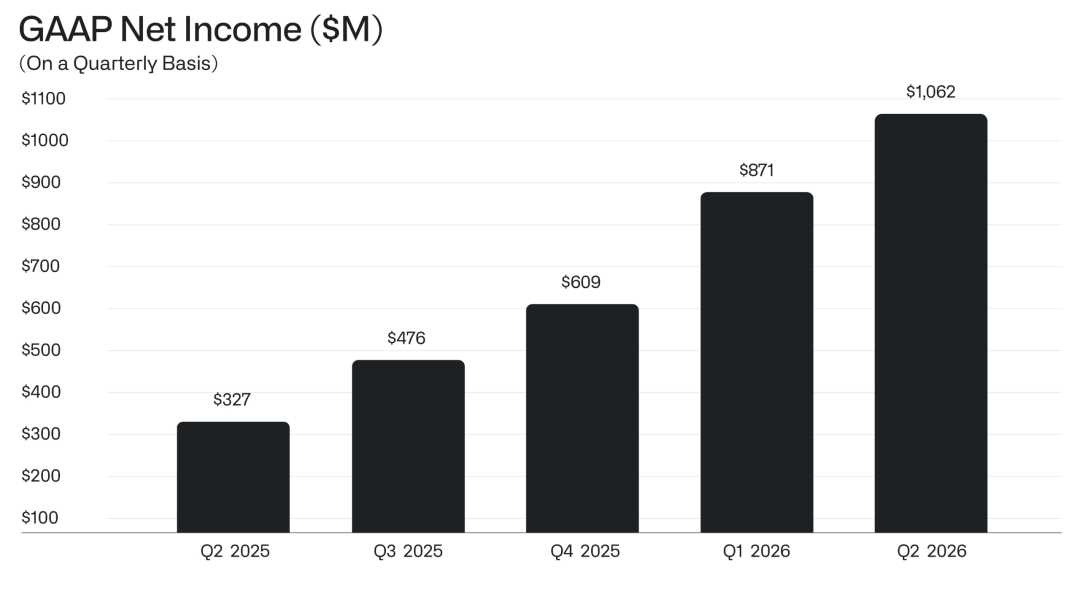
The Rule of 40 hit 155. This metric adds revenue growth rate and profit margin together, with 40 considered the healthy line. A score of 155 means there's almost no comparable company among software companies. Chip-selling companies like NVIDIA, Samsung, and Micron can achieve this, but it's truly remarkable for an enterprise software company to reach this number.
No wonder Palantir co-founder and CEO Karp said just one thing on the earnings call: "Stop talking about consensus." The subtext: software companies can be extremely profitable too!
Karp also published a shareholder letter. In it, he called out large model companies, saying they "intentionally or unintentionally intend to seize the means of production of their so-called partners." The meaning is clear: he believes the OpenAI and Anthropic crowd will sooner or later turn customers' data and business into their own training corpus.
And Palantir itself emphasizes that it does not build models—this is precisely the key to understanding it.
1. What Does Palantir Actually Do
Many people understand Palantir's FDE as "outsourcing," a translation that loses the most important part.
FDE is a role concept Palantir pioneered in the early 2010s. The origin was special: its earliest customers were militaries, aircraft manufacturers, banks, and hospitals—institutions that couldn't clearly articulate "what I need," and whose data couldn't be freely shared.
The only option was to send people into the customer's company, work in their environment, use their data, understand their workflows, and then build systems hands-on.
So an FDE is like an on-site CTO—someone who both writes code and discusses solutions face-to-face with customers.
But the difference from pure outsourcing is this: outsourcers must obey the other side's project managers, product managers, and various other roles—doing whatever they're told, doing only as much work as they're paid for, essentially a downstream subcontractor. And when something goes wrong with a project, the customer can shift the blame onto the outsourcer.
An FDE, by contrast, is a combination of consulting + implementation + delivery—and once at the client's company, can even join them for afternoon tea. The FDE listens to the client's needs over tea, proposes a solution afterward, then directly builds the system. If it doesn't work, the customer doesn't accept it and doesn't pay.
This is Palantir's way: having salespeople alone interact with customers isn't enough—technical experts must be together with the customer.
But you can't understand FDE as pay-for-results outsourcing either—it also involves a middle-layer system distilled from customer service.
In April 2023, Palantir released AIP, the Artificial Intelligence Platform. It aggregates different customers' real business processes onto this platform, then uses large models to solve specific problems.
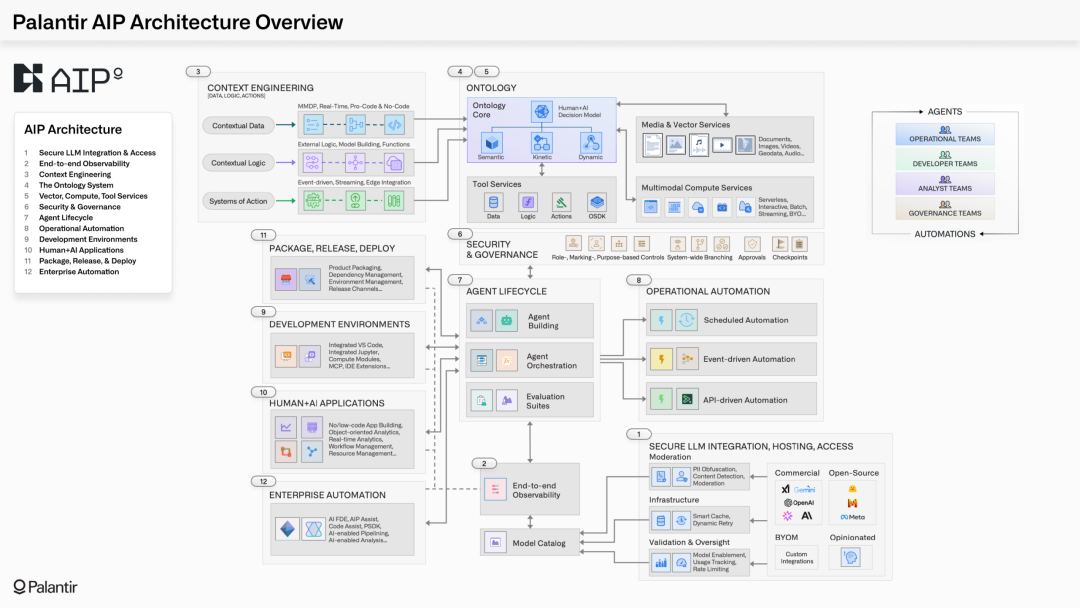
Palantir's own phrasing is "turning tokens into real economic value."
Many companies are now learning from this approach. For example, today Cloudflare launched Cloudflare OS, integrating components like Workers and Access to let employees safely use AI and deploy agents.
But many people miss this: AIP is not a data analytics dashboard. Its internal core is called Ontology, an ontological architecture. It puts an enterprise's data, decisions, and execution on the same platform. AI can not only analyze problems but also directly take action to solve them—of course, under strict safety guardrails.
This ontology is the product of 20 years of continuous evolution, and it is the key to extracting common capabilities from enterprise needs. This part is the core asset that large models cannot obtain, and it is Palantir's moat.
In short, Palantir distilled templates from custom work, thereby scaling and platformizing. Slow is fast, and the harvest season has finally arrived.
2. The Five-Day Workshop
Palantir's revenue and profits are surging now, which certainly means customers are seeing good results.
And that's indeed the case. A typical example: Walgreens used AIP to deploy AI workflows across 4,000 stores in 8 months, helping pharmacists manage inventory and prescriptions.
Trinity Rail built a supply chain workflow in three months, saving $30 million a year. Tampa General Hospital used it to improve patient flow, cutting sepsis patients' hospital stays by 15%.
These cases share one thing in common. The customer's data and business processes are mapped into Palantir's ontology, and AI models run on top of that mapping. If the model is swapped, no problem—the ontology and business processes remain in Palantir's hands.
At this point, many people will wonder how Palantir acquires customers. Is it through the SaaS-typical Net Promoter Score (NPS)? Or the traditional software deal-hunting model (the "KTV model")?
In fact, Palantir's AIP is most commonly sold through something called the AIP Bootcamp, a five-day immersive workshop. The customer provides their own real data, and Palantir's FDEs work alongside you. Within five days, you produce an AI use case that runs in a real environment.
After five days, the enterprise has a system ready to use directly. By the end of the Bootcamp, the customer has already seen their own data produce results on the platform, so signing the contract becomes a natural next step.
By the end of 2024, Palantir had completed more than 1,300 Bootcamps, with a conversion rate close to 75%. One Fortune 500 industrial company expanded its initial engagement fivefold. One Fortune 100 retailer converted a pilot into a $12 million annualized contract within months.
Compare that with the painful traditional enterprise software model: sales spends six months negotiating requirements, then another year on custom implementation, finally delivering something nobody is satisfied with.
Palantir's competitors are exactly like this. C3.ai has been retreating step by step, shrinking into the smaller industrial IoT niche. Snowflake shifted from competition to cooperation, ceding the analytics side to Palantir and refocusing on data warehousing.
3. What Is Karp Worried About
Palantir doesn't build models, but its analytics business increasingly depends on them.
In fact, after Claude emerged in 2023, Palantir's mission analysis system only became truly useful by leveraging the generalization capabilities of large models.
The turning point is there, and so is the problem.
On January 30, 2026, Anthropic added 11 plugins to Claude Cowork, directly covering core SaaS functions like legal, finance, CRM, and marketing. It is no longer just a chat tool—it has started doing concrete work for enterprises.
The release of this AI enterprise service system directly triggered a stock market crash dubbed the "end of SaaS." Stocks of companies like Salesforce plunged more than 20%.
But this collides with Palantir's AIP. Both are stuffing AI into enterprise workflows, but via different paths.
Claude Cowork works downward from the model, using plugins and connectors to directly call data in Salesforce, DocuSign, and Google Workspace, building business logic into the agent.
Palantir works upward from enterprise data and processes, first mapping the customer's business into an Ontology, then running models on top of it.
The difference is very practical. Palantir has no model of its own; what it builds for customers is a "business ontology," and the model is swappable. That's why Karp calls on enterprises to establish their own AI sovereignty—a simple analogy being "using someone else's autonomous driving system is selling your soul."

Anthropic has the Claude model and is now building business plugins. If enterprises find that buying one Claude Cowork plus a few plugins can replace some AIP scenarios, Anthropic believes that even if it can't kill you in a few years, it will kill Palantir in 10.
Therefore, Karp specifically mentioned the need for defense in earnings calls and shareholder letters. He emphasized that model companies will "seize the partners' means of production," meaning that customer data and business processes falling into Anthropic's hands could become training corpus.
For domestic (Chinese) enterprises, the ecosystem lacks a powerful Anthropic that can solve many enterprise problems simply through the Claude model—at least domestic models' coding and agentic capabilities have only just caught up—so building a Chinese version of Palantir has some room for development.
Looking at the Palantir model itself, it has also seen considerable gains. Its full-year revenue guidance was raised to $8.15 billion, corresponding to 82% growth. Karp said this growth "can last at least another 18 months."
Of course, he made such statements because Palantir's valuation is already very high, with a price-to-sales ratio above 40x. He needs to give the market more confidence and steady everything.
For SaaS and cloud companies, enterprise services used to be thankless, grueling work—before 2020, China's AI Four Little Dragons almost all nearly failed to climb out of that big pit.
Palantir has finally turned enterprise services in the AI era into a high-gross-margin, high-growth business. We also need to understand the essence of its services:
The FDE is about taking on outcomes and responsibility—being an on-site CTO who can enjoy the fruit platter. AIP is an upgraded version of SaaS services, distilling scalable platform capabilities out of the mire of customization. The 5-day bootcamp is a demand-side customer acquisition method—not traditional sales, but letting customers see results first before signing.
Reference sources:
Palantir Q2 2026 earnings report (investors.palantir.com); Palantir Q2 2026 shareholder letter; public reports from FinancialContent, InvestingYoung, and others;
Anthropic official blog "Customize Cowork with plugins" (January 30, 2026, 11 plugins);
Caijing magazine's February 2026 special report on the "End of SaaS."
This article was originally written/authorized for publication on Renrenshi Chanpinjing (Everyone Is a Product Manager) by the author [Jingxuan AI], WeChat official account: [Jingxuan AI]. Reproduction without permission is prohibited.
Cover image provided by the author.