The engineer who received a 50,000-yuan-a-month offer arrived for his first day not at an office building, but on the shop floor of a manufacturing plant. This detail comes from a real account: the job posting listed production-grade Python coding, RAG building, and Agent architecture, but the first task after onboarding was to dive into the roaring production line, record the ID number of every machine, stick QR codes onto the equipment by hand, and then type an oil-stained, scrawled paper ledger into a spreadsheet word by word.
This job comes from one of the hottest roles this year in the AI sector and recruiting: FDE, Forward Deployed Engineer.
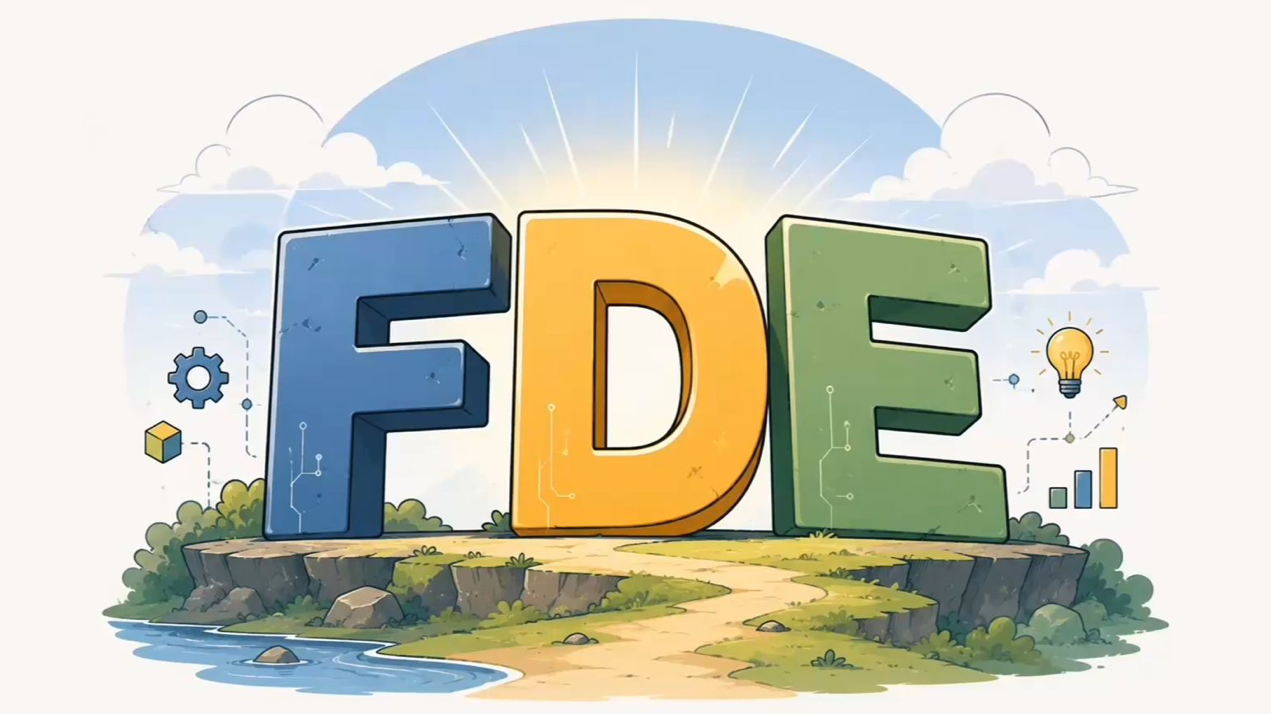
A role that sends engineers to stick QR codes on equipment has become one of the big-model industry's biggest spenders this year.
The job with a workstation inside the customer's workshop
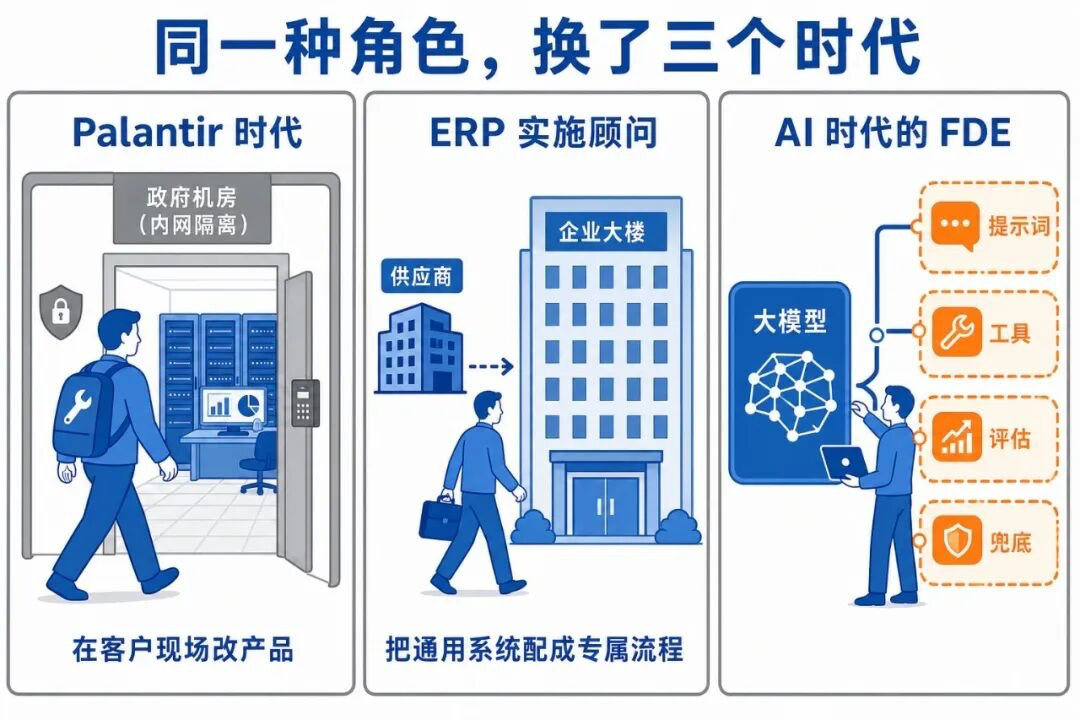
FDE stands for Forward Deployed Engineer. The role was first defined in Palantir's 2020 prospectus: our Forward Deployed Engineers have been to military bases in Afghanistan and factories in the American Midwest to deploy our platform.
Traditionally, algorithm engineers are responsible for model precision and recall, and Solutions Architects are responsible for the architecture design—once the diagram is drawn, it's handed off—whereas an FDE is responsible for the customer's business outcomes: writing production code, deploying, and taking full responsibility, all the way until the customer's business numbers actually change. In its early years, Palantir split this team into two roles: Echo, staffed by people with customer-industry backgrounds, responsible for understanding the business and translating requirements; and Delta, staffed by engineers, responsible for quickly turning requirements into working code. The line on the recruiting page captures the difference best: ordinary engineers use one skill to serve many customers; FDEs use many skills to serve one customer.
On IDE, Mark Scianna—a former Palantir FDE who later founded Forward Deployed VC—offered three criteria: whether you enter the IDE to write production code, whether a single on-site engagement is measured in months or days, and whether you are authorized to make decisions directly at the customer's site. Taken together, this role demands business understanding, engineering ability, and the capacity to abstract and codify knowledge—if any one of them drops to zero, the product is zero. That's the root of why this role has struggled to fill its headcount.
This is how it was done twenty years ago
This playbook was run once before, twenty years ago. Palantir, founded in 2003, had as its earliest customers organizations like US intelligence agencies and the Army—extremely sensitive data, siloed architectures, processes hidden behind security clearances, requirements written in classified documents. No form of remote delivery could work. Backed into this corner, the company made a decision that seemed dumb at the time: send engineers directly to the customer's site to work side by side with users. The term "Forward Deployed" itself is borrowed from military terminology, meaning to deploy forces to the front line; around 2011, these on-site engineers were formally named Delta—both a letter code and an echo of the special-forces philosophy of completing hard missions amid incomplete information and chaotic environments.
Mark Scianna is a name repeatedly cited in this history. In his own words, he was a founding member of Palantir's defense team, worked as an FDE for 11 years, was deployed to Afghanistan and Iraq, and lived and ate alongside intelligence analysts while hauling server hardware.
But the "dumb" method did turn into a profitable business. The Q2 2026 shareholder letter reported quarterly revenue of $1.935 billion, up 93% year over year, net dollar retention of 157%, full-year guidance raised to $8.15 billion, and revenue per employee of about $1.5 million disclosed in Q1. Karp also dropped a telling line in the letter, noting that the sales team running today is smaller than it was two years ago. The cloud-computing era gave rise to DevOps and SRE; the big-model era has given rise to FDE. Before any generation of technology platform truly matures, a group of people has to weld the technology into reality first.
Overseas giants and scenarios have set the direction
The density of moves by four companies and the amounts of capital involved are striking. On May 4, Anthropic moved first, forming an AI services joint venture with Blackstone, Goldman Sachs, and Hellman & Friedman targeting mid-sized enterprises, using exactly the on-site deployment model. On May 11, OpenAI set up a holding company with TPG leading the investment, and the same day acquired the UK AI consultancy Tomoro, absorbing about 150 senior engineers in one stroke. From late June into early July, AWS announced a $1 billion investment to build its own FDE organization. On July 2, Microsoft followed by establishing Frontier Company.
Why is the money arriving now? Half the answer lies in two sets of report cards: the much-cited MIT NANDA report states that of the $30–40 billion enterprises have invested in generative AI, 95% of pilots produced no measurable profit impact, and only about 5% of custom tools truly reached production. McKinsey's 2025 global survey reached a similar conclusion on a different sample: 88% of enterprises claim to be using AI to some degree, but only about 6% have scaled it and converted it into profit.
The other half of the answer is on the ground. In the Morgan Stanley project, OpenAI's technical pipeline took only 6–8 weeks to build, but getting advisors to actually trust and use the system took another 4 months. Another team stationed at John Deere's farms built an intelligent spraying system with agronomists; the final result wasn't any technical metric but a 60–70% reduction in chemical spraying—the decision logic lives in experience that never gets written into documentation. Where customers get stuck is strikingly similar: not knowing how to use it, data that won't connect, unstable results, and no one willing to take responsibility after launch. What the frontier labs have collectively admitted boils down to one sentence: the old road of just selling APIs doesn't lead to the business.
The domestic market fully opens up capabilities and resources
The domestic market stopped being just a buzzword long ago. On August 27, the competent authority issued a document explicitly encouraging service providers to build Forward Deployed Engineer teams, rooted at users' sites to ensure scenario implementation—using "front line" rather than "frontier," marking the first time this role name appeared in a national-level document.
Shanghai moved faster. Last November it held the first specialized training program, folding this into the "Hundred-Thousand-Ten-Thousand Project," with the goal of connecting a hundred enterprises, building a thousand agents, and driving ten thousand developers to transform, assembling a talent reserve of over a thousand people. It later rolled out a training program covering three groups—authority officials, industry engineers, and universities—and plans to link the training with intermediate professional titles from the human resources and social security department.
Companies and schools are acting too. In September, Tencent Cloud launched an engineer certification for agent delivery roles. The same day, Moonshot AI launched the Kimi Moonshot Program, building on-site teams with system integrators, with the first batch of signatories including five listed companies: ChinaSoft International, Kingsoft Cloud, AsiaInfo Technologies, and others. Shanghai Jiao Tong University's Antai College opened a specialized cultivation program in the same direction.
The pay isn't as outrageous as the rumors. By Liepin's statistics, from February to August, these roles averaged an annual salary of 408,000 yuan with a median of 366,000 yuan, and a supply-demand ratio of 0.28. Geographically, Shanghai and Beijing each account for over 20%; by industry, AI and internet/IT account for 72.36%. Maimai's figures are on another dimension: from January to July, related job postings grew 1522.73% year over year, topping the expansion list.
The naming is still all over the place: the same role is called Forward Deployed Engineer at Alibaba Cloud, AI Frontline Deployed Engineer at Tencent, and AI Application Engineer at ByteDance, making it hard for job seekers to tell whether they're applying for the same thing. A widely circulated article on the Tencent Cloud developer community puts it bluntly: the essence of FDE is the right to define the problem, not the qualification to be on-site. Whether you've been authorized by the customer to overturn the customer's own stated requirements says far more about what you're actually doing than how many days you've sat on site.
Who can carry this bowl of rice
There are three paths to this position: people from business backgrounds—former consultants, former product managers, and industry experts—who pivot and fill in coding skills enter the role fastest, but need 6 to 12 months of engineering training; people from technical backgrounds—frontend/backend, data engineers, AI engineers—who must break the habit of "I just write good code"; and the AI-native generation, who carry no historical baggage and only lack the chance to get into real customer sites early and grow.
The bar is real. A research team read through the hiring requirements of 28 nameable positions at Tencent, ByteDance, Alibaba Cloud, Ant Group, Zhipu and others, ranked them item by item, and the top three turned out to be: breaking vague requirements into actionable plans, communicating clearly with clients and articulating value, and deploying to production and integrating into the client's systems — none of them an AI skill. In another statistic, among companies with such hiring needs, 60% explicitly require 3 to 10 years of work experience, while it takes 2 to 3 years to train a mature person, and universities are a complete mismatch.
The records of hardship are also concrete. Some describe being on-site or traveling more than 20 days a month with almost no fixed office location, nearly 50 hours a week at the busiest, three days a week at client sites or on the road. One intern earning 200 yuan a day described the whole thing as more like a research laborer. Another interviewed for an AI Product Manager role and was sent to an out-of-town on-site posting within a week of joining, involved in about 80% of the work on a project, yet still paid a product manager's salary.
At LangChain Interrupt in 2026, Andrew Ng said something to the effect that if your company has a small handful of FDEs from some vendor stationed in-house and everything is bound to a single model, then two or three years later your optionality will be reduced.
Can the next deal be cheaper
All the controversy ultimately converges on one question: after delivering for one client, can the next one require one fewer person and one less month? The historical data a16z's Joe Schmidt presented is quite persuasive: ServiceNow's gross margin at IPO was only 63.2% and Workday's 54.1%, far below the software industry's ideal of 80%; by 2024 the two had risen to 79% and 75% respectively. It's the same story — a delivery-heavy company's gross margin can climb over time, provided that what is delivered gets folded back into the product.
Huaxi Securities offered another more digestible piece of evidence in a research report: Palantir's project delivery cycle shrank from about 9 months around 2021 to about 2 months now. The real moat is not headcount; it's that the second engagement costs less than the first.
In September, Gartner released a prediction that by 2028, 70% of enterprises will abandon agentic AI built by vendor engineers of this kind, citing rising costs and enterprises' inability to continue evolving it themselves, and fewer than 20% of projects will truly feed clients' common needs back into the vendor's core products. The firm gave this phenomenon a name: FDE washing — slapping the forward deployed label onto consulting and implementation to charge a premium.
The way money is charged is already changing. Huo Jia, a vice president at Alibaba Cloud, put it bluntly in an interview during the Yunqi Conference: Alibaba Cloud doesn't make money from this role, and the core metric for evaluating the team is whether it drives the product. He personally favors pay-for-results and long-term service contracts for key clients. Translated, that sentence means something simple: it's a means, not a business. On the pay-for-results path, deals are indeed being signed: Salesforce's intelligent customer service is priced per ticket autonomously resolved, and Intercom's similar product charges a fee for each successful resolution. Meanwhile, someone read through the pricing pages of over a hundred AI companies one by one and came away with a sobering number: only 12% of vendors are truly willing to bear the risk of not delivering results, while under 45% of the terms, buyers have to pay no matter what.
In a financial report, Youzan stated plainly that the reason for its declining gross margin was that gross margins on large-client customization projects are lower than on subscription revenue; in the first half of 2025, Yonyou's gross margin fell to 48.33%, attributed in part to the customized development and operations costs of deeply adapting to the complex needs of large state-owned enterprises; enterprise SaaS companies have averaged negative net profit margins over the past three years. Clients want customization, private deployment, on-site presence — and in the end SaaS becomes project work and a product company becomes an outsourcing firm. This script has played out more than once in China.
The historical reference point is actually SRE. In the cloud computing era, this practice began when Google assembled a seven-person team in 2003, and only after a book was published did it spill over into an industry-wide methodology. Today it is an independent job ladder, with an internal hard rule that operations work must not exceed 50%, protecting engineering time. These forward deployed people lack exactly this kind of mechanism: their output happens on the client side, across company boundaries, and nothing equivalent guarantees that experience will flow back.
Intriguingly, Palantir — the first to make this approach work — itself launched a product in September this year that lets multiple AI agents collaboratively optimize already-deployed systems. The official line is that what only humans can fix cannot be scaled. Applied to the people doing this work, the same holds true.
Conclusion: Where models can't reach
With every generation of model advancement, much of the on-site code may have to be rewritten, but the unnameable things at client sites have never changed: the serial numbers of depreciated equipment, the oil stains on the ledgers, the production-scheduling logic in an old technician's head.
This role is hot not because it's new, but because the debt owed by two decades of informatization has come due for repayment all at once. What determines how far it can go is not how strong the hiring demand is, but whether each delivery makes the next one cheaper.
On one side are people worried about losing their jobs to AI; on the other are enterprises disappointed at seeing no returns from AI. In between stands a group of people using the crudest methods to connect the two. This playbook is being written into documents, into courses, into certification systems, and is beginning to take on a shape of its own.
The author of this article can add more content!