- +1
Monthly salary up to 80,000 yuan — why are FDEs in such high demand?

AI's "last mile" of deployment targets FDEs | Image AI-generated
Author / IT Times, Shen Yibin
Editors / Hao Junhui, Sun Yan
"I don't want to talk about FDEs anymore." At the media group interview session of the 2026 Yunqi Conference, this remark from Huo Jia, Vice President of Alibaba Cloud Intelligence Group, reflected both the buzz and the controversy surrounding this role.
In just one year, FDE has become a hot job in the AI industry's recruitment market. Citing Indeed data, US-based Business Insider reported that in April 2026, demand for FDE-related hiring grew about 729% year over year. Yet even as engineers become increasingly sought after, there is still no unified answer to how much companies should pay for this kind of service.
"There is still no widely accepted pricing system for FDEs." Zhang Hua (a pseudonym), an AI project lead at a state-owned enterprise, told IT Times reporters. Unlike traditional software outsourcing, this role — known as a Forward Deployed Engineer — doesn't just deliver software to clients; it also goes into the business field, participating in requirements assessment, development, launch, and effectiveness verification.
As AI gets better and better at writing code, why do companies need even more engineers on-site with clients? A more practical question is: what new value do these highly paid professionals actually create? Or are they simply traditional pre-sales, implementation, and on-site engineers with a new name?
Monthly Salary of 80,000! High-Paying Roles Emerging
FDEs are red-hot right now.
According to statistics from domestic recruitment platform Liepin, the average annual salary for related positions is 408,000 yuan. Leading companies such as ByteDance and Zhipu AI offer FDEs monthly salaries as high as 80,000 yuan.
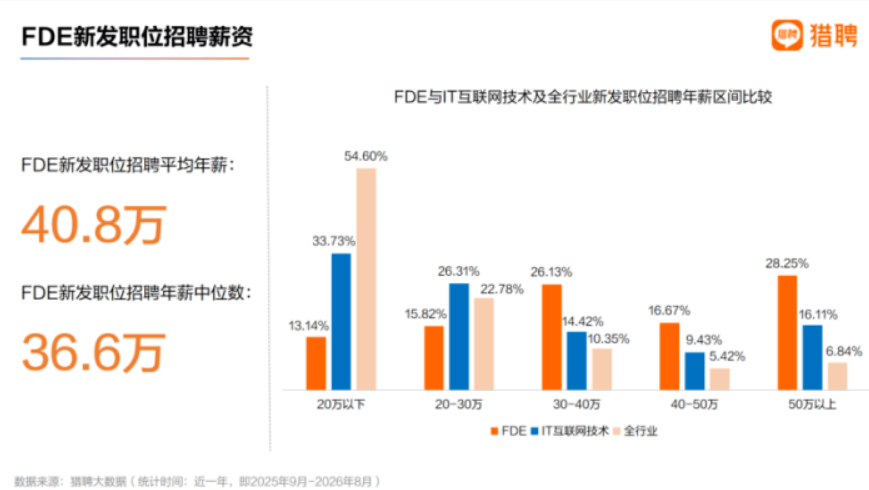
Policy changes are also providing new momentum for this model. On August 31, 2026, the General Office of the Ministry of Industry and Information Technology issued the "Notice on Launching a Special Action to Cultivate AI Application Service Providers," which explicitly encourages service providers to build FDE teams, embed themselves at user sites, and ensure the implementation of application scenarios. The notice also calls for establishing a resource pool of AI application service providers, promoting the formation of application service teams, and strengthening collaboration across the industry chain.
Shanghai, in its "Shanghai Three-Year Action Plan for Supporting the Transformation and Upgrading of Advanced Manufacturing (2026–2028)," proposed cultivating FDE teams, supporting enterprises in applying large AI models, building industry-specific models and industrial AI agents, and accelerating the digital-intelligent transformation of large enterprises.
In its 2026 report "Co-Creation on the Front Line, Two-Way Empowerment: Industry Observations and Practices of the FDE Model" (hereinafter referred to as the Tencent Research Institute FDE report), the Tencent Research Institute noted that, based on industry observations, the pure service fee for an FDE project typically ranges from 1 million to 5 million yuan.
High service fees are not the only business path. For large model and cloud vendors, FDEs are more like an entry point into clients' businesses: early-stage services can be offered at low prices, with revenue later generated through model calls, token consumption, cloud resource purchases, and product repurchases. OpenAI and Anthropic have deployed FDEs to penetrate high-value scenarios such as finance and validate their models' real-world capabilities; Alibaba Cloud feeds frontline requirements back to product teams like Qianwen Office and Qoder, using real business scenarios to drive product iteration.
"The projects our team has landed are generally small in scale, mostly in the tens of thousands of yuan range," Zhang Hua told IT Times reporters. Team members are all the company's own regular employees, with labor costs already covered by the existing compensation system, so the marginal cost of taking on clients' AI needs is low. For clients with ample budgets, they can quote at market prices; for clients with limited budgets, they can enter at a low price or even near zero cost in exchange for future collaboration opportunities.
Hard Numbers for Companies to Crunch
But not every service provider can replicate this model. FDE costs include not only engineer salaries but also business analysis, system integration, computing environments, travel, and ongoing operations and maintenance. Cloud vendors can recover their investment through subsequent ecosystem revenue, while product-platform companies depend on whether project experience can be distilled into reusable functional modules and industry templates. If every project is custom-built from scratch — with no follow-up revenue and no reusable development results — FDEs can easily degenerate into a traditional outsourcing model that relies on piling up manpower.
Zhang Hua explained that his team currently uses "nearby on-site debugging plus remote daily support" to reduce on-site staffing and travel expenses, and has built its own local testing environments to replace hourly-billed temporary cloud hosts, lowering R&D and testing costs.
In fact, there is still no industry consensus on how FDE services should be priced. Traditional software outsourcing typically charges by person-day, project duration, or contract scope — revenue can be roughly estimated based on how many people are involved and how many days they work. But FDEs try to get clients to pay for solving business problems — that is, "pay for performance." Under this model, service providers can charge based on the efficiency gains or cost savings an AI system brings to a company, or even take a percentage share.
Wan Ruyi, Vice President of ChinaSoft International, has analyzed that "pay for performance" has different levels: at the basic level, accuracy and system adoption rates can be assessed; the ideal state is to tie compensation directly to a company's financial metrics. But in actual execution, quantifying and attributing business outcomes remains a persistent challenge — "it's hard to say how much of a company's revenue growth is actually due to the AI system."
According to Wang Peng, a senior expert at the Tencent Research Institute and author of the aforementioned report, about 10% of companies in traditional industries are motivated to undergo AI transformation, and of those, only about 10% are willing to pay for FDEs — together roughly 1% of all companies, mainly leading enterprises in finance, manufacturing, pharmaceuticals, and other industries.
A New Role, or Old Wine in New Bottles?
Many industry insiders have long harbored doubts about the FDE model: "How is this any different from traditional on-site engineers?"
To understand FDEs, you have to go back to where they were born.
Around 2010, the US data analytics company Palantir gradually developed the Forward Deployed Engineer working model. This was tied to its early work on complex government and military projects: after software was delivered, it had to enter real operating environments to solve problems that were difficult to fully define in advance from an office.
This model starts from a premise different from traditional software development: "first understand the task, then bring the technology to where the task is." Engineers need to know not only how the system works, but also why the client needs it, what constraints the real-world environment imposes, and whether the solution actually solves the problem.

Palantir still emphasizes this distinction today. Its official recruiting materials show that traditional software engineers mainly work within product development organizations, while Forward Deployed Software Engineers face clients more directly and take responsibility for delivering both technical and operational outcomes.
This model was later adopted by more AI vendors. With the emergence of large models and AI agents, certain aspects of software development have changed: code that once took engineers weeks to write can now be generated faster with AI. But clients' real business processes, permission rules, data quality, and organizational collaboration have not become any simpler.
For example, suppose a company wants to use AI to process orders. A typical technical solution might be to connect a large model and have it recognize order contents. An FDE, however, would keep asking: How many suppliers do the orders come from? Are the formats consistent? Where is the data stored? Which fields can be auto-filled? When recognition errors occur, who reviews them? Can the results flow directly into the existing business system? The FDE then quickly turns these abstract requirements into a working system prototype.
The Tencent Research Institute's FDE report views FDE as a shift in the delivery model, emphasizing two-way feedback between on-site client experience and vendors' product capabilities.
Qian Wenying, Director of the Gravitational Field AI Business Innovation Research Institute, also believes that FDE is indeed not a brand-new profession that suddenly appeared in the AI era, but rather a recombination — into one person or a small team — of capabilities previously scattered across roles such as Solutions Architect, Sales Engineer, implementation consultant, product manager, and full-stack developer.
Traditional on-site engineers usually work around predefined projects, system operations, or specific technical tasks, with their scope of responsibility often determined by contracts and project requirements. FDEs, by contrast, should get involved earlier: when requirements are not yet fully clear, they first work with the client to identify problems worth solving, then turn technology into business outcomes through prototype validation, iterative development, and production deployment. In this process, Skills can both solidify individual experience and distill business knowledge into an "ontology."
Qian Wenying proposed three more practical criteria for distinguishing them: Does the engineer have direct authority to develop and modify applications? Can problems discovered on-site be fed back into the company's product roadmap? Is evaluation focused on real user usage and business outcomes, rather than just project acceptance and payment collection? If the role is limited to being on-site to gather requirements and call APIs, then leaving once the project is done, then even with the FDE title, it is hard to distinguish from traditional implementation services.
Why do people need to be on-site?
The Tencent Research Institute FDE report points out that the difficulties of enterprise AI implementation are no longer just about model capabilities, but also involve multiple aspects such as business processes, system integration, organizational collaboration, and outcome verification.
"In the process of building AI systems for clients, we found that clients may not even be able to articulate what capabilities they need." Zhang Hua gave an example: a business manager may know that hundreds of orders need to be processed every day, but cannot say which fields are most error-prone; a company's IT department may know the system architecture, but may not understand how frontline employees bypass cumbersome processes.

The FDE sits precisely in these gaps. Its value lies in helping clients break vague requirements down into verifiable tasks. First, use small-scale prototypes to test feasibility, then connect to real data and systems, and finally keep adjusting based on usage feedback. For enterprises, this is equivalent to surfacing problems that would otherwise be easily overlooked at the project initiation stage early in the development process.
What is more noteworthy is that the rise of the FDE does not mean engineers will become less important; rather, the value of engineers is being redistributed. Repetitive coding is increasingly easy to replace with automation tools, while understanding the business, judging requirements, integrating systems, controlling risks, and verifying results are becoming harder-to-replace capabilities.
Qian Wenying further pointed out that a true FDE does not just "take care of" more steps from requirements to delivery; more importantly, it abstracts common problems found at client sites into reusable tools, components, or product capabilities. Otherwise, every new client requires a fresh round of customization, and the larger the scale, the higher the engineer and delivery costs may become.
But the FDE is not a universal key either. The deeper one goes into the client's site, the more likely one is to face problems such as costs, custom development, and independent maintenance. A forecast released by Gartner in September 2026 even pointed out that by 2028, 70% of enterprises will abandon agentic AI applications built by vendors through the FDE model, citing reasons including high costs and enterprises' difficulty in independently maintaining and continuously evolving these systems.
In the final analysis, whether an AI vendor's FDE business math adds up depends on whether it can continuously create value at a controllable cost. After all, AI has made writing code easier and easier, but making technology truly work remains a difficult business.
Layout / Ji Jiaying
Images / Liepin pexels unsplash AI-generated
Source / "IT Times" official account vittimes
E N D
This article was uploaded and published by a Pengpai Hao author or organization on The Paper, and represents only the views of that author or organization, not the views or positions of The Paper, which merely provides an information publishing platform. To apply for a Pengpai Hao, please visit http://renzheng.thepaper.cn on a computer.






Scan the code to download the The Paper app
- The Paper Weibo
 The Paper official account
- The Paper Douyin account
- Paisheng Wanwu Open Platform
- IP SHANGHAI
- SIXTH TONE
- News tips hotline: 021-962866
- News tips email: news@thepaper.cn
Internet News Information Service License: 31120170006
Value-added Telecom Service Business License: Hu B2-2017116
© 2014-2026 Shanghai Dongfang Newspaper Co., Ltd.