The Forward Deployed Engineer is one of the hardest roles to hire for, and the reason is the skill set: it demands strong engineering, real AI deployment ability, and genuine customer-facing skills, all in one person. Most engineers have one or two of these; FDEs need all three, which is exactly why the role is scarce and well paid. This guide lays out every skill a Forward Deployed Engineer needs in 2026, grouped into four areas, with a checklist and a practical plan to build each one.
Whether you are aiming for the role or hiring for it, treat this as the definitive skills map. I have organised it the way the job actually works, from the engineering foundation up through AI, deployment, and the customer skills that most technical people underrate, and I have flagged which skills matter most at each seniority level so you can focus your effort.
The 4 Skill Areas of an FDE
A Forward Deployed Engineer's skills fall into four areas, and the role requires real competence across all of them rather than depth in just one. Together they cover the full path the FDE owns: building the thing, making it AI-capable, getting it reliably into production, and working with the customer the whole way. Here they are before we go deep.
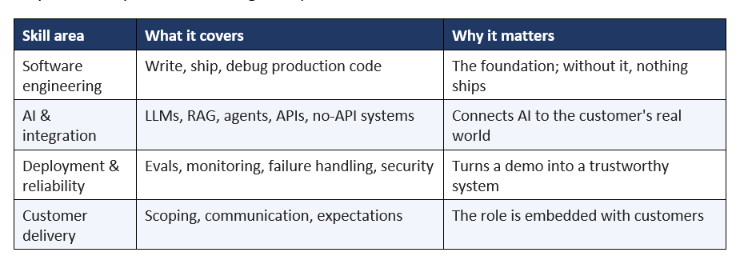
The defining feature is the combination. Plenty of people can code, fewer can deploy AI into a mess, and fewer still can also work directly with customers. The FDE is valuable precisely because they do all three, which is why breadth across these four areas, not mastery of a single one, is the real target. Let me break down each area.
1. Software Engineering
Software engineering is the non-negotiable foundation of the FDE skill set, because everything the role delivers is working software. You need to write, ship, and debug real production code, not just complete tutorials or build prototypes that never run. This is the skill that is hardest to fake and most valued, because an FDE who cannot build cannot do the job, no matter how good their other skills are.
- Fluency in a primary language, Python is the default for AI work.
- Writing clean, working code that handles errors and edge cases.
- Debugging in messy, unfamiliar environments, not just your own codebase.
- Version control, basic testing, and shipping code that others can run.
The FDE bar for software engineering is pragmatic rather than academic. You do not need to be an algorithms competition winner; you need to reliably produce working software under real-world constraints. The instinct that matters most is building for reality, handling the bad input, the failure, the edge case, rather than only the happy path, because that instinct is what separates software that ships from a demo that breaks.
2. AI & Integration
The AI and integration skills are what let a Forward Deployed Engineer actually build AI systems and connect them to the customer's real world. On the AI side, you need to build with large language models, prompting, retrieval (RAG), and agent frameworks. On the integration side, you need to connect those systems to real data and real tools, including the common case of systems that have no clean API.
- Building with LLM APIs: calling models reliably, structuring inputs and outputs.
- Prompting and context engineering to get useful, consistent results.
- Retrieval-augmented generation (RAG) for grounding AI in real data.
- Agent frameworks and tool use for multi-step workflows.
- Integration: APIs, databases, and automation for systems with no API.
Integration is where a lot of real FDE work lives, because connecting AI to a customer's messy systems is the hard, unglamorous part that most tutorials skip. The ability to get data in and out of a legacy system, through a hidden interface, screen automation, or a human step, is a defining FDE skill, which we cover in automating a system with no API. Foundational AI concepts are in our beginner guide to agentic AI.
3. Deployment & Reliability
Deployment and reliability skills are what turn a working demo into a system a customer can trust in production, and they are the skills that most separate an FDE from a prototyper. This means building the control layer around the AI: evaluations that measure correctness, monitoring that catches problems, failure handling for when things break, and the security and permissions real users require.
- Evaluations: measuring whether the system is right on real cases, and catching regressions.
- Monitoring: watching the live system so problems surface early, not silently.
- Failure handling: fallbacks and alerts for when a dependency is down or an input is bad.
- Security and permissions: handling real data and access safely.
- The approval boundary: deciding what the AI does alone versus what needs a human.
These skills are unglamorous and decisive. A model that is accurate in a demo but has no evals, monitoring, or failure handling will lose users the first time it confidently does the wrong thing in production. The FDE who can build the reliability layer is the one who ships systems that survive real users, a theme we explore in the 3 layers of an AI system that survives real users. If you build only one thing beyond the model, build this.
4. Customer-Facing Delivery
Customer-facing delivery is the skill area most technical people underrate, and it is half of what makes an FDE effective, because the role is embedded with customers. You need to scope a vague business problem into a workable solution, communicate clearly with non-technical stakeholders, set honest expectations, and handle the inevitable moments when a customer wants something unrealistic or a project hits a snag.
- Scoping: turning a fuzzy business problem into a defined, buildable solution.
- Communication: explaining technical realities to non-technical people clearly.
- Expectation-setting: saying no or reframing without damaging the relationship.
- Pragmatism: shipping what delivers value now, not chasing perfection.
These skills are why an FDE is not just a strong coder dropped at a client. The ability to understand what a customer actually needs, often different from what they asked for, and to deliver it while keeping the relationship healthy, is what makes the role work. An engineer who cannot do this will struggle as an FDE even with excellent technical skills, which is why the best FDEs deliberately build the customer side as seriously as the technical side.
Technical Skills Checklist
Here is a concrete checklist of the technical skills a Forward Deployed Engineer should have or build, pulled together across the areas above. Treat it as a self-assessment: the more you can genuinely tick, the more ready you are for the role.
- Strong Python (or equivalent) and general software engineering.
- Building with LLM APIs, prompting, and context engineering.
- Retrieval-augmented generation (RAG) and working with embeddings.
- Agent frameworks and tool use for multi-step tasks.
- API integration and database access.
- Automation for no-API systems (browser or desktop automation).
- Handling messy, real-world data (OCR, normalisation, multilingual).
- Evaluations, monitoring, and failure handling.
- Basic security, permissions, and deployment practices.
You do not need every item at expert level on day one, especially for a junior role, but you should be building toward all of them. The checklist doubles as a learning plan: pick the gaps and close them through real projects, which is the only way these skills actually stick.
Soft Skills That Set FDEs Apart
Beyond the technical checklist, a handful of soft skills consistently separate great Forward Deployed Engineers from merely competent ones, and they are worth building deliberately. These are the traits that make the customer-facing, ambiguous, high-ownership nature of the role work.
- Comfort with ambiguity: thriving when the problem is vague and the environment is messy.
- Ownership mindset: treating the outcome as yours, through to it running in production.
- Pragmatism: a bias toward shipping something that works over perfecting something that does not.
- Empathy: understanding the customer's real needs and constraints.
- Resilience: staying effective when a deployment is hard or a customer is difficult.
These are harder to teach than technical skills, which is partly why strong FDEs are scarce. If you naturally gravitate toward owning messy problems end to end and enjoy working with people as much as with code, you have the temperament the role rewards. If not, they can still be developed deliberately, but they matter as much as any technical skill on this page.
Skills by Seniority Level
The skills that matter most shift with seniority, so knowing where you are helps you focus. A junior FDE is judged mostly on building ability and learning speed, a mid-level FDE on independent delivery, and a senior FDE on judgment, ambiguity, and customer leadership. The underlying skill areas are the same; the weighting and the expected autonomy change.
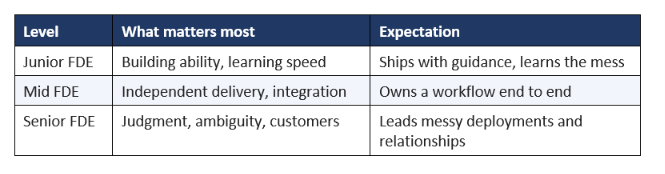
The practical takeaway: a beginner should over-invest in the software engineering and AI-building foundation, because that is the entry gate, while a senior should lead with judgment, delivery track record, and customer skill, because at that level the build is assumed. Either way, the path up is through shipping progressively harder, messier systems, which is how FDE skill actually compounds.
Common Skill Gaps That Hold People Back
Most people who want to become Forward Deployed Engineers are not missing raw ability; they are missing one or two specific skills that the role exposes immediately. Knowing the common gaps lets you target your effort instead of grinding on skills you already have. Here are the gaps I see most often, and what closing each one looks like in practice.
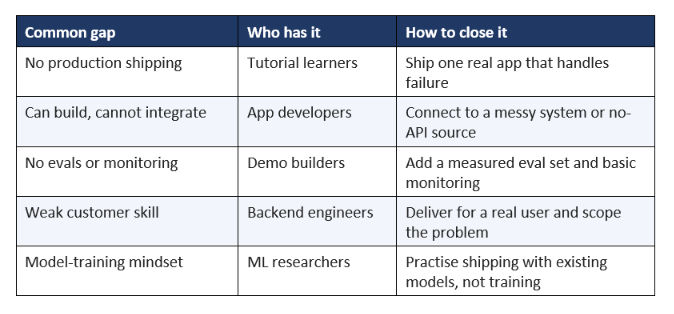
The pattern across these gaps is the same: the missing skill is almost always on the deployment or delivery side, not the model side. People arrive able to build a model or a demo and discover the role is really about everything around the model, integration, reliability, and the customer. If you honestly assess which of these gaps is yours and close it with one real project, you move faster than someone adding yet another course to a pile. Teams that train engineers into this role deliberately close these gaps through hands-on delivery rather than lectures, because the skills only stick when someone ships something real with them.
One more gap is worth naming on its own: the tendency to over-engineer. Strong engineers new to the FDE role sometimes build elaborate, elegant systems when the customer needed something simpler shipped faster. The FDE skill is judgment about what is enough, delivering value now and improving later, rather than chasing a perfect architecture no user asked for. Learning to ship the pragmatic version first is a skill in itself, and it is one that only comes from real delivery pressure.
How to Build These Skills
You build Forward Deployed Engineer skills the same way the job is done: by shipping real, end-to-end projects, not by collecting courses. Here is a practical progression that develops all four skill areas in the right order.
- Get solid at software engineering. Build and ship real applications; practise debugging in unfamiliar code.
- Learn to build with AI. Make small end-to-end AI apps using LLM APIs, RAG, and an agent framework.
- Practise the deployment 80 percent. Handle messy data, integrate real systems, add evals and monitoring.
- Ship for real users. Build something an actual person or business uses, to develop the customer and delivery skills.
- Document and reflect. Write up the messy reality you handled; these become your portfolio and interview stories.
The single most important habit is to ship things that touch real data and real users, because that is where all four skill areas get exercised at once. Tutorials build knowledge; shipped projects build the skills employers actually hire for. For the full career path around these skills, see our guide on how to become a Forward Deployed Engineer in India.
Frequently Asked Questions
What skills do you need to be a Forward Deployed Engineer?
You need four skill areas: software engineering (shipping real code), AI and integration (LLMs, RAG, agents, APIs, no-API systems), deployment and reliability (evals, monitoring, failure handling, security), and customer-facing delivery (scoping, communication, expectation-setting). Breadth across all four matters more than being world-class in just one.
What programming language should an FDE know?
Python is the default language for Forward Deployed Engineering, since most LLM APIs, agent frameworks, and AI tooling are Python-first. Beyond Python, general software engineering ability matters more than any single language, and knowing enough JavaScript or SQL to integrate with real systems is a plus. Focus on being able to build and ship.
Do FDEs need machine learning skills?
FDEs need to build with AI, but not necessarily to train models from scratch. The job is shipping AI systems into production using existing models, so skills like prompting, RAG, agents, and integration matter more than deep ML research or model training. Understanding how models behave is important; being a research scientist is not required.
What soft skills does a Forward Deployed Engineer need?
Comfort with ambiguity, an ownership mindset, pragmatism, empathy for the customer, and resilience. Because the role is embedded with customers and owns messy problems end to end, these soft skills matter as much as technical ones, and they are a big reason strong FDEs are scarce. They can be developed deliberately through real delivery experience.
How do I build Forward Deployed Engineer skills?
Build them by shipping real, end-to-end projects rather than collecting courses. Get solid at software engineering, learn to build AI apps with LLM APIs and RAG, practise the deployment 80 percent (messy data, integration, evals), and ship something real users touch. Document the messy reality you handled, which becomes your portfolio and interview material.
Do I need a computer science degree to be an FDE?
No. A computer science degree helps but is not required; many strong FDEs are self-taught or come from software, data, or consulting backgrounds. The role is judged on what you can build and ship, so a portfolio of real, end-to-end projects outweighs a specific credential when it comes to landing an FDE role.
Is RAG an important FDE skill?
Yes. Retrieval-augmented generation (RAG) is a core FDE skill because it is how you ground an AI system in a customer's real data, which is central to most deployments. Being able to build a reliable retrieval step, handle messy source documents, and evaluate its accuracy is exactly the kind of practical AI-plus-integration ability the role demands.
How long does it take to build FDE skills?
If you are already a software engineer, adding AI building and deployment skills and shipping a few real projects can make you FDE-ready in several months of focused effort. Starting from scratch takes longer, since the software engineering foundation is the slowest part. The fastest path is always shipping real, progressively messier projects.