Anduril builds autonomous defense systems and runs a genuine Forward Deployed Engineer loop, embedding engineers with operators and customers to ship mission software in the field. The process is known for roughly six sessions across three stages and for weighting customer judgment as heavily as code: intentionally vague, multi-phase technical prompts, plus rounds that probe how you handle ambiguity, make tradeoffs under real constraints, and stay effective with a frustrated non-technical stakeholder. Experienced hires are matched to a specific team first, so some rounds go deep on domain skills such as C++, perception, or ML infrastructure.

Start preparing

Start with a related free lesson, then practise the questions below.

Build an evidence map of an unfamiliar system →

28 min · no account needed

Find Anduril FDE jobs

The Anduril Forward Deployed Engineer interview process

Documented

Public guidance on the Anduril Forward Deployed Engineer interview experience, including round formats and preparation priorities. Last reviewed July 31, 2026.

  • 1Recruiter phone screenBackground, role and team match, and motivation for working in defense.
  • 2Technical phone screenCoding with intentionally vague, multi-phase prompts.
  • 3Final round (4 sessions)Two coding rounds, an object-oriented design round, and a behavioral conversation with a senior or staff engineer; experienced hires may get domain-specific depth in C++, perception, or ML infrastructure.
  • The loop scores five things at once: working software, working directly with a client, handling ambiguity, real tradeoff calls under constraint, and staying effective with a frustrated non-technical stakeholder
  • Experienced-hire candidates are matched to a specific team before the loop, so some rounds test that team's domain
  • Genuine, well-reasoned motivation for the defense mission is assessed across rounds

Compiled from public interview guides and candidate reports; loops vary by team and level, so confirm your exact rounds with your recruiter.

Compiled from our research and publicly available information (candidate reports and company interview guides). Interview loops change and are continuously iterated, and they vary by team, level, and region. Treat this as directional preparation, not an official spec, and confirm the exact rounds with your recruiter or hiring point of contact.

Anduril Forward Deployed Engineer salary

What we can trace, labelled by where it came from. We publish a band only where there is a source behind it, so some of this page is a gap rather than a number.

We do not have a verified compensation band for this role at Anduril recorded in this profile. Check the current posting for the role, level and location before comparing offers. Their careers page is the authority, and postings in some jurisdictions are required to state a range.

A US defence or national-security employer. These roles routinely require US citizenship or an active security clearance, so for most India-based candidates this is not a hiring route regardless of what it pays.

We are naming the constraint rather than a number, because the number is not the thing standing in the way. Requirements differ per req, so confirm on the posting itself.

Full method, US bands by level, and the three India tiers side by side are in the FDE salary guide.
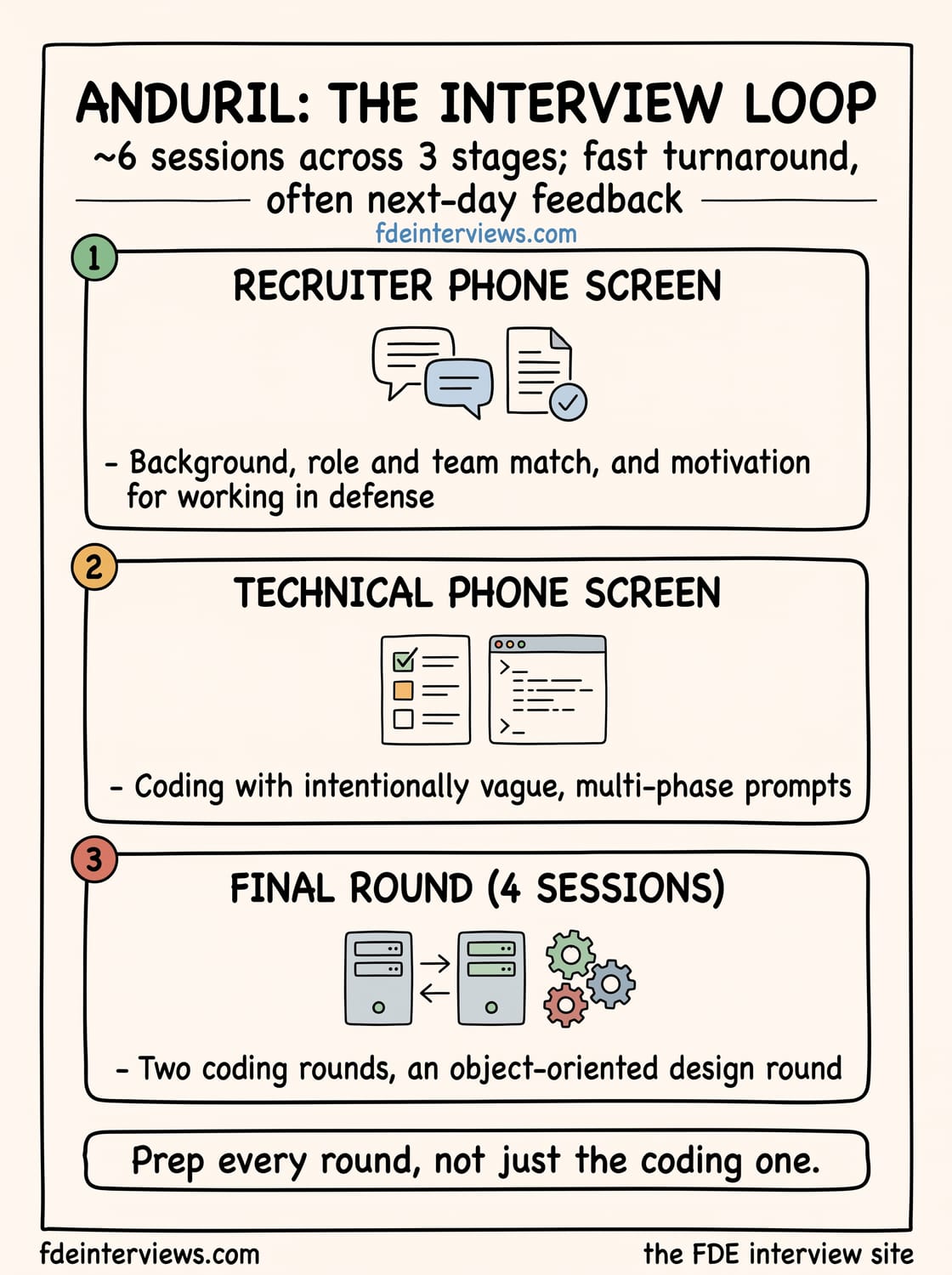
Infographic of the Anduril interview loop, round by round: Recruiter phone screen, Technical phone screen, Final round (4 sessions).

↧ Download

Share on X ↗

Share on LinkedIn ↗

Questions modeled on Anduril loops

More from the tracks Anduril's loop tests

The highest-signal questions across Anduril's core tracks.

Go deeper on the topics Anduril's loop tests

The tracks that map to a Anduril Forward Deployed Engineer loop, ordered easy to hard.

The concepts Anduril's Forward Deployed Engineer loop assumes you know

The vocabulary and mental models behind Anduril's questions, from our curriculum. Start with the foundations free; the deeper, interview-defining ideas are part of premium.

CODING & ENGINEERING CRAFT

FoundationalParsing Messy, Real-World DataCustomer files are dirty: inconsistent quoting, missing headers, junk rows, encodings that lie. The job is to parse defensively, skip and log bad rows instead of aborting the whole batch, and keep parsing pure and separate from business logic so it stays testable and deterministic. This is most of what early FDE data-ingestion work actually is.

FoundationalBig-O That Actually MattersOn a deployment, Big-O is not a whiteboard puzzle; it is the one calculation that tells you whether the customer's data fits in the approach you picked. The skill is spotting the term that dominates at their scale, knowing when brute force dies and you need an index or ANN, and recognizing when constant factors and memory decide the outcome instead of the exponent.

CoreSign inTestability and Dependency InjectionCode that reaches out to the clock, the network, the filesystem, or a random generator cannot be tested deterministically, because its output depends on the world. The fix is to separate pure logic from side effects and inject the things that touch the world (the clock, I/O, randomness) so a test can pass fakes. When you inherit untestable code, pin its current behavior with a characterization test first, then refactor under that net.

CoreSign inStreaming and BackpressureStreaming processes data one chunk at a time so memory stays flat no matter how big the input is. The moment a producer outruns its consumer, you need backpressure: a bounded buffer that makes the producer wait instead of piling unbounded work into memory. In Python this is generators and chunked reads for the streaming half, and a bounded queue (or a blocking put) for the backpressure half. Get it wrong and a 50 GB file or a fast upstream OOMs the box.

SYSTEM DESIGN FOR AI IN PRODUCTION

FoundationalFrom Proof-of-Concept to ProductionA notebook that answered one question correctly during a demo is not a deliverable. Production is the unglamorous work that turns a one-time success into a system the customer can run, trust, and operate without you in the room. Closing that gap is most of the FDE job.

CoreSign inAI Cost and Unit EconomicsUnit economics is the napkin math that decides whether an AI deployment ships: cost per request driven by input and output tokens, multiplied by volume, against the human or manual baseline it replaces. It also governs the API-versus-self-host break-even, which only flips in favor of your own GPUs above a real utilization threshold.

FoundationalRetries, Exponential Backoff and JitterWhen a call fails on a transient error, retrying immediately is the worst thing you can do: it piles load onto an already-struggling service and synchronizes every client into a stampede. Exponential backoff spaces retries out, and jitter de-synchronizes the clients so they stop arriving in lockstep.

Advanced🔒 PremiumVPC and Air-Gapped DeploymentLarge enterprises will not let their data leave their security boundary, so you deploy your software inside the customer's private VPC, reach their data over PrivateLink instead of the public internet, authenticate through their SSO, and encrypt everything at rest and in transit. For air-gapped environments you ship self-hosted models too. This is core Forward Deployed Engineer work.

ML INFRASTRUCTURE & SERVING

CoreSign inGPU Memory and VRAMVRAM is the budget that decides which models you can actually run. It is spent on three things: model weights, the KV cache, and activations. Knowing the back-of-envelope arithmetic (a 7B model at fp16 is roughly 14GB of weights) is what separates a candidate who has deployed an LLM from one who has only read about it.

CoreSign inQuantizationQuantization stores model weights (and sometimes activations) in fewer bits, fp16 down to int8 or 4-bit, which cuts memory and speeds inference. The quality hit is usually small at int8 and larger at 4-bit. Knowing post-training quantization versus quantization-aware training, and when each is acceptable, is standard FDE interview ground.

CoreSign inKnowledge DistillationDistillation trains a small student model to mimic a large teacher, learning from the teacher's full output distribution rather than just hard labels. The soft targets carry extra signal about how the teacher 'thinks', so the student keeps much of the quality at a fraction of the size and latency. Knowing when distillation beats quantization or pruning is standard FDE ground when you have a latency or cost budget to hit.

Advanced🔒 PremiumContinuous BatchingStatic batching runs a fixed group of requests to completion together, so a batch of one short reply and one long reply makes the GPU idle while it waits on the longest. Continuous batching adds and evicts sequences from the running batch every decode step, keeping the GPU saturated and multiplying throughput. It is the scheduling trick at the heart of vLLM and every modern LLM serving stack.

THE CUSTOMER-FACING CRAFT

FoundationalRequirements DiscoveryRequirements discovery is the work of finding the real problem hiding behind the customer's stated ask. The request they hand you ("build us a chatbot") is almost never the need; the FDE who surfaces who uses it, what success looks like, what data actually exists, and why the deadline is the deadline is the one who ships something people use.

FoundationalScoping Ambiguous ProblemsScoping an open-ended prompt ("a city wants to reduce 911 response times") is a structured move, not a flash of inspiration: clarify inputs and constraints, state your assumptions out loud, carve out the smallest useful MVP, name the accuracy/cost/latency trade-offs you are choosing, and plan for what happens when it fails. Diving straight into a model or an architecture is the most common reason candidates get cut in the simulation round.

FoundationalExplaining Trade-offs to Non-EngineersAn exec does not care whether you chose RAG or fine-tuning; they care what it costs, when it ships, and what it might get wrong. Translating a technical trade-off means converting accuracy, cost, and latency into the decision the business is actually making, framing each option as a choice with a consequence in their terms, and answering the question they will all eventually ask: why does the AI give a different answer every time, and why is that not a bug.

Advanced🔒 PremiumPilot Acceptance CriteriaPilot acceptance criteria connect a test result to a bounded deployment decision. Define eligible work, failure limits, missing evidence and the people who can approve the next step.

Where to apply, and official Anduril resources

Straight from Anduril: open roles and the company's own hiring guidance. Prep here, then apply there.

External links to Anduril's own pages. Roles and processes change; always confirm on the official site.

Forward Deployed Engineer / Software Engineer. Typical loop: ~6 sessions across 3 stages; fast turnaround, often next-day feedback. Stages: Recruiter phone screen → Technical phone screen → Final round (4 sessions). Key focus: The loop scores five things at once: working software, working directly with a client, handling ambiguity, real tradeoff calls under constraint, and staying effective with a frustrated non-technical stakeholder. Compiled from public reports; loops change over time, so confirm the exact rounds with your recruiter.

Yes. Anduril runs a real forward deployed engineering function, embedding engineers with operators and customers to build and ship mission software in the field, alongside its core software and hardware teams.

Expect roughly six sessions across three stages: a recruiter screen, a technical phone screen, and a final round of two coding interviews, an object-oriented design round, and a behavioral conversation with a senior engineer. Rounds weigh working code, handling ambiguity, real tradeoff calls, and staying effective with a frustrated non-technical stakeholder.

Be ready for intentionally vague, multi-phase prompts, strong coding and object-oriented design, and a clear, honest motivation for working in defense. For experienced roles matched to a team, brush up on the domain that team uses, such as C++, perception systems, or ML infrastructure.

As a high-value private defense company, Anduril offers competitive base plus equity that varies by level and location. Public figures are approximate.

Walk into your Anduril Forward Deployed Engineer interview ready

Prepare across the full loop with worked answers and the curriculum behind them. Start with the free questions and concepts to judge the depth.

Every answer, concept and course, every paper breakdown, all published video lessons, hands-on FDE Lab missions, Premium PDF guides and companion files, the full practice-test bank and work-sample downloads. Referral Premium excludes guide PDFs and their companion files.

6 months · One payment · No auto-renewal

Study alongside free video lessons.

Or create a free account to unlock more free answers per topic.

Other Forward Deployed Engineer interviews to prep

Companies whose loops test the same tracks as Anduril's.

Independent and not affiliated with Anduril. All trademarks belong to their owners.