Melissa Perri's 2018 book for product managers, even more useful for Forward Deployed Engineers (FDEs) who need to measure outcomes rather than output.
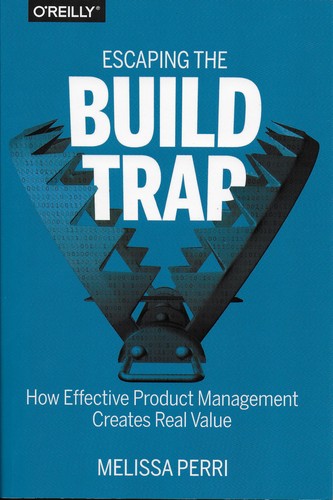
Escaping the Build Trap: How Effective Product Management Creates Real Value · Melissa Perri ·
Key Takeaways
- Melissa Perri's book was published by O'Reilly in 2018: the build trap is measuring success by output rather than outcomes
- Output isn't inherently bad—it's the means to reach a goal; the trap only appears when teams forget the goal
- For FDEs, the most memorable lesson is: use strategy as a filter when deciding what to build for customers
An engineering team can ship every feature on schedule and the project can still fail. Melissa Perri gave this situation a name: the "build trap." Companies caught in it judge success purely by output, endlessly pushing out features to hit deadlines.
Her book, *Escaping the Build Trap: How Effective Product Management Creates Real Value*, was published by O'Reilly in 2018. The cover says product management, but for anyone aiming to become a Forward Deployed Engineer (FDE), the book reads more like a guide: how to avoid becoming a "feature factory" that builds whatever the customer orders.
When you're embedded on-site and developing close to users, speed is your most visible output. That's exactly why the trap is hard to spot: the more you deliver, the easier it is to feel the project is going well.
The problem is the metrics, not the effort
The book's definition is brief: the build trap is when an organization is stuck measuring success by output rather than outcomes. The getAbstract summary puts it another way: companies tend to care more about what they delivered than about the value customers actually got.
Output is what the team produces: features, APIs, interfaces. Outcomes are the changes these bring to the customer. Perri doesn't say output is bad. At ProductCon 2022 she called output the means to reach a goal. According to notes from Dragonboat, the trap only appears when there's no clear goal and the team just keeps "building, building, building."
Imagine you're an FDE rolling out an invoice processing system for a logistics company. Six weeks in, the report shows nine features delivered, not a single delay. Yet accounting still spends roughly 40 minutes processing each invoice, same as before you arrived. By output, the project is a success; by outcome, nothing has changed.
Now imagine the goal had been reset in week one: cut the time to process an invoice from 40 minutes to 15. Very likely only three of those nine features were needed, and those six weeks would have been better spent sitting next to accountants, watching where they get stuck.
Strategy is a filter, not a plan
The second idea that matters for FDEs is the book's definition of strategy. In Perri's view, strategy is a decision framework you can put to use immediately, helping the team take action and achieve the desired outcomes. It is not a plan listing tasks.
At a customer's company, this distinction is very practical. Back to the invoice example: mid-week, the head of finance asks for a button that exports reports as PDFs. If all you have is a plan, you'll ask: is this request in scope?
If you have a decision framework, you'll ask: does it help reduce those 40 minutes? If not, you have a clear reason to deprioritize it, and the customer can understand that reason too.
That's why this lesson fits FDEs better than product managers sitting in an office. FDEs hear requests directly every day, and every yes adds another item of output. Without a filter, the backlog becomes the wish list of whoever talks loudest in meetings.
Used wrong, outcomes become a trap too
The easiest mistake after reading this book is to use outcomes as a shield to reject every request. That PDF button might be exactly what the head of finance needs to report data upward—in other words, it serves a real problem you haven't heard about yet. Before saying "not for now," ask what they actually need it for.
The second mistake is picking an outcome that can't be measured, like "make the customer happier." The 40-minute number is useful precisely because it can be measured before and after. An unmeasurable goal filters nothing.
The last mistake is setting the outcome yourself and keeping it in your head. If the customer hasn't bought into the 15-minute target, your filter is just a personal opinion, and every rejection turns into an argument. Lock in that number with the customer in week one.
The page introducing the book on Perri's personal website describes the destination as building a culture that is customer-centric and values outcomes over output. An FDE can't change an entire customer company's culture, but you can carry that mindset into every meeting, every ticket, and every weekly report.
Who should read it, and how
This book suits developers with two to eight years of experience who are used to picking up tickets and closing them, and now want to move toward deciding what to build themselves. Read it before your first on-site deployment, because the trap appears most easily in the first few weeks: that's when you're eager to prove you can deliver.
Don't read it in one sitting and set it aside. After finishing the part that defines the build trap, open the backlog of your current project and write a measurable outcome next to each item. When you reach the part on strategy, try writing a one-sentence goal for your current customer, specific enough to serve as a filter.
When reading FDE job descriptions, notice whether they talk about impact on customers or just list technologies you need to master. On your resume, replace "built 12 APIs" with a sentence that includes a before-and-after number from the user's side. That one sentence shows the reader you already think in outcomes—which is exactly what this book teaches.
At a customer's company, no one remembers how many features you shipped. They remember what got faster, cheaper, or less painful after you arrived.
Was this article helpful?
Thanks for your feedback!
5 sources
- Escaping the Build Trap. How Effective Product Management Creates Real Value - Melissa Perri (Helion) · 2018-11-01
- Melissa Perri – Escaping the Build Trap (author's book page)
- Escaping the Build Trap – getAbstract summary · 2018
- Our Favorite Moments From ProductCon 2022 (Dragonboat) · 2022-02-26
- Lessons from Melissa Perri (Antoine Buteau) · 2026-06-25