The Heath brothers' 2010 book Switch points out that the problem often lies with the emotional "Elephant," and that changing the "Path" is what makes a system truly adopted.
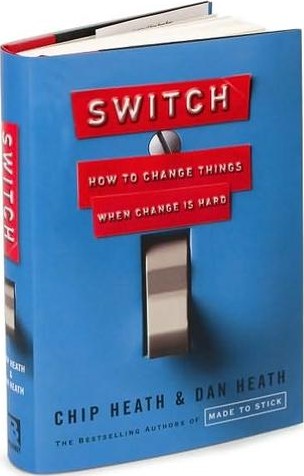
Switch: How to Change Things When Change Is Hard · Chip Heath ·
Key Takeaways
- Switch (2010) argues that change is hard because rationality and emotion compete for control within each of us.
- The Rider, the Elephant, and the Path correspond to concrete direction, motivation, and the work environment.
- For an FDE, the Path matters most, because it can be changed directly through system configuration.
Every Forward Deployed Engineer (FDE) has experienced this moment: the demo goes smoothly, everyone nods along during training, and the system runs reliably on real data. Three weeks later, you check the logs and find that most users have gone back to their old ways of working.
Switch: How to Change Things When Change Is Hard, co-authored by Chip Heath and Dan Heath, was written precisely for moments like this. Published in 2010, the book spent 47 weeks on the New York Times bestseller list. On August 22, 2024, Random House Business reissued it in the UK, 320 pages, ISBN 9781847940322.
This book was not written for engineers. But an FDE should read it before reading many architecture-focused books. Because after go-live, what determines a project's success is whether users actually change the way they work.
Knowing but Not Doing: Where Does the Problem Lie?
The authors argue that the main obstacle is a conflict built into the human brain. The book states that our minds are governed by two systems, rational and emotional, which compete for control. The authors' metaphor is: a Rider sitting atop an Elephant, both moving along a Path.
This changes how we look at deployment failures. Some people go back to the old ways because they genuinely don't know what to do; the Rider part of the framework targets them. But others fully understand the system and still revert: the Elephant finds the old way more familiar and safer, and the Rider doesn't have the strength to keep steering it.
Imagine you've delivered an invoice reconciliation AI agent to the finance department of a logistics client. The AI agent proposes matching pairs, and accountants just need to approve them. Yet many people still export the data to spreadsheets and reconcile line by line as before. Applying Switch's three components to this case, every failure point becomes clear.
Direction, Motivation, Environment: Three Different Failures
The first component is directing the Rider. Umbrex's summary of the Switch framework contains a line worth taping to your monitor: what the Rider needs is clarity, not just inspiration.
In that finance department, instead of saying "trust the AI agent," simply write the next step: each morning, approve high-confidence pairs first, and leave the rest for the afternoon.
The second component is motivating the Elephant, meaning users' emotions, energy, and instincts. The book tells the story of a home organization expert who designed a simple method to help people overcome their dread of household chores.
The story doesn't say where that dread comes from. But for an FDE, a useful way to understand it is: treat it as fear of a task that looks too big. So on first use, have accountants approve ten pairs and see themselves finishing early, rather than handing them a full batch of three thousand rows right away.
The third component, and the one FDEs can use most, is shaping the Path. Umbrex describes the Path as the work environment: processes, norms, incentives, tools, defaults, and colleagues' behavior.
The book tells of a manager who transformed a listless customer service team into an enthusiastic one by removing an industry-standard tool.
In the invoice case, this is the part you can control through configuration. You can make the review interface the default screen after login, or move the export-to-spreadsheet button into a secondary menu. If the new way is the path of least effort, the Elephant will walk it on its own.
Change Doesn't Have to Start at the Top
The book also has another memorable example: a group of junior resident doctors overturned a medical practice that had been in place for decades and endangered patient safety.
At a client company, the most senior person is usually not the one who gets the system truly adopted. That falls on a handful of frontline users whom colleagues turn to when they run into problems.
So in the first week after go-live, find two or three of these people, sit next to them, and fix on the spot whatever is blocking them. Their behavior itself is part of the Path that others will follow.
Read It by the Three Components, Not as a Story
The most rewarding way to read this book is to sort each story into one of the three components—Rider, Elephant, or Path—and then ask yourself: which failure at the client does it correspond to?
Put most of your energy on the Path. Read with a pen in hand, and next to each story write down one corresponding configuration change. If you like this style, the Heath brothers have two other bestsellers: Made to Stick and Decisive.
This book is best suited for FDEs in the post-go-live phase, and for engineers who want to move into an FDE role but only have system-building experience.
The invoice case also gives you a number you can measure: before and after changing the default interface, track what percentage of invoice pairs are approved within the system rather than exported to a spreadsheet.
Stating this configuration change and this number on your resume, or telling this story clearly in an interview, is more persuasive than listing a string of frameworks.
Getting the system to run is only half the journey. A deployment is truly complete only when users no longer want to go back to the old ways.
Was this article helpful?
Thanks for your feedback!