Background:
On June 30, 2026, AWS announced it would invest $1 billion to build an FDE organization, embedding engineers into customer teams in 45-day sprints. Two days later, Microsoft established Frontier Company, committing $2.5 billion and 6,000 engineers to do the same thing. A few weeks earlier, OpenAI spent $295 million to acquire Tomoro and set up an independent deployment company, Google Cloud attached its embedded FDE teams to its product organization, and Anthropic partnered with PE firms to have portfolio companies deploy AI agents at scale. Five companies are all betting on the same type of role: sending people to the customer site to turn AI from a demo into a production system.
AI Lens is a series of industry observations in the AI era initiated by Tencent Research Institute, focusing on real changes in technology, organizations, and business frontlines. Industry roundtables are one of its discussion formats for frontline practitioners: not just interpreting trends, but openly discussing the roles, tactics, and organizational experiments happening right now.
We invited two frontline practitioners—Zhong Qianjie, head of AI agent FDE at Cresta, and Lu Xiaopeng, co-founder of Ventus AI—to join Yu Yi, senior researcher at Tencent Research Institute, and Wang Peng, senior expert, in a discussion around seven questions: What exactly is an FDE, and what is the essential difference from outsourcing and implementation? How severely underestimated is the complexity of going from demo to production? Why does "distillation" determine whether this model can work as a business? Is Palantir's FDE from ten years ago the same species as today's? What kind of company and boss can actually push AI forward? Can China make it work? And is this path still worth it for engineers?
The last question of this discussion was left half-answered: Can China actually make FDE work? Tonight (July 8, 20:00), in the second AI Lens industry roundtable, Li Jiarui of Sentance Interactive, Qin Rui of BISHENG, Ru Bingsheng of CodeWisdom, and Yu Yi and Wang Peng of Tencent Research Institute will break down the local reality of AI's hottest role—doing FDE in China. Welcome to watch the livestream on Tencent Research Institute's video channel.
Guest Profiles:
Zhong Qianjie (Jove), Head of AI Agent FDE at Cresta. Leads 30+ senior FDEs across North America, Australia, and Europe, delivering production-grade AI agents for leading enterprises in aviation, finance, healthcare, and more. Won FDE Team of the Year at the Propel 26 conference in 2026. Previously had over 20 years of engineering experience at IBM, EMC, and Splunk, and spent four years as an entrepreneur in real-time data analytics. A Fudan University graduate, currently based in Vancouver.
Lu Xiaopeng (Vincent), Co-founder & CTO of Ventus AI. Founded Ventus AI in 2024, backed by a16z, focusing on AI deployment in the North American healthcare industry, serving 300+ clinics and medical institutions. A CMU graduate who worked in China for two years, he offers a firsthand comparative perspective on the FDE ecosystems in China and the US.
Yu Yi, Senior Researcher at Tencent Research Institute, host of the AI Lens series, a 5,000-hour AI First experimenter, and co-lead of AI-native initiatives at Tencent Research Institute. Her research and practice cover AI-native innovation and organizational strategy, super individuals, AI digital avatars, and related topics. With years of experience in innovation incubation and investment, she has led multiple Tencent innovation accelerator programs, and before Tencent was a vice president at a well-known USD fund.
Wang Peng, Senior Expert at Tencent Research Institute, professor-level senior engineer.
[Lens Quick Take] Frontline answers to seven questions about FDE
What exactly is an FDE? Why are five giants betting on three different playbooks?
In the same quarter, five giants poured money into the same type of role, but the core tension is not about who invested more—it's that the FDE naturally morphs with a company's stage and business model. At Cresta, a 500-person company, Zhong Qianjie added one word: Product. His team spends a third of their time modifying product code—spotting a problem at the customer site in the morning, submitting a PR in the afternoon, shipping the next day. At the 10-person Ventus AI, Lu Xiaopeng's FDEs follow through from pre-sales to post-sales, carry business metrics, and are expected to do the work of ten people. As for model companies doing FDE, Zhong Qianjie's take is blunt: essentially they want to sell more tokens, and the model is precisely the layer most easily replaced. The fragmentation of the definition is itself a signal: FDE is a role that grows on demand, and trying to force it into a single standard definition is doomed to miss the mark.
Where exactly is the line between FDE and outsourcing, implementation, and Solutions Architect?
When engineers in China hear FDE, their first instinct is to map it to on-site engineers, outsourcing, or Solutions Architects. Zhong Qianjie draws a hard line: anything you can teach the customer is not FDE—SAP implementation can be taught to customers, but AI agent hallucinations and latency simply cannot. Lu Xiaopeng is more honest about the 10-person Ventus: in the early days, FDE is solutions plus implementation, following through from pre-sales to post-sales, one person doing the work of ten. The disagreement is not about the name but about company stage: Cresta has dedicated SAs handling legacy systems like Five9 and NICE, so FDEs focus on AI agents; Ventus still bundles everything into one role. An FDE with no product to improve, stacking headcount and selling time, is no different from outsourcing.
From demo to production—why is it not just the "last mile"?
A single voice AI agent may run 20 models simultaneously—from ASR, interruption detection, and noise isolation to RAG, Tool Call, and multi-model concurrent Guard Rails—plus PCI or HIPAA compliance audits that easily take six months to a year. Zhong Qianjie offered a very concrete ratio: spend a week getting end-to-end working, then spend a month writing thousands or tens of thousands of tests. These are not traditional unit tests—you need to use historical calls to train small models to simulate impatient customers or patients with missing teeth speaking unclearly. This complexity explains a core fact: it's not that customers lack engineers—it's that the complexity of AI agents exceeds the experience boundaries of traditional engineering teams.
Why is "distillation" the prerequisite for the FDE business model to work?
If an FDE finishes one project and the next starts from scratch, it's no different from outsourcing with stacked headcount—or even worse than outsourcing. Lu Xiaopeng made a precise distinction: experience scattered in individual heads is not accumulation; only when it converges into a concrete knowledge base or Skill does it count. Zhong Qianjie's team has already taken the next step: packaging internally distilled artifacts (Markdown, CLI, scripts) into agentic tools—when a customer says what they want to do, best practices are automatically invoked to attempt it. After an FDE has built five or six insurance agents, industry vocabulary and processes become second nature; jumping into a completely new vendor, the technical side may still be fine, but the customer easily perceives you as an outsider. With large models and Skills, distilling and reusing experience becomes possible, and FDE transforms from a human services offering into a business model.
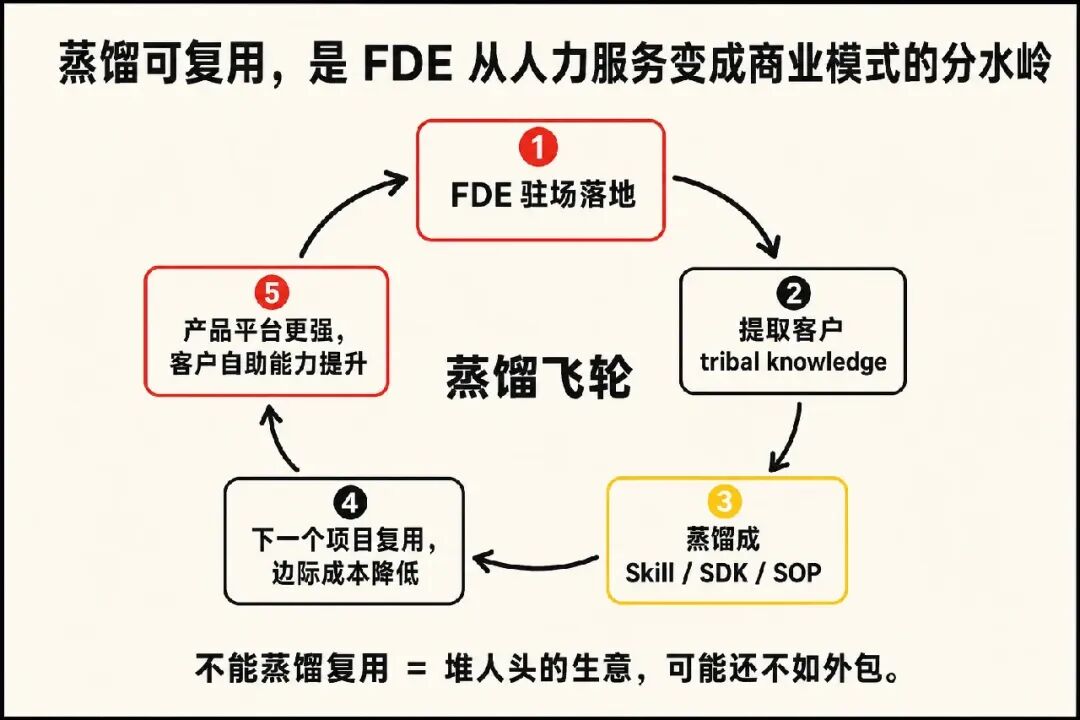
Distillable reuse is the watershed that turns FDE from human services into a business model
Palantir has been doing FDE for over a decade—is it still the same species today?
Same name, but the species has changed. Ten years ago, Palantir's FDEs struggled to accumulate knowledge or influence the product, and many who left complained they had no say over Foundry—"If you don't know how to use it yourself, go read the docs." Today, AI coding has turned the sound of artillery into PRs: those who hear the pain points can boldly modify the repository. Another shift is in supply and demand: the last wave relied on business relationships to sell headcount, signing multi-year contracts and delivering slowly; this wave, internal push at large customers has risen exponentially while products are not yet 100% there, making FDEs the ones who fill the gap. But model companies doing FDE and SaaS companies doing FDE still have different motives—the former burns more tokens, the latter makes the product stronger. Cresta also has a 20-plus-person FDPM team, with mini-CTOs and mini-CEOs dividing the work. Palantir deserves respect, but copying Palantir is not the same as copying success.
What kind of company and boss can actually cross the last mile?
The two guests, from both the supply and demand sides, confirmed the same judgment: the only common trait of companies that can push AI forward is that the boss must be AI native themselves. Among the bosses Lu Xiaopeng served in the healthcare industry, at most 5% had this mindset. His strategy in six words: win the lighthouse customer first, then push downward. Zhong Qianjie saw the same shift from the supply side: last year he still had to spend effort persuading major clients to adopt AI, but this year there has been an explosion—no one wants to be in the last batch to be eliminated. Resistance from the middle layer comes from conflicting interests: once you distill everyone's capabilities, that person no longer has much reason to exist. Without C-level support, it's almost impossible to push through. This means a window of opportunity for companies deploying AI: while models keep getting stronger but aren't yet foolproof, the high ground you seize now will be hard for others to take later.
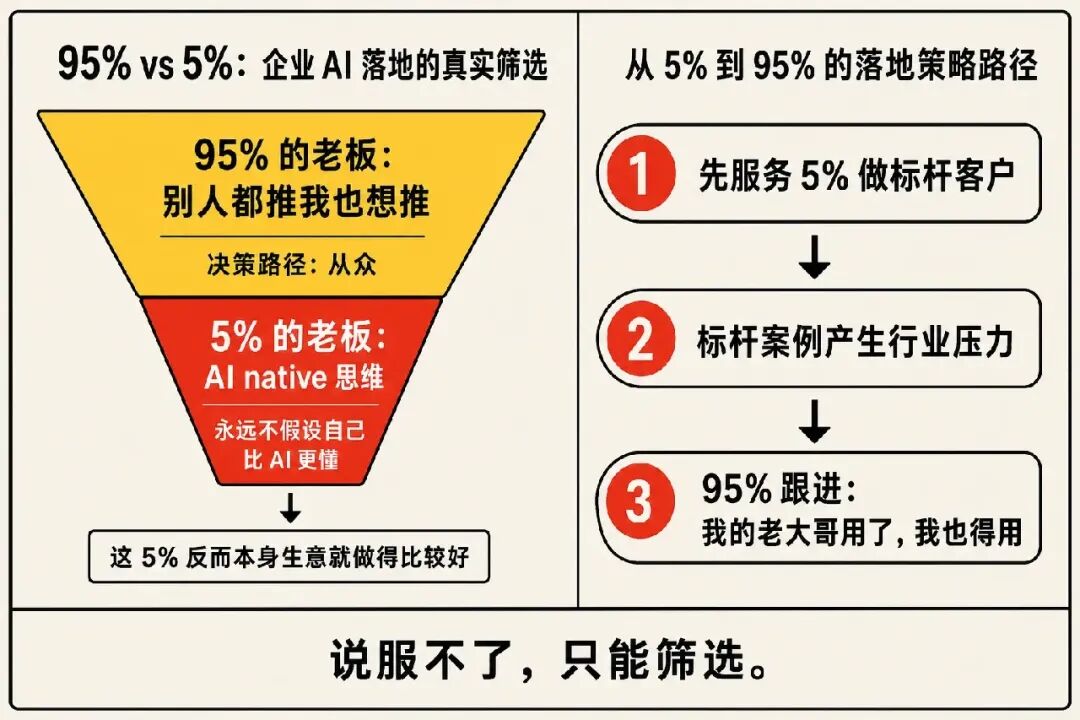
95% vs 5%: The Real Filter for Enterprise AI Adoption
Can the FDE model work in China? Is this path still worth pursuing for engineers?
High deal size is a prerequisite, but more fundamentally it's about payment habits and awareness. Domestic bosses often think "two or three people tinkering around could build this too"; clients even ask directly: "If you give me two people to accompany me, why can't I just hire two people myself and evaluate them?" A quote from Zhong Qianjie that was repeatedly cited in the discussion: "The most dangerous illusion is the boss having illusions." Lu Xiaopeng believes the business environment will gradually improve, but what FDE solves is how to actually get standard solutions into enterprises. The same discussion also came down to people: Zhong Qianjie rates his team's AI nativeness 9 out of 10, and in interviews he looks at where you push back against AI in Claude Code; Lu Xiaopeng rates it 1—each person is 10x more efficient, but the whole enterprise may only improve by one or two times. 7,000 resumes, twenty-some offers, an acceptance rate of less than 0.3%. FDE is the escape hatch out of the sealed room, provided you're fiercer than AI.
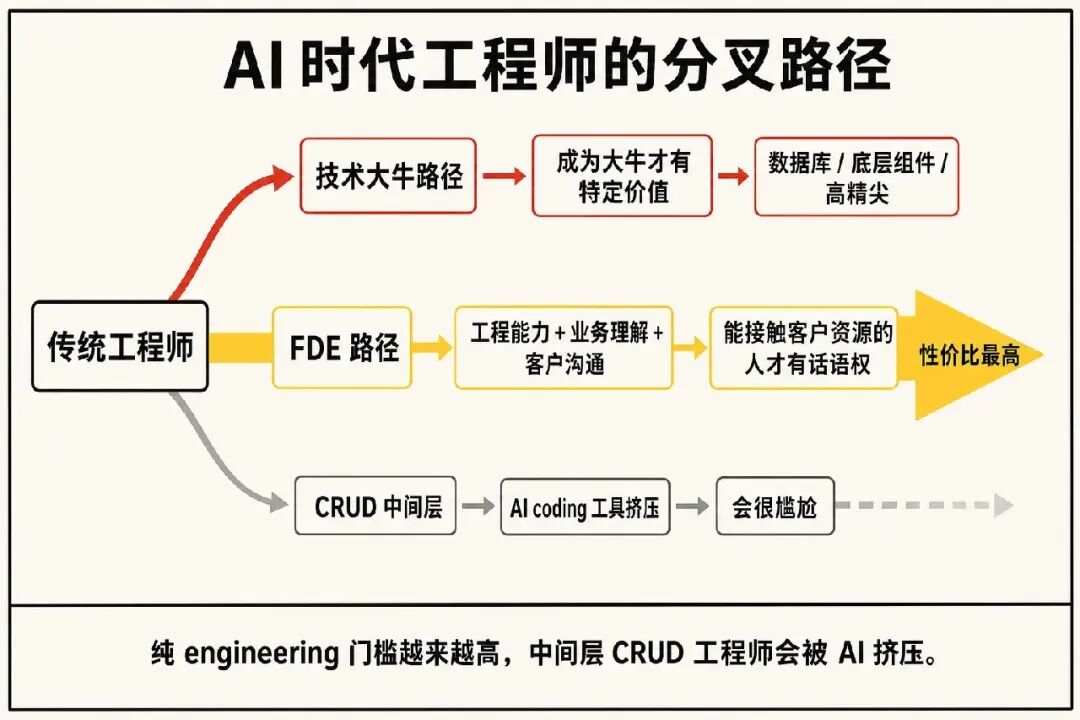
The Diverging Paths for Engineers in the AI Era
Full Interview
Yu Yi: Hello everyone. It's rare that our AI Lens series is happening in the morning—we usually hold it in the afternoon and evening. This may be the first time everyone is catching our livestream in the morning, starting their learning and brain-training time early. We chose this time slot because today is special: we've invited two friends, one in Canada and one in Silicon Valley. Right now it's morning for us and evening for them, which is why we picked this time.
As for why we had to invite two friends on the front lines to share with us this time: if you've been following recent news, you'll notice that OpenAI, Anthropic, and Google—the three major model companies we call the "Big Three"—have all made new moves, whether acquiring other companies, forming new companies, or merging with others to establish new companies, and all of them mention a term: FDE. I've heard many different Chinese translations for it, such as Forward Deployed Engineer. Later we'll discuss with our two guests which Chinese translation they prefer.
This time's topic is one we care deeply about: when it comes to AI deployment—especially given the overall acceleration we're feeling this year—how exactly is this role done and built at companies in Silicon Valley and the US that are a step ahead, and what are the roles of individuals and even teams? So we've invited two highly qualified guests: one whose entire company does FDE work, and one who leads the FDE team at a unicorn company, currently a team of 30, reportedly expanding rapidly to 100. Also co-hosting this discussion with me is Mr. Wang Peng, a senior expert at the Tencent Research Institute. If you follow Mr. Wang Peng's video channel, you'll know that for a long time the two of us have frequently discussed this new role and enterprise deployment, and internally we've written considerable research on FDE through internal reference reports. That's what you can look forward to in this discussion. Feel free to leave questions in the comments; we'll be watching in real time for new questions on this topic. We've already collected some related questions, so today's official AI Lens roundtable now officially begins. Moving into the formal discussion, let's have the two guests and Mr. Wang Peng introduce themselves in turn.
Zhong Qianjie: Hello everyone, hello host. Although it's evening, as you can see this is my real background, not a virtual desktop. The sun has just set, and Vancouver is quite pleasant. I'm currently living in Vancouver; I've been in North America for about nine years and work at Cresta. As the host said, we're a unicorn company headquartered in the Bay Area, focused on using AI agents to reshape customer experience. And it's not just call centers—many small and medium-sized companies without call centers now also want to use AI to answer questions and handle business.
I'm the Head of the AI Agent FDE team at Cresta; the team should now be more than 30 people. We have FDEs already onboarded in Canada, the US, Europe, and Australia, plus a dozen or so people who have signed offers but haven't started yet. We deploy production-grade AI agents for many leading enterprises in aviation, finance, healthcare, and more—companies like Alaska Airlines and Marriott.
Coincidentally, I was in Silicon Valley on a business trip last week and picked up an award I can brag about: FDE Team of the Year, awarded by Propel 26, a fairly authoritative industry conference. So it's an honor that our team has grown rapidly and gained industry recognition.
My own background: I graduated from Fudan University in early 2003, and previously worked at IBM, EMC, and Splunk with over 20 years of experience, always in engineering and mid-level management, building large-scale systems and earning some patents. Before joining Cresta, I spent four years as an entrepreneur doing real-time data analytics. I think that's an interesting point we can discuss later—the relationship between FDE and entrepreneurship. I'll leave more time for the other guests.
Lu Xiaopeng: Hello everyone, and first of all, many thanks for organizing this event. I'm Vincent, Co-founder and CTO of Ventus AI. Our company started in mid-2024, and when we began, my co-founder and I decided to focus on vertical domains in North America. Why this track? The main reason is that we felt Silicon Valley's technology is very advanced and everyone is excited to work on the latest tech, but what my co-founder and I wanted to do was truly apply that technology to vertical domains, letting experts from various industries combine their professional knowledge with AI to unlock greater advantages.
Our company received investment from a16z in the mid-2024 round. We now focus on the healthcare industry in North America, building real AI applications in healthcare—we call them AI teammates. Because healthcare has its particularities, this requires FDEs, which I can expand on later.
As for me personally, I graduated from CMU in 2021 with a pure AI research background, but I felt entrepreneurship was more interesting and challenging, so I've been starting companies and hustling since 2021. Interestingly, I also returned to China to work for two years, during which I got a sense of what the domestic version of FDE looked like. So now that I'm back in the Bay Area to start a company again, I can also compare the similarities and differences of FDE on both sides.
I. The Definition of FDE and Different Bets on Models
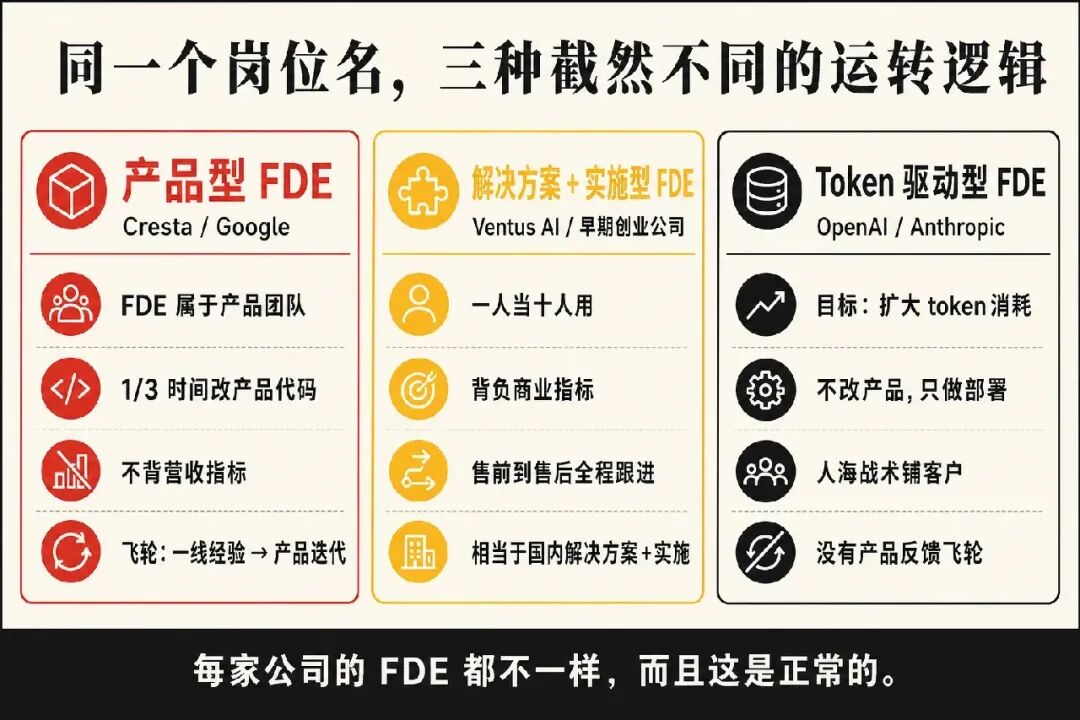
One Job Title, Three Completely Different Operating Logics
Yu Yi: OK, let's start with a definition, or a delineation of this role. As Mr. Wang Peng said, for many people in China, FDE is a new concept, but globally Palantir has been doing it for over a decade. That said, the role's current popularity should also be tied to this wave of AI. Regarding the translation question everyone mentioned, I've already seen several versions: Forward Deployed Engineer, Forward Deployed Engineer... What stays constant is probably the "engineer" and "deployed" parts. So I'd like to hear from Zhong Qianjie and Lu Xiaopeng: how do you define this role? Are there actually different types of positions within FDE in the market today? I've also seen that there seem to be three types of FDEs now. Please introduce your understanding, as well as the current state of and recent changes in the FDE role in the market.
Zhong Qianjie: I think the main thing is just not to call it "Frontend Deployed Engineer", because the word "frontend" is too easily confused with front-end development.
Let me go through this in order. Since this is an interactive discussion, I don't want to talk for five or ten minutes in one big block. Whether you're a front-end engineer or a back-end engineer, you probably feel some confusion these days, because AI is getting stronger and stronger. Let me start with a conclusion: FDE really is an escape hatch out of the closed room. Especially if you're very confident in your engineering skills, confident in your problem-solving ability, and not afraid of interacting with people (though if you'd rather hide in a room writing code, that's a different story), but if you have strong technical skills and are willing to use them to make things happen, FDE is a great way out. And I don't think there will be a so-called AI version of the FDE in the short term—one, two, or three years—because there's so much human element involved.
To make a long story short, my definition is Forward Deployed Product Engineer (FDE): not only do you land the product and build the solution, but you also bring frontline experience back into the product to make it better. Of course, this varies from company to company. Our company's characteristic is that we're fundamentally a SaaS with a very complex feature set—possibly thousands of APIs and tens of thousands of features. If customers had to learn all these features on their own after paying for them, it might take three months or six months and they still might not use them well. Especially now, the complexity isn't just in software features; the complexity of AI is enormous too—are you on OpenAI's 5.1, 5.2, or 5.3, and what are the subtle differences between them? Is your prompt more effective if you write the corresponding table as a Markdown table, or as several sections? There are many details that aren't obvious at all. Even if a customer has an engineering team of hundreds or thousands of people, they may not be as strong in AI expertise as our team.
So this complexity is right there—whether it's the complexity of the software itself or the complexity that AI brings—and if customers have to learn it themselves or stumble through the pitfalls slowly, it takes far too long. Nowadays we often finish a project in two or three months, and the customer gets an AI version that can replace a call center. When people call in, they don't have to wait half an hour or an hour listening to music; they can come right in and say what they need, give their order number, ask whether they can change their booking, and roughly how much extra it would cost—all these boring things can be handled by AI.
For this kind of AI deployment, FDE is a very good model. But at least for me, my approach is: these engineers deployed to the front lines take the information they gather there (what works well in practice, what products have problems or defects) and bring it back into the product, making the changes directly. This is a crucial point. Including myself and my team, we probably spend a third of our time continuously improving the product itself. Because we're not just hearing the gunfire—the shells are exploding right next to us—we know exactly what works and what doesn't. And these people are hired to a very high standard, very full stack, almost like mini CTOs. So once we know where the problem is and how to improve it, with today's AI it's easy to work on several repos at once, get things moving, and then do some manual testing.
Because AI coding is so powerful now, those of us on the front lines dealing with real deployments know where changes should go, then come back and have AI generate PRs to make the changes ourselves, so the product keeps getting stronger, and other FDEs can work on more advanced, harder, newer things. This iteration makes the platform stronger and stronger. Of course, there will never be a day when customers can just mindlessly drag and drop (the world keeps moving forward), but we're always making the platform more powerful and the quality on the customer side very high. We don't just walk away, we don't sell headcount, and we don't do consulting—we have a strong product mindset. So I think this is a fairly effective approach.
Of course, including the conference I attended in San Francisco last week—it was full of people doing professional services and selling customer services. They were very interested in whether they could generate revenue through the FDE model, charging by the hour or by headcount. I personally don't agree with that, because I don't carry a quota, and our FDEs don't charge customers directly. We're part of the product—it's like buying a car with a driver included, or buying a coffee machine with someone who makes the coffee for you. So we're part of the product, with a strong emphasis on making the product stronger. I wonder what Lu Xiaopeng thinks about this?
Lu Xiaopeng: As I understand it, the two domestic roles that map to FDE are Solutions Engineer plus implementation—at least that's how it is at our company.
Why do I say that? I think to define the FDE role, you first have to start with why the role exists. Why is FDE so hot in this wave of AI? I think the fundamental reason is that the speed of software development and requirements convergence can't keep up with the pace at which users want product features to iterate. That's why, for things the main SaaS product can't cover—because the customer is an enterprise, a key account, and needs these features—you need the FDE role to bridge the gap, building a bridge between user needs and the product's core functionality.
Looking back at enterprise services in China: a company has a middle-platform system, so how do you deliver to customers? Customer data is scattered everywhere, and there are all kinds of customization needs, so you need a solution. Once the solution is out, who delivers it? If it can be absorbed into the platform and handled by the product, it becomes a development requirement; if not, it's handled by on-site implementation developers. So that's my understanding of FDE: first produce a solution, then deploy and implement it. At least in our work on US healthcare scenarios, that's roughly the role definition for now.
Wang Peng: From what I've heard, domestic engineers will definitely have a question. Zhong Qianjie just made it clear that this should sit within the product team, while what Vincent described maps to the domestic Solutions Architect, which is a pre-sales role, and outsourcing and custom development are mid-sales or even post-sales roles. I think there's a disagreement here—what do you two think?
Zhong Qianjie: Right, and regarding this disagreement, a lot has happened in just the past two weeks or so: OpenAI set up a company, apparently spending a billion, and also acquired companies. Anthropic is also investing alongside a bunch of companies, and it's not playing with Accenture—it's partnering with some large PE firms, and that model is quite clever: it partners with institutions that mobilize their portfolio companies to use FDEs, so application-layer token consumption burns very hot. So OpenAI and Anthropic are doing this. Google also seems to have announced an FDE team just last week, and Google's FDE team belongs to the product team.
I think our philosophy is close to Google's, because we're a very complex SaaS—whether you score it 80 or 95, there's always some room for improvement that customers find hard to do themselves. We get things done through FDEs while continuously finding places where the product can improve, making the product more and more complete. So Google's approach is that FDEs both deploy and improve the product, and that's what we do too.
OpenAI's approach is more about selling more tokens, without wanting engineers earning millions a year to do this work, feeling the whole story doesn't hold together, so they're willing to spin off some companies, hire slightly cheaper people, make the story look better, and focus only on models. But conversely, I think models are actually the most easily replaced. Frankly, for me, Cresta's moat isn't the models. A single session of ours may use twenty-plus models, and we make sure we can switch between OpenAI today and Anthropic tomorrow. Our moat is more in having the entire stack be extremely low latency, with very accurate Tool Calls and very well-done RAG.
For companies like ours that are heavily AI-application-focused, we need FDEs to hide the complexity and make internal complexity more refined. For model companies, they don't care how the application turns out—as long as there are new use cases burning more tokens, that's enough—so they have no incentive to have FDEs work in reverse to make the product better.
It also depends on the size of the company. Our company has five or six hundred people now, relatively flat, iterating quickly, without many PMs or rigid processes, so this mechanism is allowed: an FDE sees a problem in the morning, fixes it in the afternoon, the CTO approves it, and it ships the next day. But you can't expect every company to move at that pace.
A consensus from the meeting two weeks ago was: every company's FDE is a bit different, and that's normal, because everyone is different.
II. The Divide Between FDE and Traditional Roles
Yu Yi: If there's nothing to add, let me add to Wang Peng's question. Indeed, whenever FDE comes up, both we ourselves and outsiders have a lot of confusion. This role is a new one in the AI field, but previously in SaaS—including the on-site engineers and outsourced engineers that Chinese companies are particularly good at, as well as Solutions Architects and customer success engineers—there seems to be some overlap with FDE. What do you two think is the most unique aspect of the FDE?
Zhong Qianjie: My provocative take is: anything you can teach the customer is not FDE work.
Yu Yi: So only what you can't teach the customer is FDE work? OK, is that the distinction?
Zhong Qianjie: Right. If you can teach the customer, then the complexity of that thing itself is limited. For example, if you previously did SAP implementation, some people think FDEs are just the suit-wearing SAP implementers from ten or twenty years ago. But with SAP, there's the opportunity to teach the customer or do it for them, so that's traditional implementation engineering or consulting.
With FDEs—especially FDEs for AI agents—it's because AI itself looks easy but is actually very hard. So what if you have 500 or 1,000 engineers? You still don't know how to build a good AI agent. I have too many examples: a company first thinks it's strong, even fights internal political battles to carve out a path, and finally builds an agent, only to find it's still not good enough—waiting three or five seconds for a question to be answered, prone to hallucinations, and even eliminating the last few percent of hallucinations is very hard.
So this is something that either can't be taught, or combined with a specific platform like Cresta, you can hardly expect the customer to learn. At that point, the FDE approach is especially effective, because the complexity is hidden away, and there are many magical parts the customer doesn't need to know about. So FDEs doing data engineering, FDEs doing security, or FDEs without any product accumulation—those don't count as real FDEs to me.
Yu Yi: So the product is the most important thing—there has to be something that lands in the product. OK, Lu Xiaopeng, since you've worked in both China and the US and are familiar with this role in both places, I'd especially like to hear your perspective from the front lines on both sides.
Lu Xiaopeng: I think this really has to be viewed from the stage of the company, because any role exists to serve commercial success. From what I've heard, Cresta should be the big brother, probably our next stage—we have things to learn from you.
Our company is at the stage of moving toward Series A, with a size of about 10 people. At this stage, how do we define the FDE, or what kind of person fits the need when hiring? First, they need to be able to communicate with customers, similar to half a customer success manager. Why? Because there are many customer needs right now, and we need someone to follow through from beginning to end (starting maybe a few months before the sale, through the sale, and after it). So the FDE has to cover that entire line.
Second, they need to understand the user's scenario and actually get the thing done. As I just said, they have to bridge the gap: the company's internal product covers 80%, and the remaining 20% is the customer's own needs—like how to get data in, how to export it, how to integrate with the customer's systems—and that's what the FDE needs to do.
So in an early-stage company, the FDE's definition is rather vague—you almost have to use one person as ten. At this stage, they first need to take on the customer success role, doing weekly meetups with customers, understanding new requirements and whether timelines can be met. That's the most important thing. Second, based on the timeline, break it down into milestones and deliver them. With these two lines covered, you can call someone a qualified FDE.
Wang Peng: From what I've heard, I get a sense: as the product form evolves (from fairly pure base models, to harnesses with some complexity but relatively thin—like context—to deeper industry-specific SaaS), the FDE's role is actually differentiating along the way. At first it might be relatively general—both telling users how to operate in an AI-native way and how to develop; later, if your SaaS specialization is already fairly high, it becomes product deployment or solving users' specific problems. This may indeed be related to the evolution of the product form. When I did research inside Tencent, I got the same feeling—the FDEs on our own internal teams are completely different in nature.
Zhong Qianjie: Right. And given our company's current state, I think it's quite fortunate for me and my team—we focus more on the AI agent itself. The company also has SEs who mostly handle demos, and SAs who mostly handle integrations with call center systems, like Five9, NICE, and so on—roughly 10 to 15 very complex systems on the market, some of which came out 20 or 30 years ago. The integrations are very technical but not AI. We have dedicated Solutions Architects who handle these telephony system integrations, knowing how data flows back and forth, how conversation history gets written to tickets or placed into Snowflake. These data engineering tasks are done by other teams.
I think this is a luxury and a stroke of luck—my team can spend more time on the AI agent itself. Of course, ultimately our FDEs are responsible end to end; technically speaking, they're like a mini CTO—we can talk with customers and understand the business situation. But we influence the whole deal and the whole process more through technical means, making changes.
Because the company is neither particularly small nor particularly large, there are dedicated people with different responsibilities to handle fancy demos or large system integrations. That way, our group focuses more on tackling hard problems: how to eliminate hallucinations, how to reduce latency, how to provide a smoother communication experience. These AI-related things are often hard to keep up with—best practices may need to be overhauled every three or five weeks—and we can devote a lot of energy there. So it's mostly luck. Different companies, different forms, different markets—FDEs will operate differently.
III. From Demo to Production: Complexity Beyond Imagination
Yu Yi: You just mentioned this. Earlier you also mentioned that right now you have to handle two kinds of complexity simultaneously: one is software complexity, hoping customers can use it well, and the other is the model itself. You think the complexity of the model itself, or of agents, is even higher than that of software. I'd like to ask you both: from a demo to an agent or related product actually being deployed at scale in enterprises, where do the complexity and difficulty mainly concentrate?
Zhong Qianjie: For us, we focus mainly on customer experience, starting from call centers and now also doing non-call-center business. For example, with a voice conversation: from the moment the call comes in (needing to detect the language, do ASR, determine when to interrupt, when to let the other party think, whether there's noise requiring voice isolation, whether there are special terms requiring handling), then let the model think—in between there may be retrieval, embeddings, tool calls, MCP, plus memory management and context and session handling—and finally generate text and do TTS to convert it to speech.
Even throughout the whole process, you can't just let one model think and talk on its own. We have guard rails, many concurrent models, even from different vendors, to judge whether the main model is saying the right things—for example, if it touches on politics or sensitive topics, it needs to brake. So you might end up using 20 models: some focused on speech, some on conversation, some on reasoning, even multimodal ones for image judgment. So model selection is a heavy task.
If you need to handle special scenarios—for example, PCI (things related to credit cards), or possibly HIPAA and healthcare-related work that Lu Xiaopeng's side can handle—industry regulations are extremely strict. Passing certification may take six months to a year of extensive audits and lots of documentation. AI-level development also involves this: what information can be stored, how data must be handled, what needs to be filtered, how long things can be kept. In some scenarios you can only use models in a specific environment, not public models, because they don't support PCI or HIPAA well.
So there are many choices, which also makes debugging extremely hard. This looks easy—as if you could just post a tutorial online and build a locally runnable model. But for enterprises, the compliance in between and improving communication smoothness are all very hard. And as an FDE, suppose you spend a week getting the end-to-end flow working—you may then need to spend a month writing thousands or tens of thousands of tests. These aren't traditional unit tests or SIT tests; they need to figure out how to simulate the way people normally talk in these scenarios. And if you can get one or two years of call history, you can build a small model to simulate those calls—for example, whether the callers were impatient or nice.
Take a dental case, for example: the patient may have already lost their teeth and speaks unclearly—how do you handle that? There's a very real, harsh, and complex side to this. FDEs must dive in and co-create with customers to make it work. That's also why I think big model vendors like OpenAI and Anthropic can't rely on tokens and compute alone; they must clearly understand how to get applications to land and keep users using them long-term.
Back to your question: I think there are too many places in between that require extra engineering and communication. Testing is a big part, then model selection—how to have a solution that isn't too expensive yet follows what you want to do reasonably well, avoids hallucinations, and keeps up with the customer's iteration pace. For example, some customers we're talking to may have new material packages every two or three weeks, and this information needs to be effectively kept up with, including multilingual content. There are very complex things that look easy but are actually hard. That's why enterprise AI still has a big market and a long road ahead.
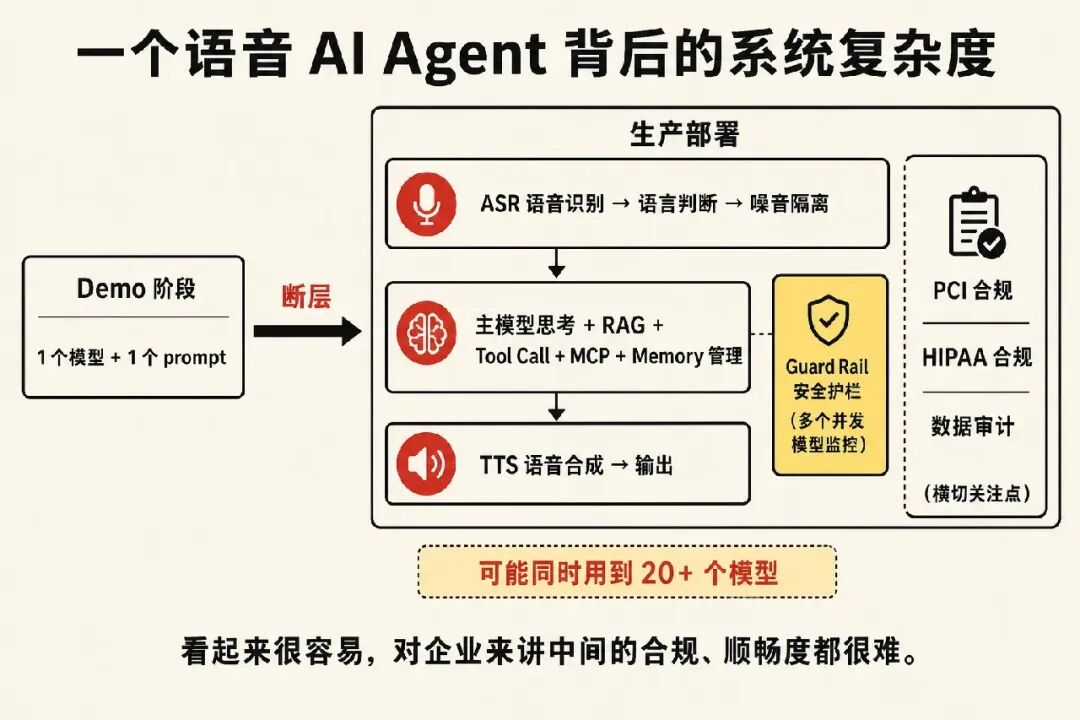
The system complexity behind a voice AI agent
Lu Xiaopeng: For our company it's a bit different, because we're still at a fairly early stage. The FDE role, as I just said, is a role that blends multiple positions together.
On one side is customer success: the FDE has to follow the customer's entire lifecycle. How do you build a pilot or demo that gets the customer to sign? It's more about how to quickly and cheaply put something together that impresses the customer—at that point it's more of a customer success role.
During the sales process, the difficulty lies more in integrating with the customer's systems. This exists in traditional industries too, but especially in the healthcare industry we're currently working in. We do some specialty care in healthcare, such as dentistry and dermatology, and the systems they use are even more outdated. This may be what Zhong Qianjie mentioned earlier—something they have a dedicated team doing: integrating with relatively old systems. But for us, it's all done by a single FDE role, so it's very challenging. With old systems, first, technically you have to work with their IT; second, learning to use such systems and their products takes a lot of time. That's the second difficulty.
Overall, there's another one: within the framework of business goals. FDEs at our company also have to carry some business metrics—for example, how much value to deliver to a customer this year, whether it's saving you two million or helping you earn two million more. At that point the FDE has to think about how to set timelines, how to set milestones, and how to hit targets. Of course, this third point definitely has to be worked out together with the company's CEO and CTO.
Overall, compared with a relatively late-stage company like Cresta, at companies from seed round to Series A and even Series B, the FDE is a fairly comprehensive role that has to consider all aspects and manage the customer's project progress and expectations as a whole.
Wang Peng: Because when I talk with major Chinese companies, one consideration about where to place the FDE is whether there's something like Palantir's "ontology" accumulation. Placing it in product may help accumulate experience; but some things, like data, not only have little to accumulate but may be a heavy burden—better handed to outsourcing. Have you considered whether accumulating reusable knowledge is related to where the FDE is placed?
IV. Distillation: The Core Value of the FDE
Zhong Qianjie: Accumulation is definitely very important. I wonder if Lu Xiaopeng's side also encounters things like Epic systems in dentistry. Frankly, I think the more mature the customer is, the better it is for enterprise AI companies like us, because, for example, I've encountered customers whose IVR phone systems connect to a mainframe—very old technology—and now they want to start doing intelligent voice, which requires time to build APIs and sort out their SOPs and such.
At that point, embracing AI is very important for them. They may have been skeptical about embracing cloud computing or mobile before, but now, if they don't embrace AI, it's hard to explain to investors, customers, or even employees. So everyone needs to embrace AI, but they need a strong partner to sort out the SOPs, sort out the data, and build the AI. As an external force, we're actually very effective—even more effective than hiring McKinsey to produce some slides, because we ultimately build the thing, turning ideas that live in people's heads into something AI can automate. For the customer, it's clearly cost reduction and efficiency gains, or making the business more agile.
If we have some accumulation for specific scenarios (like dentistry, travel, insurance), the next project becomes much easier. So we develop some SDKs and templates ourselves. Suppose an FDE has already built five or six insurance-related agents—the next one will come easily; they'll be adept at industry vocabulary and processes, even non-technical things, and it's easier to reach consensus when communicating with the other side. If you have a completely new vendor jump in—technically fine but with no concept of the product or vocabulary—people easily see them as an outsider, and it's hard to reach consensus.
So accumulation, whether grand narratives or small points, is a good thing. The fear is that people stay high up in the clouds, with an ICP that's too grand and unfocused, and in the end nothing gets done.
Lu Xiaopeng: I understand the essence of accumulation as distilling human knowledge. What's scattered in each person's head isn't accumulation, but if it's converged into a concrete form of knowledge within the enterprise (whether a knowledge base or a skill), that's a kind of accumulation.
In the process of using FDEs to deliver for customers, we're actually helping customers accumulate their knowledge, turning tribal knowledge scattered everywhere (the experience in each person's head) into automation, into part of automation. So what FDEs do is essentially helping enterprises accumulate.
The other kind of accumulation is how to distill our own set of SOPs from the process of FDEs helping enterprises accumulate. This is something we take very seriously at this stage: how to distill the knowledge each FDE has learned so other FDEs can learn it faster. Because only by doing this can the business gradually become scalable and grow quickly; otherwise it's a headcount-stacking business that might be worse than outsourcing—outsourcing is paid upfront by hours, while FDEs sign annual contracts paid monthly, so that business model definitely won't work.
So essentially it's still about accumulating layer by layer. What ultimately gets accumulated is customer resources and the company leadership's understanding of the industry—knowing clearly what is a good business in this industry and what isn't. For example, for certain system integrations, no matter how you optimize, they take that much time; compared with another system, I've distilled a set of SOPs and know exactly which departments' people to approach in a company of that size and what information to obtain, so I can bring the integration time down to under two weeks. With this kind of business insight, you accumulate a lot of useful information for the company's future expansion in the industry.
Zhong Qianjie: The word "distill" is quite interesting. You might even say an FDE is a distiller—we help customers distill, and in fact we're constantly distilling ourselves. Of course, I know that in China there's also been a lot of buzz lately about things like "anti-distillation."
Yu Yi: The theme of our last episode was inviting those authors over to discuss the original work.
Zhong Qianjie: Right, very interesting. I think at least in our current state we have no worries holding us back—we spend all day thinking about how to distill ourselves away. So the FDE team internally maintains a pretty impressive collection of distilled outputs. Basically, if you've integrated with a certain system or optimized voice, you've done a lot of distillation work and produced many skills. These skills might be a Markdown file, a CLI, or a script. What we're doing now is packaging these distilled outputs in a new way that customers can use.
Because enterprise software is often extremely complex—there may be thousands or tens of thousands of features and many parameters to tune—customers don't have time to dig through documentation and experiment on their own. But they do know what problem they want to solve. So we now have a new mechanism (one that's being used more and more in Silicon Valley): providing a very agentic approach where customers say what they want to do, and behind it an agentic workflow combines these skills, best practices, CLIs, and even sample code to try things out. "You want to do this—great, I've got it done for you; if it doesn't work, I'll try the next approach." This form is neither an IDE nor a form—it's a highly intelligent tool. This is also something our FDE team at Cresta spends a lot of time on: distilling ourselves well and distributing it in some form to colleagues who do demos, partners, and even customers.
Of course, this involves some sensitive things—IP, hard-won know-how—so it's not fully public; it's more of a value-added package. If you're our customer and you're willing to tinker yourself but don't want to learn everything, just use this tool and you can leverage the skills we've distilled to get things done. Customers love this too—they want some control but don't want to learn, so these distilled outputs are a great fit.
Of course, you might ask: if I have twenty or thirty people all distilling themselves, won't their jobs be at risk? But if the company keeps growing, you'll move into different industries (say, one day we enter nuclear power or a new industry), and there will always be new things to do. We want to make the things we currently do a lot of—insurance, hospitality—as foolproof as possible, so AI or customers can do them. Of course, some things don't need to become skills; if it's something deterministic like adding a cache or a parameter, just write it directly as a recipe or a CLI. But there are many things where AI may need to burn some GPU cycles and tokens to attempt completion—we distill those into skills, which are useful for ourselves, for customers, and for partners.
Wang Peng: Yes, I'd even say that being distillable and reusable, and able to reduce marginal costs, is a prerequisite for the FDE model to work. That's also why it differs from traditional custom development, and why at this point in time we've started paying attention to this business model: with large models and skills, distilling and reusing experience within an industry has become possible, lowering the cost of repeating the same work, turning it into a business rather than a headcount.
V. Palantir's FDE and Today's FDE Are Already Two Different Species
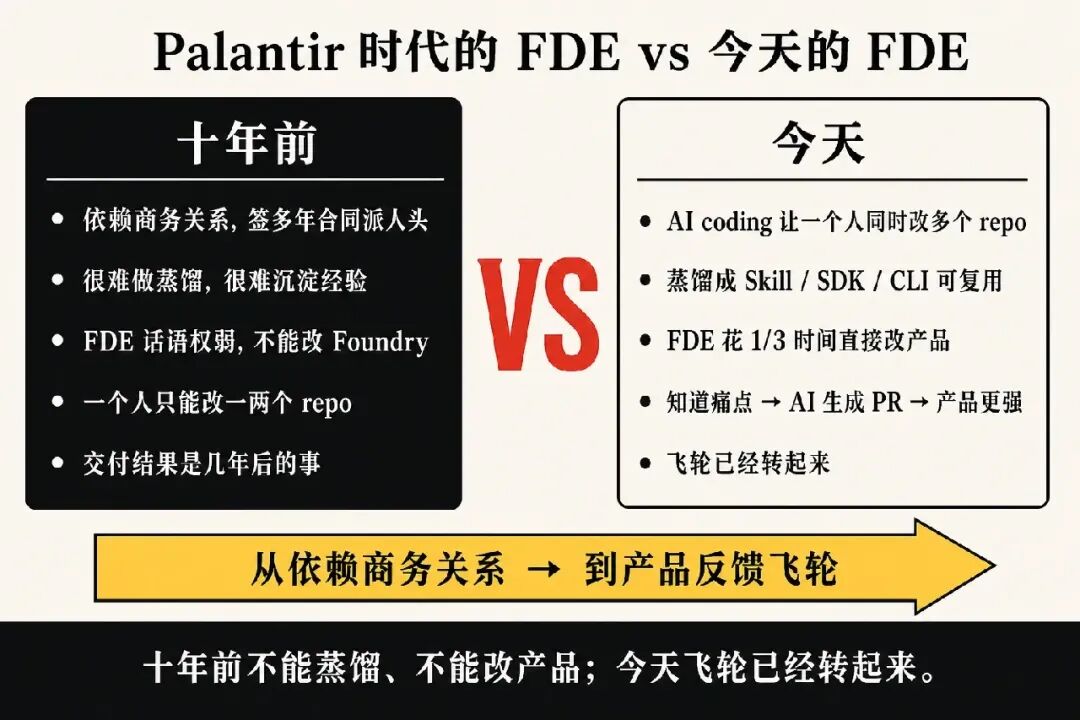
Palantir-era FDE vs. Today's FDE
Yu Yi: On the topic of FDE, I'd like to use this question to wrap things up before we move into more interesting, more specific discussion. I'm curious: Zhong Qianjie and Lu Xiaopeng, has the FDE role in the AI field already changed dramatically from Palantir's original model? Also, since the second half of last year, with the large-scale advancement and popularity of AI coding and AI agents, has the FDE's job itself also seen related changes?
Zhong Qianjie: One part is that because AI coding and AI are so powerful, FDEs—these people who hear the cannons, even have shells exploding right next to them—can now boldly modify the product based on pain points and itches. That was impossible before; you might have been impressive to modify one or two repos, but you couldn't know everything. Now AI lets you change anything—TypeScript, Swift, databases—as long as you know what you want to change, AI gives you the chance to change it. So this product-oriented type of FDE becomes more viable. Including what Teacher Wang mentioned—these mechanisms now make distillation feasible.
Ten years ago, doing this at Palantir was very hard. Honestly, I've interviewed many people who wanted to leave Palantir, and many of them weren't really into AI—they might have been doing data engineering or IoT stuff. Because the Palantir background is strong, they could land a lot of business; some of it was dirty work, some not sexy and not AI, but because the channels were there, they did it. So on one hand, Palantir ten years ago needed more people doing hands-on service to get things done; at that time there was no good opportunity to build skills, it was hard to accumulate knowledge, and it was hard for one person to learn about a pain point and then go back and change the product.
In fact, from my interviews, a major pain point for many FDEs who wanted to leave Palantir was that FDEs had relatively weak voice and no opportunity to push Foundry around. When they found something hard to use, the Foundry people would say, "You just don't know how to use it—go read the docs yourself." The Foundry folks had a sense of superiority and didn't think they had a problem, so a good feedback loop never formed.
Palantir is still a remarkable company. Some of the models inside Palantir, as Teacher Wang mentioned, include Delta and Echo. At Cresta we buy into this: I have a 30-person FDE team, and my peer leads a team of roughly 20 to 25 FDPMs—Forward Deployed Product Managers. Essentially, we're a bunch of mini CTOs, and the other group are mini CEOs. They're highly capable, good at reading people, and they need to own these behaviors; often they're the ones writing the test cases. They don't need to actually touch code, don't need to know how to do context engineering, MCP integrations, and so on. But they're sensitive to basic logic, interpersonal relationships, and the costs, dependencies, and risks encountered along the way.
So we complement each other well—no need for FDEs to be in meetings with customers all the time; some meetings have nothing to do with technology at all, and the customer hasn't even articulated what they're arguing about. At that point, an FDE's time isn't being spent very wisely. The corresponding FDPM team can step in to guide the discussion and build consensus; they influence more through people, while we influence more through technology. Palantir is certainly worthy of respect, but copying Palantir's FDE model doesn't mean you'll be as successful as Palantir.
Lu Xiaopeng: I think the essence of Palantir's model is that first there's a commercial relationship. I'm not saying the company is only about commercial relationships—I just think a precondition for FDEs to exist is that there must first be a commercial relationship, and the customer must be big enough to justify deploying one or more FDEs; only then does everything below come into play. If it's a small customer paying you just 50K a year, there's no opportunity for an FDE.
The difference between the last era and this era, I think, lies mainly in this: before AI came along, everything relied heavily on business relationships. Once you had those relationships, selling headcount was easy—you'd sign a multi-year contract and dispatch a few people to the client, and how things ultimately turned out was a matter for years later. It was a slow model with long time cycles.
This wave involves a fundamental change in supply and demand: many large companies have a strong internal push to roll out AI, and demand is already growing exponentially. Everyone wants to win over big companies, but nobody has a 100% ready product. So what do you do? OK, I'll give you one person or a team of people. It's still fundamentally driven by business relationships. The boss signs the deal—can it actually be delivered? Of course you say yes; you'd never sign saying you can't deliver. But the product isn't there yet, so you deploy FDEs.
So what has actually changed? I think the change is more like what Jove said earlier: how to distill reusable knowledge from the user requirements gathered by FDEs, or how to iterate on the product faster—that layer has changed. Because coding agents are so powerful now, FDEs themselves can distill knowledge back into the company, making the product better and better. That flywheel has already formed. This is a major difference between this wave of FDEs and the previous one.
VI. A Week in the Life of an FDE: On-Site Work Is the Exception
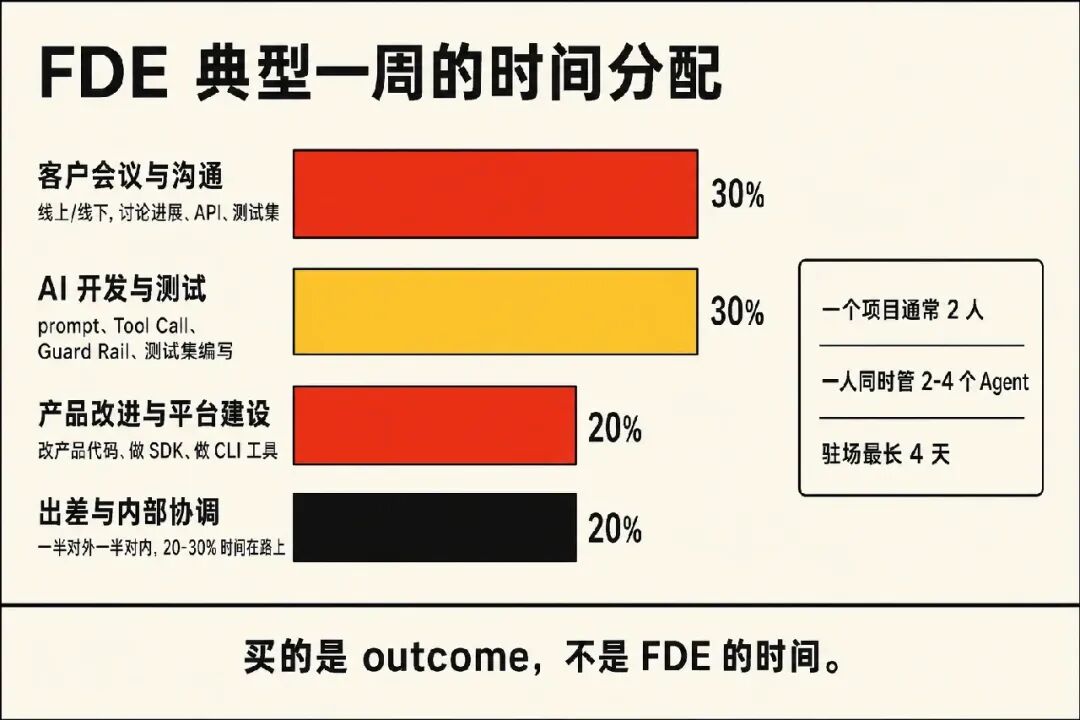
A typical FDE's weekly time allocation
Yu Yi: For the second part, I want to ask you both a very concrete question. Since you are both FDEs yourselves—one a founder-FDE and one an FDE lead—could you describe what a typical week looks like for an FDE?
Jove: First, I need to reiterate: at our company, on-site work is just an occasional episode. As far as I know, nobody on my team has spent more than four days at a single client.
We do sometimes need to forward deploy to a client's site, to have meetings and meet people, but usually that's just at the start of a project, then another visit two or three months later when UAT acceptance is approaching, and maybe one more after that. In between, it's daily or weekly online meetings. What do we do when we go? Usually discuss the big picture: what they want to build, how to measure the KPIs, which APIs are available, which knowledge bases and SOPs exist, getting test accounts—those details—plus getting to know everyone. Since friction is inevitable later on—APIs not working, outdated documentation, someone going on leave—having coffee, meals, and drinks with people early on is very useful for later collaboration; you don't have to beat around the bush or hold back.
Meeting with clients (whether in person or online) is certainly a very important part of an FDE's job. On average, travel accounts for maybe 20% to 30% of my time, and about half of that travel is internal and half external. Because FDEs are tightly bound to the product, a lot of time goes into communicating with internal teams—what problems exist, where there's room for improvement, whether there are new approaches. Even meeting with various senior leaders, building consensus, sharing meals and drinks is useful, because a lot of co-creation happens later. They also help with interviews. So travel might take up 20%.
Then there are many meetings with clients to discuss progress—whether the API is ready, how the test set is doing. Some time is spent on development work: writing prompts, writing Tool Calls, writing test cases, and defensive things like Guard Rails. But even more time goes into building test sets. In the AI field, test sets are extremely time-consuming; if you don't test properly, you're just relying on luck. Even a 3% or 5% hallucination rate can be disastrous—potentially major brand damage—so you have to drive the hallucination rate down very low.
On the engineering side, we also spend 10% to 30% of our time improving the product itself, including turning common features into reusable SDKs, building them into the platform, or even into a CLI. We've already built several versions of our CLI. The early ones were pretty rough; the current one is more agentic—for example, it automatically suggests available commands and parameters, and after running one command, it suggests what to run next. That way, if you use Claude Code or another tool to take over, the CLI can be chained together. So FDEs spend a lot of time making the developer experience and the platform easier to use.
We try to leave most business communication to our sibling team, FDPM. So we're lucky in that we don't have to do everything ourselves like Vincent's team did early on. We have some room to each focus on our own roles. Of course, there are still moments when someone has to make the call—things get bounced back and forth or quick decisions are needed, because in today's AI market, everyone wants to lock in big clients and build stickiness early. If you act slowly, hesitate, or ship things too slowly, you may lose the opportunity. So that's roughly how our time breaks down: some time on the road, a lot of time in the office or at home doing development, lots of AI-related testing, and some platform-level changes.
Lu Xiaopeng: It's similar for us, except that none of us has a sibling team—each person is their own team. So we probably spend even more time on client engagement. You have to start from understanding requirements, then coordinate with multiple departments at the client—first the business departments, then IT—then come back and develop, deploy for them, and report to their leadership. You have to follow the entire chain. But otherwise it's pretty much the same as Jove's team.
Yu Yi: You only let FDEs stay on-site for a maximum of 4 days? Isn't that a common misconception about FDEs—that they might need to sit inside the client's company and build everything for them? What does support, service, and delivery for clients generally look like for an FDE?
Jove: This really varies from company to company. I've heard that OpenAI, because it has so much money, can hire lots of FDEs—reportedly it had one or two hundred FDEs even before becoming a standalone company. When OpenAI hires FDEs, it's often group warfare: five or six people dedicated to serving a single client, providing all kinds of services for whatever that client wants to use from OpenAI. That's a different story—one person or four or five people serving the same client for six months or even a year and a half—I'd say that's basically no different from true on-site work.
But we're different. On my side, a project usually involves two people, so they can look out for each other, do code reviews, and it's not awkward when one of them goes on leave. Meanwhile, one person might be working on two, three, or four AI agents at the same time. So we rarely have anyone stay at one company for more than a week, because even while there, they'd be busy with other clients' work. Of course, you have to communicate this well—you can't just tell one client, "I'm off to a meeting with another client."
From the client's perspective, we don't want them buying our time; they're buying outcomes. As long as we can deliver the work well, they don't need to micromanage our FDEs' time.
Different companies do things differently. What we ultimately deliver is a highly unified customer experience—whether it's a phone number or a chat window—and what we build is ultimately for the client's customers to use. Take Alaska Airlines, for example: what we build isn't for Alaska's employees, it's for Alaska's customers. Building a good voice model or a good chatbot is actually quite hard. Once it's done, it goes straight into production, running in our own SaaS. Every company's product form is a bit different; this is how we do it.
Lu Xiaopeng: For us it's even more extreme—our FDEs basically never work on-site at all.
The reason is this: we know exactly what we're providing to clients. Since we're at the Series A stage, we're very clear that for clients of this size, providing these services means they'll pay a certain amount, because we save them or earn them a measurable amount of money. If you're that clear about it, there doesn't seem to be much need for on-site work.
I think there are two situations where on-site work makes sense—one good, one bad. The good case: a very large deal with an enterprise client, where I need to give them confidence, dedicating that much headcount to serve them—three to five excellent engineers on-site for six months to do this work. The prerequisite is that I know what to deliver: because of data compliance or data integration issues, there's a clear purpose requiring that many people to do that one thing—hence the on-site presence.
The bad scenario is: I don't really know what to have you do, but you're a major client, so let me give you one or two people first and figure it out later. I think this is very bad—I don't know what to sell, but I'll grab the spot first and talk about a concrete contract six months later. Many companies do this now, but I think it's unhealthy and doesn't create much value. When a company's decision-makers can't even figure out what value they can provide to industry companies, but shift the pressure onto the FDE, that's not the right decision.
Wang Peng: If long-term on-site presence exists, is there a possibility that in the future clients will hire such roles themselves? Or for some low-value things, wouldn't it just be an outsourcing company staying there long-term to provide clients with emotional value?
Lu Xiaopeng: This is something that came up while serving clients (clients chatting casually with us)—they told us that recently many companies said they'd assign two people to keep them company. Our clients themselves do think, "Why wouldn't I just hire two people myself? I can even evaluate them—why do I need you to give me two people?" People really do think this way. So this business model doesn't hold up in the long run, or rather its margin is inherently very thin.
Yu Yi: The first time I learned about the FDE role was when the head of Scale AI's enterprise business gave a talk, saying he had something like a special forces unit—a three-person squad that would go directly into client sites to help them build products and do delivery, especially data governance. Listening to Zhong Qianjie and Lu Xiaopeng just now, I feel you've corrected some of my views on FDEs—it seems that because big companies or model companies have plenty of money, or because user exploration is still at an early stage, the model of directly sending people on-site seems to be the approach.
VII. Can the FDE Model Work in China?
Wang Peng: Obviously, high customer deal size is an important prerequisite, which is also why domestic vendors are confused. Domestic SaaS margins are already thin. Do you think high deal size could be achieved in a different way in China? Since domestic deal sizes can't increase in the short term, will this become a major limitation?
Lu Xiaopeng: First, about that Scale example—I think there's another point: Scale's own company culture is one that loves doing this kind of thing, everyone tackling projects together. Sometimes when they tackle a project, they'll book a hotel, book a few rooms, and grind for two weeks—they just love doing this. So I think it's determined by company culture.
Back to Mr. Wang Peng's question, I think it's possible—just find clients with money, do to-G business. But doing to-G doesn't necessarily make money either. So I think it's very difficult. Without high deal size, it's very hard to do. A possible situation is that I know it's a pain point and I've built it, but there's just no money. So it's still determined by the business environment.
Zhong Qianjie: We do target fairly large enterprises (Fortune 100), so our deal sizes are higher. PLG, which used to be discussed a lot, is viewed differently now. Including discussions about whether SaaS is dead—because if you can Vibe Code something, and the remaining 20% can't be reflected in SaaS, people are increasingly worried about that remaining 20%, thinking, "Since you can't do that 20%, I'll just do it myself." So SaaS that previously pursued PLG and commonality faces big challenges in this era as people become more discerning.
We ourselves are a fairly complex platform—it's hard for people to Vibe Code something like it in a few weeks. We also want to create stickiness: after building the AI agent, it's already live, clients love it, and our low latency and accuracy are there, making it hard to migrate away. It's not just swapping a model from OpenAI to Gemini—you'd have to replace a complex system, and the many AI optimizations behind it are a black box to clients. So for them, if it can save them a certain amount of labor and provide a certain amount of emotional value for customers, and the cost per month or year is known, once the ROI checks out they won't want to leave.
In China, with the deal size issue, or people not caring much about the cloud and wanting private deployment, or bidding wars thinning profit margins, the FDE becomes rather awkward. We also have entry thresholds—below a certain amount we won't consider FDE, or we'll offer relatively low-end PLG or self-serve products. But for larger enterprises, they still want to use FDEs to launch early. Even if the FDE eventually hands over organized skills or tools and they're capable of maintaining them afterward, they don't want to spend half a year learning themselves—it would put them at a disadvantage in a competitive environment.
Wang Peng: Vincent also has experience doing similar business in China. Do you have any advice for FDE vendors in China? With deal sizes not that high, is it possible to make it work in some way?
Lu Xiaopeng: First, I think deal sizes will gradually increase and the environment will gradually improve. Another thing is people's payment habits for enterprise software—these consumption habits need to be cultivated, just like watching TV shows, which Tencent Video and iQiyi spent ten years cultivating. The same goes for software.
Right now in China, people doing enterprise services often fall into a dilemma: the boss's mindset is "I can whip something up with two or three people." But FDE is essentially about solving the last mile: standard SaaS or open-source solutions are easy to obtain, but how do you actually use them in an enterprise, and use them well? In the US, people are more accustomed to finding vendors and service providers to do this. This is also why a company like Cresta is so valuable—not just providing a platform, but truly deploying the platform into enterprises to make it generate value.
It's the same for us. On this point alone, in China it may still come down to each enterprise's margins being too thin—they cut costs wherever they can. So it's still the broader business environment; if it improves step by step, this model will gradually become viable later on.
Zhong Qianjie: And there's a joke: the scariest hallucination is when the boss has a hallucination, thinking "this thing can just be handled with AI."
VIII. What Kind of Enterprises Can Actually Drive AI Adoption
Yu Yi: Speaking of hallucinations. We all say FDEs help enterprises cross the last mile from AI demo to real business. I'd like to ask you both: for this last mile to be truly crossed well, beyond the services you provide, from the enterprises' own perspective, what common traits have you observed in enterprises that genuinely cross the last mile? And to help them get there, beyond what you do yourselves, what do you usually help enterprises with, or hope they do themselves?
Zhong Qianjie: Lu Xiaopeng, why don't you go first.
Lu Xiaopeng: In the AI era, if an enterprise wants to cross the last mile well, first the boss himself must be AI native. We've found this is the only point that matters—nothing else does. If the boss is certain that AI is the next opportunity to make his business grow exponentially, then no difficulty is a difficulty, and all resources can be secured.
For the boss, everyone hired is an investment, part of the factors of production. How to adjust these factors and accelerate the process depends on whether the boss wants to accelerate it. The specific change management is actually a big issue: we found that when pushing two clients of similar size simultaneously—one where the boss says "everyone else is doing it, so I want to as well," and another where "I genuinely want to push it, I'm very certain AI must start now, and I'm willing to invest this much and that much"—the difficulty of change management is completely different on the two sides. With CEO-level support, things move very, very fast.
Wang Peng: Please continue.
Lu Xiaopeng: Because for mid-level employees, they and AI are sometimes mutually exclusive—if you distill everyone's capabilities, then the person themselves no longer has much reason to exist. This is very challenging. Without C-level leadership support, it's indeed hard to push forward.
Wang Peng: A follow-up question. You talk about AI native, but this is hard to pin down. I often see a problem: it's precisely the boss who hasn't figured it out. The common logic of custom development is "I'll keep doing things the way I always have, and you use your tools to enhance what I already do"—that's a "+AI" approach. Another approach is "we tell them how other companies in their industry are doing this in an AI native way with our help"—that means you need to persuade them, and you need to understand their industry even better than they do. Which of these two situations do you think is more common, or how do you weigh them?
Lu Xiaopeng: In the healthcare industry we serve, 95% of people are in the first category: I have this org structure, all the software I buy serves that org structure, and AI is always just a pilot—seeing which part of the process can save some headcount, so they bolt on tools.
The second kind is more AI native. How do you define AI native? I think it means never assuming you know better than AI on anything—whether at the org structure level or any small execution level, never assume you know better than AI. Instead, first ask AI "from your perspective, how do you see this?" and then keep iterating with AI. That's an AI native mindset and starting point.
But very few bosses have this mindset—maybe at most 5% in our industry. Yet these people tend to be the ones whose businesses are already doing well, genuinely leading in the industry.
Wang Peng: So even then, you haven't persuaded that 95% to move in this direction?
Lu Xiaopeng: You can't persuade them; you can only filter. You can only sell to them in language they can understand.
Zhong Qianjie: Half-jokingly, there's now a term called "AI housekeeping"—not buying a robot to do chores at home, but a company bringing in a group of people like FDEs to tidy up the house: pour out what should be poured out, throw away what should be thrown away.
On the topic of AI native, we're very focused on AI agents for customer experience—not research agents, coding agents, or video generation agents. So for stakeholders it's very clear: can the original 1,000 people become 20% of that, with that 20% focusing more on serving high-net-worth customers or handling tricky issues, while simple, boring tasks like credit card loss reporting and replacement or address changes can be handled by AI.
Because of this focus, we spend a lot of time making sure we're familiar with voice models and do tool calls and API calls well. On API calls, we also have a rough notion of which companies are AI ready (say, if they use a lot of Salesforce or ServiceNow, their APIs are fairly standardized, accessible over the public internet, reasonably secure, and their documentation and knowledge bases are fairly complete)—these customers are comfortable to serve. Other customers' homes are already a complete mess: their API might have been built five years ago by an Indian outsourcing company that no longer exists; sending the same parameters to the API lands in different places—it's like paper mache. Sometimes, without outsiders coming in to help sort things out, people just let things rot for all kinds of reasons.
So sometimes an FDE or an AI company, as an outside force, can clean up a company's messy, dirty, and shabby stuff. Of course, this also requires boss-level support. It's often not suitable for us to talk only with the head of the call center, because this has risen to the level of customer experience and even brand identity. The people we usually talk to, if not the CEO, are teams in charge of Customer Experience or Digital Experience—these people often report to the CEO, control a lot of budget, and have strong motivation around modernizing the brand image, increasing stickiness, and upselling more products. Some even come in with big ambitions to make the company fully AI-driven, believing that without AI you fall behind, and after much vetting they pick Cresta as one of the key players to achieve that.
That makes the push very different. Because, as Vincent said, sometimes we inevitably step on some people's toes—some people were living comfortably, doing simple tasks every day and leaving at five to go cycling. Those repetitive jobs will be replaced by AI. If you go talk to them about "what you do every day and how to say it most effectively," they might throw up smoke screens, because they don't want to be distilled away. So you need to find a good stakeholder to help push this forward. Ideally the CEO; if you can find an executive, and you frame it not as cost savings but as increasing customer stickiness and standing out from competitors, the push will be much stronger. Along the way, someone will inevitably get hurt or resist.
The so-called last mile is sometimes not purely a technical or knowledge base problem—it needs some catalysts. We are people who understand AI better than ordinary engineers and can fill in the last mile more easily. For example, we're familiar with healthcare and with talk tracks, and we may do more than the people inside the customer's company. If you've already done 10 projects in healthcare, compared to the healthcare people at the customer's company—who have a narrower view and don't know what better solutions exist now—they're more willing to trust our recommendations.
Filling in the last mile is arguably an art, but you definitely have to dig in deep. That's also why today's large model vendors—even ones like Databricks with a huge platform business—are eager to do FDE work: it lets them see the most real-world difficulties and friction, and whether by themselves or co-creating with customers, once the gap is filled and customers see real business value, they'll keep using your product and won't easily switch around, which benefits everyone.
Wang Peng: I'm thinking of an ideal model. You said maybe 5% of customers are AI native—could you work out a good model with those customers and then show it to the 95%, so they accept it more readily? Within deep engagement in one industry, do you think this is an effective flywheel or closed-loop model?
Lu Xiaopeng: Yes, that's exactly the model we're pursuing now. For traditional enterprises, what's the decision path of 95% of bosses? Their main line is, say, operating a chain of clinics (how do I get better doctors, improve patient satisfaction, expand and buy more clinics)—that's the main line. They have no understanding of AI at all. When does it prompt them to sign an AI deal? Most of the time it's "everyone else is using it, so I will too." It's hard for them to compare three or four different AI companies; instead it's "the big player in my industry is using it, so I have to keep up"—95% of people think this way.
So our current strategy is to first find that 5% (basically who we serve now), serve them well as lighthouse references, and then push horizontally or downward—it becomes much easier to push. Because most people's decision path isn't "I understand AI deeply and want to try three or four vendors," but rather "everyone else is using it, and if I don't I'll fall behind, so I have to use it." That's just how it is in this industry.
Zhong Qianjie: On our side, we observed that last year we had to spend a lot of breath encouraging large customers to AI-ify some use cases. Some were persuaded to give it a try, but back then models' instruction following wasn't great, they made frequent mistakes, voice models would drift off mid-conversation. There was still a lot of friction. But this year it's truly exploding.
As Lu Xiaopeng said, many people are willing to follow the crowd and don't want to be the first to try something new, but no one wants to be in the last batch to be eliminated. When you see everyone around you doing it and there are good examples, the pressure on you not to do it is huge. In North America, the customer experience space is actually quite bad: you often wait an hour or two on the phone to book a doctor's appointment, in-home installation is a hassle, and banks are a big problem too. So we spend a lot of time landing big logos. If two of the five banks you regularly use are running very modern AI agents, the other three will get anxious and come looking for us or other vendors. At that point, pushing becomes easy—people believe what they see with their own eyes, not flashy things in videos. There's a real sense of pressure.
For enterprise companies like us doing AI deployment, this is a calculator problem: while demand is hot and models are getting stronger but not yet foolproof, we should do more use cases and seize more high ground. Once you've taken the high ground, it's very hard to be dislodged.
IX. Can Big-Tech KA Experience Be Replicated to Industry Verticals
Wang Peng: Right, but I want to raise an issue: at big companies, the KA industry lines and the regular service lines are actually separate, and there's some competition between them. You actually finish with KA and then replicate into industries, but for us, KA is KA and industry is industry—replication from regular services has a gap, at big companies. Do you have any suggestions?
Zhong Qianjie: Sorry, I don't quite understand. What's the difference between big companies and industries, in the Chinese context?
Wang Peng: For example, at Chinese big companies, our industry line serves KAs, and there's also an ecosystem team for a broad range of industry customers. There's a certain competitive relationship between them—whoever names the customer first gets to own them. KA may serve the high-end heads of industries, while the teams serving regular industry customers felt in their research that there's this problem: KA finishes a project at very high cost, but because they're two separate teams, the experience is hard to pass on to the regular customer teams.
Zhong Qianjie: Is this because of the human factor? Not something technology can solve.
Lu Xiaopeng: It just requires organizational change. Maybe Tencent needs to go AI native internally first, right? It feels like this is an internal organizational relationship problem.
Zhong Qianjie: We're trying something like that too. For sales, there will still be one group for large customers and another group for mid-market enterprise, and even a split between East and West—sales has a strong regional orientation, because in the end it's a scaling problem: how many calls to make, how many people to visit.
But for those of us doing the actual technical work (especially on my side, FDE), I haven't yet reached the point of splitting into East and West regions. On my side, I deliberately cultivate specialists: payment specialists, database specialists, insurance and aviation specialists. It's hard to say these people must be in the East or the West. In a team of ours—500, 600, under 1,000 people—doing this is relatively easy. But when a company gets big, everyone sets up their own fiefdoms and easily steps on each other's toes, so there must be some fine-grained division, and some places become awkward.
10. Who to hire: picking 20 out of 7,000 resumes

7,000 resumes, 20 offers
Yu Yi: The livestream time is up, but I still have some questions I'd like to ask you both—could I take another 15 to 20 minutes? The livestream side also just told me the numbers are very good right now and suggested we keep chatting.
Lu Xiaopeng: OK, no problem.
Yu Yi: Actually, I'd like to ask some more specific questions. I saw you posted an FDE position and received over 4,000 applications. We've previously dug through Silicon Valley FDE job descriptions too. I'd like to ask you both: for FDE hiring, what qualities are you focusing on now, and how do you screen and verify candidates?
Zhong Qianjie: Simply put, we're hiring mini CTOs, and the hands-on kind—people who can write code, can push back with clients, and are extremely reliable. I really identify with the word "reliable." If you're a reliable person, you'll learn what you don't know and break through obstacles when you encounter them. That's why I really like hiring people who have started their own businesses. If someone has previously worked at a so-called founding engineer role or an early-stage startup, or even been a founder, and is also capable, has good product sense, and is reliable, then they can make things happen.
Because on my side it's often one or two people running a project, interfacing directly with the client's technical lead. Taking on many APIs and building a really good AI agent is genuinely hard. So technical ability, client communication skills, and that kind of drive (carrying things end to end, mowing down whatever stands in the way) require strong capability and initiative. You definitely can't wait for a PM to file a ticket before you act—you need very strong initiative.
On the other hand, everyone is in a hurry and racing to claim territory—I need to go from 10 people to 100—so we can't wait for an ordinary backend engineer to be trained into an AI agent FDE. I require the people I interview to have actually built AI agent things, like having used LangChain, AutoGen, and the like, having built some AI agents themselves and tested them. It's not enough to call yourself an AI engineer—everyone is an AI engineer. You must have actually built AI agents for me to even put your resume in the pile to review.
We've already received 7,000 resumes and have only hired twenty-some people so far—the ratio is staggering. Of course there's a lot of noise in between; these days making a resume is too easy. You can completely use AI to produce a beautiful resume tailored to a JD, even fake LinkedIn profiles, homepages, GitHub accounts. Many people want to do AI but have actually never had the chance to build it themselves—they've only used it. Those people are rather awkward for me. So going from 7,000 people to issuing twenty-some offers is a very large funnel, and the recruiting workload is heavy.
But many problems can only be solved through hiring—it's not realistic for one person to run seven or eight projects. You have to fish for good people worldwide, which is also why there's an advantage in the US: you can draw talent from all over the world. We have Chinese people, Indians, people from all kinds of places. As long as the ability is there and they have that founder mode, founder mindset—whether they're currently an IC or a manager, or will go start their own company later—they'll appreciate this work environment: lots of autonomy, being able to make the right decisions, and growing very fast.
Hiring still comes down to luck. That's also why I spend a lot of time winning awards externally and building brand effect, so that people who are hesitant or very talented can keep an open mind and give the FDE role a try.
Wang Peng: A lot of companies now say they're recruiting FDEs from high school students. Do you think this is a future trend? That there's no need for a university education to do this work.
Zhong Qianjie: I wouldn't dare. I know Palantir claims to recruit people directly from high school. I think they must have really strong connections to pull that off with high schoolers.
Lu Xiaopeng: We currently have two people: one just graduated from high school and is about to start undergrad at Harvard, and the other studied at NYU for two years and then joined us. But I think there are still some issues. If it's about being an engineer, I think it's totally fine—being a software engineer is completely fine. But doing the FDE role at our company right now falls a bit short. The main reason is that we're quite early-stage and the role requires taking on part of the client communication. Also, project management and controlling project timelines—without having stepped in a few potholes yourself, it's hard to develop project management awareness. That's also a very difficult thing.
Wang Peng: Because I do research in education. Some high schools now already have project-based learning, where students have communication skills and some development ability by high school. I don't think it's necessarily true that you must have an undergraduate education. I also have friends who received US undergraduate offers saying, "Once I get this, I can use it to find a job—I don't need to actually get the diploma." Is that a future trend?
Lu Xiaopeng: I think education needs to be completely restructured. The current education system simply cannot handle this wave of AI. What are we learning? Testing how much book knowledge the brain can memorize—that in itself is already meaningless, because no matter how much we memorize, we can't out-memorize AI. It actually runs counter to the AI native direction.
If the education system were restructured, with more project management taught, and exposure at a younger age to how to plan projects, understand user needs, and use AI tools to do all of this, it would be entirely possible. But doing this now is more like panning for gold: 1,000 high schoolers come, and you pan out the one who becomes the next founder. That's very difficult.
Let me also reflect: this may be why hiring is so hard for us. We want to hire people who have started companies or really want to, who understand technology and can communicate—and in the Bay Area such people are genuinely scarce. The education system can't keep up.
11. The appeal and career prospects of the FDE role
Yu Yi: Since you brought this up—basically, both from what you've said and what I've seen in the JD descriptions, this is a startup-prep role. And the compensation seems to have a median in the $200,000 to $300,000 range, not a particularly high-paying position. So I'm curious: for people willing to join this role with that all-around, hexagon-warrior level of ability, what's the incentive to join and to stay?
Zhong Qianjie: One part is that everyone realistically needs to support their families, so the salary can't be too low. There's a gradual trend working in our favor—FDEs seem to get paid slightly more than other backend engineers, because the work really is hard and demanding.
On the other hand, Lu Xiaopeng and I are both at startups. Although our ARR recently reached 100 million, we're still early-stage, with a long road ahead and lots to look forward to. Beyond the base salary, you get some company equity, and who knows what might happen. For those of us putting in enormous effort and making many sacrifices, there's still hope: on one hand, you get to work on very exciting, challenging AI problems and engage with many excellent companies, and the potential returns are very promising.
And frankly, some of my cases were internal transfers—people who were doing full stack work and saying "in three years I want to start my own company," and when they saw the company hiring FDEs, they wanted to move over to better prepare themselves for entrepreneurship. That's fine too; I don't expect anyone to stay here for ten years. If they grow well over these three or four years, accomplish a lot for us, and become senior themselves, then whether they want to become a manager or leave later, we can talk about it then.
For capable people who embrace challenges, FDE is an ideal job.
Lu Xiaopeng: For smart people, FDE seems like a very high-value role. Once all technologies are equalized, what's left? What's left is traffic and resources. The people who can access customer resources are the ones with the most say. For all engineers, when Codex and Claude Code are this powerful, how should you think about your career development? If you have more ambition and want to start a company later, which skills do you need to strengthen?
I think it's actually knowing how to communicate with customers, solve concrete problems, and calculate how much value solving that problem generates—this is a scarce resource, and increasingly so. Because for all other technical capabilities, AI is rapidly catching up.
Zhong Qianjie: Sometimes an FDE may even be more valuable than a PM, because traditional PMs may not be that familiar with technology. Of course, this inevitably steps on the toes of some PM colleagues. But because FDEs are on the front line, haggling with customers all day, they discover new business models our company could build that customers are willing to pay more for, or that features we were once proud of simply don't work—FDEs are extremely sensitive to these pain points. Because you're on the front line, you can push for change internally in a very loud voice, or even just make the change directly without notifying anyone, without first going to a PM or arranging things with others. And ultimately, engineering-wise, it's all online, so it's easy to make very concrete changes.
So there will be many opportunities for traditional engineers to transition into FDE roles. Of course, there will always be top-tier talent working on databases and very low-level things. But FDE will be a good choice. Including meetings with customers—once the meeting ends and everyone is having coffee or a meal and chatting about this and that, you might pick up a lot of information (like "who had they already approached before coming to us, why did their own attempts fail, what were they dissatisfied with").
That's also why I think Vincent's side should try on-site work—being on-site brings many surprises. Sometimes I'll even deliberately have a newly hired FDE sit in on a project they're not involved in, just to get a feel for how much information being on-site brings. You can then just type up or dictate that information to your AI agent afterward. We FDEs can access the real world and feed it back to AI. AI can't do that itself, so we're very valuable.
Twelve. AI native scoring: 9 points vs 1 point
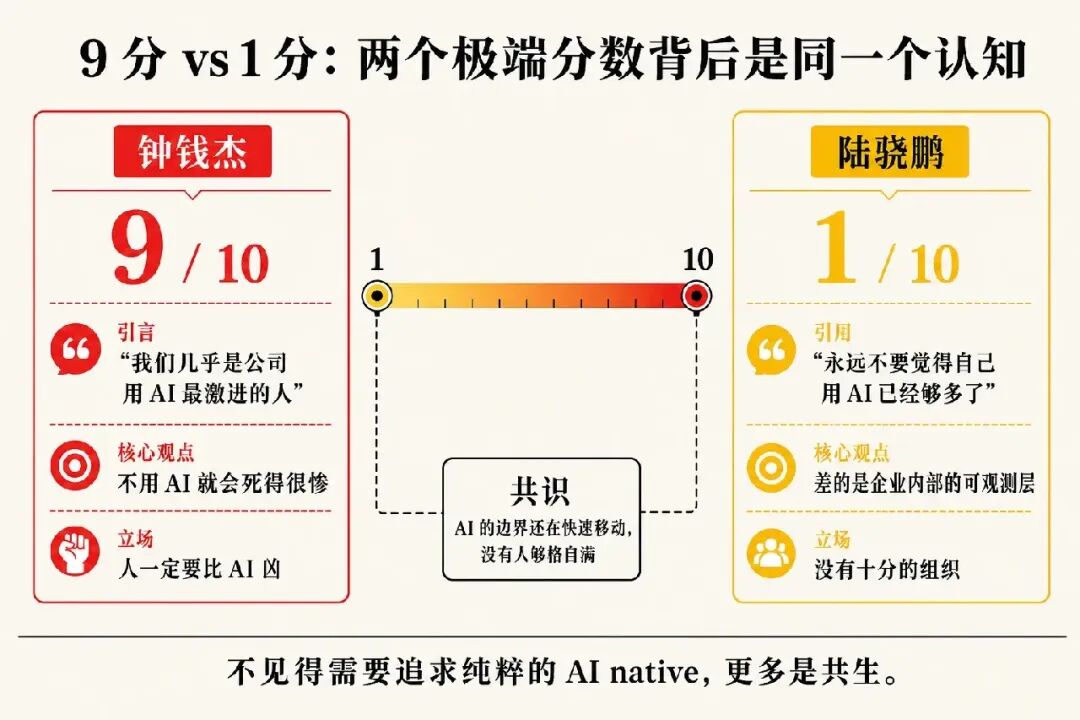
9 vs 1: Behind two extreme scores lies the same understanding
Wang Peng: Do you think FDE is a transitional role that exists because AI isn't yet AGI, or will there be more and more of them in the future? There's even a saying that future education and talent demand may shift toward the FDE direction. How do you understand the capability model for using AI well?
Zhong Qianjie: I don't know if it's the ultimate form, but I think it will be a mainstay for a long time. A company with good salespeople—sales are also hard to replace. Simple cold emails and phone calls can be AI-ified, but truly great salespeople are hard to replace with AI. FDEs are very down-to-earth people with engineering skills who leverage great AI, and that part is also hard to AI-ify. You have some decision-making authority—roughly speaking, that's what it takes.
You don't necessarily need that many engineers doing low-level component library development or CI/CD. You just need to build what you want to say—Codex and Claude Code can do it very well for you. The bar for pure engineers will keep rising; you have to become an expert to have specific value. The CRUD engineers in the middle will be in an awkward position: either become very strong and become a technical expert, or get closer to the business and become an FDE.
Lu Xiaopeng: I think FDE will increasingly lean toward customer success. Since the technical requirements are getting lower, how do you out-compete other companies and provide better value? It comes down to providing emotional value, better service, and better understanding of needs. I think FDEs in the future will lean more toward customer success.
Yu Yi: Let's wrap up with one last, fairly general question. We've recently been doing research on AI native organizations (the "AI Leap-takers Survey") and have already spoken with quite a few domestic companies. One fixed question from that survey I'd like to ask you both: Using AI native as the standard, how closely does your team work with AI, on a scale of 1 to 10? And why that score?
Zhong Qianjie: For the FDE team, I'd say we can reach 9. We're probably the most aggressive AI users in the company. Look, I'm currently managing 30 people directly, with no managers in between. With so many one-on-ones, so much project scheduling, everyone's leave requests—my AI is my assistant, my EA, or my junior manager.
Our FDEs also use AI heavily—I won't even mention how many tokens we burn in a day. We're almost the most aggressive AI users in the company, and we often train salespeople and even other engineers on "new ways to use AI lately." Because if you don't use AI, you'll die a miserable death. Everyone is already so busy—without AI for writing code, doing research, or even reviewing flags, doing it manually just isn't feasible. And sometimes you need to impress the other side's CPO or CTO, doing lots of research and saying the right things—all of this requires using AI in various ways. Even making slides is done with AI.
A common approach for us now is: say what you want to do, don't tell the AI how to do it—the AI may understand how better than you do. This is a mindset issue. Of course, we don't blindly follow AI's suggestions; AI is more for gathering information or doing simple work, and ultimately a human still needs to be in the loop. But you definitely have to be tougher than the AI—you need to have value. That's also why sometimes in interviews I look for: you use Claude Code's code well, but during the process, what did you push back on with the AI, proving you could be better than it? That's how you have value—otherwise I could just hire a middle schooler who uses AI all day. You must be tougher than the AI. But I'm fairly confident in our FDE team.
Lu Xiaopeng: Right, right. Because I think you should never feel you're already using AI enough, or that you understand things better than AI. So I'll give it a 1—there's still a lot of room for improvement.
Think about this question: what are the things only humans can do that AI can't? Where AI beats humans is that as long as it has electricity, it can keep burning tokens—that's an energy problem. For humans, it's a brain capacity problem.
I think what's missing right now is the internal observability layer within enterprises. If you ask every CEO or CTO "which of your employees' tasks can be AI-ified and which can't," no one can answer. First of all, there's no such observability layer, so there's no way to answer how AI native a company or a person really is.
Essentially, it's still a continuously looping, evolving relationship. The ultimate measure actually comes down to how replaceable each employee is. If a person can define an input and an output, like an API, then they are the most replaceable. But if there's a segment between "input → output" that AI can't handle and requires a human, then at that point that person is 100% AI native. This is an extremely extreme way of thinking.
But what I want to express is: although everyone is using a lot of AI, within the overall organizational structure, the complexity of the organization itself creates a lot of man-made noise. Even though everyone feels they're using AI and their personal efficiency has increased 10x, the efficiency of the entire enterprise may have only improved by one or two times. Fundamentally, observability is still too poor—we don't know which things must be done by humans. There's still a long way to go.
Yu Yi: I usually also follow up with this question: since it's on a 10-point scale, what would a 10-point AI native organization or team look like in your minds?
Lu Xiaopeng: I don't think such an organization exists. If it did, it would surely first appear at companies that master intelligence.
Yu Yi: So Anthropic and OpenAI are more likely to become such organizations.
Lu Xiaopeng: Right, the most native companies within each region under geopolitical dynamics.
Zhong Qianjie: I'm also curious what a 10-point company would look like. I believe wherever there are people, there's politics, so I don't think OpenAI is an ideal utopia either. There will still be a strong human element (even I find it hard to fully AI-ify project assignments). After all, humans hold a lot of extra information, and even have intuition and a sense of aesthetics.
So we don't necessarily need to pursue pure AI nativeness; it's more about a place of symbiosis. How to hand the boring things and the hard things to AI, but people still need to retain their humanity. For example, I spend a lot of time doing one-on-one talks—as an employee, if you're unhappy, you don't want to talk to an AI; you still want to talk to a person, vent some complaints, or even prove that you deserve a promotion. Unless eventually all managers in management are AI, but as long as there are people judging who has more potential, who has more influence, and who can take on the big deals, these decisions are still made by humans, so there's no need for us to pursue pure nativeness.