Hello everyone, it's been a while. Recently, I've been involved in a consulting project for a large enterprise on "SAP replacement." Since the project is at an extremely critical blueprint planning and architecture design stage, the pace of work has been nearly frantic, which caused this account to go silent for almost three months. I sincerely apologize to all the readers who have been following this account. Going forward, I will do my best to gradually restore the update frequency based on the project's rhythm, continuing to bring you the most in-depth and cutting-edge industry insights.
Through this deep involvement in building a core domestic ERP system, I have a very strong impression: the enthusiasm among Chinese enterprises and IT architects for data intelligence, agile development, and the reconstruction of underlying digital platforms has not diminished at all; instead, it has become even more urgent with the evolution of large model technology. In particular, the FDE and its derivative AI-empowered development models remain a hot topic in China's tech circles and in discussions among CIOs of major enterprises. Everyone is eager to see clearly how AI can truly sink into the complex business scenarios of vertical industries, rather than merely staying at the level of writing copy or building simple customer service Q&A bots.
For this issue, I have deliberately chosen a highly instructive overseas top-tier industrial digitalization case: the deep practice of Palantir and North American railcar leasing giant Trinity Industries using AI FDE to reconstruct complex asset and financial audit processes. By reviewing and deconstructing this real case, I hope to provide practical implementation references and paradigm inspiration for readers in China who are undergoing digital transformation, ERP upgrades, and exploring "AI + industry/supply chain."
I. The "Gray Quagmire" of North American Rail Asset Management and the Predicament of Traditional IT
To understand the transformative power of this technology, we must first turn our attention to the heavy industry and logistics transportation sectors, which feature massive asset scales and extremely intricate business rules.
1.1 Trinity Industries' Giant Asset Footprint and Business Complexity
As North America's leading railcar leasing and manufacturing giant, Trinity Industries' management scale is astonishing: the railcar leasing fleet it directly manages and operates reaches 140,000 units, with total asset value exceeding $8 billion.
Across this rail network covering the entire North American continent, these railcars do not operate in a closed environment; rather, they run intermodally across different rail networks and lines operated by different carriers in the United States, Canada, and Mexico. This highly mobile, distributed asset nature brings extremely high and complex maintenance costs.
1.2 The Invoice Audit Nightmare Under AAR Interchange Rules
In North America, all railcars running across rail lines must comply with the extremely strict and intricate "interchange rules" established by the Association of American Railroads (AAR).
Under these rules, when Trinity Industries' rail assets (vehicles) break down or require routine maintenance anywhere in North America, the local rail operator or third-party repair shop can perform the repair immediately and send the bill to Trinity Industries afterward.
While this mechanism ensures the efficient operation of the rail network, for asset owners it is a continuous financial and compliance nightmare. Trinity Industries receives tens of thousands of repair invoice records from across the United States every month. Every invoice and every line item contains extremely complex underlying dimensions:
- Labor hour standard verification: For repairs to specific vehicle models and specific parts (such as replacing wheelsets or brake pads), the AAR has stipulated standard working times. Do the labor hours in the actual bill exceed the standard?
- Material cost reconciliation: Do the materials used in the repair conform to the AAR's price master data? Is there any under-reporting of materials while over-reporting prices?
- Duplicate billing traps: Has the same vehicle and the same job been billed for claims repeatedly at different repair locations or at different times?
- Reverse billing and claim review: Do any bill items involve costs that should be borne by the previous repair shop due to substandard quality of the last repair?
1.3 The Six-Month "Race Against Time" and the Helplessness of Traditional IT
Worse still, the AAR rules set a strict compliance window: asset owners have only 6 months to discover, verify, and dispute or claim against erroneous bills. If this six-month window is missed, even if fraud or major errors are discovered afterward, the losses must be borne by Trinity Industries itself.
Faced with such a massive volume of data and highly specialized business rules, Trinity Industries confronted the systemic predicament common to traditional giant enterprises. Because data is scattered across Railinc (North America's core rail data exchange platform) and multiple internal legacy heterogeneous systems, building an intelligent invoice audit system through traditional IT means would require locking together 6 different cross-functional teams spanning finance, supply chain, technical support, legal, and data engineering.
According to Trinity Industries' CEO and President Jean Savage, a year earlier they had launched a digital reconstruction project aimed at replacing an old management system that had been running for 25 years. At that time, the assessments given by traditional top consulting firms and IT service providers were nearly absurd: the first version of the plan was estimated to take 5.5 years, with funding that was an astronomical figure; the second version, after multiple rounds of cuts and optimization, still required 3 years.
In today's rapidly changing market environment, a core management system upgrade taking several years means the enterprise bears extremely high opportunity costs and technology lag risks. It was precisely against this backdrop of "severely limited resources, time windows pressing hard, and traditional IT paths completely failing" that Trinity Industries chose to partner with Palantir and turned its attention to the AI FDE.
II. Paradigm Shift: What Is Palantir's AI FDE?
Before diving into the technical details, it is necessary to clarify what kind of paradigm shift Palantir's AI FDE (AI-powered Forward Deployed Engineer) actually brings.
The AI FDE is an interactive intelligent agent for the Foundry platform that can understand user intent through natural language and automatically translate it into specific operations on the Foundry platform, including data processing and transformation, code repository management, and ontology construction and maintenance. Meanwhile, users can also provide the AI FDE with contextual information from the Foundry platform, helping it understand business scenarios more accurately and thus perform more precise and efficient operations.
In traditional enterprise digitalization, even when large language models (LLMs) are introduced, AI often plays only the role of an "outsider": the user asks the AI a question through a chat interface, the AI generates a piece of code or offers a suggestion, and then a human engineer copies that code, logs into the development system, and performs clicking, configuring, debugging, and deployment. Under this model, AI is completely disconnected from the enterprise's core data flows, business flows, and system middleware.
The core logic of Palantir's AI FDE is: let AI directly act as the operator to run and drive the entire digital platform.
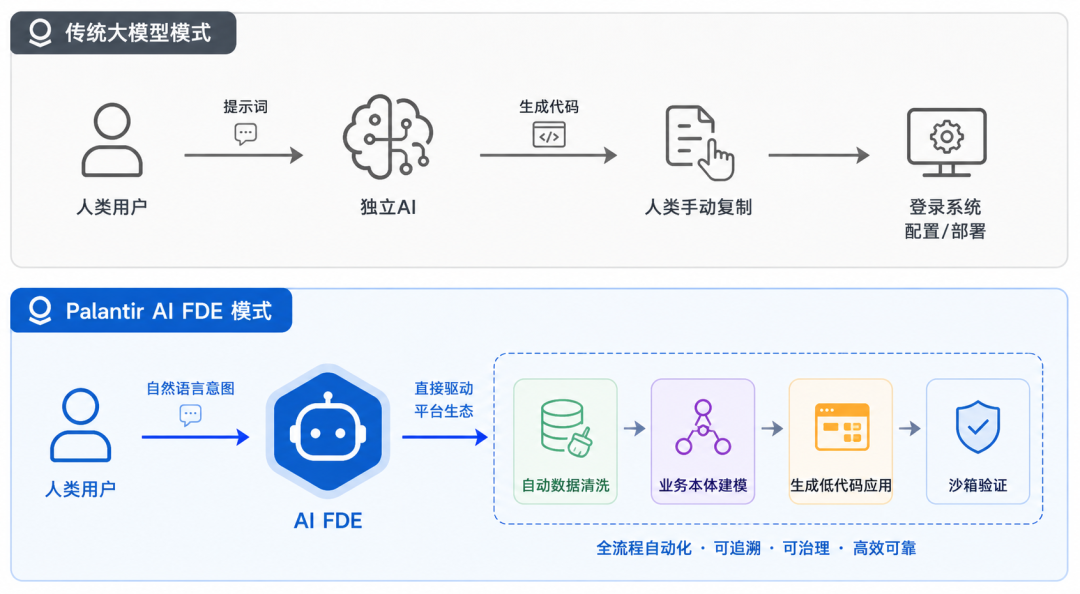
It has a full set of API permissions to directly operate underlying data integration, ontology design, data transformation, and front-end low-code application generation. Humans no longer need to concern themselves with underlying database table structures, complex SQL or Python transformation logic, or front-end component bindings; instead, by providing high-level "natural language intent" and "industry domain knowledge," the AI FDE completes full-chain system construction within minutes.
In other words, the AI FDE converts the physical operations of "clicking, dragging, and writing code" that previously required the collaboration of software engineers, data engineers, and product managers into fully automated execution by AI at the underlying level.
III. Five-Step Evolution: Rapidly Building an Intelligent Audit Workflow with AI FDE
In the live demonstration by Palantir software engineer Ankit Shankar and Trinity Industries CEO Jean Savage, an intelligent invoice audit system covering assets across the entire United States and connected to external industry systems underwent a complete evolution from nothing to something within minutes.
We can divide this process into five core stages:
- Raw data ingestion and understanding of multi-source heterogeneous systems
The first major hurdle for any digital system is always "understanding the data." Sany Industries imported a series of fragmented, unstructured raw datasets and documents—including Railinc documents, AAR price master data, labor and material cost conversion rules, a quick reference guide for reverse billing, and internal operational audit processes—directly into the AI FDE interface.
Throughout this process, humans provided no preset hints to the system about database schemas, foreign key relationships, or field meanings. Jean Savage issued the first instruction directly to the AI FDE:
"What do these datasets contain? How should I apply them to the railway repair billing audit workflow?"
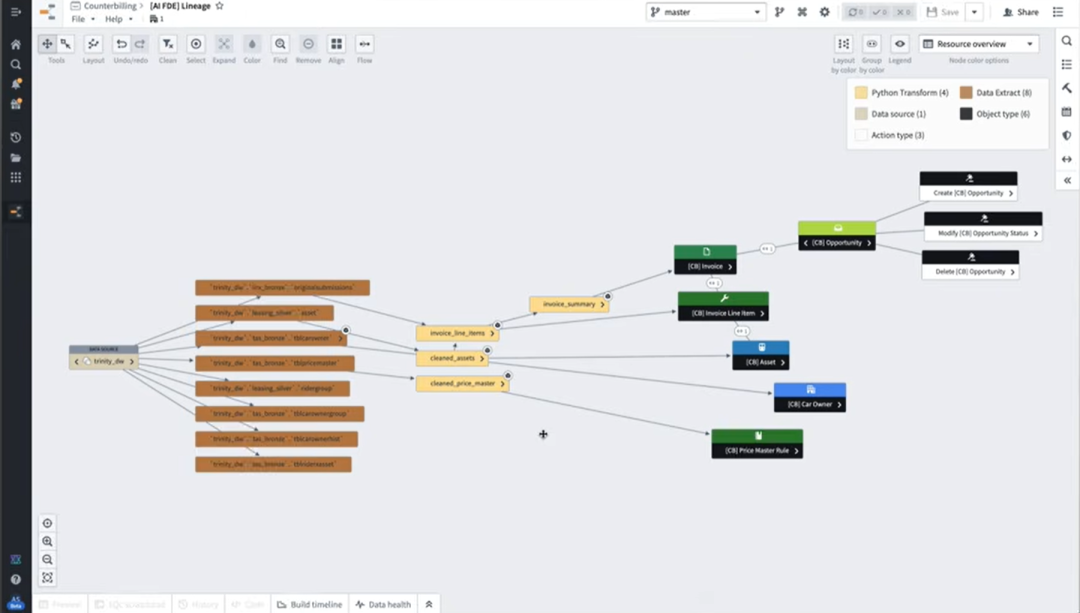
Upon receiving the instruction, the AI FDE instantly launched a full scan of the underlying multi-source heterogeneous data. It not only quickly mapped out the core entities in each spreadsheet and document, but also automatically derived the logical relationship chains between these entities, and output a high-definition data relationship diagram directly in the front-end interface.
- Automatic Generation of the Business Ontology
In Palantir's technical philosophy, the ontology is the core bridge connecting the physical world to the digital twin. It abstracts the cold, obscure "tables" and "columns" of traditional databases into "real-world objects," "relationships," and "actions" that business people can fully understand.
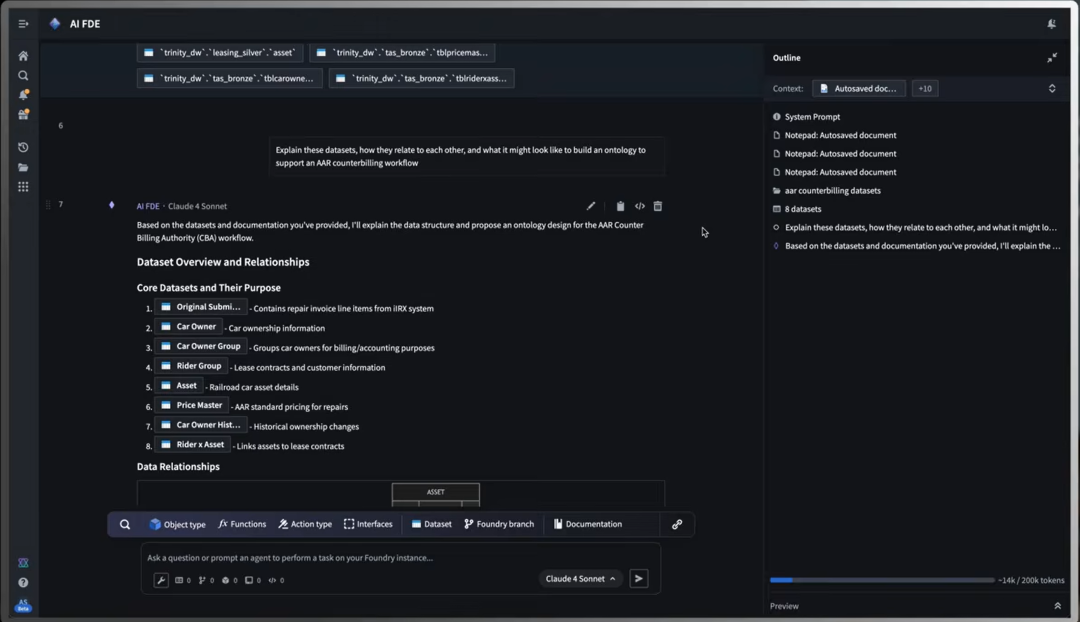
Through its understanding of the aforementioned invoice data and industry rules, the AI FDE automatically proposed an ontology design highly tailored to the railway asset management scenario for Sany Industries:
- Core objects: Abstracting the data into "vehicles," "assets," "repair invoices," "invoice line items," "materials/parts," and "owners/operators."
- Logical actions: Defining business actions such as "initiate a claim" and "flag an anomaly."
This automated ontology modeling, requiring no human involvement, directly eliminates the weeks-long business research and database modeling meetings typical of traditional IT projects.
- Domain Knowledge Input and Closed-Loop Encoding of Business Rules
With the system's skeleton (the ontology) in place, the next core step is injecting the blood: the specific audit and business validation logic.
Jean Savage distilled the core business logic of Sany Industries' senior audit experts into a natural verbal description:
"Every incoming invoice contains multiple line items. Each line item details the specific type of work, the materials used, the quantity repaired, and the corresponding labor hours. We must check each of these elements one by one. At the same time, we must cross-check car numbers across invoices to ensure that the same car has not been reported with the same repair item repeatedly within a short period."
The development team fed this high-level business rule into the AI FDE and asked it to encode it into the newly established ontology system.
At this point, the fascinating behind-the-scenes mechanism began to run: the AI FDE immediately generated high-quality, highly readable, and extensively commented program code in the background (such as Python/SQL data transformation logic based on the Foundry environment). However, due to occasional hallucinations or unfamiliarity with specific underlying APIs, the first run encountered compilation or runtime errors.
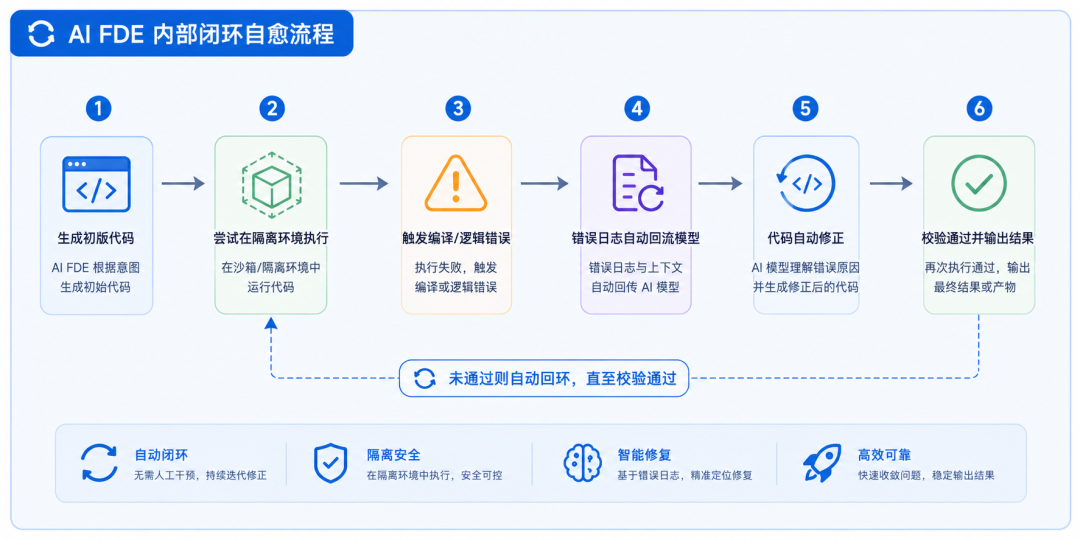
This is precisely the core value of the "closed-loop self-healing system" introduced by the AI FDE. The AI FDE is not a one-shot code generator; it has its own execution and testing environment. When it discovers that its generated code has errors, it acts like a real data engineer: automatically capturing error logs, analyzing the causes, refactoring the code, and then re-executing the query and validating the results.
Ultimately, after several rounds of rapid iteration imperceptible to humans, the AI FDE successfully produced transformation logic that perfectly complied with AAR standard labor hours and Sany Industries' internal risk control requirements.
- The "Risk-Free Sandbox Mechanism" Based on Foundry Branches
For a publicly listed industrial giant managing $8 billion in assets and facing strict Sarbanes-Oxley Act (SOX) regulation, any AI-introduced code or logic changes acting directly on production systems would be an unacceptable financial and operational risk.
To solve this pain point, the AI FDE runs all automated builds and logic evolution on Foundry branches. This is a highly isolated "business sandbox environment," similar to Git branches in software development.
The AI FDE uses real production data on the branch to test rules and run through processes, without causing any interference to the currently running main production line. This completely breaks the inefficient curse of traditional large-enterprise IT upgrades, where "new and old systems must run in parallel for six months or a quarter for manual reconciliation."
- Zero-Code, One-Click Generation of Production-Grade Standalone Applications
Once the underlying full-chain data transformation, entity ontology, and audit action logic have all been automatically built by the AI, the final core step is to provide front-line business users (invoice auditors, finance specialists) with a handy operating system.
In the past, development from backend APIs to front-end UI required front-end engineers to go through lengthy processes of UI design, component state management, and API integration. In the AI FDE, developers simply issue an instruction to the AI next to a completely blank custom application canvas:
"Please use the asset and invoice ontology we just built to create a high-priority, production-ready digital audit workspace for the invoice audit team."
The AI FDE instantly assembled the entire application on the canvas. Although the first version of the interface was somewhat rough, it already had the core skeleton of an enterprise-grade application:
- Executive/supervisor dashboard: Automatically aggregates core financial metrics and intuitively displays the total potential recoverable amount.
- Intelligent risk screening matrix: Automatically performs top-level aggregation and highlighting of high-value invoices and line items that trigger audit anomalies (such as excessive labor hours, material price mismatches, or suspected duplicate billing).
- Native security and permission isolation: Since the application is built entirely on Palantir's underlying security architecture, a permission request automatically popped up the moment the application was generated, perfectly inheriting the enterprise's existing multi-tenancy, data column-level permissions, and compliance controls—truly achieving "production-grade readiness."
With further fine-tuning by the AI FDE, the application interface was quickly optimized to be clear and legible. Invoice auditors can expand the repair history of a specific vehicle with one click, compare it against AAR benchmark data, and, upon confirming an anomaly, click the "Initiate Reverse Billing Claim" button directly on the interface, with the system automatically drafting and sending formal legal and financial claim letters to the relevant parties.
IV. Deep Engagement: Hard-Core Q&A on SOX Audits, Data Lineage, and Business Iteration
As CEO of Sany Industries, Jean Savage displayed the clear-headedness and rigor typical of an industrial giant's leader. She was not dazzled by the flashy appearance of an AI generating an application in minutes, but instead went straight to the three most critical and fatal "hard-core compliance pain points" of enterprise digital transformation.
The answers given by Palantir's Ankit Shankar precisely reveal the foundational capabilities AI must possess when moving into deep waters.
Pain Point One: How to pass strict public-company financial audits such as SOX?
Jean Savage's question:
"All of this sounds very efficient, but as a publicly listed company, we face extremely strict external audits and SOX compliance checks. How can AI-generated logic and AI-made adjustments prove their financial compliance to rigorous auditors?"
In-depth analysis: This is precisely the core reason why many pure large-model wrapper applications face outright rejection in the enterprise market: "black-box uncontrollability." If an enterprise cannot prove who modified a piece of financial audit code, when, and based on what rules, it may face a massive compliance disaster.
Palantir's solution is not to try to explain the complex weight neural networks inside large models, but to leverage the Foundry platform's extremely powerful deterministic foundation: full-lifecycle data lineage and tracking views.
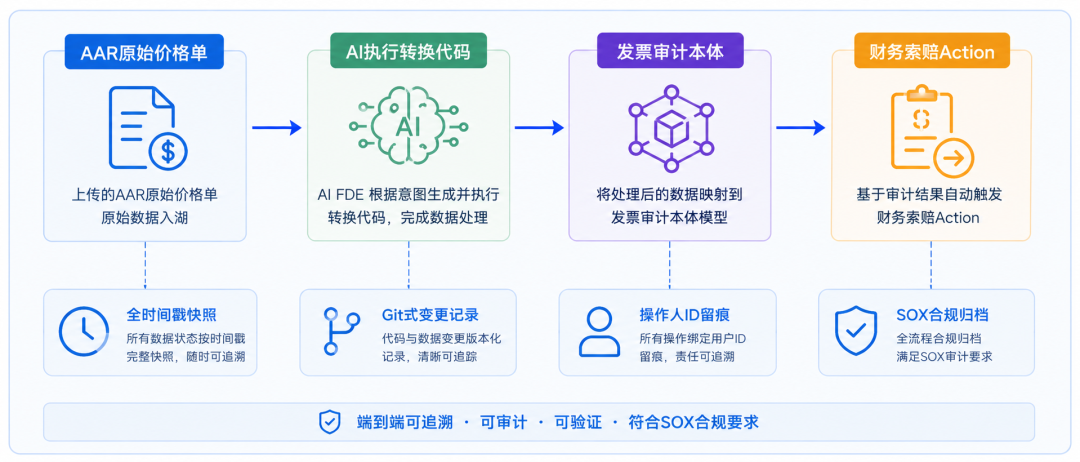
In the AI FDE-driven ecosystem, the system permanently and immutably records the evolution history of all metadata.
- It will clearly record: on which day, at which second, by which AI agent, and based on which human natural language instruction, a specific audit formula was generated.
- It fully preserves every intermediate step of the code's evolution and every sandbox test result.
- Whether it is the objective logic drift of an upstream automation system, or a tiny decision clicked by a business user on the front end, everything is bound with a unique identity credential and a precise timestamp, and permanently sealed away in the form of a visualized topology graph.
When auditors come to inspect the books, the enterprise can, as if flipping through a perfect ledger, clearly show auditors the "full life story" of any financial decision. This architectural design—wrapping the "unexplainable AI generation process" inside "an absolutely certain, traceable platform lineage"—is the only viable path for AI to enter high-risk compliance domains.
Pain point two: In the face of highly volatile external rules, how can the system avoid becoming a "one-time toy"?
Jean Savage's question:
"In the rail transportation industry, AAR rules and price master data are updated and adjusted every quarter. If this system is just a static snapshot of this very moment, won't it turn into a pile of garbage by next quarter?"
Deep analysis: Traditional enterprise software development has a major flaw: it is outdated the moment it is delivered. Once the external business environment changes, the enterprise has to submit new requirements, go through lengthy change processes, find outsourced developers, and retest—a cycle that often takes months.
AI FDE completely transforms this static software lifecycle. It defines the entire application and its underlying ontology logic as "a living ecosystem capable of continuous evolution."
When the new AAR rules for the next quarter are released, business users do not need to change any underlying code; they simply hand the latest spreadsheet or rules document to the AI FDE, and the system automatically activates its change analysis mechanism. It will clearly tell the human: "Because external rule B has changed, I recommend adjusting the underlying transformation logic from C to D, which will affect the E metric on the front-end desktop."
After human confirmation, the new rule is merged with one click in the sandbox, and the system instantly completes a seamless online upgrade. Not only is the business logic alive, but historical data is also automatically preserved as multi-version snapshots as ontology versions iterate, ensuring the system stays in sync with the enterprise's business development.
Pain point three: How to quickly incorporate multi-dimensional business objects like "maintenance curves" that do not exist at all in the current data sources?
Jean Savage's question:
"In real asset operations, we don't just look at the invoices in front of us. We also have our own internal core asset 'maintenance curves,' which can predict what parts should be replaced on different freight car models in which year of operation and at which mileage. If an external invoice shows that a car replaced its wheelsets prematurely (replacing a set of wheelsets costs over $2,000, our largest AAR maintenance expense), I must intercept it and raise a challenge, even if the labor hours and unit prices on that invoice fully comply with AAR standards. But the data for this 'maintenance curve' is currently not in this invoice data source at all—how do we add it? Would it be difficult?"
Deep analysis: From the perspective of traditional IT, this seemingly simple request would be nothing short of a disaster: it would mean introducing a brand-new asset health management system, rewriting ETL pipelines, modifying the core database's table structures, and forcibly adding new cross-table join logic to the front-end application.
Ankit Shankar's on-site answer was extremely confident, and the subsequent operation validated that confidence: under the AI FDE framework, "the first version is always wrong, and adjusting it takes only a few minutes."
Because the system's underlying layer has been highly abstracted into an ontology network composed of "vehicles" and "invoices," when Sany Industrial wanted to introduce the entirely new dimension of "maintenance curves," the business users only needed to provide the AI FDE with their internal asset forecast Excel spreadsheet or database connection, and tell it in a single sentence:
"Associate these maintenance curves with the existing vehicle objects. If the wheelset replacement time in an invoice line item is severely earlier than the maintenance curve's predicted window, immediately flag that line item with the highest-level risk challenge status."
Upon receiving the instruction, the AI FDE automatically modifies the backend ontology definition, extends a new logical link from the "vehicle" object pointing to the "maintenance curve" knowledge base, and after automatically rewriting the backend validation logic, recalculates all affected invoices.
What used to be months of secondary system development and requirement changes is instantly compressed, driven by the AI FDE, into a two-minute natural language dialogue.
V. Paradigm Shift: From "IT Experts Build Systems" to "Everyone Is a Builder"
As this stunning demonstration of less than ten minutes drew to a close, Jean Savage, as the CEO of a traditional heavy-industry giant, let out a heartfelt sigh:
"Under normal circumstances, to reach the level of maturity of the system you see before you, we would first have to go through three to six months of defining business requirements. Then the IT team would start writing programs. By the time they finally produced a first version to show me, I would often say: 'Oh, this is good, but could you change this, or add that?' Then everything would be torn down, and they would have to go back to square one and start over.
But now, this ability to turn ideas into reality within minutes, allowing us to 'experiment quickly at extremely low cost, fail fast, and adjust fast,' completely changes the total volume of work we can take on and changes the boundaries of where we can deploy digital capabilities. It opens countless brand-new doors for how we run our business and make decisions."
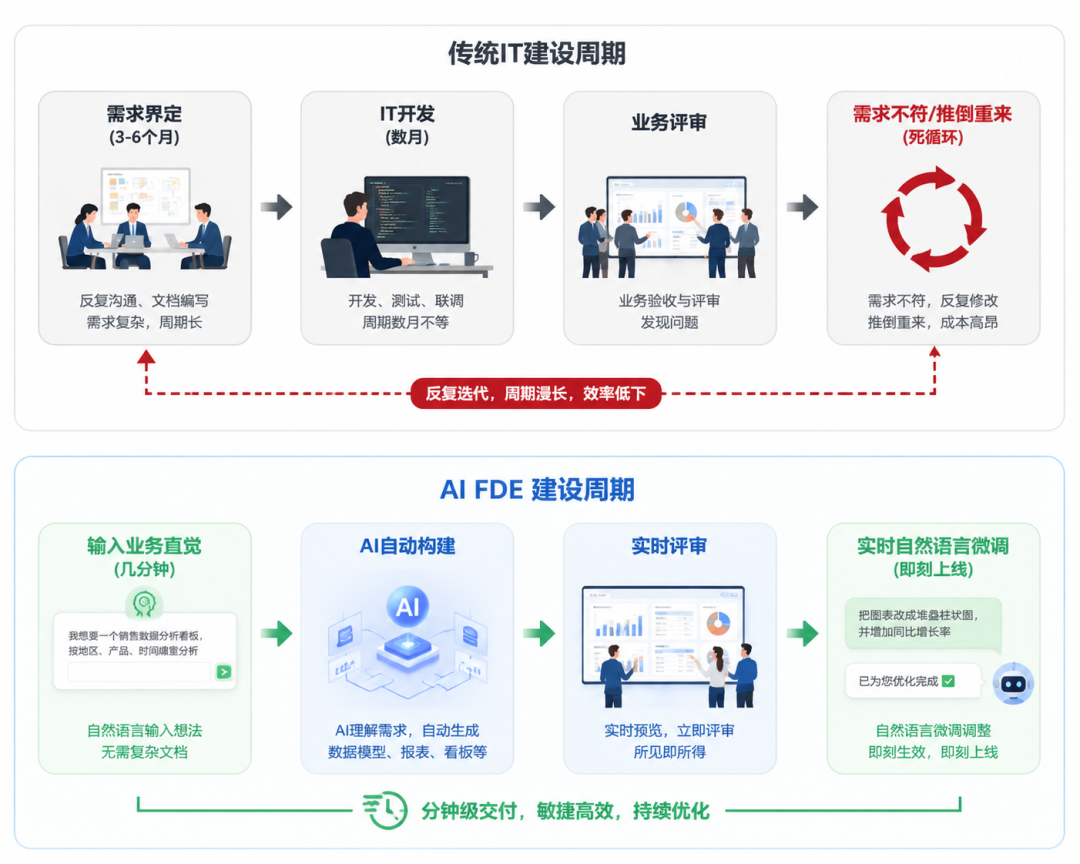
This statement hits squarely at the most hidden and stubborn pain point in digital transformation for enterprises worldwide and in China: the severe disconnect and time gap between the business intuition of core executives and the technical execution capabilities of IT teams.
In the traditional digital transformation path, core decision-makers like Jean Savage, who have sharp business intuition about things like "each wheelset replacement costs $2,000" and "wheelset replacement frequency directly determines the company's profit margin," could never directly touch the system's foundation. Her intuition had to be translated layer by layer into a thick stack of requirement documents, and then into lines of code that even she herself could not understand. In this lengthy chain, business opportunities vanish in an instant, and the organization's enthusiasm for innovation is worn away by endless wrangling.
The important change brought by Palantir AI FDE is that "builders" are no longer limited to professional developers, but gradually expand to business users, data analysts, and other broader roles, democratizing the ability to build.
When large models truly sink in as operators on top of a high-certainty industrial operating system foundation, the barrier to technical creation is completely erased. An asset operations expert, a financial risk control director, or even a company CEO who knows no programming language and cannot write complex SQL—as long as they possess sufficiently deep industry insight in their mind and can clearly define problems in terms of business logic—can sit directly in the driver's seat and, through natural language, "drive" and "shape" this massive digital system, letting it aggregate and take shape within minutes according to their business intent.
This is the ultimate form that "AI + industry"—or enterprise software in the era of large models—should take: AI handles low-dimensional repetitive physical clicks, logic coding, and self-healing of errors, while humans are completely liberated to focus all their energy on high-dimensional business strategy definition, compliance bottom-line control, and monetizing business value.
Conclusion
Back to the SAP replacement project I am currently deeply involved in. Much of the time, we spend enormous energy and time discussing the classification of technical components, how to sort out interfaces, how to design table structures, and how to migrate existing functionality to the new ERP system.
But after watching this lightning-fast practice by Sany Industrial and Palantir, I can't help wondering: do the core digital assets of future enterprises really still need to be pieced together from thousands of rigid, inflexible, and costly-to-maintain fixed functional modules?
Perhaps, when the underlying distributed data environment is solid enough, when the business ontology is highly abstracted, and when AI truly gains the hands to drive the platform, the next generation of ERP systems should itself be an "intelligent organism" that can perceive, build, and evolve in real time through natural language.
For China's digital transformation wave, currently at the center of attention, the case of Palantir and Sany Industry is undoubtedly a remarkably clear mirror, illuminating the true path forward for AI as it ventures into the deep waters of vertical industries.