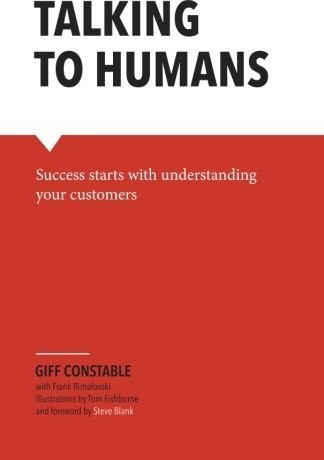
Giff Constable's 2014 book *Talking to Humans* teaches you how to find the right people on-site with customers and get them to tell the truth.
Talking to Humans · Giff Constable ·
Key Takeaways
- *Talking to Humans* (co-authored by Giff Constable and Frank Rimalovski, 2014) is a practical guide to the qualitative side of customer development.
- The goal of early interviews is to learn, not to sell. Ask about behaviors that have already happened, not what customers think.
- At the end of each interview, ask for 1 to 3 referrals, and organize your notes immediately, because details fade fast.
The worst question a Forward Deployed Engineer (FDE) can ask in a customer meeting also happens to sound perfectly polite: "Do you think this tool would be helpful to you?" Almost everyone will answer "yes." And that "yes" tells you nothing about what to actually do.
Talking to Humans was written precisely to correct this habit. The book's official website describes it as a practical guide to the qualitative side of customer development, with the tagline: success starts with understanding your customers.
For an FDE, that qualitative phase is the first week embedded with a customer. You need to find the right people to ask, ask in a way that gets them to tell the truth, and capture enough detail that the whole team can rely on it. The book grew out of a 2012 blog post, and all three points were already covered there.
Who wrote it, and where can you buy it?
Giff Constable co-wrote the book with Frank Rimalovski in 2014. The download page notes that nonprofits and schools can get the ebook for free via a sign-up form, while other readers can purchase the Kindle or print edition.
The blog post is "12 Tips for Early Customer Development Interviews," with the third version published in late 2012. If you want a taste before buying, read that post first. The three ideas worth remembering below are all covered in it.
Every interview leads to the next
Constable advises against interviewing friends and family, because they distort the answers. On-site with a customer, the "friend" role usually belongs to the project champion who signed the contract. They want the project to succeed, so they tend to describe the most flattering version of the process.
His approach is practical: at the end of each interview, try to get contact information for 1 to 3 other people. Do the math: start with the 3 people the champion introduces, and each of them introduces you to 1 to 3 more.
One round later, you have 3 to 9 additional conversations, likely with the people who actually do the work day to day—the ones who never appear on the org chart.
On-site with a customer, the first step is small: add the referral question to the end of your interview guide so you never forget to ask it.
Ask what happened, not for opinions
The blog post is blunt: the initial goal is to learn, not to sell or pitch. To learn, you have to ask what people have actually done, not what they guess they would do or how they think they would feel. Then have them walk you through how they encountered the problem.
Suppose you're about to deploy an AI agent for a logistics company's customer service team to triage complaint emails. "Would an agent that automatically sorts emails be helpful to you?" This question is both long and loaded with the answer you want to hear—exactly what Constable warns to avoid: questions should be short and unbiased.
Instead, ask: "The last time you received a tricky complaint email, what happened?" The answer will be a story full of details: how long the email sat in the shared inbox, who forwarded it to whom, how many systems had to be opened. Those details are the requirements spec for the deployment, and the baseline for measuring its value later.
Notes fade faster than you think
Constable suggests bringing a note-taker if possible. He also warns that details of a conversation fade quickly, so if you're not recording, you must organize your notes immediately.
For an FDE, this matters even more than for a founder. Notes aren't just for yourself: the product team back home, the machine learning engineers, and the account team all depend on them. A line like "the customer thinks email sorting is slow" helps no one.
A passage that faithfully retells the complaint email story, preserving the speaker's own words, is enough for the whole team to discuss priorities. The simplest method: block out 15 minutes on your calendar after every interview, used only for organizing notes.
What mistakes do FDEs commonly make?
The most common is pitching mid-interview. The customer has just described an email bouncing between three people, and you jump in: "Our agent can solve exactly that." From that moment, the interview becomes a sales call, and the customer starts giving you the answers you want to hear. Jot the idea in the margin and save it for another meeting.
The second is listening only to the champion. The person who signed the contract has every reason to give you the flattering version, just like the friends and family Constable warns to avoid. If, after the first week, all your notes come from a single person, that's the signal to immediately ask for more introductions.
The third is putting off notes until the end of the day. After four interviews in a row, the stories blur together, leaving only generic conclusions no one can use.
Who should read it, and in what order?
The book suits engineers who have just moved into an FDE role or are aiming for one: people who are great at building but have never run a discovery interview. Read the 12-tips blog post first—you can absorb the main ideas in one evening; then read the book when you have real customer meetings coming up, so you can put it to use immediately.
For career development, watch for FDE job descriptions that mention customer discovery or working directly with customers—that's exactly the skill this book trains. Don't write "strong communication skills" on your resume; be specific: how many interviews you've run, and one technical decision that changed because of a story a customer told.
This book won't teach you to write one more line of code. It teaches you which code is worth writing—and for an FDE, that's often the harder part.
Was this article helpful?
Thanks for your feedback!