The enabling team in the book closely matches the FDE role, but Docker admits that its first attempt at applying this model did not reduce cognitive load.
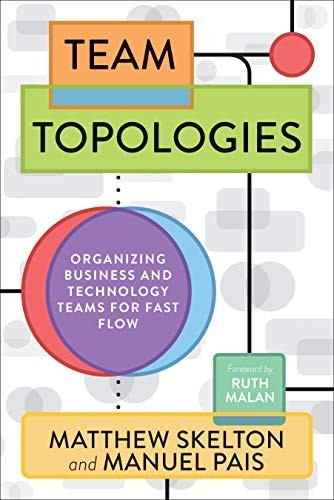
Team Topologies: Organizing Business and Technology Teams for Fast Flow · Matthew Skelton ·
Key Takeaways
- Matthew Skelton and Manuel Pais's book does not discuss FDEs, but it provides a vocabulary for describing where FDE teams sit relative to product and platform teams
- Cognitive load is the primary reason for splitting teams: overloaded teams make poor decisions and move slowly
- Every collaboration between FDEs and platform teams should be time-boxed; afterward, the platform delivers the outcome as a service that FDEs can use directly
Docker once wrote about reorganizing its engineering teams along Team Topologies lines, and included a sentence rarely seen in corporate blogs: the first attempt did not reduce cognitive load, and they had to start over.
That detail carries more weight than any endorsement. The book co-authored by Matthew Skelton and Manuel Pais is not a recipe to follow blindly, but a vocabulary for describing where each team sits and how teams connect with one another.
For Forward Deployed Engineers (FDEs), this vocabulary is the most valuable. You sit between customers, sales, and product teams, and whenever a frontline request gets stuck among the three, you need to make clear: who does it, for how long, and when it ends.
Which edition to read, and in what order?
The first edition, Team Topologies: Organizing Business and Technology Teams for Fast Flow, was published by IT Revolution Press on September 7, 2019, with 240 pages. The whole methodology revolves around four fundamental team types and three team interaction modes.
The second edition was published on September 23, 2025, with 304 pages, and the subtitle changed to Organizing Business and Technology for Fast Flow of Value. The publisher treats teams as the fundamental unit of value delivery, and still calls the book a major advance in the organizational design of IT and knowledge work.
Suggested reading order: first read the Key Concepts page on teamtopologies.com, which is short and contains all the definitions; then read the second edition; finally, compare the book with PostHog's publicly available FDE handbook to see how a real company positions its FDE team.
First idea: overloaded teams make bad decisions
The book argues that cognitive load is the primary reason for splitting teams. The Key Concepts page offers a fitting analogy: an overloaded CPU slows down a computer, while an overloaded team makes bad decisions and moves slowly.
Suppose a 4-person FDE team serves 6 customers, each on a different tech stack. Every ad-hoc patch on the frontline becomes something the team must keep in mind long-term. By the 7th customer, the team does not lack skills; it simply has no headroom left.
The first thing to do on-site with a customer: list everything the team maintains alone, such as connectors, scripts, and custom configurations. This list will tell you what needs to be pushed to other teams.
Second idea: name the team types accurately
Of the four team types in the book, three are directly relevant to the daily work of FDEs; the fourth appears when you read the Key Concepts page.
A stream-aligned team follows one flow of work, usually corresponding to a business domain; product teams generally fall into this category. Platform teams build services that absorb some of the complexity for stream-aligned teams, helping them move faster.
Most important for FDEs is the enabling team: it helps stream-aligned teams overcome obstacles while identifying missing capabilities. This role closely matches PostHog's description of its FDE team.
This team sits between customers, sales, customer success (CS), and product engineering; it does not control product direction, but channels real-world experience from customers back into the product through the product engineering team.
Rocketlane describes another model: placing the FDE function within product and engineering rather than within go-to-market. No placement fits every company. What you need to do is recognize which model your team uses, because it determines where customer requests ultimately flow and who makes the final call.
Third idea: choose the right interaction mode and set an end date
The book proposes three interaction modes: collaboration, X-as-a-Service, and facilitation. Collaboration means two teams work together for a limited time to discover something new, such as an API, a practice, or a technology. X-as-a-Service means one team provides something and another team consumes it as a service.
For FDEs, facilitation means helping product teams understand the problems encountered on the frontline so they build the solutions themselves, rather than writing features for them.
Suppose a banking customer needs to integrate SSO through an unfamiliar identity provider. For the first three weeks, the FDE and the platform team collaborate to find the right API. After that, the platform provides it as a service, and the FDE simply uses it.
If that collaboration has no end date, the platform team gets pulled into every customer, and cognitive load spreads across both teams.
To judge when a piece of work should become a service, use Rocketlane's test: a solution that helps only one customer is customization; a solution that helps all future customers is product development.
Applied to the example above: a connector written specifically for this bank's identity provider is still customization; only when it is built into something all future customers can use does it count as product development.
What lesson does Docker offer on redrawing team architecture diagrams?
An architecture diagram that looks reasonable on paper may not reduce load in practice, and Docker is the clearest example. The company used the Reverse Conway Maneuver to align teams with the architecture, aiming to reduce cognitive load, cut dependencies, and stay aligned with product direction.
The first time, they got it wrong. This is a reminder: when creating a new team (such as an FDE team) alongside existing ones, check whether cognitive load has actually dropped; redrawing the org chart alone is not enough.
Who should read it, and how to use it for career development?
If you are an engineer with 2 to 8 years of experience, currently working as an FDE or hoping to transition into the role, this is one of the few organizational books you can put to use next week. Those leading a newly formed FDE team have even more reason to read it.
In interviews, you can ask directly: does the FDE team report to product or to sales? Through what path do customer requests reach the platform team? If the answers are vague, expect plenty of friction ahead. On your resume, instead of writing "customer integrations," spell out how you turned a piece of custom work into a feature shared by multiple customers.
Every org chart has an FDE box. This book helps you draw the arrows connecting that box to other teams, and write a due date on each arrow.
Was this article helpful?
Thanks for your feedback!
6 sources
- Team Topologies book (teamtopologies.com) · 2019-09-07
- Team Topologies, 2nd Edition (IT Revolution) · 2025-09-23
- Key Concepts (Team Topologies)
- Building Stronger, Happier Engineering Teams with Team Topologies (Docker) · 2022-05-20
- Forward deployed engineering overview - Handbook (PostHog)
- Forward Deployed Engineering: Finding the Model That Fits (Rocketlane) · 2026-06-15