Annie Duke's *Thinking in Bets* points out that good decisions can still lose, which is highly useful for engineers who make promises to clients based on incomplete data.
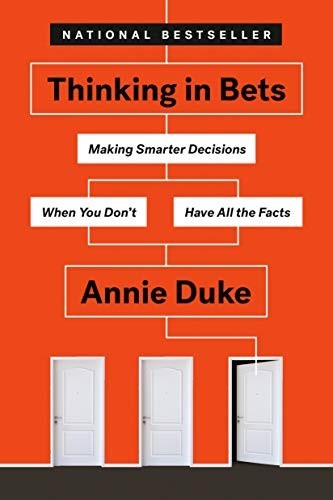
Thinking in Bets: Making Smarter Decisions When You Don't Have All the Facts · Annie Duke ·
Key Takeaways
- Annie Duke's book (Portfolio, 2018) separates decision quality from outcomes, because luck and hidden information are always present
- For FDEs, the biggest takeaway is building the habit of reporting to clients with probabilities rather than definitive conclusions
- Three points worth remembering: avoid resulting, speak in probabilities, and stress-test your claims before reporting
A player who spent twenty years among the world's top poker players wrote a book about decision-making. The most memorable line in the publisher's blurb isn't a winning secret, but a candid admission: even the best decisions don't necessarily lead to the best outcomes.
For Forward Deployed Engineers (FDEs), this line is practically a job description.
You're sitting at the client's site with incomplete data in hand, facing legacy systems no one has ever diagrammed, and the client still asks: "When will it be done? Will it work?" Thinking in Bets isn't a technical book, but it trains an ability few engineers have ever learned: being honest about uncertainty while preserving the client's trust.
Who is the author, and what does this book bet on?
The book's full title is Thinking in Bets: Making Smarter Decisions When You Don't Have All the Facts, published by Portfolio, an imprint of Penguin Random House. The hardcover and ebook were released on February 6, 2018, and the paperback on May 7, 2019. Aimed at general readers, it became a national bestseller in the US.
Annie Duke is more than a poker player. She received a National Science Foundation fellowship to study cognitive psychology at the University of Pennsylvania, and in 2014 co-founded the Alliance for Decision Education. As a result, the book combines table experience with psychological rigor.
The core argument is simple. Every decision is affected by two kinds of uncertainty: luck you can't control, and hidden information you can't see. Duke argues that every time we make a decision, we're wagering something we value, not just money. For an FDE, the chips are the client's time, your credibility, and the client's trust in the product.
Idea 1: A good outcome proves nothing
Duke calls one error "resulting": the tendency to equate decision quality with outcome quality. A good outcome may just be luck, which means you learn nothing from it.
Imagine a team pushes a data pipeline into a client's environment without testing it on real data, yet the demo still goes smoothly. The team concludes its process is sound. In Duke's terms, this is resulting: next time the data will be messier, and the process will break.
The reverse mistake is just as easy. Suppose the team thoroughly tested on real data and prepared a rollback plan, but on launch day a third-party API goes down. Given the information the team had, the decision was still sound; what failed was the portion of luck the team couldn't control.
Don't overturn an entire process because of one bad outcome.
At your next retrospective, draw two columns: one for what the team knew when making the decision, and one for what should be attributed to luck. Only the first column contains lessons.
Idea 2: Speak in probabilities, don't make promises
Duke points out that events with a probability of exactly 0% or 100% are rare. She treats honestly expressing your degree of belief as part of good decision-making. That degree is often "uncertain," and saying so is nothing to be ashamed of.
A simple calculation shows the benefit of this framing. Instead of promising "the AI agent will cut ticket handling time by 30%," write "there is a 70% probability of a 30% reduction within six weeks."
If you made 10 such estimates, about 7 should come true. If all 10 hit, you're being too conservative; if only 4 hit, you're overconfident.
Clients also get something they can plan around. Knowing there's a 30% chance of falling short, they'll prepare backup plans in advance instead of being caught off guard in week six. Record your estimates across projects, and over time you'll see how reliable your numbers are.
Idea 3: Before meeting the client, find someone to challenge you
Duke recommends forming a "decision group": a small circle that helps each member articulate the beliefs behind their decisions. FDEs often work alone at client sites, making it easy to carry an unexamined assumption straight into the meeting room.
The method is simple: before each weekly report, ask another FDE or a colleague from the product team to challenge you with "why 70, not 50?" If you can't answer, the number isn't ready for the client.
Who should read it, and how?
This book suits FDEs who need to write progress reports for clients, as well as software engineers who want to move into FDE roles, since software engineering rarely forces you to fill this gap. Don't expect to find evals methods or statistical techniques in it; its value for FDEs lies in a mindset that lets you use those tools honestly.
Finish it before your next project starts. After each idea, immediately apply it to a real decision that same week. For career development: when interviewers ask about failed projects, clearly separate the decision from the luck.
This kind of answer shows interviewers that you know where lessons should come from, rather than shifting blame or boasting. On a resume, a line like "made probabilistic forecasts for deployment timelines and tracked their accuracy across projects" carries more weight if you state how many projects you actually tracked.
Clients don't pay you to be right every time. They pay you to be clear about what you're betting on and what your odds are.
Was this article helpful?
Thanks for your feedback!