Kahneman's *Thinking, Fast and Slow* exposes the optimism bias behind missed launch dates and offers tools to correct it; skim the priming chapter.
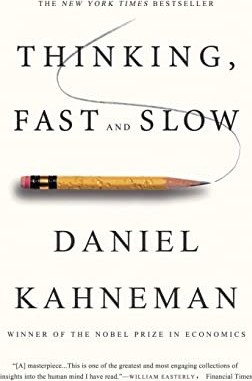
Thinking, Fast and Slow · Daniel Kahneman ·
Key Takeaways
- Kahneman argues that optimism bias may be the most consequential of all cognitive biases. It shows up every time you give a client a date.
- The fix: start from the average outcomes of similar past projects, rather than extrapolating from what you just saw.
- Read the chapters on judgment and optimism closely; skim the priming section, since some of those studies failed to replicate.
In 1979, Daniel Kahneman and Amos Tversky documented a phenomenon familiar to every Forward Deployed Engineer (FDE) who has missed a launch date: people systematically underestimate the cost, duration, and risk of their own work, and they err in the same direction every time.
More than three decades later, Kahneman called the optimism bias behind this perhaps the most consequential of all cognitive biases.
For an FDE, this is not a philosophical question.
*Thinking, Fast and Slow* explains why that number is often wrong, and always wrong in the same direction. More importantly, the book offers tools to correct it.
What to Read Closely, What to Skim
Kahneman is an Israeli-American psychologist. This popular science book was published in 2011 by Farrar, Straus and Giroux; the 512-page paperback was released on April 2, 2013.
The book is built around two systems of thinking. System 1 is fast, intuitive, and emotional; System 2 is slower, more deliberate, and more logical. In the context of FDE work, the number that slips out right after requirements gathering is a System 1 answer: quick, fluent, and not yet thought through.
At 512 pages, it is a substantial book, so read the chapters on judgment under uncertainty and on optimism closely. You can skim the priming section, and stay skeptical: some of the priming studies cited in the book came under scrutiny during the replication crisis, and Kahneman himself admitted he placed too much faith in studies with samples that were too small.
Idea One: Requirements Gathering Won't Show You Everything
Kahneman calls this WYSIATI, or "What You See Is All There Is": the mind works only with the information in front of it and ignores what is missing.
Picture this scenario: after discovery, you have seen a clean schema, documented APIs, and enthusiastic stakeholders. System 1 immediately spins a smooth story from this and produces a number.
What you haven't seen never enters the estimate, for the simple reason that it wasn't in your head at the time. For example: the process for getting production data access approved, a few dirty data tables, or a security reviewer who never attended any of the meetings.
The first step is simple. Before stating any number, list the parts of the client's system you haven't seen with your own eyes. The length of that list alone should discount your confidence.
Idea Two: Use Past Projects as Your Yardstick
The book describes the planning fallacy as the tendency to overestimate benefits and underestimate costs. Its root is the inside view: fixating on the specific difficulties of the project at hand.
The remedy is the outside view: anchor your forecast on the average outcomes of similar past projects.
Try a hypothetical calculation. You judge that integrating with the client's system will take 3 weeks. In your previous five deployments, each plan was also 3 weeks, but the actual work took 5, 6, 4, 7, and 8 weeks respectively. The average is 6 weeks, twice the plan.
Those five deployments are your reference class. A reasonable starting point is 6 weeks, adjusted for whatever is genuinely different about this project, rather than a 3-week baseline padded with a little slack for peace of mind.
Idea Three: Sometimes the Numbers Are Deliberately Embellished
In July 2003, Kahneman and Dan Lovallo published "Delusions of Success" in the Harvard Business Review (HBR), arguing that the evidence is clear: most large business projects fall short of expectations, and the cause is optimism in the decision-making process. The article is much shorter than the book and makes a good follow-up read.
Bent Flyvbjerg wrote a commentary on the article, published on arXiv in 2013. He argues that the two authors correctly diagnosed the causes of the planning fallacy by analyzing excessive optimism, anchoring effects, neglect of competitors, and the role of the outside view in forecasting.
But he also identified an error source the two underestimated: people deliberately make forecasts look good in order to get projects approved.
For an FDE, this critique hits home. Pressure from sales or the client may push you to commit to a number you know is overly optimistic. At that point it is no longer a cognitive bias, but a choice about how to negotiate.
So always keep two numbers separate: the reference-class estimate, and the level you agree to commit to. Write down the estimate before entering the call.
Who Should Read It, and in What Order
This book is for people who quote dates directly to clients, or who are about to take on that responsibility for the first time. Reading order: first the chapters on judgment and optimism in the book, then the 2003 HBR article, and finally Flyvbjerg's commentary.
This lesson is also useful in interviews, provided you have data to back it up.
Record the planned date and actual completion date of every deployment. Then, when asked about a delayed project, you can tell a story like this: the first commitment was 3 weeks, but it took 6; the next time, you started from the average of past projects, told the client up front about the parts you hadn't yet seen, and delivered on time.
When reading job descriptions, if you see phrases like "scoping" or "managing client expectations," be ready with such a story.
The next time a client asks "How long will it take?", don't rush to answer. First look at your past projects.
Was this article helpful?
Thanks for your feedback!
5 Sources
- Thinking, Fast and Slow - Tradebook for Courses (Macmillan)
- Thinking, Fast and Slow (Wikipedia)
- Delusions of Success: How Optimism Undermines Executives' Decisions (HBR) · 2003-07
- Delusions of Success: Comment on Dan Lovallo and Daniel Kahneman (arXiv) · 2013-04-19
- Looking Outside: A Fresh Approach to Project Management (strategy+business) · 2013-11-07