Marquet turned followers into leaders aboard the Santa Fe; Forward Deployed Engineers (FDEs) need the same ability to survive handover day.
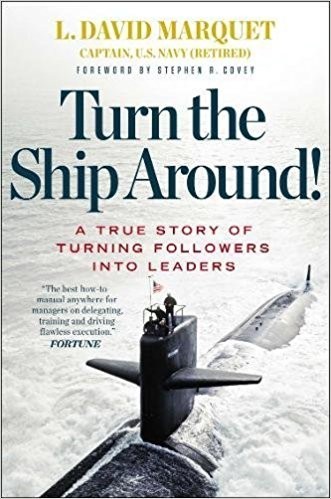
Turn the Ship Around! A True Story of Turning Followers into Leaders · L. David Marquet ·
Key Takeaways
- Marquet took the Santa Fe from the worst submarine in the fleet to the best, and even after he left, the ship kept producing submarine captains.
- Customer teams only make their own decisions when the environment allows it and people feel safe speaking up, even if they might be wrong.
- A team's authority should expand in step with its competence and understanding of the goals; don't hand everything over in the first week.
According to an article from the Naval Submarine League, in early 1999 the submarine USS Santa Fe had only three sailors re-enlist in the previous 12 months. By 2001, nine of the ten eligible petty officers on board had been promoted to chief petty officer.
The man between those two numbers is L. David Marquet, and *Turn the Ship Around!* is the story of those years. The book never mentions software, yet it pinpoints a flaw every Forward Deployed Engineer (FDE) will eventually encounter.
On a customer site, it's easy to become the captain everyone has to ask for permission. Re-running a data pipeline, changing a single line of a prompt, rolling back a version—all of it waits for your nod. In summarizing Marquet's views, Shortform puts the consequence precisely: when a strong leader leaves, performance often collapses, because the team has grown used to depending on them. For an FDE, this moment has a name: handover day.
The worst submarine in the fleet changed who makes decisions
The book's full title is *Turn the Ship Around! A True Story of Turning Followers into Leaders*, with a foreword by Stephen R. Covey. According to the publisher, Marquet reversed the Santa Fe's decline and lifted it from the worst submarine to the top of the fleet.
But the more convincing evidence is on Marquet's own website: an unusually high number of the Santa Fe's officers were later selected as submarine captains. According to Stratechi, this continued even after he left the ship.
Wikipedia gives the figure as ten captains, though that number has not been verified against Navy data. The corresponding metric for an FDE is: after you leave, can the customer team keep the system running on their own?
First insight: change the environment, not the people
In a 2017 talk at Google, Marquet described his role aboard the Santa Fe as creating an environment where people came to work ready to give their best. The focus is the environment, not replacing the crew.
Suppose you deployed a ticket-handling agent for a logistics company's operations team. The on-call engineer is the one who sees the logs, knows the peak hours, and can spot which kinds of tickets the agent gets wrong.
If he wants to turn the agent off for one category of tickets but still has to message you in the middle of the night for approval, the problem isn't his ability—it's the environment: the person with the information has no authority, and the person with the authority lacks the information.
The first thing to do on a customer site is list every decision waiting for your sign-off. Then ask, one by one: who has the data needed to make this decision, and which process is blocking them?
Second insight: people only make their own decisions when they feel safe
In the Google talk, Marquet also said he worked to make his crew feel safe voicing ideas, even ones that might be wrong or unconventional. At a customer, this is the precondition for everything: if a single mistake gets called out in front of their boss, engineers won't make their own decisions.
One concrete tool is replacing requests for approval with statements of intent. Stratechi's summary of the book is titled "I Intend To," meaning you announce what you're about to do first.
"Can I roll back v2?" becomes "I intend to roll back v2 at 2 p.m., because the refund-flow evals have dropped below threshold; I've confirmed v1 is still running fine." The second version already contains the reason, the evidence, and the plan; all you need to do is ask one follow-up question, or reply "ok."
Third insight: expand authority with competence and clarity
Crisp, an authorized partner of Intent-Based Leadership International, offers a simple principle: adjust the level of control to match competence and clarity. Handing authority to a team that can't yet read eval results or doesn't know what goal the system serves is a gamble.
So don't hand over full authority to the customer team in the first week. At the start, have them send "I intend to..." before making small changes like configurations or alert thresholds. Once they can read eval results and articulate the system's business goals, expand their authority to prompts, then to rollbacks.
Clarity is easy to underestimate because it never shows up in the code. If a team doesn't know which metric the customer actually cares about, no amount of competence will keep them from optimizing in the wrong direction.
The best evidence is what happens after you leave
This book suits FDEs about to own projects independently, as well as tech leads considering a move into FDE roles. Read it as an exercise: every time a decision in the book shifts from the captain to an officer, note in the margin the corresponding decision in your deployment and the name of the person who should own it. By the end, you'll have a first draft of next week's handover checklist.
That checklist is also resume material. Claims like "strong leadership skills" are hard for recruiters to believe; measurable outcomes after a project handover are far more convincing.
On your resume, write something like: "Transferred authority over configurations, prompts, and rollbacks to the customer's operations team; the system ran for N weeks post-handover with no FDE involvement." Replace N with your own real number. If you don't have one yet, start counting from your current project.
In interviews, a roughly 30-second answer can follow three steps. Situation: "Every rollback required FDE approval, even at midnight." Action: "Wrote a one-page goals document, taught the team to read eval results, and replaced approval requests with 'I intend to...' messages." Result: "Before handover, the team could decide rollbacks on their own, and the FDE only needed to reply ok."
People remember the Santa Fe for the captains it produced after Marquet left. A deployment should be judged the same way: by how well it runs after you're gone.
Was this article helpful?
Thanks for your feedback!