Executive Summary
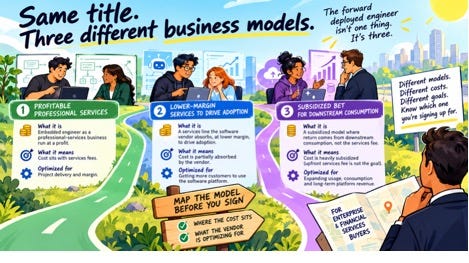
The forward deployed engineer is the enterprise AI hire of the moment, and most coverage treats it as a single phenomenon. It is not. Behind the shared title sit three different business models, and they are not interchangeable. In one, the embedded engineer is a professional-services business run at a profit. In another, it is a lower-margin services line a software vendor absorbs to drive adoption. In the third, it is a subsidized bet whose return is downstream consumption rather than the services fee itself.
The model a vendor is running tells a buyer two things that matter more than the brochure: where the cost sits, and what the vendor is optimizing for. For enterprise and financial-services buyers, mapping the model is the first step, before signing.
One role, three business models
The embedded engineer has become the industry’s common answer to a single problem: powerful AI models that enterprises cannot put into production on their own. Palantir named the role, and through 2026 OpenAI, Anthropic, Microsoft, ServiceNow, AWS, Salesforce, and the large systems integrators all stood up a version of it. As Microsoft’s corporate vice president for forward deployed engineering, Kevin Shatzkamer, put it in October 2026, “the hardest problems in AI have shifted from the model to deployment.”
Because the title is shared, the economics are assumed to be shared too. They are not. The forward deployed engineer sits inside at least three distinct business models, and the differences decide who pays, how much, and what the vendor is trying to achieve. A buyer who cannot tell them apart is negotiating blind.
Model one: professional services, run for profit
In the first model, the embedded engineer is a services business, billed at a margin. For the systems integrators this is the core franchise. Accenture, Deloitte, Infosys, Capgemini, and Cognizant have each stood up forward deployed or “reinvention” engineering practices, and billable deployment work is what these firms have always sold.
Several platform vendors run the same model. Dell and Microsoft operate large deployment and consulting practices and use them to pull through hardware and cloud. Microsoft has institutionalized the role in a dedicated forward deployed engineering organization, and frames the work as leaving the customer able to run the system rather than dependent on the vendor. It does not disclose the margin on that work separately, but it is run as a business, not a giveaway. Palantir is the clearest case. In fiscal 2025 it reported about $4.5 billion in revenue at an 82 percent gross margin and $1.6 billion in GAAP net income, and its forward deployed engineers sit inside high-margin platform contracts rather than as a separate, low-margin services line.
For a buyer, this model is the most transparent. You are paying for the engineer, on an invoice or inside the contract value, and the vendor’s incentive is aligned with delivery and with keeping you as a reference. The better-run versions of this model are built to transfer the capability and leave the institution able to operate on its own, which is how the systems integrators and vendors like Microsoft describe the goal. The risk is ordinary professional-services risk: scope, rates, and whether that transfer happens in practice.
Model two: margin-dilutive services, booked not buried
In the second model, a software vendor whose core business is high-margin subscription absorbs the embedded engineer as a lower-margin services line. ServiceNow’s third quarter is the visible example. The company disclosed that it is placing its own deployment engineers in large deals and treating part of that work as professional services for accounting, a shift of about a quarter of a percentage point of revenue mix, expected to roughly double the following quarter.
The effect is small today, but the direction matters. Professional services carries far lower margins than a subscription seat, so the more of this work a subscription vendor absorbs, the more it dilutes the blended margin. The vendor is spending real money to get customers live, in the expectation that consumption revenue follows. That is a bet, booked honestly on the income statement rather than buried in the platform price.
For a buyer, the signal is that the vendor is investing to accelerate adoption, and that the investment has a limit. The embedded help is funded by the vendor’s own margin, which means it will be steered toward the deals and the configurations most likely to grow consumption.
Model three: the subsidized consumption bet
In the third model, the deployment work is priced to seed downstream usage, and the return is the meter rather than the services fee. The frontier labs are the clearest case. OpenAI’s Deployment Company launched with more than $4 billion of committed capital, and Anthropic’s venture with Blackstone and others at $1.5 billion; both embed engineers with customers, and both are backed by private capital that expects its return in token consumption. AWS stood up a $1 billion forward deployed organization aimed at cloud and model usage, and Salesforce is fielding more than a thousand engineers to drive Agentforce and Data Cloud.
Here the embedded engineer may be inexpensive to the customer, because the engineer’s real job is to grow what the meter measures. Industry analysts have flagged the attendant risk that the model builds dependency on the vendor’s people over time.
For a buyer, this is the model to map most carefully. The help is cheap precisely because the cost moves to consumption, where it compounds, and the vendor’s incentive is to increase usage rather than to restrain it. That incentive is worth understanding before, not after, the agents are running at scale.
What the model tells a buyer
The three models are easy to separate once the question is asked. Does the engineer show up as a bill, as a drag on the vendor’s margin, or as a subsidy funded by future consumption? The answer reveals where the cost sits and what the vendor is optimizing for.
It also connects to a governance question I have written about separately. In the consumption model especially, the vendor’s incentive runs toward more usage and faster deployment, while the people who best understand the resulting agents work for the vendor. That combination does not make a vendor adversarial, but it does mean a buyer should own the economics and the controls rather than inherit them from the field.
The forward deployed engineer is not a single trend to accept or reject. It is three business models under one title. The task is to know which one is across the table.
Reference: the roles and the vendor landscape
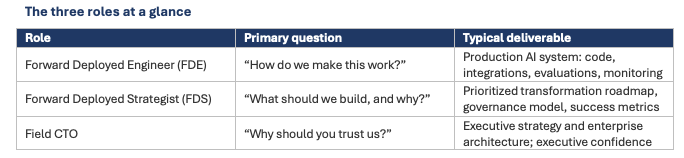
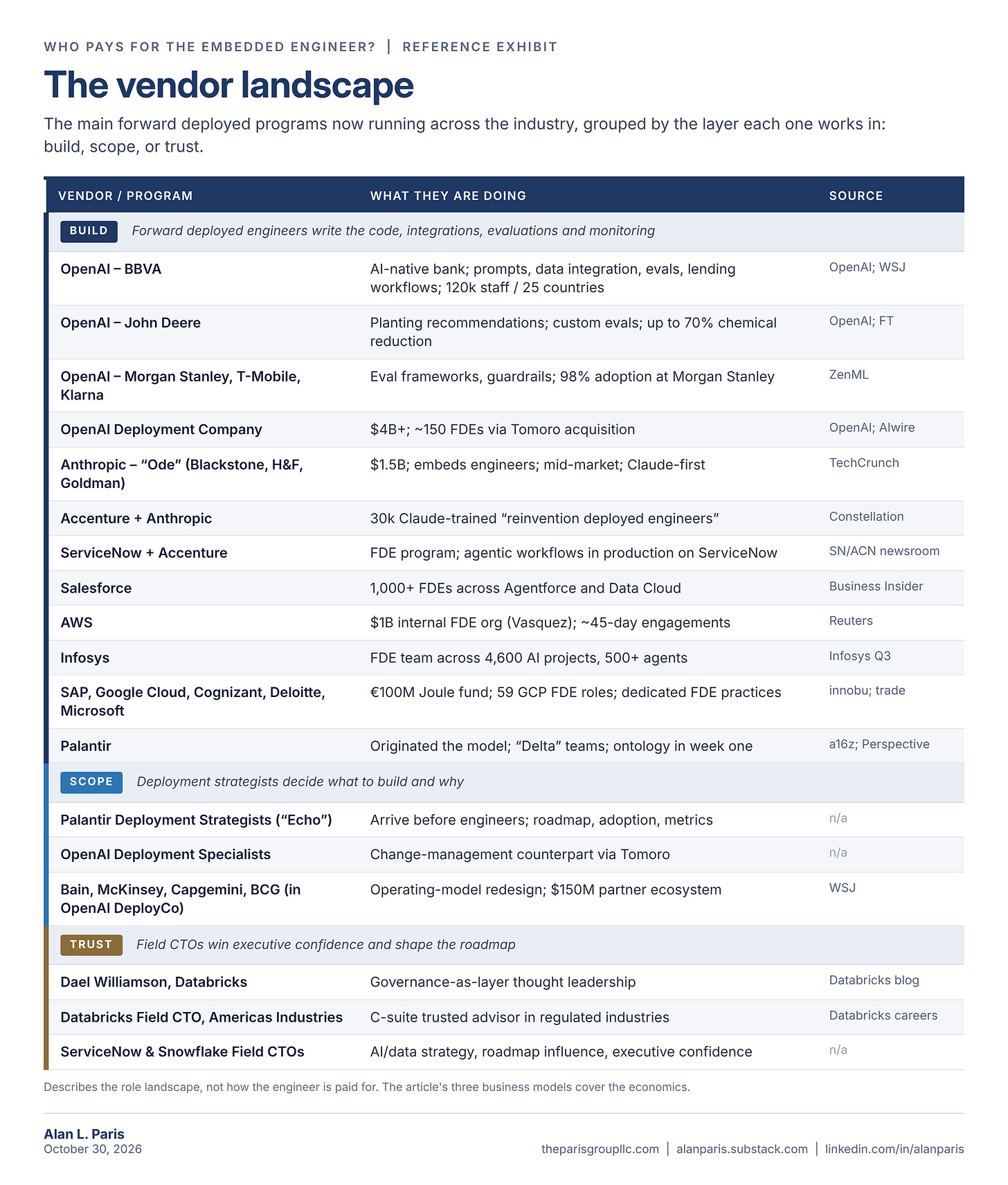
The two tables below are reference exhibits. The first distinguishes the embedded engineer from the two roles it is most often confused with. The second maps the main programs now running across the industry. Both describe the role landscape; the three business models above describe how the engineer is paid for.
Sources
Palantir Technologies Inc., FY2025 Form 10-K (fiscal year ended December 31, 2025), U.S. Securities and Exchange Commission, filed February 2026. Revenue of about $4.5 billion is stated in Item 1; consolidated statements in Item 8. https://www.sec.gov/Archives/edgar/data/1321655/000132165526000011/pltr-20251231.htm Exact full-year figures drawn from that filing: revenue $4,475M, gross profit $3,686M, gross margin 82.4 percent, GAAP net income $1,625M.
Kevin Shatzkamer (Corporate Vice President, Forward Deployed Engineering, Microsoft), “The evolution of forward-deployed engineering,” Command Line, Microsoft, October 28, 2026. https://commandline.microsoft.com/thinking-about-the-evolution-of-forward-deployed-engineers-over-the-last-24-months/
Microsoft Corporation, FY2025 Annual Report and segment notes (consulting and enterprise-services margin not disclosed separately).
ServiceNow, Inc. Q3 FY2026 earnings release, Form 8-K, SEC, October 28, 2026, and Q3 2026 earnings call transcript, The Motley Fool, October 29, 2026 (deployment engineers booked as services; about 25 basis points of revenue mix, rising to about 50).
OpenAI, “The OpenAI Deployment Company,” May 2026; Anthropic and Blackstone enterprise venture, reported by TechCrunch, 2026; AWS forward deployed engineering organization, reported by Reuters, 2026; Salesforce forward deployed engineering, reported by Business Insider, 2026.
Larry Dignan, “Forward deployed engineers: The promise, peril in AI deployments,” Constellation Research, February 1, 2026 (vendor dependency and product-maturity risks).
About the Author
Alan L. Paris is an Adjunct Professor and Advisory Board Member for the Strategic Artificial Intelligence (AI) Program at the University of San Francisco School of Management. He previously served as Field CTO and Enterprise Architect at ServiceNow, leading AI strategy, agentic implementation, and platform architecture for marquee financial services accounts. He is the author of It’s Not About AI, a practitioner-focused guide to designing and deploying agentic AI within complex organizations. Paris has addressed the U.S. Department of State and the Federal Reserve, chaired or presented at more than fifty-five industry conferences across North America, Europe, and Asia, and published more than eighty articles on artificial intelligence, anti-money laundering, enterprise risk management, and financial markets technology. He has been interviewed by media including CNN, the Wall Street Journal, and the Financial Times. https://theparisgroupllc.com/ | Connect on LinkedIn: linkedin.com/in/alanparis
#EnterpriseAI #AIStrategy #ForwardDeployedEngineers #AIMonetization #FinancialServices