Forward deployed engineering is the AI industry’s answer to an uncomfortable insight: better models alone do not bring AI into production, that takes engineers who sit with the client.
This briefing explains what the term means, how an engagement runs, how labs, consultancies and enterprises are reorganizing around it and where the criticism comes in.
What gap does FDE close?
OpenAI calls the core problem the deployment gap: the distance between what a model can do and what people can reliably achieve with it in their daily work. This gap rarely lies in the model. It lies in the client’s legacy systems, security requirements and organizational obstacles. Forward deployed engineers (FDEs) combine AI and software expertise with an understanding of how companies operate. That is how they turn promising experiments into applications the company actually uses.
This shifts the question companies ask. It is no longer only about which model is best, but about how it improves workflows with measurable results. A large IT provider describes the bottleneck like this: what holds many companies back is no longer access to frontier models but a lack of professionals who can build with them inside their own systems.
How does a forward deployed engineer work?
The core is embedding. An engineer from the provider works at the client during the build phase and responds directly to the opportunities and obstacles that come up there. That sets FDE apart from the classic project with a requirements document: the engineer helps find the problem on site instead of working through a specification.
An engagement follows a phase model (FDE Engagement Model).
Diagnostic: a focused diagnostic of where AI can create the most value comes first. Priority workflows: then a small number of workflows follows, selected with the client’s leadership and operating teams. Build and deployment: the FDEs design, build, test and deploy production systems and connect the models to the client’s data, tools, controls and processes. Handover: in Anthropic’s training, the simulated deployment runs from the use case through security review to handover.
OpenAI sums up its FDE work in four principles: start with the outcome, make success repeatable, close the intelligence gaps and go find the harder problem. One example shows what this looks like in practice. At a large semiconductor client, about 15 FDEs put more than ten use cases into operation within three to six months. The use cases then moved onto a harness based on OpenAI Codex. Each project dropped about 90% of its custom code, and rolling out to a second team shrank from two months to one day.
Two properties make the model distinctive.
- The first is the feedback loop: every recurring workflow, integration hurdle and failure at the client becomes input for the next models and products. For a voice agent in a telecom setting, the eval rose from about 60% to over 90% within six months.
- The second is the goal of making itself redundant: the FDE team does its job if it makes itself obsolete every couple of months.
Where does the model come from, and why now?
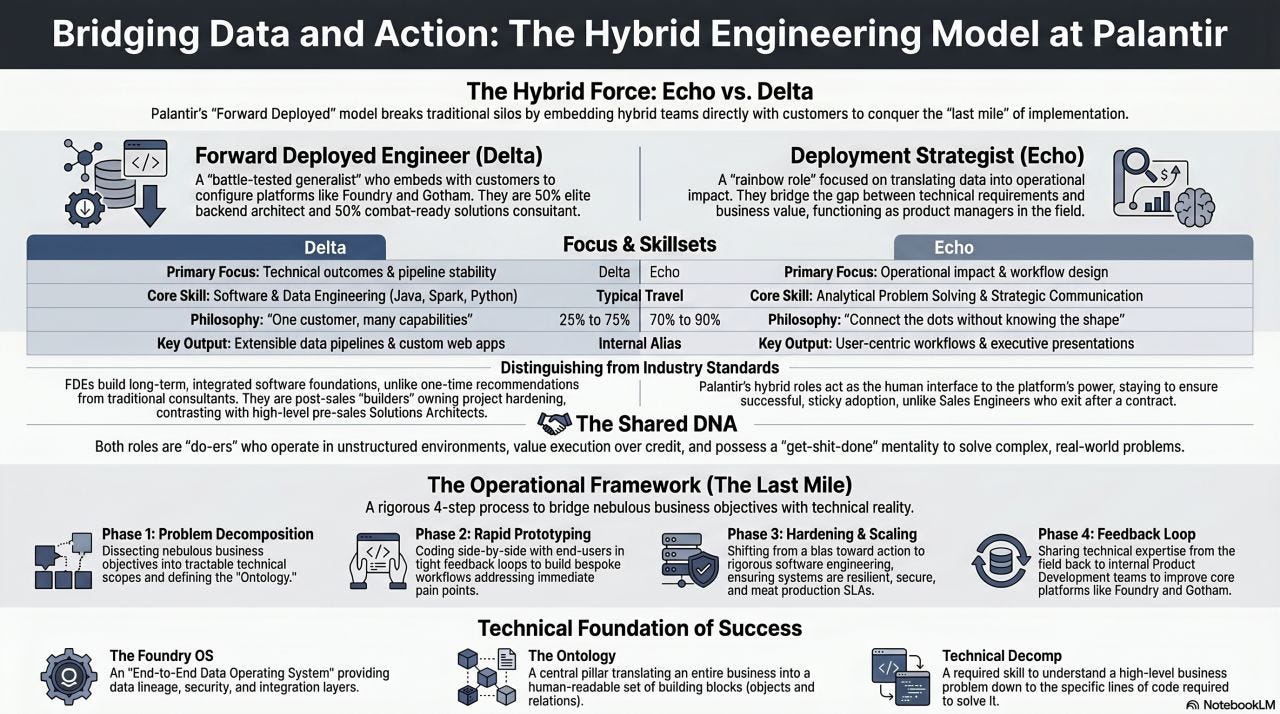
The FDE model originates from Palantir’s business. From the mid-2000s, Palantir sent its own engineers to clients in intelligence, the military and later the private sector. Its platform was hardly usable without heavy customization: data sat in heterogeneous legacy systems, workflows were complex and security requirements high. Generative AI meets a very similar situation in enterprises today.
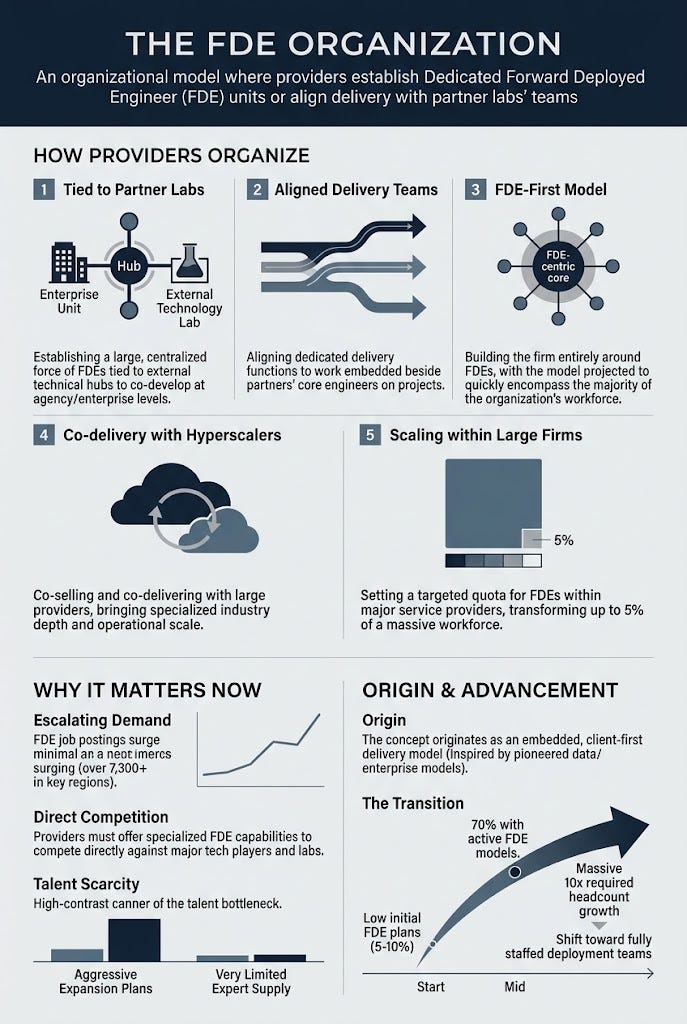
The push in 2026 comes from pressure on returns. Investors question AI investments, which is driving strong demand for FDEs. At the start of the year only 5–10% of companies planned to hire FDEs. By the end of the second quarter it was 70%.
How is the market organizing around FDE?
The organizational question is more interesting than the role itself. FDE changes who sits with the client, and with it the division of labor between labs, consultancies and enterprises.
Labs become service firms. With its deployment company, OpenAI has changed roles. The trade press sums it up: the model company is now the services company.
The channel is being renegotiated. Anthropic justifies its own services company by saying demand is growing faster than any single delivery model. It targets mid-sized companies that lack the resources for frontier deployments, while the system integrators are to keep serving the largest enterprises. AWS’s FDE organization relies on co-selling and co-delivering with partners who bring client relationships, industry depth and operational reach.
Consultancies build capacity at scale. The largest consulting and services firms reported needing to grow their FDE headcount tenfold and to build full teams of 20 to 100 people. One large Indian IT firm plans up to 8,900 FDEs; according to its CEO, up to 5% of the workforce qualifies. Another large firm set up units for two competing labs within eleven days.
Labs train their own. Anthropic is investing $100 million to train 10,000 FDEs by the end of 2027. The badge is tied to a real use case: an in-person program with a simulated deployment is followed by a twelve-week residency in the engineer’s own organization. Google embeds its own FDEs at seven large system integrators.
Talent is bought, not only developed. Acqui-hiring, buying a company mainly for its well-rehearsed team, is most likely when talent is scarce. The first acquisition of OpenAI’s deployment company was a consultancy with about 150 FDEs.
How scarce is the talent?
The numbers show a gap between plans and skills. Lightcast counts more than 7,300 FDE job postings in the US in the first nine months of 2026, up from fewer than 200 in 2023. Indeed reports about 729% more for April 2026 than a year earlier. According to Gartner, recruiters compete for just a few thousand practicing FDEs. In India, two IT firms together plan up to 14,900 FDEs, but one industry estimate puts the number of fully equipped professionals at only about 1,200.
Where does the criticism come in?
Relabeling. Gartner expects most vendor-led deployment interventions to fail by 2028. Clients should watch for traditional IT consulting hastily relabeled and sold at a premium as FDE work. Even an AI-native consultancy warns against simply giving people an FDE title.
No capability building at the client. From a CIO’s point of view, the FDE function sits on the commercial side of the providers, not in research. An engagement leaves a working workflow but no internal capability for the next bottleneck. Constellation Research warns that FDEs often serve as a crutch for product immaturity. Without Palantir’s feedback loop, what remains is expensive systems consulting with a frontier brand name.
Cost. The biggest downside is the labor needed to maintain a permanent FDE force.
What does this mean for Data & AI professionals?
⚪ FDE is less a new technology than a new role profile. It asks for the combination of software engineering, AI know-how and process understanding that has rarely come together in one person. Anyone who masters data engineering, integration and evals and moves confidently in the business domain brings exactly the profile the market is competing for right now.
⚪ Three questions help when buying FDE services. How does the engagement end, and who runs the system afterwards? What capability stays in-house? And is the offer really FDE, or classic consulting under a new name? The phase model with handover and the stated goal of making itself redundant are a good yardstick.
⚪ The model contains a notable contradiction. When FDE succeeds, the work moves into reusable harnesses and platforms, as the semiconductor example shows. Successful FDE thus partly makes itself redundant. For enterprises this can mean building their own FDE teams instead of buying external ones permanently.
Do you already have experiences with FDEs? What does the concept means to you?