Ryan Singer fixes time at six weeks first, then shapes the scope to fit the time. Every customer pilot needs that discipline.
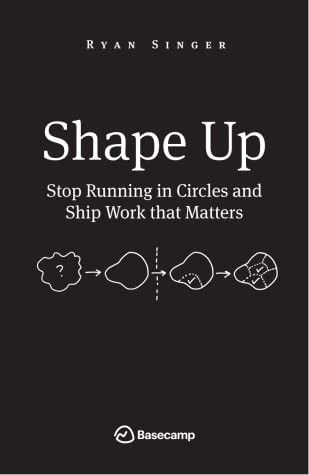
Shape Up: Stop Running in Circles and Ship Work that Matters · Ryan Singer ·
Key Takeaways
- Ryan Singer's *Shape Up* (37signals) is free to read at basecamp.com, published July 10, 2019
- Appetite is a time budget chosen in advance: time is fixed, scope flexes
- For FDEs, it's a way to scope customer pilots and keep projects from dragging on forever
Ryan Singer has a rule that sounds brutal: work not finished within the allotted time is automatically cancelled. On episode 47 of the Rework podcast, aired in July 2019, he called this mechanism the "circuit breaker."
For engineers building internal products, this rule is just a process matter. For Forward Deployed Engineers (FDEs), it touches a familiar anxiety of the job: if no one fixes the time up front, the pilot's scope grows a little with every meeting, until no one remembers when it was originally supposed to end.
*Shape Up* gives you the language to shut this problem down in the very first meeting. The key word is "appetite."
A Free Book That Often Gets Skipped
The book's full title is Shape Up: Stop Running in Circles and Ship Work that Matters, by Ryan Singer, published on Basecamp's (37signals) website. It came out on July 10, 2019, is free to read online in full, and is positioned as the spiritual sequel to *Getting Real*.
The book describes how Basecamp works. The company runs in six-week cycles. After each cycle there is a two-week cool-down for fixing bugs, handling unplanned work, and holding a "betting table" to decide what to bet on in the next cycle.
The book is written for internal product teams, where both time and scope are decided by the company itself. Customer projects require some adaptation, because the contract may already have locked in a feature list. Even so, three ideas from the book are worth applying to customers.
Idea 1: Ask What It's Worth Before Asking How Long It Takes
The glossary at the end of the book defines appetite as the time you're willing to spend on a project, and explicitly states it is different from an estimate. Singer puts it more succinctly: appetite starts with a number and ends with a design. The number comes first and constrains the solution; it is never derived from the solution.
Paired with this is the principle of "fixed time, variable scope." The book calls this the key to defining and delivering a project.
Take a hypothetical example. A customer wants to pilot a customer service AI agent with a dashboard, alerts, and SSO login. If you ask "how long will it take," you'll add up the four items and produce a number everyone knows will slip.
If you set the appetite at six weeks, the question becomes: which part can prove value within six weeks? Maybe just the AI agent running on real data, plus a simple metrics table. SSO and alerts wait for the next cycle.
What if the contract has already locked in all four items? Then push the appetite down to the milestone level: each milestone gets a fixed time box agreed by both parties at the start.
Within the time box, trade one feature for another rather than pushing back the deadline. The total scope in the contract stays unchanged; at each milestone, only the order and depth of the items are renegotiated.
Idea 2: Why Six Weeks?
The number came from Basecamp's trial and error. According to Chapter 1, six weeks is enough to build something meaningful from start to finish; at the same time, it's the longest a team can go while still feeling the deadline pressing from day one. Capping each bet at six weeks is the book's way of reducing planning risk.
Appetite comes in only two sizes. Small batches are one to two weeks; big batches fill an entire six-week cycle, with the same team size. Add the two-week cool-down, and each big bet maps to an eight-week rhythm.
This rhythm fits customer projects well. The first six weeks are for development and shipping to production with the customer's real data.
The next two weeks are for fixing the bugs that real data exposes, then sitting down with the customer to pick the next bet. The customer gets certainty: they'll see a result every eight weeks and can decide whether to continue.
Idea 3: Learn to Say No, and Install a Circuit Breaker
Chapter 3 suggests that for any unshaped idea, the default answer should be "Interesting. Let's revisit later." This doesn't reject the idea; it just keeps it from becoming a commitment before anyone decides how much time it's worth.
Singer's circuit breaker is the other half. When time runs out and the work isn't done, the work stops; it doesn't automatically extend. With customers, saying "six weeks is the cap; if we don't finish, we sit down and re-bet" sounds rigid, but it's more reassuring than a schedule that keeps drifting.
Two Pitfalls When Bringing Appetite to Customers
The first pitfall is turning appetite into an estimate in disguise. If you add up the time for each item and call the total an appetite, that number is derived from the solution—exactly what Singer says to do in reverse. One telltale sign: when scope grows, you raise the appetite along with it instead of cutting scope.
The second pitfall is applying the circuit breaker to a customer who never agreed to it. At Basecamp, whether to cancel is decided by the company itself; with a customer, if they hear about the rule for the first time in week six, and something stops abruptly when time is up, it looks like abandonment.
So, write the circuit breaker into the project kickoff meeting minutes, along with what happens when it triggers. If the customer agreed to it in advance, the circuit breaker firing is just honoring an agreement, and no one will treat it as bad news.
What to Read First, and How to Put It on Your Resume
The fastest path is to read Chapter 1 first to understand the rhythm of cycles and cool-downs, then read Chapter 3, "Set Boundaries", which is the core content on appetite.
After that, listen to this episode of the Rework podcast to hear Singer explain it himself. The rest of the book can wait until you start leading entire customer projects.
The book is best suited for FDEs in their second year and beyond, when you start negotiating scope yourself rather than just taking tickets. If you transitioned from a software engineering role, it gives you a vocabulary for describing disciplined scope management.
On your resume, don't just write "managed scope." Be specific: you set a pilot at six weeks, which items you cut to protect the deadline, and what the results were. When an interviewer asks about scope creep, tell that story, including the appetite you chose and what you said "later" to.
Every customer asks when the work will be done. *Shape Up* helps you counter with a harder and more useful question: how many weeks is this worth to both sides?
Was this article helpful?
Thanks for your feedback!