When enterprises undertake software projects, especially AI projects, one of the most agonizing questions is: who should do the work?
There are only three options:
- Hire your own people (internal team) — reassuring, but expensive and slow
- Hire an outsourcing company (traditional outsourcing) — cheap, but prone to "death upon delivery"
- Hire an FDE (Forward Deployed Engineer) — a new model that many don't know much about
What exactly are the differences between these three models? What are the pros and cons of each? Which one should you choose in which situation? Many enterprise decision-makers are unclear on this.
This article provides a comprehensive comparison across 12 dimensions to help you build a clear decision-making framework.
The Fundamental Differences Between the Three Models
Before starting the comparison, first understand the underlying logic differences of the three models:
| Model | Core Logic | Nature of Relationship | Source of Value |
|---|---|---|---|
| Internal team | "I hire people, they report to me, and they do what I need" | Employment relationship | Long-term capability accumulation |
| Traditional outsourcing | "I pay you, you do the work per contract, and deliver when done" | Buyer-seller relationship | Economies of scale + labor cost arbitrage |
| FDE | "You send people to work with us, and they are accountable for the results" | Partnership | Professional expertise + deep integration |
None of the three models is absolutely better or worse — it's only about fit. The key is to choose the most suitable model based on the project's nature, stage, and budget.
Comprehensive Comparison Across 12 Dimensions
To make the comparison more intuitive, here is a panoramic comparison across 12 dimensions:
Overview Comparison Table
| Dimension | Internal Team | Traditional Outsourcing | FDE | Winner |
|---|---|---|---|---|
| 💰 Total cost (short-term, 3 months) | High (recruiting + salary + management) | Low | Medium | Outsourcing |
| 💰 Total cost (long-term, 2 years) | Low (amortized) | High (accumulated fees) | Medium-high | Internal |
| ⚡ Startup speed | Slow (2-6 months of recruiting) | Medium (1-2 months of bidding) | Fast (onboard in 1-2 weeks) | FDE |
| 🎯 Business alignment | High | Low | High | Internal = FDE |
| 📊 Delivery outcome assurance | Medium | Low | High | FDE |
| 🔄 Flexibility for requirement changes | Medium | Poor | Good | FDE |
| 🧠 Knowledge retention | Medium-high (lost when people leave) | Low | High | FDE |
| 📞 Communication efficiency | High | Low | Medium-high | Internal |
| ⚠️ Quality risk | Medium | High | Low | FDE |
| 📈 Scalability | Poor (hiring is hard) | Good | Medium | Outsourcing |
| 🔒 Information security | High | Low | Medium | Internal |
| 🎓 Team capability improvement | High | Low | High | Internal = FDE |
| Overall score (out of 10) | 7.0 | 5.5 | 8.5 | FDE |
Detailed Analysis of Each Dimension
1. Cost Comparison
| Dimension | Internal Team | Traditional Outsourcing | FDE |
|---|---|---|---|
| Entry cost | High (recruiting, training, management costs) | Low (pay per project) | Medium (higher than outsourcing, but lower than building in-house) |
| Unit cost | High (monthly salary + social insurance + benefits + management) | Low (labor cost arbitrage) | Medium-high (senior engineers, priced by value) |
| Total cost (short-term) | High (salaries must be paid even when there's no work) | Low (stops when the project ends) | Medium |
| Total cost (long-term) | Low (amortized over years) | High (accumulated fees from continuous outsourcing) | Medium-high |
| Cost transparency | Low (many hidden costs) | High (fixed in the contract) | Medium (billed per person-day or per project) |
| Sunk cost risk | High (hiring the wrong person is costly) | Low (ends when the project ends) | Medium (can cut losses quickly) |
Key insights:
- Short-term (within 3 months): traditional outsourcing < FDE < internal team
- Medium-term (6-12 months): FDE ≈ traditional outsourcing < internal team
- Long-term (2+ years): internal team < FDE < traditional outsourcing
Reference data: FDEs typically earn 10-20% more than software engineers of the same level, but FDEs are billed per project, so you don't bear hidden costs like recruiting, training, management, or social insurance. For projects lasting 3-6 months, the total cost of ownership of an FDE may actually be lower than hiring internally.
2. Speed Comparison
| Dimension | Internal Team | Traditional Outsourcing | FDE |
|---|---|---|---|
| Startup speed | Slow (2-6 months of recruiting) | Medium (1-2 months of bidding + contract signing) | Fast (can start in 1-2 weeks) |
| Ramp-up speed | Slow (1-3 months to learn the business) | Slow (2-4 weeks of requirement communication and understanding) | Fast (senior engineers learn while doing) |
| Iteration speed | Medium (constrained by internal processes) | Slow (changes go through processes, waiting for scheduling) | Fast (issues found can be fixed the same day) |
| Delivery cycle | Uncertain (affected by priorities) | Long (waterfall style — one delayed phase delays everything) | Short (agile style, with results every week) |
Key insight: FDEs have an overwhelming advantage in speed — fast to start, fast to ramp up, fast to iterate. For projects with a "very short time window," FDEs are often the optimal choice.
3. Quality and Outcome Comparison
| Dimension | Internal Team | Traditional Outsourcing | FDE |
|---|---|---|---|
| Technical quality | Medium-high (depends on team capability) | Inconsistent (depends on luck) | High (FDEs are senior engineers) |
| Business alignment | High (in the company every day, knows the business best) | Low (one layer removed, understanding is skewed) | High (embedded on the business frontline, deep understanding) |
| Final outcome | Medium (someone does the work, but not necessarily well) | Low (delivered doesn't mean adopted) | High (accountable for business results) |
| Maintainability | High (those who wrote it maintain it) | Low (handover docs = nobody reads them) | High (knowledge transfer, mentoring and training) |
Key insight: The biggest pain point of traditional outsourcing is "death upon delivery" — the features get built, but the business doesn't use them, no one maintains them, and they gradually become obsolete. The core advantage of the FDE model is solving exactly this problem: not only building it, but getting it running, and making sure the client team can maintain it.
4. Flexibility Comparison
| Dimension | Internal Team | Traditional Outsourcing | FDE |
|---|---|---|---|
| Requirement changes | Flexible (but priorities must be set) | Difficult (changes = extra cost + delays) | Flexible (quick adjustments, small iterative steps) |
| Scale flexibility | Difficult (hiring is hard, layoffs are harder) | Flexible (adjust headcount per project) | Medium (can increase or decrease the number of FDEs) |
| Direction changes | Medium (possible but with inertia) | Difficult (fixed by contract) | Flexible (can be reviewed and adjusted every two weeks) |
| Ending a project | Difficult (what to do with the team?) | Easy (ends when the project closes) | Easy (ends when the project is completed) |
Key insight: The flexibility of FDEs sits between in-house teams and outsourcing—easier to "cut losses" than with an in-house team, and easier to "adjust direction" than with outsourcing. For highly exploratory projects with uncertain direction (such as AI implementation), this flexibility is extremely valuable.
5. Risk Comparison
| Risk Type | In-house Team | Traditional Outsourcing | FDE |
|---|---|---|---|
| Quality risk | Medium | High (vendor quality varies widely) | Low (senior engineers + accountability for results) |
| Schedule risk | Medium (priority conflicts, resource competition) | High (unclear requirements, poor communication) | Low (dedicated full-time staff, fast iterations) |
| Cost risk | High (budget overruns are common, many hidden costs) | Medium (fixed contract amount, but high change fees) | Medium (billed per person-day/project, relatively controllable) |
| Talent attrition risk | High (project collapses when key people leave) | Low (outsourcing firm reallocates staff internally) | Medium (FDE firms have backup mechanisms) |
| Information security risk | Low (in-house employees are controllable) | High (risk of data leakage) | Medium (NDAs in place, but trust is required) |
Key insight: Different models carry different types of risk. The biggest risks for in-house teams are "talent attrition" and "hidden costs"; for traditional outsourcing, they are "loss of quality control" and "schedule delays"; for FDEs, the biggest risk is "finding a reliable FDE"—choose the right person, and the risk is very low.
6. Knowledge Retention Comparison
| Dimension | Internal Team | Traditional Outsourcing | FDE |
|---|---|---|---|
| Knowledge retention | Medium-high (knowledge stays while people stay, leaves when they go) | Low (knowledge stays with the outsourcing firm) | High (knowledge transfer is a core deliverable) |
| Documentation quality | Inconsistent | Usually poor (just to fulfill the contract) | Good (must be well-written for knowledge transfer) |
| Team capability improvement | High (learning while doing) | Low (client team not involved in development) | High (FDE mentors and works alongside the team) |
| Long-term capability building | Highest | Lowest | High |
Key insight: Many companies overlook the value of knowledge retention. Under traditional outsourcing, the money is spent and the system goes live, but the company retains no capabilities of its own—next time it has to hire outsourcers again. Under the FDE model, by the end of the project the company has not only the system but also an internal team that knows how to maintain and iterate on it.
7. Communication Efficiency Comparison
| Dimension | Internal Team | Traditional Outsourcing | FDE |
|---|---|---|---|
| Communication layers | Few (direct contact) | Many (client → project manager → team lead → developers) | Few (direct contact with the FDE) |
| Information loss | Low | High (a game of telephone, distortion at every layer) | Low |
| Decision speed | Slow (many internal processes) | Slow (outsourcers have no decision-making authority) | Fast (FDEs on-site can make many decisions themselves) |
| Cultural friction | Low | High (client-vendor mindset) | Medium (but much better than outsourcing) |
Key insight: Many problems with traditional outsourcing are fundamentally communication problems—misunderstood requirements, slow response to changes, hard-to-troubleshoot issues—all rooted in "too many layers in between." FDEs are embedded directly in the client team, so communication is far more efficient.
8. Suitable Project Types
| Project Type | In-house Team | Traditional Outsourcing | FDE |
|---|---|---|---|
| Long-term stable routine operations | ✅ Best | ❌ Not suitable | ⚠️ Possible but expensive |
| Standardized development with clear requirements | ⚠️ Possible | ✅ Best | ⚠️ Possible but expensive |
| 0-to-1 innovation projects | ⚠️ Possible | ❌ Easy to go off track | ✅ Best |
| AI implementation / system upgrades | ⚠️ Not viable without the capability | ❌ Poor results | ✅ Best |
| Urgent projects | ❌ No time to hire | ⚠️ Slow to start | ✅ Fastest |
| Exploratory / validation projects | ⚠️ High cost | ❌ Inflexible | ✅ Best |
Decision Guide for Typical Scenarios
Scenario 1: CRM AI Upgrade
Background: The company already has a CRM system and wants to add AI features (lead scoring, churn prediction, etc.), but the internal team only has traditional Java developers with no AI experience.
| Option | Assessment |
|---|---|
| In-house team | ❌ Lacks AI capability; hiring is costly and slow |
| Traditional outsourcing | ❌ AI project requirements are unclear; the outsourcing model easily goes off track |
| FDE | ✅ Best choice—senior AI experts embedded on-site, delivering one use case in 6-8 weeks while mentoring the internal team |
Recommended approach: FDE model. Start with a pilot for one use case (e.g., lead scoring), then gradually expand to other use cases after validating the results.
Scenario 2: Building a Brand-New ERP System
Background: The company has grown, Excel-based management is no longer sufficient, and a complete ERP system is needed.
| Option | Assessment |
|---|---|
| In-house team | ❌ Too costly, takes too long |
| Traditional outsourcing | ✅ Best choice—ERP is a highly standardized system with relatively clear requirements |
| FDE | ⚠️ Possible but unnecessary, and more expensive |
Recommended approach: Traditional outsourcing (or buy a SaaS ERP directly). ERP is a mature product category with clear requirements, so outsourcing offers the best value for money.
Scenario 3: A 0-to-1 New Product
Background: You want to build a brand-new product but aren't sure whether the market will accept it, and need to quickly build an MVP to validate it.
| Option | Assessment |
|---|---|
| In-house team | ❌ Hiring is too slow; you miss the window of opportunity |
| Traditional outsourcing | ❌ MVP requirements change daily; the outsourcing model is a complete mismatch |
| FDE | ✅ Best choice—fast start, fast iteration, fast validation |
Recommended approach: FDE model. Build the MVP in the shortest time possible, and after validating market feedback, decide whether to build an in-house team or continue outsourcing.
Scenario 4: Maintaining and Iterating an Existing System
Background: The system is already live and needs long-term maintenance and feature iteration.
| Option | Assessment |
|---|---|
| In-house team | ✅ Best choice—lowest cost and fastest response in the long run |
| Traditional outsourcing | ⚠️ Possible, but slow to respond and inconsistent in quality |
| FDE | ❌ Too expensive; overkill |
Recommended approach: In-house team. If the budget is limited, outsourced operations are also an option, though response times will be somewhat slower.
Cost Calculation Example: CRM AI Upgrade Project
Suppose a mid-sized company wants a CRM AI upgrade covering two use cases—lead scoring and churn prediction—to be completed in 3 months. Let's do the math:
Option A: Hiring AI Engineers In-house
| Cost Item | Amount | Notes |
|---|---|---|
| Recruiting costs | 30,000 RMB | Headhunter fees, time cost of recruiting |
| 3 months of salary | 120,000 RMB | 40K/month × 1 person |
| Social insurance, housing fund + benefits | 42,000 RMB | 35% of salary |
| Management costs | 20,000 RMB | Managers' time, training costs |
| 3 个月总成本 | 212,000 元 | |
| Additional risks | — | What if the hire turns out to be a poor fit? What does the person do after the project ends? |
Option B: Traditional Outsourcing
| Cost Item | Amount | Notes |
|---|---|---|
| Project cost | 150,000 RMB | Outsourcing quote |
| Communication and coordination cost | 40,000 RMB | Internal staff time spent on liaison |
| Rework/change costs | 30,000 RMB | Additional costs from requirement adjustments |
| Ongoing maintenance cost | 50,000 RMB | No one to maintain after launch, outsource again |
| 总成本 | 270,000 元 | |
| Additional risks | — | What if it's delivered but can't be adopted? Who do you turn to if results are poor? |
Option C: FDE model
| Cost Item | Amount | Notes |
|---|---|---|
| FDE fees (3 months) | 240,000 RMB | 80K/month, senior AI FDE |
| Internal coordination cost | 15,000 RMB | Far lower than outsourcing, since the FDE embeds directly |
| Knowledge transfer/training | 0 RMB | Included in the service |
| Ongoing maintenance capability | In place | Internal team has learned to maintain it |
| 总成本 | 255,000 元 | |
| Additional benefits | — | Internal team capability improvement, a system that actually works, guaranteed results |
Comparison conclusion
| Dimension | Internal hiring | Traditional outsourcing | FDE |
|---|---|---|---|
| Total cost (3 months) | 212K | 270K | 255K |
| Results guarantee | Medium | Low | High |
| Knowledge retention | Medium | None | High |
| Time investment | Slow (2 months hiring) | Medium (1 month bidding process) | Fast (on-site in 1-2 weeks) |
| Risk | Medium-high (wrong hire) | High (dies at delivery) | Medium-low (delivered by senior engineers) |
Conclusion: For AI upgrades—projects with dynamic requirements that need deep business integration—the FDE model offers the best overall value. On the surface, FDE costs slightly more than outsourcing, but considering results guarantees, knowledge transfer, and risk control, the actual ROI is higher.
Project success rate comparison: AI project performance under different models
Under different delivery models, AI project success rates vary dramatically:
| Metric | Internal team | Traditional outsourcing | FDE model |
|---|---|---|---|
| PoC → production conversion rate | ~45% | ~25% | ~85% |
| On-time delivery rate | ~50% | ~35% | ~80% |
| Results target achievement rate | ~55% | ~30% | ~80% |
| Average cost overrun rate | ~35% | ~60% | ~15% |
| User adoption rate (3 months after launch) | ~50% | ~25% | ~75% |
| System still running after 1 year | ~60% | ~30% | ~90% |
Data sources: Estimated from Gartner (2025 AI infrastructure project success rate survey), McKinsey (2026 State of AI report), Deloitte (2025 GenAI project ROI study), and FDE industry practice data. Note: Internal team data assumes the team has some AI capability; if the team lacks AI experience, success rates will be lower.
Why is the FDE model's success rate far higher than traditional outsourcing? There are three core reasons:
- Accountability for outcomes: FDEs deliver business results, not just features
- Deep embedding: On-site with the client, low communication costs, accurate understanding of requirements
- Agile iteration: Small, fast steps with timely adjustments, avoiding going too far in the wrong direction
ROI payback period comparison
Under different models, AI project payback periods differ significantly:
| Metric | Internal in-house team | Traditional outsourcing | FDE model |
|---|---|---|---|
| Time from kickoff to launch | 4-8 months | 3-6 months | 4-8 weeks |
| Time from launch to results | 2-4 months | 3-6 months (often requiring rework) | 2-4 weeks |
| Total payback period | 12-24 months | 18-36 months | 4-8 months |
| First-year ROI | 1.5-2.5x | 0.8-1.5x (many projects struggle to break even) | 3-5x |
| Three-year cumulative ROI | 5-8x | 2-4x | 8-12x |
Data sources: Estimated from McKinsey (2026 AI ROI study), Deloitte (2025 GenAI project return analysis), Nucleus Research (2025 AI CRM investment returns), and FDE industry practice data. Note: Internal teams have longer ROI cycles but higher long-term returns; outsourcing has lower unit prices but high failure rates, dragging down overall ROI; the FDE model delivers results quickly with high success rates, showing a clear short-term ROI advantage.
Best delivery model by project type
Not all projects are suited to FDE. Different project types have different optimal delivery models:
| Project type | Internal team | Traditional outsourcing | FDE | Recommended model |
|---|---|---|---|---|
| Routine operations (bug fixes, small features) | ✅ Best | ⚠️ Possible but slow | ❌ Overkill | Internal team |
| Standardized feature development (e.g., backend CRUD) | ✅ Possible | ✅ Lowest cost | ❌ Wasteful | Traditional outsourcing |
| Corporate website/showcase site | ⚠️ Possible | ✅ Recommended | ❌ Wasteful | Traditional outsourcing |
| Implementation of mature systems like ERP/OA | ⚠️ Only with a team | ✅ Recommended (find an implementer) | ⚠️ Unnecessary | Traditional outsourcing/implementer |
| Data dashboards/BI reports | ⚠️ Only with a data team | ⚠️ Mixed results | ✅ Good results but costly | Depends on budget |
| System refactoring/technical debt cleanup | ✅ Best (long-term maintenance) | ❌ Unsuitable (requires deep understanding) | ✅ Can serve as external support | Internal + FDE consultant |
| 0-to-1 new product MVP | ❌ No time to hire | ❌ Requirements change daily | ✅ Best choice | FDE |
| AI implementation/AI feature integration | ❌ Lacks AI capability | ❌ High failure rate | ✅ The only reliable choice | FDE |
| Urgent projects/short time windows | ❌ No time | ❌ Slow to start | ✅ Fastest | FDE |
| Innovation exploration/uncertain direction | ❌ High trial-and-error cost | ❌ Bound to fail | ✅ Best choice | FDE |
Rule of thumb:
- Standardized, clear requirements → outsourcing
- Long-term, ongoing maintenance → internal team
- Uncertain, exploratory, needs speed → FDE
When facing a specific project, you can use the following decision matrix to quickly determine which model to choose:
Decision matrix table
| Project characteristic | Internal team | Traditional outsourcing | FDE |
|---|---|---|---|
| Duration: Long-term (1 year+) | ✅ First choice | ❌ Not recommended | ⚠️ Consultant-style |
| Duration: Medium-term (3-12 months) | ⚠️ Only with a team | ⚠️ Consider only if requirements are clear | ✅ Recommended |
| Duration: Short-term (<3 months) | ❌ No time | ⚠️ Consider for standardized work | ✅ First choice |
| Requirements: Very clear | ✅ Works | ✅ Recommended | ⚠️ Somewhat wasteful |
| Requirements: Partially clear | ✅ Works | ⚠️ Prone to disputes | ✅ Recommended |
| Requirements: Highly uncertain | ⚠️ High trial-and-error cost | ❌ Bound to fail | ✅ Best choice |
| Innovation: Standardized features | ✅ Works | ✅ Recommended | ❌ Overkill |
| Innovation: Somewhat innovative | ⚠️ Depends on team capability | ⚠️ Choose cautiously | ✅ Recommended |
| Innovation: Cutting-edge exploration (AI, etc.) | ❌ Lacks capability | ❌ Won't do it well | ✅ The only reliable choice |
| Budget: Ample | ✅ Build your own team | ⚠️ Choose suppliers carefully | ✅ Quick start |
| Budget: Limited | ⚠️ Hire slowly | ✅ Most cost-effective | ⚠️ Choose a small pilot project |
| Confidentiality requirements: Extremely high | ✅ Must build in-house | ❌ High risk | ⚠️ Sign NDA + on-site work |
Quick decision flowchart
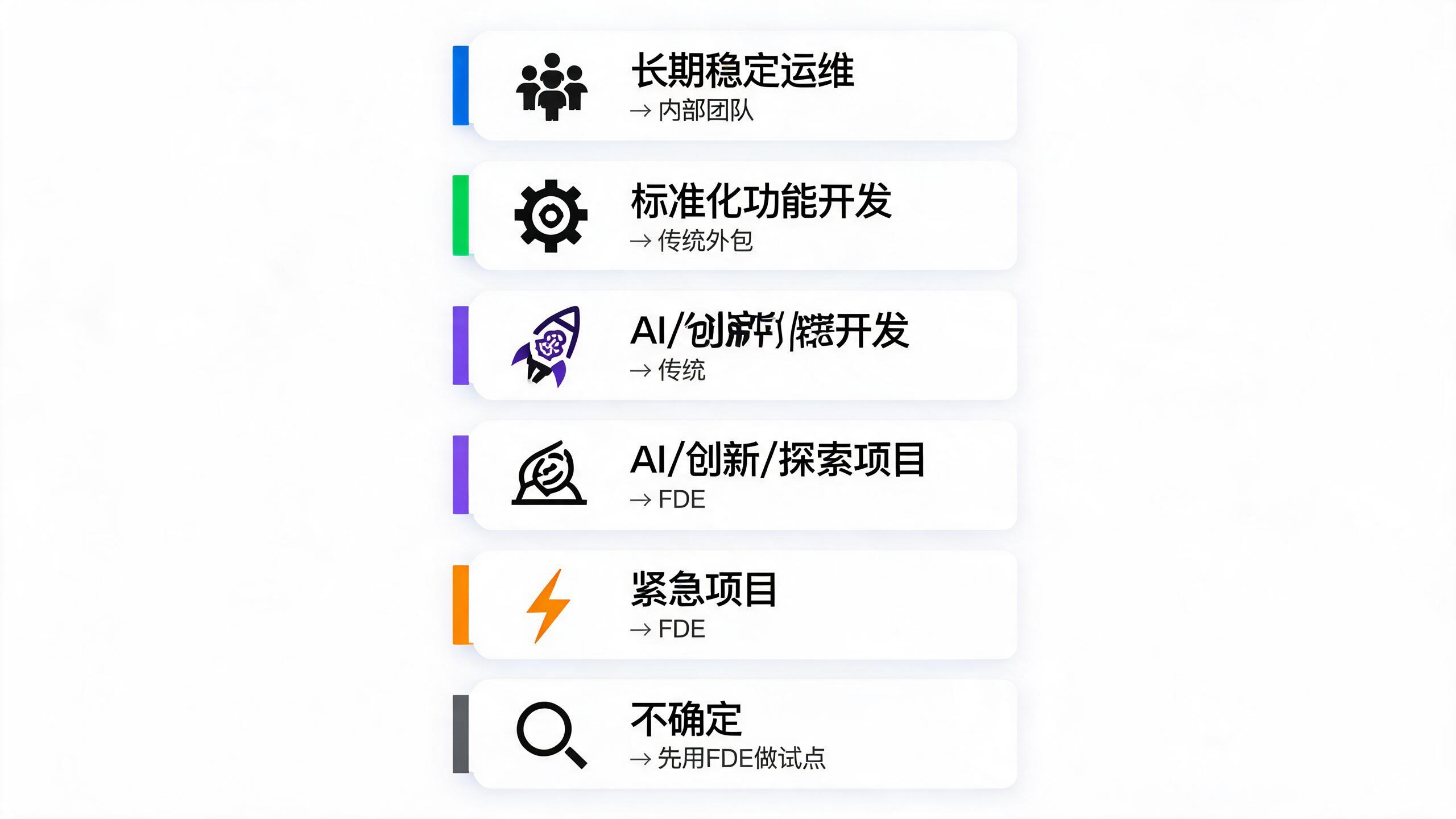 Figure: Optimal delivery model for different project types
Hybrid model: The optimal solution is often a combination
In reality, many companies don't choose just one model, but use a mix:
Model 1: FDE + internal team
- FDE is responsible for: Early-stage architecture design, core feature development, solving technical challenges
- Internal team is responsible for: Daily development, maintenance, feature iteration
- Applicable scenario: You have a basic in-house development team but lack high-end experts (such as AI experts or architects)
Model 2: FDE + traditional outsourcing
- FDE is responsible for: Requirements diagnosis, solution design, core module development, acceptance checks
- Outsourcing is responsible for: Standardized feature development, testing, data entry, and other routine work
- Applicable scenario: Large projects with both standardized and innovative parts
Model 3: Internal team + outsourcing + FDE consultant
- Internal team: Primary development and maintenance
- Outsourcing: Handles peak periods or non-core requirements
- FDE consultant: Participates at intervals, providing technical guidance, architecture reviews, and solving difficult problems
- Applicable scenario: Large enterprises with some technical foundation that need periodic guidance from external experts
Core principle: Use FDEs for the most valuable work, outsourcing for standardized work, and the internal team for long-term work.
Selection decision tree
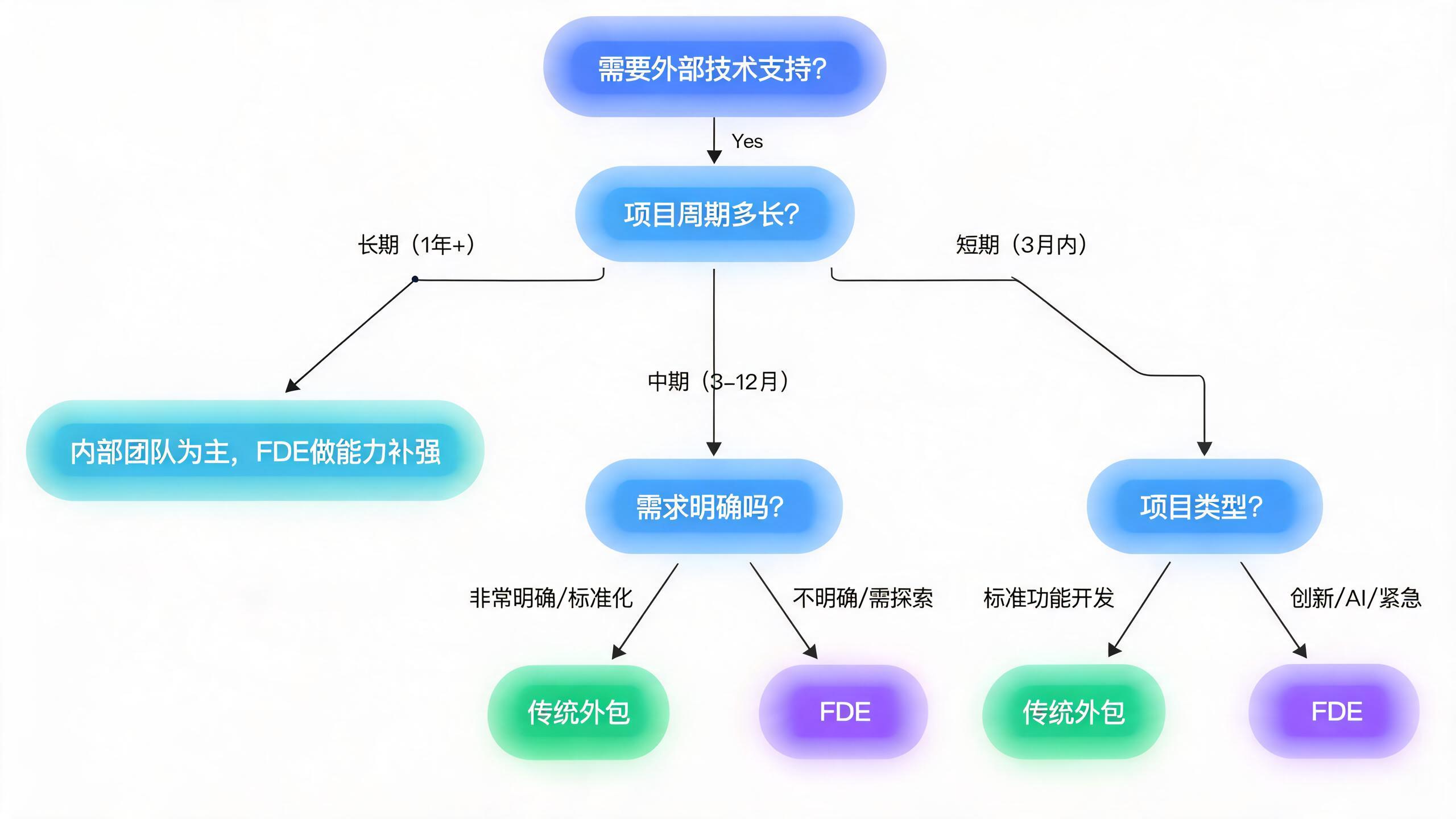 Figure: Delivery model decision tree based on project cycle and requirements clarity
Things to consider when choosing FDE services
If you decide to try the FDE model, the following points can help you avoid pitfalls:
1. Look at the FDE's actual experience, not the company's name
The quality of an FDE depends on the person, not the company. Big companies may assign junior engineers, and small teams may have very senior experts. Be sure to talk with the FDE who will actually work on the project to judge their level.
2. Define success criteria and sign outcome-oriented contracts
Don't just sign for "what features to build"—also sign for "what results to achieve." For example, "increase lead conversion rate by 15%" or "reduce customer service response time by 50%." Only outcome-oriented contracts ensure that the FDE's interests are aligned with yours.
3. Start with a small pilot project
Don't sign a big project right away. First find a small scenario (such as a one-month AI lead scoring pilot) to see how the FDE's capability, communication, and results are. Expand if it goes well; cut losses promptly if it doesn't.
4. Assign internal counterparts to participate throughout
An FDE doesn't come to "do it for you"—they come to "do it with you." Be sure to assign internal business and technical leads to participate throughout. This not only yields better results, but also ensures knowledge transfer by the end of the project.
5. Prioritize knowledge transfer; don't create new dependencies
Knowledge transfer should happen in parallel during the project—coding standards, architecture documentation, operations manuals, monitoring and alerting—to ensure the internal team can take over after the FDE leaves. Otherwise, it just becomes "outsourcing dependency in a different form."
Final thoughts
None of the three models is absolutely superior; it's only a matter of fit.
- If you want long-term capability and can bear the recruitment cost and time cost—choose an internal team
- If you want the lowest cost and your requirements are very clear—choose traditional outsourcing
- If you want results and speed and the project is exploratory—choose FDE
Projects in the AI era are increasingly "exploratory"—no one knows what the optimal solution is, and you need to try and adjust as you go. For such projects, traditional outsourcing has a high chance of failure, while an internal team is too slow and expensive. The reason the FDE model is becoming more popular is essentially that it matches the characteristics of projects in the AI era.
Not every project is suited to FDE, but more and more projects will find that FDE is the optimal solution.
📚 FDE article series
| Article | Core content |
|---|---|
| Complete Guide to Forward Deployed Engineers | Full analysis of role definition, value, competency model, and pricing models |
| FDE vs traditional outsourcing vs internal team (this article) | Comprehensive comparison of the three models to help you choose the right delivery approach |
| FDE Project Delivery Process: Full-Chain Analysis from Requirements Diagnosis to Knowledge Transfer | Breakdown of the standard delivery process—what to do and deliver at each stage |
| Why Do AI Projects Need FDEs? Avoiding 70% of Implementation Failures | Core pain points of AI implementation and how FDEs solve them |
❓ Frequently Asked Questions FAQ
Q1: FDEs are much more expensive than outsourcing—why choose FDE? Because the "delivery quality" and "implementation results" of FDEs far exceed outsourcing. Many companies that have done outsourced projects know the feeling: outsourcing seems cheap on the surface, but if the system never gets used, the money is wasted. FDEs have a higher unit price, but they are accountable for results—the system actually works, the business actually improves, and the team actually learns. In total cost terms, FDEs often deliver higher ROI.
Q2: What's the difference between an FDE and a technical consultant? A technical consultant "gives advice"—offering suggestions, making plans, and writing reports, but is not responsible for implementation. An FDE "does the work"—not only providing solutions, but also personally writing code, doing integrations, driving launches, and ensuring results. Simply put: a consultant "tells you how," while an FDE "shows you by doing it and does it together with you."
Q3: Will an FDE take away our core technology? This concern is exactly backwards—an FDE comes to "empower you," not to "steal technology." The core value of an FDE is bringing in advanced external experience, methodologies, and technical capabilities to help the client team grow. Moreover, FDEs serve many clients, and every company's business is unique—what an FDE takes away is only general methods, not your core business secrets. What you should really worry about is "not learning anything," not "having something taken away."
Q4: How do I judge whether an FDE is reliable? A few criteria: first, technical depth—can they discuss technical details in depth, or do they only talk in concepts; second, business understanding—can they quickly grasp your business pain points, or do they only pitch their own solution; third, communication skills—does the conversation flow smoothly, and do they get to the point; fourth, past cases—have they done similar projects, and what were the results? The best approach is to start with a small 2-4 week pilot—proving it through action is more effective than anything they can say.
Q5: How long is an FDE engagement typically appropriate for? It depends on the project size. The smallest validation projects take just 2-4 weeks; landing a single scenario usually takes 6-8 weeks; medium-scale system overhauls take 3-6 months; large transformation projects may take 6-12 months or even longer. I recommend starting small—first run a 4-6 week pilot, then renew after validating the results. This minimizes risk and makes it easiest to win over management.
If you're struggling to decide which delivery model to choose for your project, feel free to reach out to me to discuss. Based on your specific situation, I can help you with a free selection assessment.