Forward Deployed Engineering · Part 1 of 4
Walk into a busy hospital and you will notice something strange. Doctors — among the most highly trained people in the building — spend a large part of their day hunting for information. Which scan was done last month? What did the previous consultant write? Is there an allergy on file?
Walk into a bank and you will find the same shape of problem. A loan that could be cleared in minutes waits three days, because someone has to open a dozen documents and verify them by hand.
Neither of these is a technology problem. Both are business problems that happen to be waiting for the right technology.
AI can solve a great many of them. There is only one catch, and it is a big one.
The people who understand the problem usually do not understand the technology. The people who understand the technology usually do not understand the problem.
That gap is where most projects quietly die. It is also where a new kind of engineer has appeared.
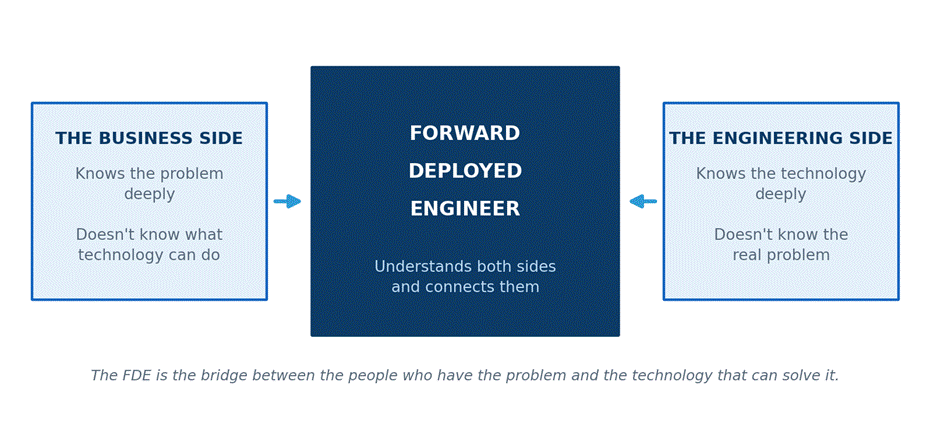
Figure 1 — The gap between the business side and the engineering side, and who closes it.
1. What Is a Forward Deployed Engineer?
Simple definition
A Forward Deployed Engineer (FDE) is an engineer who goes to where the problem actually is — sits with the customer, works out what is really going wrong, designs a solution, builds it, and puts it into live use.
The word “forward” matters. It means deployed close to the action rather than working far away from it. A traditional engineer usually receives a requirement and builds it well. A Forward Deployed Engineer goes and finds out what the requirement should have been in the first place.
They still write code. But writing code is only one part of the job. The rest is sitting in the room where the problem lives.
An analogy that makes it click
Think about building a house.
A traditional engineer is like the construction team. Hand them a good blueprint and they will build something excellent, on time, exactly as drawn.
A Forward Deployed Engineer is like the architect who visits the family first. They ask how the family cooks, whether the grandparents will move in, how many people work from home, where the morning light falls. Only then do they design. And they stay on site while the house is being built, adjusting as reality shows up.
Both are skilled. But only one of them is responsible for whether the family actually enjoys living in the house.
2. How Software Engineering Arrived Here
This role did not appear overnight. It is the result of thirty years of the job quietly changing shape.
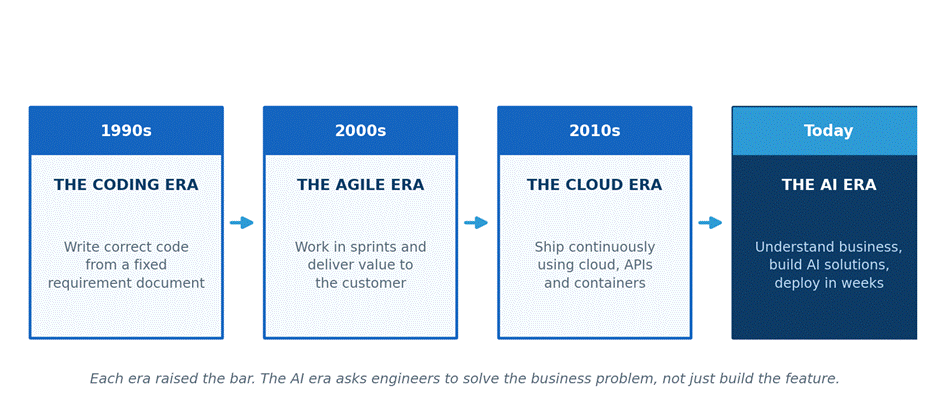
Figure 2 — Four eras of software engineering, and what “good” meant in each.
The Coding Era (1990s)
A customer wrote a requirement document. It travelled to a developer. The developer produced an application. Success meant the code was correct and matched the document.
The Agile Era (2000s)
Teams stopped working from frozen documents and started working in short cycles with constant feedback. Success moved from “correct code” to “value delivered, sprint by sprint.”
The Cloud Era (2010s)
Cloud platforms, APIs, containers and automated pipelines changed delivery itself. Software stopped being a product that shipped once and became a service that evolved continuously.
The AI Era (Today)
Now systems are expected to understand plain language, generate sensible responses, learn from data, connect to large language models and automate whole workflows. And customers expect all of this in weeks, not quarters.
Here is the important part. Cloud infrastructure and modern AI models have made building dramatically faster. What has not become faster is working out what to build.
When building becomes fast, understanding becomes the bottleneck. Forward Deployed Engineers exist because the bottleneck moved.
3. One Sentence, Two Very Different Responses
A hospital CEO says:
“We want an AI assistant that helps doctors retrieve patient records instantly.”
A traditional engineering team hears a specification. A Forward Deployed Engineer hears a symptom.
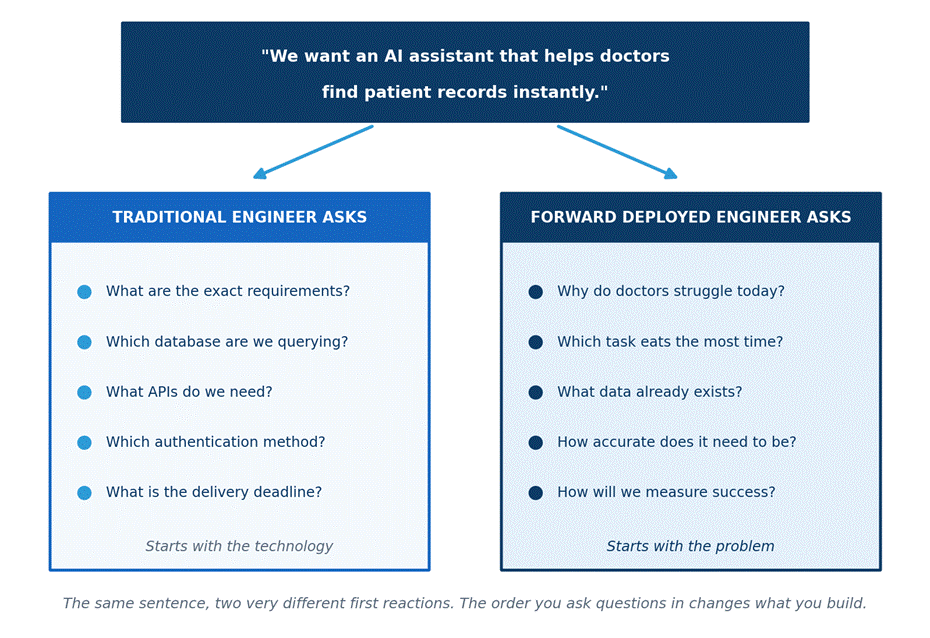
Figure 3 — The same request, heard two different ways.
The questions on the left are not wrong. They are essential, and they will all be answered eventually. The difference is that they come second.
Ask them first and you lock in a solution before anyone has confirmed the problem. You may end up building a beautiful search feature when the real bottleneck was that half the records were never digitised in the first place.
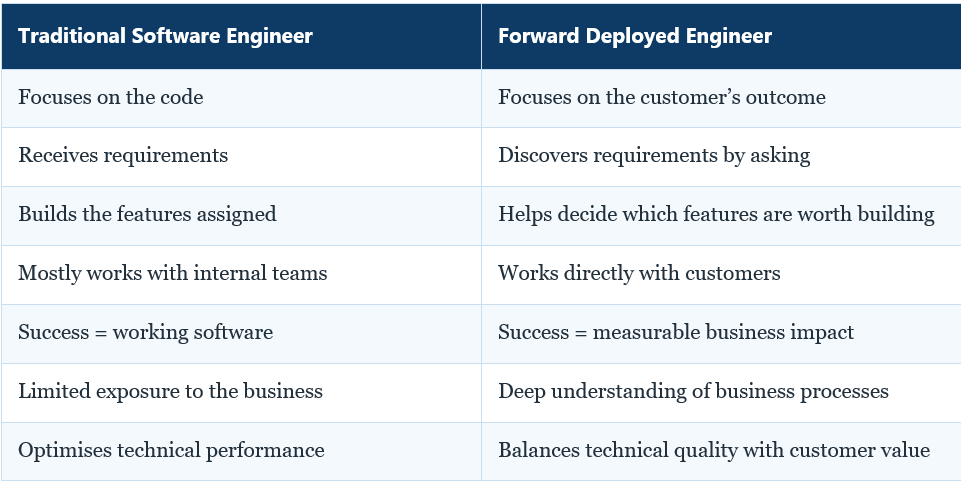
4. Traditional Engineer vs Forward Deployed Engineer
Neither role is better. They are answers to different questions.
5. Why the Role Is Growing So Fast
Five forces are pushing demand for this skill set at the same time.
● AI adoption. Almost every organisation now wants AI inside its existing systems. Very few know exactly where it will pay off. Someone has to go and find out.
● Compressed timelines. Customers who once accepted a nine-month release cycle now expect a working prototype in a few weeks.
● Enterprise complexity. A single business process may touch six platforms, three vendors and two decades of legacy decisions. Navigating that requires a person, not a document.
● A shift to outcomes. Companies have learned to be sceptical of technically impressive projects that changed nothing. They now fund outcomes, not features.
● No two workflows are alike. Every organisation has its own workflows, its own vocabulary and its own rules. Off-the-shelf AI products rarely fit without someone shaping them to the ground reality.
6. Two Examples From the Real World
Example 1 — Healthcare
The problem: doctors lose several minutes per consultation searching for patient information. Across a full outpatient day, that adds up to hours.
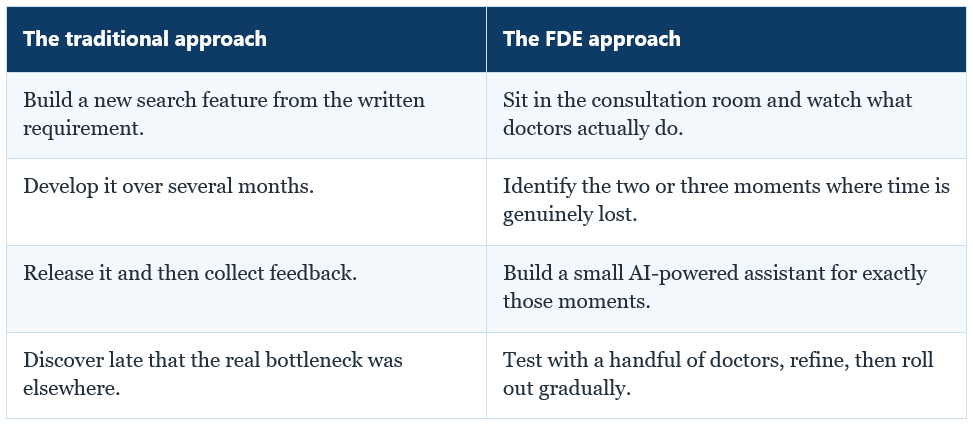
The result is not simply faster software. It is a shorter path between a doctor’s question and the answer — and a measurable improvement in how many patients can be seen properly.
Example 2 — Banking
The request arrives as one line: “We want to approve loans faster.”
A traditional team might immediately start designing a workflow engine. A Forward Deployed Engineer starts somewhere else:
● Where exactly does an application sit idle today, and for how long?
● Which documents are still being verified by a human, and why?
● Which of those checks can AI take over safely, and which absolutely cannot?
● What do the regulators require us to be able to prove afterwards?
The outcome of that conversation is rarely just faster software. It is usually a redesigned approval process where AI removes the manual drudgery, humans keep the judgement calls, and compliance stays intact.
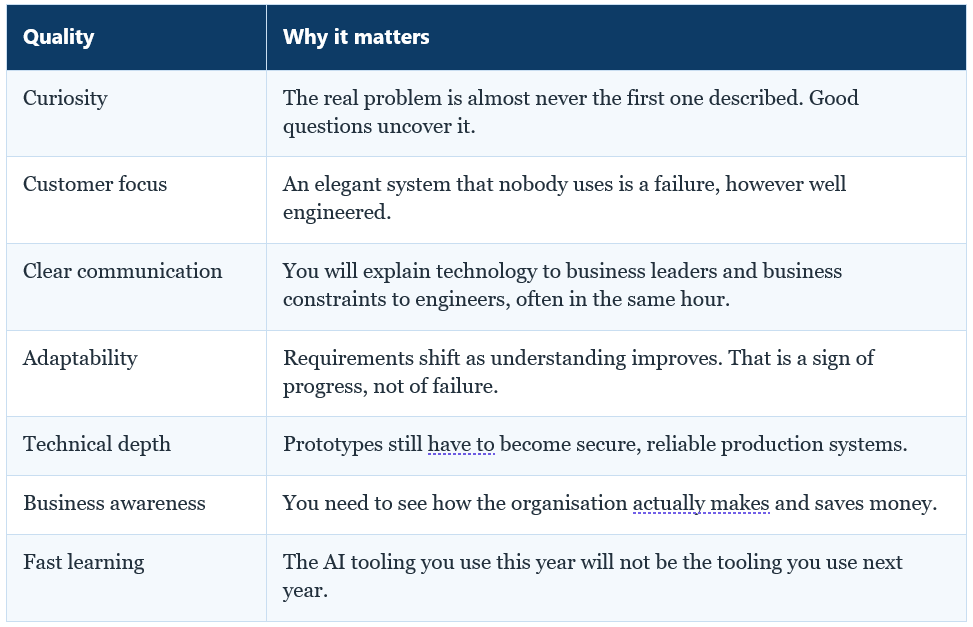
7. What Makes a Great Forward Deployed Engineer
Technical skill is the entry ticket, not the whole job.
8. How the Work Actually Flows
Put it together and the job has a recognisable rhythm. It starts with a business problem, not a ticket. It ends with a result, not a release note.
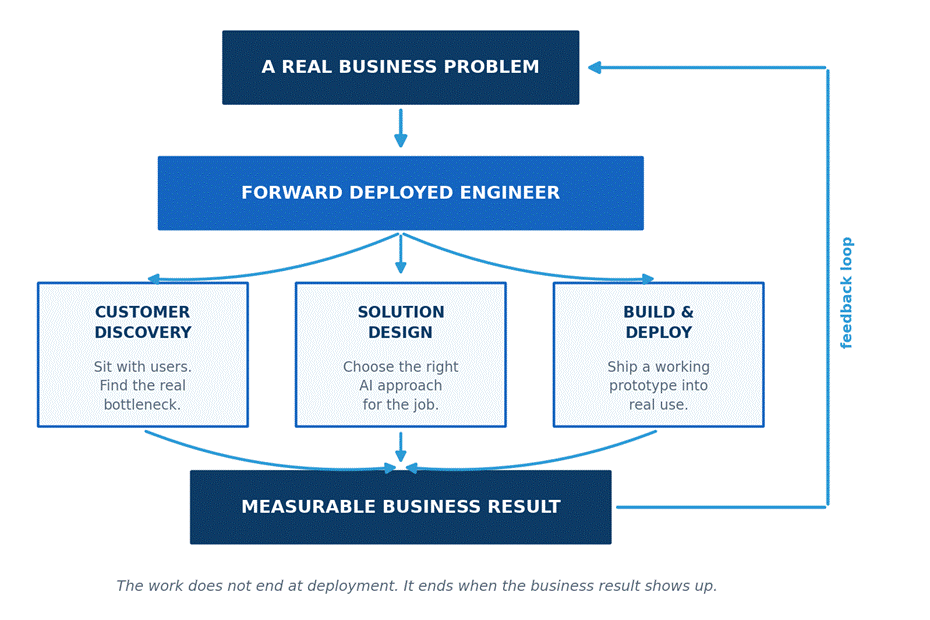
Figure 4 — The working loop of a Forward Deployed Engineer.
The loop matters as much as the steps. Deployment is not the finish line. What the customer does with the system afterwards feeds straight back into the next round of discovery.
9. The One Shift That Defines the Role
If you remember nothing else from this article, remember this change in the opening question.
A traditional engineer asks: “How do we build this feature?” A Forward Deployed Engineer asks: “What problem are we really trying to solve?”
It sounds like a small difference. In practice it changes what gets built, how long it takes, who is involved, and whether anyone is still using it a year later.
That is why, in an era where AI has made building easier than ever, the Forward Deployed Engineer has become one of the most valuable and future-ready roles in technology.
Key takeaways from Part 1
1. AI adoption fails at the gap between business understanding and technical capability.
2. A Forward Deployed Engineer works directly with the customer to close that gap end to end.
3. Building has become fast; understanding what to build is now the real bottleneck.
4. The role is measured in business outcomes, not in shipped features.
5. The defining skill is asking the right question before writing the first line of code.
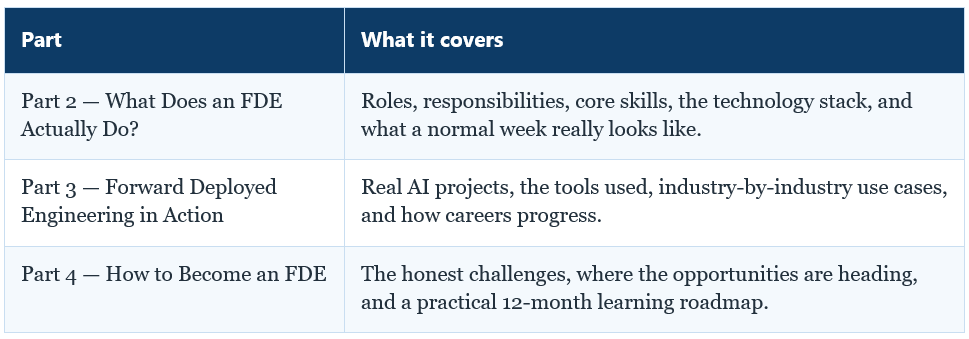
Coming Up in This Series
For more in-depth technical insights and articles, feel free to explore:
Ebasiq
- Substack: ebasiq by Girish – In-depth articles on AI, Python, and technology trends.
- YouTube Channel: Ebasiq YouTube Channel – Watch tutorials and tech videos to enhance your skills.
GirishBlogBox
- Substack: Girish BlogBlox – Thought-provoking articles and personal reflections.
Ganitham Guru
- Substack: Ganitham Guru – Explore the beauty of Vedic mathematics, Ancient Mathematics, Modern Mathematics and beyond.